
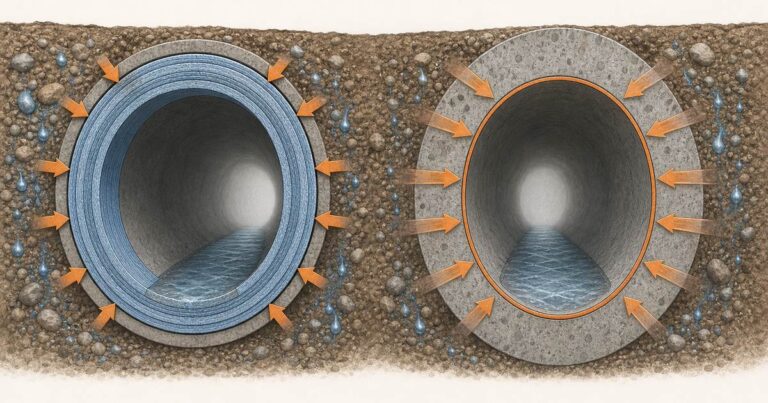
Short answer: choose cured-in-place pipe (CIPP) when the pipe needs a standalone structural liner, a semi-structural design when the wall shares load, and epoxy spray lining when the pipe is sound and only needs a corrosion and infiltration barrier. The CIPP vs epoxy lining decision turns on one test – can the host pipe still carry its own loads?
CIPP and a sprayed epoxy lining are both trenchless ways to renew a buried pipe, yet only one is normally designed to carry structural load. The CIPP vs epoxy lining comparison is therefore not about materials: it is about which component carries soil, groundwater and internal pressure.
Between the two extremes sits the semi-structural lining, which shares load with the host pipe by design. This guide separates the three on design basis, host-pipe requirement, surface preparation, thickness and verification, so the specification follows the pipe condition in front of you rather than a default method.
Is the Liner Structural or Just a Barrier?
CIPP and a sprayed coating answer different questions: one forms a new cured tube inside the pipe, the other protects the existing wall. The practical difference is one test – whether the host pipe still carries its design loads.
What Do “Structural” and “Non-Structural” Actually Mean?
Structural is a design statement: the lining, not the host pipe, carries the load. In the CIPP vs epoxy lining question, that load path is the only separator.
A structural liner is designed to resist the loads on the pipe – internal pressure, groundwater and soil overburden – on its own, without relying on the host pipe for strength. That is the category CIPP can occupy under ASTM F1216.
A non-structural lining does the opposite: it is a corrosion and infiltration barrier that depends on the host pipe to carry the loads.
A barrier stops ingress, protects the wall chemically and smooths the flow, and it adds ring stiffness only where the design says it does. Epoxy and cement mortar linings sit in this group.
Intinya: structural means the lining carries the load, non-structural means the host pipe does, and semi-structural means the design splits it.
The range of trenchless technologies sets the wider context.
How Is a CIPP Lining Designed to Carry Load?
CIPP begins as a felt or glass tube saturated with a thermosetting resin, installed against the host wall and cured in place.
The cured tube becomes a rigid liner whose thickness and modulus are chosen through the design procedure in ASTM F1216, using the allowable stress method to check internal and external pressure and soil loads.
Because the design sets the wall thickness, the structural option is a deliberate outcome, not a by-product; the same material family also serves non-structural and semi-structural linings, and only the calculation changes.
The wall is continuous around the full circumference and along the run, so the load is carried by the whole section. The resin chemistry – epoxy, polyester or vinyl ester – is matched to the service fluid, and cured-in-place material is specified under ASTM D5813.
Diameter loss is the trade-off: CIPP vs sliplining on diameter loss and structural strength sets it out.
How Does a Sprayed Epoxy Coating Work With the Wall?
A spray-applied epoxy lining, also specified as spray-in-place pipe (SIPP), is applied by a remote head that travels the pipe and lays down a two-part mix in one or more passes. It cures to a bonded shell that seals cracks and joints, resists chemical attack and lowers friction.
The coating sits at the non-structural end of the CIPP vs epoxy lining question: it is bonded to the wall and works with the pipe rather than instead of it. Its performance depends on adhesion between the coating and the wall, so a sound, clean, dry substrate is a precondition.
Why Does the Host Pipe Condition Decide the Method?
The CIPP vs epoxy lining choice is settled by what the wall can still do: a load-bearing design needs shape, a sprayed coating needs strength.
For a structural liner, the pipe has to keep a workable opening and enough shape to receive and cure the tube, but it does not have to keep its full strength; that is the point of a standalone design.
For a non-structural coating, the requirement reverses: the wall must still carry the loads and be sound enough to accept a bonded finish.
Where a pipe has lost ring stiffness, a non-structural system cannot restore what the wall has already lost. The same survey fixes the surface preparation scope, and it answers three readings:
- Remaining wall thickness at the crown, against the design requirement.
- Ovality and deformation, against the shape the lining can fit.
- Crack orientation: longitudinal cracks show hoop stress the wall cannot carry.
A collapsed section sits outside both systems and must be restored to shape first.
Intinya: non-structural systems need a host pipe that still carries load; structural systems are chosen precisely when it no longer does.
Where Do Surface Preparation and Adhesion Decide Success?
Surface preparation decides whether a sprayed coating can work at all, so in the CIPP vs epoxy lining comparison it weighs more than film thickness. The wall must be cleared of debris, grease and scale, tree roots cut back, laterals dressed, and open joints repaired before any coating goes on.
Drying most often decides the outcome. A damp substrate will not develop reliable adhesion, and a coating that de-bonds in service can trap water and allow further corrosion.
Sprayed systems need a dry wall. The wall must hold a dry state long enough for a reliable bond to develop; where groundwater cannot be held back for that window, specify a load-bearing lining instead.
For a cured-in-place lining, preparation is lighter: the tube is placed against the wall and cured, so the substrate mainly needs to be open enough to receive it.

How Thick Is Each Liner, and How Is It Checked?
Thickness makes the role difference measurable. A sprayed coating is specified as a dry-film thickness per coat, in fractions of a millimetre to a few millimetres, and accepted on continuity and bond.
A structural cured resin wall is not specified that way: its thickness comes out of the design calculation, so the two are measured, sampled and accepted on different bases.

Where Does Each System Fit?
On projects we have delivered, whether a pipe takes CIPP or a sprayed coating follows its condition rather than its diameter. A 300 mm line with a sound wall and invert corrosion behaves differently from the same line with crown loss.
- A sound wall with limited corrosion or infiltration: a sprayed barrier is enough, because the wall still carries the load.
- A wall that has lost capacity, or a run renewed end to end: the lining must be designed to carry the load itself.
- A small-diameter line where head matters: a thin coating keeps the bore open, which is the second half of the CIPP vs epoxy lining decision.
Sectional CIPP vs full-length CIPP covers repair scope.
How Do CIPP vs Epoxy Lining Compare Side by Side?
The table separates the two systems on the criteria a specification normally tests; the first row decides the rest.
| Kriteria | CIPP | Epoxy spray lining |
|---|---|---|
| Structural role | Can be a standalone structural liner under ASTM F1216 | Non-structural barrier; depends on the host pipe |
| Host pipe requirement | Usable opening and shape; wall may have lost strength | Wall must still carry the loads and accept a bonded finish |
| Typical thickness | Set by the design calculation | Fractions of a millimetre to a few millimetres |
| Adhesion with the wall | Not the load path; the cured tube carries it | Critical; de-bonding is the common failure mode |
| Not applicable where | The pipe cannot be cleaned, kept open or made round enough for a tube | The wall no longer carries its own loads |
| Semi-structural option | Available: the design can share load with the host pipe | Not applicable: a sprayed coating is non-structural |
| Verification | Cured wall thickness, flexural and tensile tests, post-cure survey | Wet-film and dry-film gauges, holiday testing, pull-off adhesion checks against specified values |

Intinya: read the table as a load-path summary – wall condition, not coating choice, decides which column applies.
Which Four Rules Choose Between Them?
Four rules resolve an open specification, in order.
- Check the load path first. If the host pipe still carries its design loads, a non-structural lining is available; if it does not, the lining must be structural. The CIPP vs epoxy lining decision starts here, before cost.
- Read the defect schedule. Widespread capacity loss points to a structural lining; localized corrosion with a sound wall points to a protective coating.
- Confirm the substrate can be prepared. Where the wall cannot be cleaned and dried to a bonded finish, a sprayed coating carries avoidable risk.
- Match the service. Pressure and aggressive fluids raise the requirement toward a structural design and a chemistry selected for the fluid.
Intinya: in our relining work, the load path decides the system and the substrate decides whether it will hold.
Not sure whether your pipe still carries the load? Send the survey and the defect schedule to our trenchless pipe rehabilitation team, and our engineers will confirm whether your pipe needs a structural lining or a non-structural coating.
Pertanyaan yang Sering Diajukan
Is CIPP a structural liner or only a barrier?
CIPP can be either, and the design decides which. Under ASTM F1216 a cured-in-place liner can be designed as a standalone structural lining that carries internal pressure, groundwater and soil loads. The same material can also be built as a non-structural or semi-structural lining where the host pipe still carries the load.
Can epoxy spray lining restore a pipe that has lost its ring stiffness?
A sprayed coating carries no load of its own, so it cannot restore what the wall has lost. The test is whether the remaining section still resists deflection under the design soil and groundwater load; where it does not, the renewal must be designed as load-bearing.
Why does surface preparation decide whether a sprayed coating works?
Bond is what gives a sprayed coating its strength. Cleaning, root removal, defect repair and drying must be completed first; a wet substrate or a poorly prepared wall leads to de-bonding, the most common failure mode for non-structural sprayed systems.
How thick is a sprayed coating compared with a CIPP wall?
Coating thickness runs from fractions of a millimetre to a few millimetres; a structural wall is thicker because the design calculation sets it. The practical difference: coating defects show up in gauge and holiday tests, liner defects in coupon tests and a post-cure survey.
Does the resin chemistry affect chemical resistance?
Yes. Epoxy, polyester and vinyl ester systems resist different chemicals, so the chemistry is matched to the service fluid. Cured-in-place material is specified under ASTM D5813, and the same selection logic applies to sprayed coatings.
Is the method choice the same for pressure and gravity pipes?
No. Internal pressure adds a load that a structural lining must resist, so pressure pipes usually require a structural design, while gravity pipes can sometimes accept a non-structural barrier if the wall is still sound. The service, not the diameter, drives the choice.
If the host pipe is only partly degraded, which method should I specify?
Specify per span, not per pipe: a pipe that is sound overall but corroding locally takes a coating, while a span whose capacity is reduced takes a load-bearing design.
How Do You Confirm Whether Your Pipe Needs Structure?
Confirming whether your pipe needs structure is the CIPP vs epoxy lining decision itself, and a short review answers it before a method is priced.
Four inputs settle it:
- The television survey graded to the NASSCO Pipeline Assessment and Certification Program (PACP).
- The design life and the service the pipe carries.
- The loads the pipe must resist, including groundwater and any internal pressure.
- Whether the wall at each defect can be dried long enough to coat.
The review produces one answer: if the wall still carries the design loads, a barrier fits; if not, the lining must carry them.
If you are an owner, ask for the design calculation, not only a method name. If you are an operator, confirm the service fluid against the resin and coating chemistry.
If you are pricing, get the same defect schedule quoted to both options, and ask each bidder to name the assumption that would change their answer.
For replacement, CIPP vs pipe bursting covers the excavation trade; trenchless methods compared with open-cut excavation covers surface cost.
Final Verdict: Which System Carries the Load?
The CIPP vs epoxy lining answer has one order of checking. If the host pipe still carries its design loads and only needs protection, a sprayed coating is a fit, and its substrate preparation and bond to the wall define the risk.
If the pipe has lost capacity, the renewal must be designed to carry the load, and that is a structural cured-in-place lining under ASTM F1216.
Where the two are close, decide on the defect schedule and the design calculation, not on the coating or the tube.
Get a second opinion at no cost. Send us the survey and the design data, and the JSW engineering team will answer in writing, with the ASTM F1216 calculation where a structural design applies.
Sources
The design, thickness and material statements in this guide follow these published industry standards and guidance documents:
- ASTM F1216, Standard Practice for Rehabilitation of Existing Pipelines and Conduits by the Inversion and Curing of a Resin-Impregnated Tube; and ASTM D5813, Standard Specification for Cured-in-Place Thermosetting Resin Sewer Piping Systems.
- NASSCO Pipeline Assessment and Certification Program (PACP) condition-grading guidance.
- WRc published guidance on sewer rehabilitation and lining performance.












 English
 Arabic
 Russian
 Spanish
 French
 Vietnamese
 Polish
 Thai
 Indonesian
 Turkish
 Portuguese