
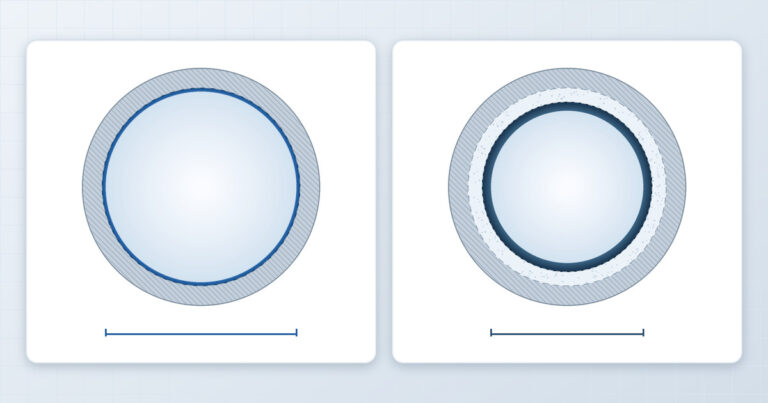
Short answer: in a CIPP vs sliplining decision, sliplining typically gives up 10%-25% of the internal diameter, while cured-in-place pipe typically loses only its own wall, a few percent. CIPP’s structural strength comes from its ASTM F1216 design, not from the host pipe.
A CIPP vs sliplining decision turns on three things: how much internal diameter each method surrenders, whether the liner carries the load itself, and where the money goes. It is written for the municipal engineer sizing an interceptor, the contractor pricing a trunk sewer and the facility manager weighing a force main. The short answer: sliplining moves a smaller pipe through the host and gives up more; cured-in-place pipe adds only a wall. Every figure is a typical published range; the tie-breaker is a capacity check at the finished diameter.
Does CIPP or Sliplining Lose More Diameter?
In a CIPP vs sliplining comparison, sliplining loses more internal diameter, and the cause is geometric.
A sliplining job must move a complete new pipe through the existing pipe, so the inserted pipe is smaller than the bore it travels through, and its wall takes a further slice out of the opening.
CIPP differs because a resin-impregnated tube is pressed to the host wall and cured in place, so the wall it adds is the only diameter it removes. That difference usually separates the two on a capacity-limited line, long before cost is compared.
What Does Sliplining Actually Install?
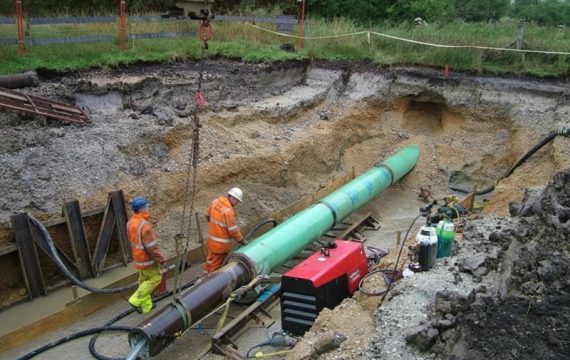
Sliplining (also written slip lining) installs a new, continuous pipe inside the old one. The inserted pipe is high-density polyethylene (HDPE), made to ASTM F585, or PVC in certain diameters; in larger sizes an HDPE pipe is the common choice.
Because the pipe is pushed or pulled through the host, it must be smaller, and the ring-shaped gap between the two walls has to be dealt with.
The build sequence sets the cost and the bore reduction:
- Prepare the host. Survey and clean the line, and confirm it is round, intact and clear of offsets that would stop the pipe going in.
- Open access. Excavate an insertion pit at each end, or reuse one large enough to feed the pipe in.
- Insert the pipe. Push or pull the new pipe through the host in one continuous length where the run allows.
- Close the gap. Seal the ends and fill the space where the design calls for it.
Sliplining sits alongside the other lining methods in the published overview of best trenchless pipeline rehabilitation methods, the entry-level page this article deepens.
Sliplining is a fit-your-pipe-inside-a-pipe method, so its bore reduction is built into the geometry.
What Does CIPP Actually Install?
CIPP installs a resin-impregnated felt or glass-fiber tube that is positioned, inflated and cured in place, forming a new wall bonded to the host pipe.
Under ASTM F1216 the liner can be designed for a partially or fully deteriorated host, which is what lets it be classified as structural when the calculation supports it.
Because a CIPP tube is soft until it cures, it follows the host bore closely, and the finished wall is thin next to an inserted pipe. That is why a cured-in-place liner takes away so little diameter. The wider family of methods is described in Apa saja teknologi tanpa galian yang ada?.
A cured-in-place liner is a wall, not an inserted pipe, which is why CIPP gives up far less of the original bore.
How Much Diameter Do You Lose, and How Is It Calculated?
For sliplining, the diameter loss is set by the wall thickness of the inserted pipe and the clearance needed to get it in, so the reduction is roughly twice the pipe wall, with clearance on top.
As a percentage, that is about two times the wall thickness divided by the host internal diameter. Common sewer combinations usually land near 10%-25%, a typical published range that depends on the pipe series.
Insertion clearance is set by the worst offset and the tightest bend the pipe must pass, so two hosts of the same nominal size can lose different amounts.
For CIPP the loss is only the cured wall, usually a small number of percentage points, fixed by the thickness the design requires. The table below shows what drives the reduction on each side.
| Factor | Sliplining | CIPP |
|---|---|---|
| Loss driven by | Pipe wall plus clearance | The cured wall thickness alone |
| Typical fraction | Commonly near 10%-25% | Typically a few percent |
| Arithmetic check | About 2 × wall / host diameter | About 2 × liner / host diameter |
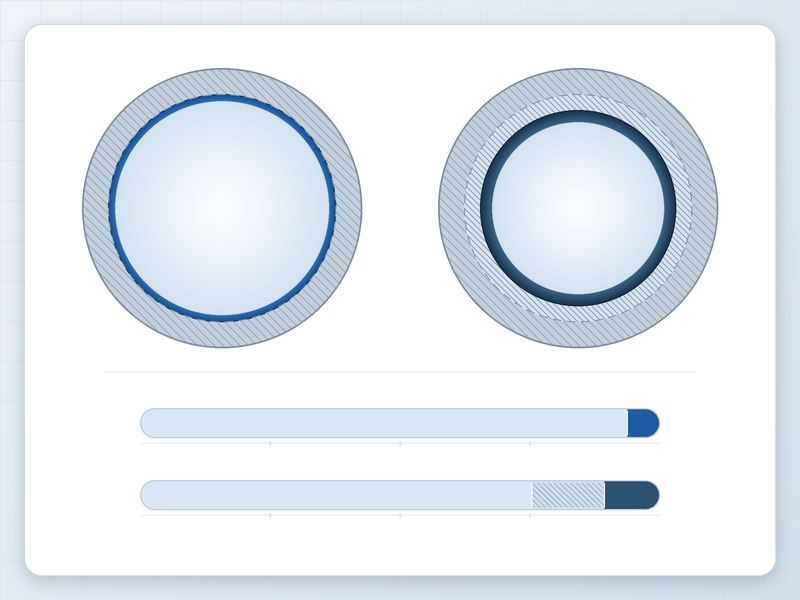
Intinya: the diameter loss a project carries is roughly double the sliplining pipe wall, against a liner wall for CIPP.
Should You Grout the Space Between the Pipes?
Sliplining always leaves an annular space because two pipes are nested, and whether to fill it is a design decision with two clear answers. Grouting that space transfers load between the new pipe and the host, stops groundwater traveling along the gap, and holds the inserted pipe in place.
Seal the ends only where the inserted HDPE pipe is stiff enough to carry the design load on its own. Fill the annular space where the host has weakened and the design relies on both walls, and control grout pressure so the inserted pipe neither floats nor deforms.
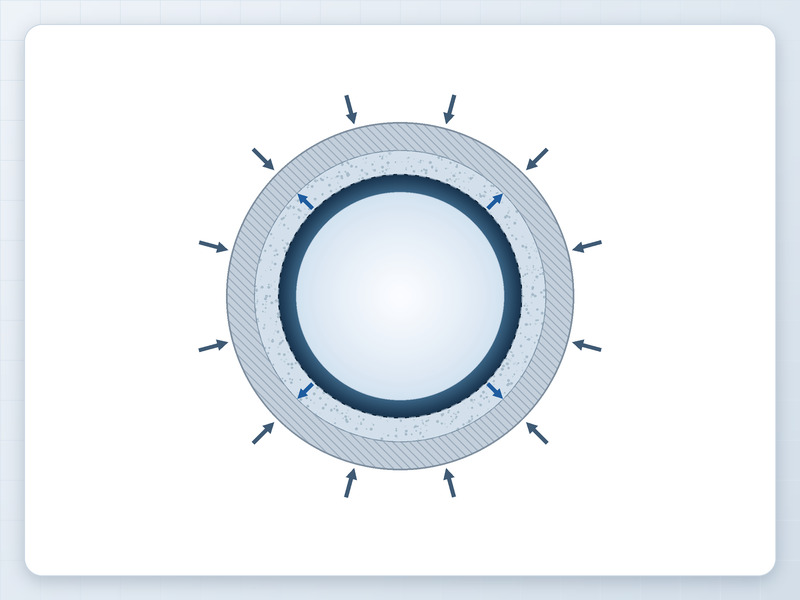
Intinya: the gap is where sliplining hides its engineering; a grouted space can restore stiffness, but CIPP closes that gap by curing against the wall.
Which Liner Carries the Load?
Structural strength means the liner can carry external loads, such as soil, groundwater and traffic, without depending on the host pipe. Sliplining is structural by nature: the inserted pipe, often an HDPE pipe, is a full pipe with its own ring stiffness.
CIPP occupies both categories. Under ASTM F1216 it can be a stand-alone structural liner that carries the full load, or a non-structural lining that acts mainly as a barrier. The deciding factor in a CIPP vs sliplining project is the wall thickness the calculation produces.
The CIPP calculation starts from one question: is the host partially or fully deteriorated? A fully deteriorated host is designed as a stand-alone pipe, so the wall grows, and the bore shrinks with it.
Intinya: sliplining supplies its own structural strength with the pipe, while a CIPP liner does so only when the ASTM F1216 design makes the wall load-bearing.
Where Does Each Method Spend Its Money?
On a CIPP vs sliplining budget, grout volume scales with annulus area, so a tighter fit cuts both bore loss and gap treatment.
Sliplining pays for the inserted pipe by the meter, the pits needed to feed it in and any grouting of the gap; CIPP pays for the felt or glass-fiber tube, the resin, the cure equipment and the manholes it works from.
- Access. Sliplining needs an insertion pit; CIPP can often work from existing manholes.
- Gap treatment. A grouted annular space is a sliplining line item with no CIPP equivalent.
For the wider view against digging a new pipe in, see trenchless technology vs open cut excavation; the choice between lining in place and replacing the pipe is in CIPP vs pipe bursting.
Intinya: sliplining concentrates cost at the pits and the gap, while CIPP concentrates it in the tube and cure.
What Happens to Hydraulic Capacity After Lining?
After lining, flow capacity falls on both sides, but the mechanism differs.
Sliplining’s capacity loss is driven by the smaller bore: under Manning’s equation, full-bore capacity scales with diameter to the power of about 2.67 at a fixed slope and roughness, so a 10% bore cut removes roughly a quarter of the capacity, and a 20% cut removes about 45%.
CIPP’s capacity loss is driven by the wall thickness it adds, and it can be partly offset by the smoother finished surface, which often carries a lower roughness coefficient than the aged host pipe.
- Gravity sewers. Recompute the hydraulic grade line at the reduced diameter before committing.
- Pressure mains. Confirm the friction loss at the design flow; a smoother lining may recover part of it.
Sliplining gives up capacity through the pipe it inserts, while CIPP gives up capacity through the wall it adds.
CIPP vs Sliplining: How Do They Compare Side by Side?
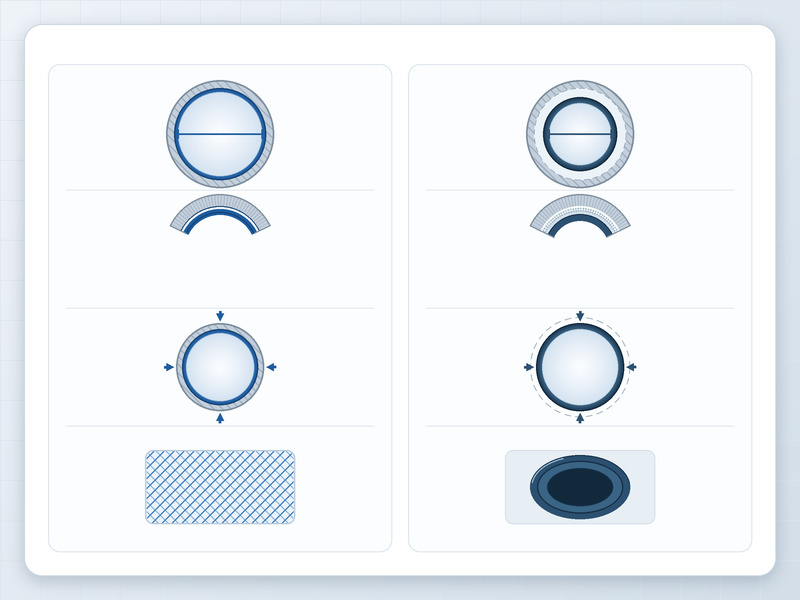
The table condenses the CIPP vs sliplining comparison into method-statement criteria.
| Kriteria | CIPP | Sliplining |
|---|---|---|
| Diameter loss | A liner wall only, a few percent | A smaller pipe plus clearance, 10%-25% |
| Annular space | None once cured to the host wall | Always present between the two pipes |
| Grouting | Not part of the lined bore itself | Fills or seals the gap when specified |
| Structural strength | Set by ASTM F1216; may be non-structural | The inserted pipe is structural on its own |
| HDPE pipe | Not used as the liner; a thermoset tube is | The common inserted pipe, to ASTM F585 |
| Flow capacity | Reduced by wall thickness; smoother surface helps | Reduced mainly by the smaller diameter |
| Access needed | Manholes where the run allows | An insertion pit for the pipe |
| Typical cost driver | Tube, resin and cure equipment | Pipe, pits and any gap treatment |
Which Four Rules Decide Between Them?
- If capacity is tight and the bore must be preserved, choose CIPP. Its wall-only loss keeps the finished opening close to the host diameter.
- If the host has lost its strength and a full structural pipe is needed, weigh sliplining, provided the reduction leaves enough capacity.
- If access is limited to manholes, choose CIPP, because sliplining needs an insertion pit.
- If the line is large and a filled space is acceptable, sliplining stays viable and its pipe can replace a failed host.
In our relining work, the diameter check is usually the fastest filter: once the required flow and the host diameter are fixed, the permitted loss is set, and that alone rules one method in or out.
Not sure how much diameter your line can give up? Send your host diameter, design flow and latest CCTV report for a free method review, and our engineers will compare a CIPP and a sliplining option for your line.
Pertanyaan yang Sering Diajukan
Does sliplining reduce flow capacity more than CIPP?
Usually yes: sliplining shrinks the bore by inserting a smaller pipe, and capacity falls steeply as the diameter drops. CIPP removes only a wall thickness and can partly offset that with a smoother surface.
How much diameter does sliplining lose?
It depends on the pipe series and the clearance, but a common published range is about 10%-25% of the internal diameter, roughly twice the inserted pipe wall.
Why is grouting the gap sometimes required?
Filling the space between the inserted pipe and the host transfers load and stops groundwater traveling along the gap. Where the inserted pipe is stiff enough, only the ends need sealing.
Is a sliplined HDPE pipe structural on its own?
Yes. The inserted pipe has its own ring stiffness and carries external load without relying on the host, which is why sliplining suits a host pipe whose own strength has been lost.
Can CIPP match the diameter of a sliplined line?
CIPP keeps more of the original bore because it adds only a wall, so for the same host pipe it leaves a larger finished opening. The exact size depends on the liner thickness the design calls for.
How are laterals and connections handled after sliplining?
They are reopened or reconnected after the pipe is in place. Sliplining needs each lateral cut back through the new pipe wall and sealed around the connection.
Does sliplining cost less than CIPP?
Sometimes. Sliplining is often lower on pipe material in large diameters, but pits, handling and any gap filling add cost, while CIPP stays cheaper where access is limited to manholes.
How Do You Get a Like-for-Like Comparison?
A fair comparison needs the same five inputs on both sides: the host internal diameter and condition from a closed-circuit survey, the design flow, the access, the material proposed, and the load the line carries.
A CIPP vs sliplining bid is only comparable at the same finished bore, so restate both prices before comparing them.
Our field crews confirm diameter and ovality before any lining is sized, because a nominal pipe size often overstates the real bore of an aged line.
The design side sits inside trenchless pipe rehabilitation, with options under solusi pemulihan pipa and upkeep under pipeline maintenance services.
If you are comparing a lining against a replacement, the load question is answered in how trenchless pipe rehabilitation works.
Which Method Should You Choose, and Why?
On a final CIPP vs sliplining choice, pick CIPP when the bore must be preserved and access is confined to manholes, because it gives up the least diameter and needs no insertion pit.
Pick sliplining when the host can no longer carry load on its own and a new structural pipe is safer, provided the loss still meets the capacity requirement.
The tie-breaker is a written capacity check at the finished diameter plus a priced comparison on the same alignment.
Get a second opinion at no cost. Our engineering team reviews the host condition, the bore loss and the load requirement before recommending either method.
Sources
The diameter, thickness and structural statements here follow these published industry standards and guidance documents:
- ASTM F1216, Standard Practice for Rehabilitation of Existing Pipelines and Conduits by the Inversion and Curing of a Resin-Impregnated Tube. (Supports the CIPP design and structural discussion here.)
- ASTM F585, Standard Practice for Insertion of Flexible Polyethylene Pipe into Existing Sewers. (Supports the sliplining description and its inserted pipe here.)
- NASSCO Pipeline Assessment and Certification Program (PACP). (Supports the survey-based condition inputs here.)
- WRc sewer rehabilitation guidance. (Supports the diameter-loss and flow-capacity framing here.)











 English
 Arabic
 Russian
 Spanish
 French
 Vietnamese
 Polish
 Thai
 Indonesian
 Turkish
 Portuguese