
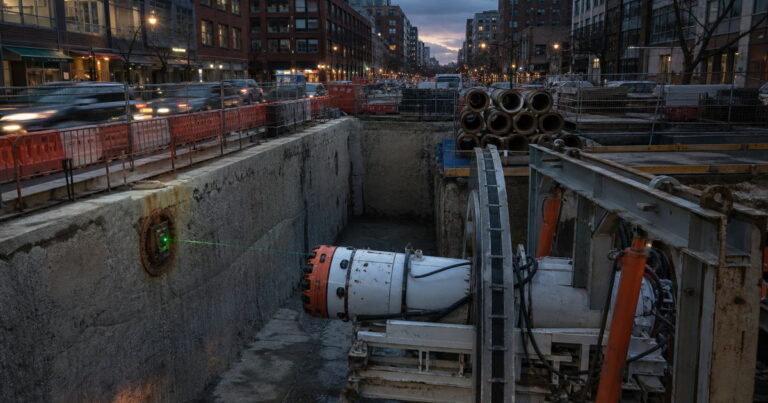
Microtunneling for sanitary sewers installs a precisely graded pipeline under a city without cutting the surface. It serves both hydraulic regimes a sanitary system contains: gravity-flow sewers that must fall at a steady slope, and force mains that move wastewater under pressure. This guide compares the tolerances, pipe standards and live-flow arrangements each regime demands, and the shafts, settlement limits and failure modes worth pricing into a bid.
What changes when microtunneling for sanitary sewers goes underground?
The change is where the risk sits: a microtunneled sanitary sewer is judged on the line and grade it holds, not only on the pipe it installs. A machine launches from a shaft, and a jacking frame pushes pipe into the open bore behind it. The pipeline is built at its finished alignment as the face advances.
The equipment set is narrow but capable. The Pipe Jacking Association describes microtunneling machines as typically pressurized slurry or auger type, each with active face support, full guidance and remote control from the surface, and generally without manned entry. Larger bores may use an earth pressure balance (EPB) shield, which suits cohesive soils; mixed ground usually needs conditioning with bentonite, water or polymer.
For microtunneling for sanitary sewers, two facts change the engineering. The sewer is part of a network, so every drive ends at a structure that must connect to something already in service, and the network carries flow every day of construction.
Is grade or diameter the real constraint on a gravity sewer?
For microtunneling for sanitary sewers in gravity mode, the invert has to fall continuously and must not flatten or rise enough for solids to settle out. Diameter sets capacity, but line and grade decide whether the sewer works at all, which is why both belong in the specification as measurable acceptance criteria.
The tolerance question is practical. In stable, self-supporting, homogeneous ground, the pipe jacking industry commonly works to about ±50 mm at any point on line and grade. Where ground is unstable, or obstructions are met, that tolerance may not be attainable, and no amount of machine precision recovers it. A larger bore absorbs part of the problem, because it gives the steering system more room to correct.
How tight does the tolerance have to be when a gravity sewer runs under a busy city street?
Where grade is functionally important, pilot tube microtunneling (PTMT) is the mainstream high-accuracy option. Its published accuracy is about ±1 in. (±25 mm) on design grade and about ±3 in. (±75 mm) on design line. The system drills a pilot bore, establishes a grade-accurate reference, then reams and jacks to the pilot.
In our bid reviews, the argument is rarely about the machine’s stated resolution. It is about whether the geotechnical data supports the tolerance being promised, and whether the contract separates the two. A specification that demands PTMT accuracy across a faulted or boulder-strewn alignment describes a risk, not a deliverable, and microtunneling for sanitary sewers is priced accordingly.
What happens when the ground will not hold a gravity grade on a sewer drive?
PTMT suits compressible soils and sites with a shallow water table or low-permeability soils. Its product pipe reaches about 48 in., a single drive is typically up to 400 ft (about 120 m), and working shafts are commonly 8 to 16 ft (about 2.4 to 4.9 m). Those limits are part of the price of the accuracy.
When the ground will not hold a grade, there are three honest responses.
- Re-align the sewer so the tolerance matches the design.
- Switch to a coarser method and document the hydraulic consequence.
- Increase the diameter so the tolerance becomes achievable.
In our experience, the honest third option is usually the cheapest: on one 1.5 m gravity drive we re-priced the contract around a larger bore at bid stage rather than absorbing a change order mid-drive, and the hydraulic design changed by less than the cost of the delay would have been.
Why does a force main behave differently from a gravity sewer?
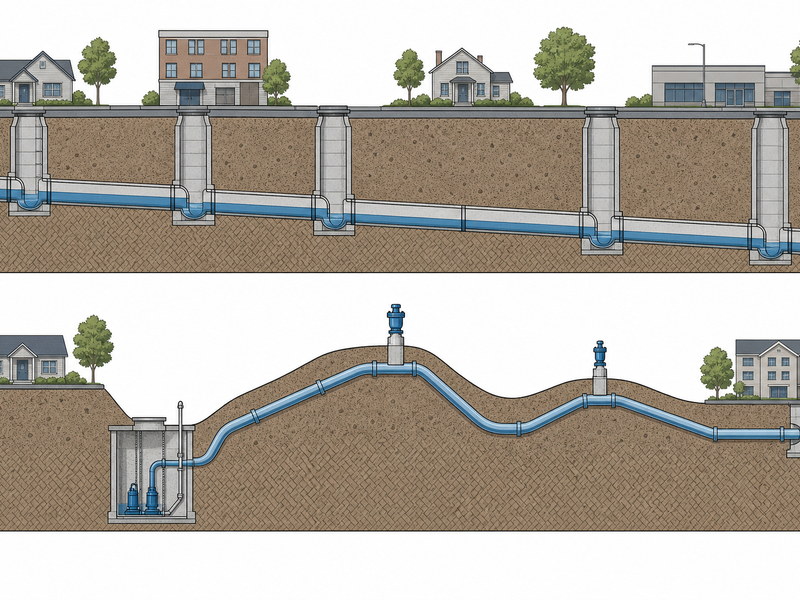
In microtunneling for sanitary sewers, the governing constraint moves from grade to pressure, surge, air and corrosion, and to the joint integrity that holds the pressure in. A force main is pumped, often from a lift station, so it does not depend on slope and its profile can follow the terrain. What keeps an owner awake is whether those joints will hold that pressure for the life of the main.
Which pipe materials and standards apply?
Pressure service brings its own standards. AWWA C900 covers PVC pressure pipe from 4 to 12 in.; AWWA C905 extends PVC to 14 through 48 in.; AWWA C906 covers PE4710 HDPE from 4 to 65 in. and explicitly addresses wastewater and reclaimed water. ASTM F714 and ISO 4427 with EN 12201 cover polyethylene, and ductile iron falls under AWWA C150 and C151. Underground installation of PVC pressure pipe is addressed by AWWA C605.
When a force main is microtunneled, the jacked pipe usually acts as a casing or carrier. Jacking pipe is typically specified under ASTM C76 for reinforced concrete, or under EN 1916, BS 5911-1 and BS EN 295-7 depending on material and market. The tunnel and the pressure pipe are two separate procurement items with two separate acceptance tests.
Surge, air and corrosion: the three design enemies
Three failure modes shape a pressure branch, and each one has a standing mitigation.
- Surge: the transient pressure created when pumps start and stop or valves close, managed by surge analysis, valve selection, and thrust and joint restraint.
- Air: the enemy of every high point, where pockets raise head loss and amplify surge, so air valves are placed deliberately rather than by habit.
- Sulfide attack: a first-order concern in gravity-flow sewers, where hydrogen sulfide collects in the crown.
- Corrosion: a slow enemy in force mains, where it can attack internal surfaces and liners, so material selection, liners and joint systems are decided together.
On the drives we have supported, the joining method receives more attention than any hydraulic figure. Butt-fused HDPE gives a continuous, restrained, leak-resistant string, and restrained mechanical joints are used where fused joints are impractical. The pressure test is the acceptance gate, and it should be defined before the first pipe is jacked.
Can you microtunnel a sewer line without stopping the flow?
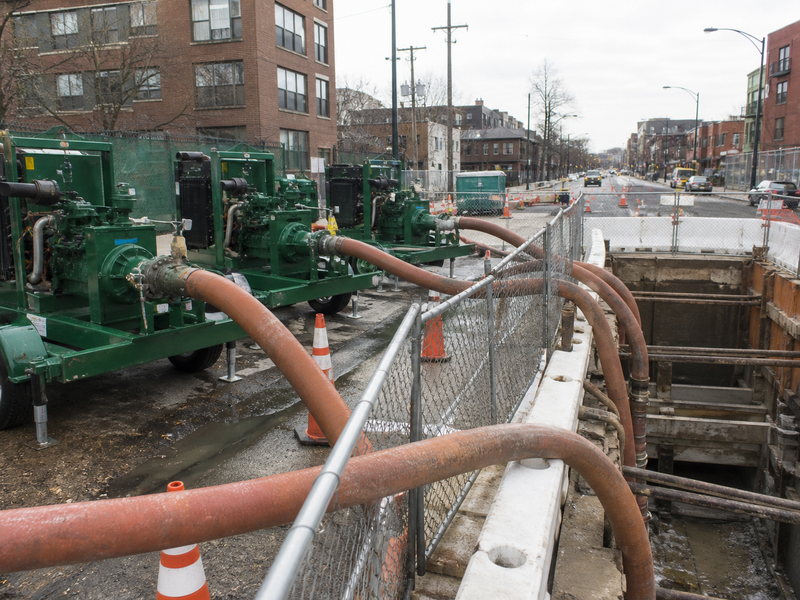
Bypass pumping carries the existing flow around the work area, and its capacity, redundancy and monitoring are construction deliverables in their own right. Existing manholes become the natural connection points, so the new tunnel ties into structures that already receive flow.
Scheduling follows the same logic. Night windows reduce traffic and community impact, temporary plugs isolate short reaches, and the sequence keeps no reach out of service longer than the contingency plan allows. A sewer that backs up into basements is a public health event, not a schedule slip, and the construction organization for microtunneling for sanitary sewers has to reflect that.
- Bypass pumping: peak flow plus standby capacity, with continuous level and alarm monitoring.
- Existing manhole connections: prefer tie-ins at structures that already serve the catchment.
- Night windows: compress surface occupation and reduce traffic disruption.
- Temporary plugs: isolate the shortest reach that the contingency plan can support.
Why do shafts and manholes decide so much of a sewer project?
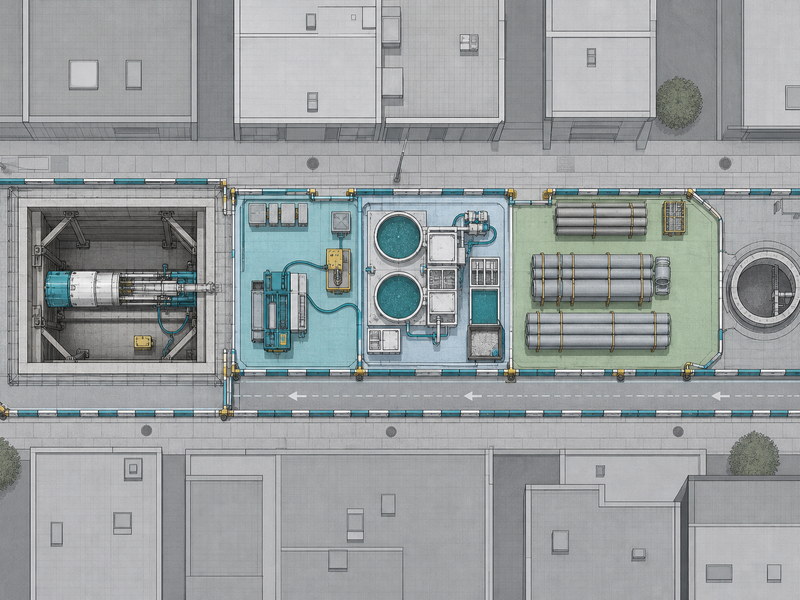
Shafts are where a microtunneling project meets the surface, and they dominate cost, footprint and community impact. Precast caisson shafts of 2.4 to 4 m diameter suit microtunneling, and the Pipe Jacking Association’s shaft guidance covers roughly 15 m in dry ground using steel sheet piles and about 20 m using secant piles.
The opportunity is to make a shaft do permanent work. Where an existing manhole can be replaced, or a new manhole built on the shaft, the temporary excavation becomes a permanent asset and its cost is shared with an item the owner needed anyway. Manholes also carry the drops, flow control and access details that determine how the network behaves after commissioning.
Footprint is not a footnote. The average minimum setup area for microtunneling work is about 11,000 sq ft, and equipment access doors for large cutterheads must be wider than 60 in. On a dense city block, those two numbers decide whether a launch site exists at all.
What settlement limit should a contract set under a busy street?
Settlement is a ground-loss problem, not a steering problem. The annular gap behind the machine is the overcut, typically 13 to 38 mm, and it has to be filled for the ground to be supported. An overcut of about 35 mm may cause movement at the surface, so under roads and railways the overcut is reduced to keep settlement below roughly 10 mm.
Specifications should carry numbers rather than adjectives. Define monitoring points, instrument type, reading frequency, trigger levels and the action that follows a trigger. Then define who pays for mitigation if a trigger is reached. A pipeline inspection service can verify the finished bore’s condition as part of acceptance.
Settlement triggers are set in writing with the road or rail owner before launch, and the governing limit is the owner’s, not a contractor preference. Compensation grouting and controlled machine parameters are the usual mitigation tools once a trigger is approached.
How do sanitary sewers and force mains differ in design and construction?
The two regimes diverge at almost every decision point, from the standards that govern the pipe to the test that proves the installation. Table 1 sets the differences side by side, and it is the table we reach for when a specification mixes microtunneling for sanitary sewers and force mains in one section.
| Criterion | Gravity sanitary sewer | Force main |
|---|---|---|
| Hydraulic driver | Slope; energy comes from elevation | Pump pressure |
| Controlling geometry | Continuous falling invert | Pressure class and thrust restraint |
| Tolerance that matters most | Line and grade | Joint integrity and leakage |
| Jacking pipe standards | ASTM C76, EN 1916, BS 5911-1, BS EN 295-7 | Casing or carrier per project |
| Pressure pipe standards | Not normally applicable | AWWA C900, C905, C906, ASTM F714, AWWA C150/C151 |
| Joints | Push-on and confined jacking joints | Restrained, welded or fused joints |
| Corrosion exposure | Crown sulfide attack and abrasion | Internal and external corrosion; liners |
| Air and surge control | Ventilation of the sewer | Air valves and surge protection |
| Acceptance test | Alignment, ovality and closed-circuit inspection | Hydrostatic pressure test |
| Shaft role | Access, drop and flow control | Access, valves and air release |
How far can a microtunneling drive go at each internal diameter?
Drive length and diameter move together. The Pipe Jacking Association’s indicative figures show short drives at small diameters and very long drives at large ones, reproduced in Table 2. The practical ceiling is set by jacking force, which depends on friction, lubrication and the number of intermediate jacking stations.
Skin friction against the pipe is typically 0.5 to 2.5 t/m² of external circumferential area, and lubrication can reduce it to as low as 0.1 t/m². That range is why long drives are designed around a lubrication and interjack strategy from the outset.
| Internal diameter | Indicative drive length | Note |
|---|---|---|
| <0.9 m | 150 m | Small-bore services and laterals |
| 0.9 m | 200 m | Common urban sewer range |
| 1.0 m | 250 m | Grade control still straightforward |
| 1.2 m | 450 m | Interjack planning begins to matter |
| 1.35 m | 550 m | Lubrication strategy required |
| 1.5 m | 700 m | Long urban trunk drives |
| 1.8 m | 900 m | Large trunk sewer range |
| 1.9 to 2.1 m | 1,000 m | Intermediate jacking stations typical |
| 2.4 m | 2,000 m | Very long drives with risk analysis |
The association notes that drives can greatly exceed 1 km, but such lengths require a project-specific risk analysis. Where we have re-priced a drive after tender, the shaft locations the city would permit, not the length table, decided the outcome.
What goes wrong, and what it costs
Most failures are foreseeable. Steering can drift until an adverse grade appears. Face instability can cause ground loss and settlement. Obstructions stall a drive and force a recovery. Jacking force can exceed the pipe’s capacity when friction is underestimated. Each has a mitigation, and each mitigation has a cost that belongs in the bid.
- Grade drift: staged survey, guidance verification and a defined correction plan.
- Ground loss: matched face pressure and prompt annular grouting.
- Obstruction: pre-drive utility and obstruction survey, plus a recovery method.
- Excess jacking force: lubrication, interjack stations and conservative friction assumptions.
- Corrosion and surge: material selection and surge analysis carried into the specification.
Real projects show why these are not theoretical. A New York project drove a 96 in. gravity sewer to depths of 65 ft, with 3,425 ft installed by microtunneling. The Denver 33rd Street Outfall project jacked 252 lf under a Union Pacific yard carrying five main tracks and two commuter tracks, and reverted one run to hand-mined shield excavation where cover fell below a single pipe diameter. Both are public-record examples rather than JSW projects, and both make the same point: the governing constraint is usually the surface above.
Compared with a 1,400 mm open-cut trench, the Pipe Jacking Association reports that a 760 mm pipe jacking drive cuts excavation to 0.5 versus 6.1 m³ per metre, cuts 20 t truck trips to 8 versus 136 per 100 m, and cuts CO2 to 27.1 versus 66.7 t, a carbon reduction of up to 75%.
Frequently asked questions (FAQ)
Can microtunneling for sanitary sewers hold a gravity grade?
Yes, when the ground and the method are matched, and pilot tube microtunneling is usually the way. PTMT works to about ±1 in. on design grade and ±3 in. on design line, which is why it dominates gravity work. Standard pipe jacking is commonly accepted at about ±50 mm in stable, homogeneous ground.
When is a force main the right choice instead of a gravity sewer?
A force main is chosen when terrain, depth or existing infrastructure makes a continuous gravity grade impractical. Because it is pumped, its profile can rise and fall, so it can follow a congested corridor. The trade-off is pressure, surge and corrosion, which change the pipe, joint and testing requirements.
Can a sewer be microtunneled while it stays in service?
Yes, through bypass pumping, tie-ins at existing manholes and short isolation windows. The existing flow is carried around the work, the new tunnel connects to structures already in service, and temporary plugs isolate the shortest reach the plan allows. Peak flow and redundancy drive the bypass design.
How much settlement should be expected under a city street?
Movement is controlled by the annular overcut and how well it is filled, not by the machine alone. Overcut is typically 13 to 38 mm, and about 35 mm may cause surface movement. Under roads and railways the overcut is reduced so that settlement stays below roughly 10 mm.
What pipe materials are used for jacked sanitary sewers?
Reinforced concrete jacking pipe to ASTM C76, EN 1916, BS 5911-1 or BS EN 295-7 is the usual choice for the tunnel. A force main inside the tunnel then follows pressure standards such as AWWA C900, C905, C906 or ASTM F714, so the tunnel and the carrier are specified and tested separately.
How long can a single microtunneling drive be?
Indicative lengths run from about 150 m at small diameters to 2,000 m at 2.4 m, and drives can greatly exceed 1 km. Length is limited by jacking force and friction, which is typically 0.5 to 2.5 t/m² and can fall to 0.1 t/m² with lubrication. Any drive over 1 km needs a project-specific risk analysis.
Key takeaways
- Gravity-flow sewers are governed by line and grade; force mains are governed by pressure, surge and corrosion.
- Pilot tube microtunneling is the usual choice where slope matters most.
- Drive length is limited by jacking force and lubrication, and long drives need a risk analysis.
- Live flow is maintained by bypass pumping, existing manhole tie-ins and short isolation windows.
- Overcut drives settlement, and the limit under roads and railways is a specification item.
- Microtunneling for sanitary sewers and force mains is chosen for the surface it protects, not only for the pipe it installs.
How JSW supports sanitary sewer and force main projects
JSW is a pipeline engineering and construction company that delivers trenchless crossings with its own crews and equipment. Our scope covers microtunneling construction, trenchless technologies, layanan pemasangan pipa and pipeline repair services, together with pipeline inspection for tie-ins and acceptance. For microtunneling for sanitary sewers and force mains, our range covers DN300 to DN1500 (12 to 60 in.), with single drives up to 600 m and laser guidance around ±25 mm.
Our teams work to the network, not only to the pipe. That means planning bypass and tie-ins with the owner before launch, giving each drive a defined tolerance and a documented correction plan, and reporting process data that a reviewer can audit after the fact.
- Integrated delivery: microtunneling, pipe installation and inspection under one scope.
- Auditable process data: guidance, jacking force and grout records available for review.
- Risk-explicit pricing: geotechnical, utility and access risks named in the bid, not hidden in a rate.
- Safety and compliance: ISO 9001:2015, ISO 14001:2015 and ISO 45001:2018 certified systems.
Planning a sanitary sewer or force main under a live city street? Send your alignment, target diameters and flow data for a free technical review. Our engineers respond with a scoped recommendation and a budget range.





































 English
  Arabic
  Russian
  Spanish
  French
  Vietnamese
  Polish
  Thai
Thai  Indonesian
  Turkish
  Portuguese