
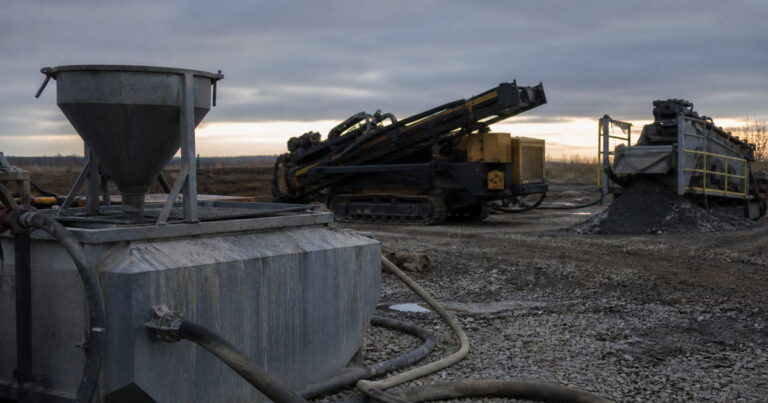
HDD drilling fluids are chosen by measured properties, not by product preference. Four properties decide whether a bore stays open: unit weight, Marsh funnel viscosity, gel strength and fluid loss, held inside the ranges the soil and hole size call for. Applies to water-based bentonite, PAC and PHPA systems in sand, gravel, clay, shale and rock. The sections below explain each function, why sodium bentonite behaves as it does, and what each out-of-range reading predicts on site.
What do HDD drilling fluids actually have to do inside a bore before the hole stays open?
A horizontal bore runs through ground with no natural tendency to stay open, and no single fluid property delivers everything a crossing needs. Six functions have to be balanced at once, and improving one usually costs something on another.
- Hold the hole open. The fluid column supports the bore wall while the reamer and the product pipe pass through.
- Suspend cuttings. Gel structure keeps sand, gravel and clay in suspension when circulation stops for a rod change.
- Remove cuttings. Annular velocity carries solids back to the entry or exit pit so the bore does not build a cuttings bed.
- Cool and lubricate tooling. Fluid removes heat from the drill head and motor and reduces friction on the drill string.
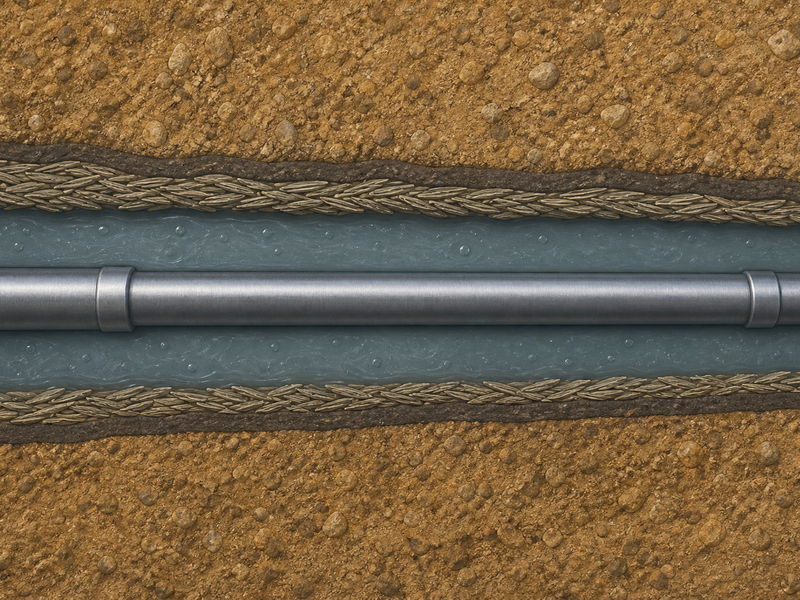
- Build a low-permeability filter cake. The deposited layer limits fluid loss into permeable ground and supports the material it forms on.
- Balance formation pressure. A fluid column held slightly above formation pressure keeps the hole from flowing or collapsing without fracturing the ground.
The six drilling-fluid functions listed above match published HDD drilling-fluid training material from GEOENGINEERS. Our own bid reviews leave the fluid section as the shortest part of the submission, yet it decides how every reaming pass behaves.
Why Sodium Bentonite Behaves the Way It Does
Bentonite is a naturally occurring sodium montmorillonite clay, and its value comes from its structure. The particles are plate-like and extremely small, with a very large surface area for their mass, and they carry exchangeable sodium ions on their faces.
Mixed through a venturi into water, the plates hydrate and the sodium ions draw water between the layers so the clay swells. The hydrated plates then link loosely, which raises viscosity and gives the fluid thixotropy: it flows when it is pumped and gels when it stops. That gel is what holds cuttings during a rod change, and it is why a well-mixed bentonite drilling fluid does not need continuous circulation to remain useful.
The plate shape also explains the filter cake. As fluid is pushed against permeable ground, the plates align and stack on the bore wall, forming a thin, low-permeability layer instead of letting water escape into the formation. In our experience the two failure directions are not symmetrical: too little shows up quickly as poor hole cleaning, while too much builds solids loading and multiplies disposal volume.
When does borehole stability depend on a pressure balance rather than on a product feature?
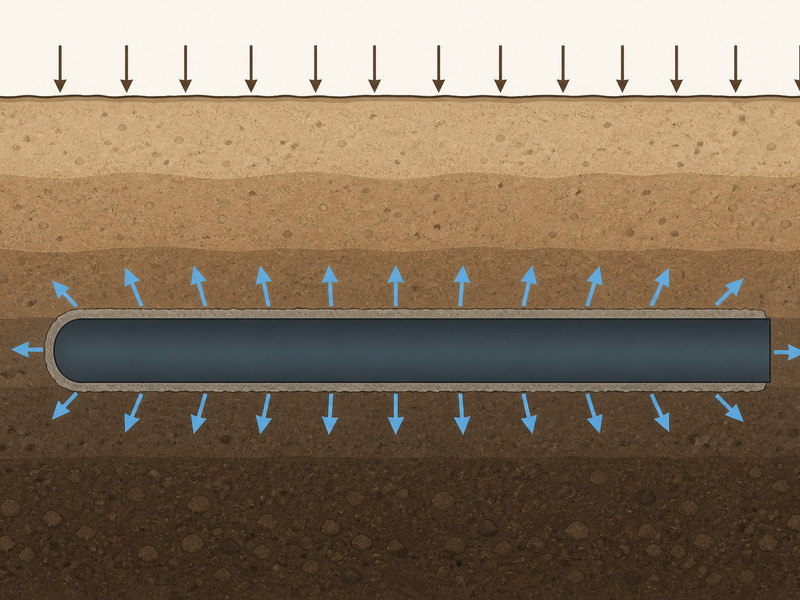
Borehole stability is often discussed as if it were a property of the fluid, but mechanically it is a balance of three things: a competent cake on the bore wall, a fluid pressure slightly above the formation pore pressure, and enough overburden and cover above the alignment.
The differential pressure is the active element. A column held just above formation pressure creates a small positive difference between the bore and the pores of the surrounding ground, and that difference presses the cake against the wall and holds loose particles in place. If the cake is missing or too permeable, the pressure leaks away and the ground begins to unravel into the bore.
The margin is narrow in both directions. Push the pressure too high and the ground fractures instead of yielding, which is the mechanism behind most inadvertent returns to surface; that limit is normally expressed as a fracture gradient set by the overburden. Cover depth sets the margin at each point, and cover is thinnest near the entry and exit curves, where the alignment approaches the surface at 8 to 15 degrees.
Gel structure is the third practical element: when pumps stop, a weak gel lets solids settle on the low side of the bore, while a very strong gel makes circulation difficult to restart without a pressure spike. Filter cake, differential pressure and overburden cover govern fluid support in all trenchless technologies.
Applies to engineered water-based systems. The properties and rules here govern bentonite, PAC and PHPA programmes. Plain water suits short, small-diameter bores in stable, non-reactive ground; that comparison belongs to the water-only vs engineered fluid guide.
The Additive Matrix: What Each Product Adds to the Fluid
Is bentonite alone enough to keep a bore open? It can build viscosity and a cake, but not every ground condition, so a modern programme is a blend chosen from the soil log.
- Bentonite builds viscosity, gel structure and the primary cake, and remains the default base for most crossings.
- PAC (polyanionic cellulose) controls fluid loss, is normally blended with bentonite, and suits sands and cobbles.
- PHPA (partially hydrolyzed polyacrylamide) inhibits reactive clay and shale by wrapping particles and limiting swelling, and is often used instead of bentonite in those formations because it also raises viscosity and lubricity.
- Xanthan gum raises viscosity at low concentration without materially increasing density, which reduces the bentonite requirement.
- Soda ash (sodium carbonate) raises the pH of the make-up water so that bentonite and polymers hydrate properly.
- Lubricants, surfactants and detergents reduce torque and pullback friction and help inhibit reactive clays.
- Flocculating agents agglomerate fine particles into larger, transportable ones so silts can be removed.
- Foam is used in rock to lift small, uniform rock flakes that a light fluid column can carry.
A polymer drilling fluid differs from a bentonite system in what it optimises: polymer systems favour inhibition and lubricity, while a bentonite drilling fluid is stronger on wall support and fluid loss because of the physical plates it deposits. Published material from GEOENGINEERS presents the two families as complementary, and most field programmes use both in the same hole.
What should a crew measure, and what does an out-of-range reading look like on an HDD drilling fluid?
A fluid drifts out of specification long before the hole fails, so properties are tested on a schedule and compared with the target for that soil and hole size. Rheology, gel strength and fluid-loss testing are performed to API RP 13B-1, and bentonite grades are specified under API 13A and OCMA.
| Property | Typical range | What happens out of range |
|---|---|---|
| Unit weight (mud weight) | Normally maintained between 9 and 10 lb/gal | Too light and the column gives little support in loose ground; too heavy and downhole pressure rises toward the fracture limit. |
| Marsh funnel viscosity | Water reads about 26 seconds; HDD fluid commonly 30 to 60 seconds, with equipment-maker guidance for most drilling applications targeting 45 to 60 seconds | Too thin and heavier cuttings fall into a cuttings bed; too thick and pump pressure rises and the fluid becomes hard to move out of the pit. |
| Plastic viscosity (PV) | Typically about 12 cP, with a common range of 10 to 20 cP | The fluid becomes harder to pump and wears tooling faster. |
| Yield point (YP) | Typically about 26 lb/100 ft² | Low yield point: poor carrying capacity; high yield point: an over-thick fluid with high restart pressures. |
| Gel strength | Measured at 10 seconds and 10 minutes to API RP 13B-1, with targets set by soil and hole size | Weak gels let cuttings settle during rod changes and breaks; very strong gels resist restarting circulation and can spike downhole pressure. |
| Sand content | Tracked as a low, stable trend rather than a single limit | A rising trend shows the bore is not being cleaned, and abrasive solids accelerate wear on pumps, the drill head and the product pipe coating. |
| pH of the fluid and make-up water | Additives hydrate and mix best at pH 8 to 9 | Below that band, the same dose gives less viscosity. |
Treatment rule: correct the cause, not the reading. Rising plastic viscosity with stable density means drilled solids are accumulating, so improve solids removal rather than diluting the fluid. Falling yield point with stable density means carrying capacity is short, so restore gel structure and the cake before the next pass. Falling pH below 8 means hydration is incomplete, so raise it with soda ash and re-test the fluid. Stop and re-test after every treatment, and log it against the station.
Temperature belongs on the same list as a tooling limit: drill-head temperatures above about 220 deg F permanently damage the transmitter that reports depth and pitch. Results are recorded against the station where each sample was taken, so a rise in sand content or plastic viscosity ties to a specific soil change, and that record is the evidence base if the crossing later needs pipeline inspection service work to confirm the installed line is undamaged.
How do you match the additive programme to the soil when the geotechnical report lands on your desk?
The soil log decides which programme is appropriate, because a polymer drilling fluid and a bentonite blend answer different ground behaviours. The table shows the logic we apply when a geotechnical report arrives.
| Soil type | Additive programme | Why |
|---|---|---|
| Loose clean sand and gravel | Bentonite base with PAC for fluid loss | Permeable and non-cohesive, so the bore depends on a quickly formed cake and enough carrying capacity to lift sharp solids. |
| Cobbles and boulders | Higher-viscosity bentonite drilling fluid with PAC | Large, heavy fragments settle quickly, so the fluid must be viscous enough to keep them moving without becoming too dense to pump. |
| Reactive clay and shale | PHPA-based polymer drilling fluid, often with little or no bentonite | PHPA wraps clay particles and limits swelling, preventing a sticky, tightening bore. |
| Mixed soil and rock | Bentonite base with xanthan gum to build viscosity | Xanthan gum raises viscosity without adding much density, so rock flakes can be carried while the fluid column stays light enough to protect the pressure margin. |
| Hard rock | Bentonite for the pilot hole, foam to lift drill cuttings | Foam carries small, uniform rock flakes efficiently and is easier to handle in hard rock. |
| Silt and fines-rich ground | Bentonite with a flocculating agent | Flocculants agglomerate fine particles into larger, transportable ones so that silts can be removed from the fluid instead of accumulating in it. |
Soda ash sits outside the table because it treats the water rather than the soil: municipal water usually falls inside the pH 8 to 9 band, while pond and well water frequently sits below it. We also read the table against hole size and crossing length, because the same sand behaves differently at river-crossing scale.
- First HDD crossing for a developer: the soil log may be the only sub-surface data, so treat the additive table as provisional and set a Marsh funnel target before drilling starts.
- Municipal crew crossing reactive clay: run a PHPA-dominated programme, and re-test the gel whenever the bore re-enters the clay unit.
- Remote site on pond or well water: raise pH to 8 to 9 with soda ash first, because the same sack count otherwise delivers less viscosity.
How much fluid does a crossing consume, and how does the mixing sequence decide whether the programme works?
Does the mixing sequence decide whether the whole programme works? Many HDD drilling fluids programmes succeed or fail here, and sequence matters as much as recipe. Bentonite is hydrated first, normally for about ten minutes through the venturi, because polymer added too early can coat the clay plates and stop them swelling.
- Hydrate the bentonite fully before introducing any polymer.
- Add PAC before PHPA, and dry polymers before liquid polymers.
- Raise the water pH with soda ash before the main additives, and record the dose and water source for every batch.
Volume is calculated rather than estimated. The working method multiplies a per-foot hole-volume factor by rod length and a soil safety factor, then divides by rig pump output to give minutes per rod. In the maker’s published worked example for a 300 ft bore in sandy clay with a 4 in product pipe, a 6 in reamer and a 25 gpm pump, a factor of 1.47 gal per ft and a soil factor of 3 define the volume the pumps must keep up with. Using less fluid than that calculation requires is the fault crews call outrunning the fluid: the fluid-to-soil ratio rises, the fluid becomes too thick to move out of the pit, and the result can be an inadvertent return, ground heave, a stretched product pipe or stuck tooling. An inadvertent return, ground heave or a stretched product can require pipeline repair services before the crossing is commissioned. Cleaning the fluid keeps the numbers stable: a bentonite drilling fluid programme that is correct at the start drifts as drilled solids accumulate, and the equipment that removes them is a discipline of its own.
Frequently Asked Questions
Do you always need bentonite in HDD drilling fluids on every crossing?
Not always; bentonite is the default viscosifier, not a universal one. Reactive clay and shale are drilled with a PHPA polymer system, while clean sands and gravels take a bentonite and PAC blend.
What Marsh funnel viscosity should an HDD drilling fluid hold in sandy clay?
Hold 45 to 60 seconds for most HDD applications and treat it as a starting point, not a target. The band moves with hole diameter and cuttings load, so a reading that is drifting matters more than one that is merely outside the band.
How does a drilling fluid keep a borehole from collapsing while reaming?
A low-permeability filter cake plus a fluid pressure slightly above formation pore pressure. The positive differential pressure presses the cake to the wall and limits fluid loss, which is what preserves the margin.
What happens when the drilling fluid is too thin?
Thin fluid drops heavier cuttings into a bed on the low side of the bore. That bed raises pullback force and the risk of an inadvertent return.
Why add soda ash to the make-up water before mixing a batch?
Bentonite and most polymers hydrate best at a pH of 8 to 9. Pond and well water often sits below that band, so soda ash is dosed first to get full viscosity from the same additive.
How much drilling fluid does an HDD crossing need at a fixed pump rate?
Enough to keep pace with the reamer, not merely enough to fill the hole.
Key Takeaways
- HDD drilling fluids are a pressure-control system first and a lubricant second: the fluid column, not the pipe, holds the bore open.
- Sodium bentonite works because its hydrated plates build viscosity, gel structure and a thin, low-permeability cake.
- Unit weight, Marsh funnel viscosity, PV, yield point, gel strength, sand content and pH are measured to API RP 13B-1 because each has a failure signature.
- A polymer drilling fluid trades some cake quality for inhibition and lubricity, so the soil log drives the choice.
How JSW Supports HDD Drilling Fluid Programmes
JSW is a pipeline engineering and construction company that executes trenchless crossings with its own crews, rigs and equipment, and it treats the fluid programme as a design deliverable rather than a site convenience. Our scope covers HDD crossing services and usługi w zakresie montażu rurociągów, so the team that reviews the geotechnical report also signs off the mud programme, the volume calculation and the monitoring plan.
Differentiation comes from how the work is controlled: crossings are delivered as integrated packages with an auditable record of fluid properties, volumes and monitoring parameters; bids state the governing risk case explicitly instead of hiding it in a lump sum; and recommendations are reviewed by professional engineers before they reach a client. A programme that cannot be defended line by line is a schedule risk disguised as a materials cost.
- One team owns the fluid plan: geotechnical review, bore plan, fluid design, drilling and pullback under one scope.
- Records a client can audit: fluid properties, volumes and pressure data held per crossing.
- Assumptions stated up front: residual risks documented in the bid, not absorbed in a lump sum.
- Containment before mobilisation: inadvertent return plans prepared before the rig moves.
Reviewing an HDD drilling fluids programme for an upcoming crossing? Send your soil log, bore profile, product pipe data and the fluid properties you are currently seeing for a free technical review. Our engineers respond with a scoped recommendation and a budget range.





































 English
  Arabic
  Russian
  Spanish
  French
  Vietnamese
  Polish
  Thai
Thai  Indonesian
  Turkish
  Portuguese