
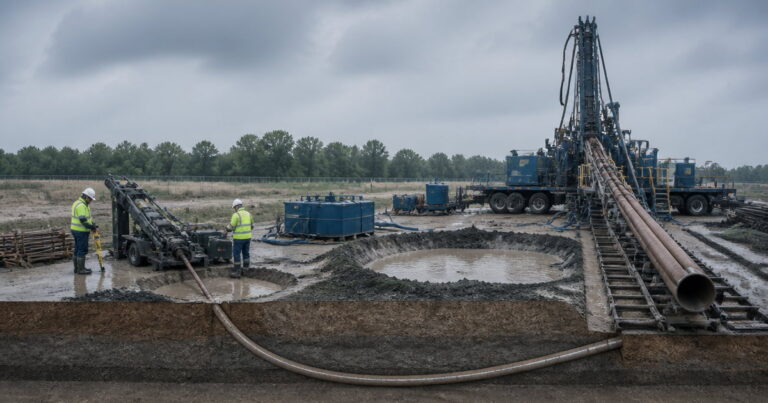
In most markets, directional boring vs horizontal directional drilling is not a contest between two methods – they are the same steerable, surface-launched trenchless technique, and the two names are used interchangeably. The difference that carries real weight is scope. Directional boring names small-rig utility, telecom and service work; horizontal directional drilling describes longer, larger-diameter pipeline and river crossings run with midi and maxi spreads.
The two labels describe the same steerable, surface-launched technique. The useful question is which scope the words buy: a mini or midi rig and pricing per bore shot on utility and telecom work, or a midi or maxi spread with wireline or gyroscopic guidance and pricing per crossing on pipeline work.
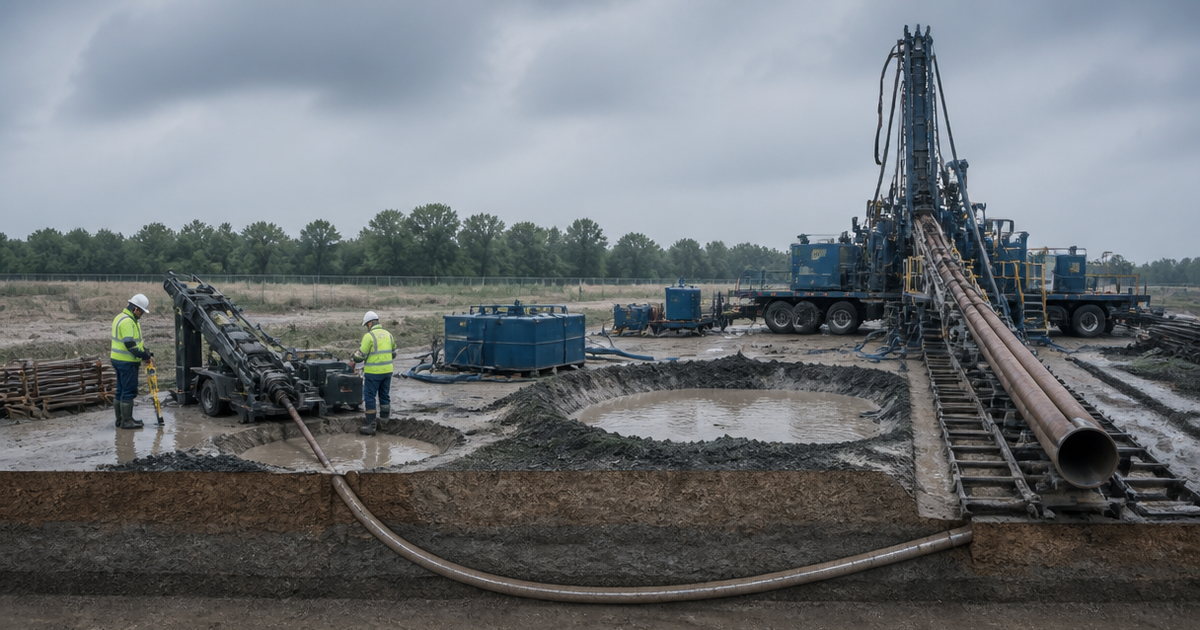
What Directional Boring and Horizontal Directional Drilling Actually Describe
Both terms describe one operation: a rig at the surface launches a steerable drill head, follows a designed arc under the obstacle, reams the hole to size, and pulls the product pipe back.
The method is identical: one steerable arc from the surface
Three features define it:
- The bore is steerable, so the alignment can follow a designed arc under the obstacle.
- The rig stays on the surface, so no launch shaft is needed.
- The pipe is installed by pullback rather than jacking.
NASTT guidance and standard reference works treat the two names as the same technique. Where definitions differ, it is emphasis – one names the act, the other the equipment family – not mechanics.
Who says directional boring and who says HDD
Usage splits by market, not geography. Utility, telecom and municipal street works say directional boring and measure in feet of bore; oil and gas and water transmission owners say horizontal directional drilling and measure in crossings.
The signal is the unit of measure: a scope priced per foot of bore is utility directional boring; one priced per crossing with a bore plan attached is HDD.
Regional and Industry Usage: Bore, Bore Shot and Thrust Boring
When directional boring vs horizontal directional drilling is argued about on a project, one of these smaller words has usually caused it.
| Term | Where it is used | What it usually means there | Risk of misreading |
|---|---|---|---|
| Directional boring | Utility, telecom and municipal work, North America | The steerable surface-launched method, usually a small rig and a short bore | Read as a different method from HDD |
| Directional drilling | Broad industry and vendor usage | The same steerable method, but also vertical oilfield drilling | Ambiguous outside a trenchless context |
| Horizontal directional drilling (HDD) | Pipeline, energy and engineering specifications | The same method, framed as an engineered crossing | Assumed to imply a large rig and budget |
| Bore | All markets | A drilled hole, or loosely the whole installation | Confusion between the hole and the pipe |
| Bore shot | Utility and telecom contracts | One completed bore between two designated points | Mistaken for a single drilling pass |
| Thrust boring | UK, Australia and parts of Europe | Unsteerable push of a casing behind an auger head | Treated as a synonym for HDD |
| Jack and bore | North American highway and rail crossings | Auger boring: a straight, unsteerable drive in a steel casing | Grouped with directional boring |
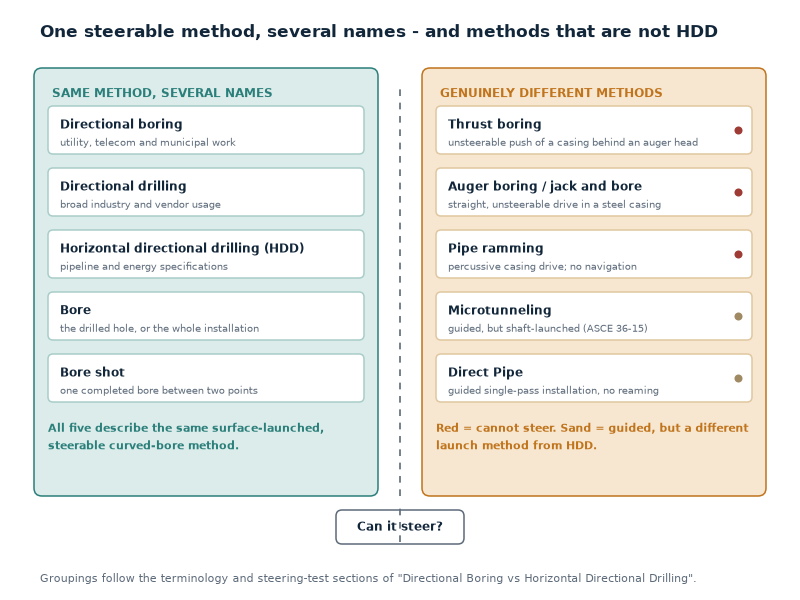
Words That Are Not HDD: Auger Boring, Pipe Ramming, Microtunneling and Direct Pipe
The problem is not only two names for one method. Names for different methods are used loosely alongside it, so a scope can specify two incompatible techniques at once. The trenchless technologies family contains all of them.
The test is steering. A machine that can correct line and grade as it advances is HDD or microtunneling, the latter guided by ASCE 36-15. One that cannot is auger boring, thrust boring or pipe ramming.
| Method | How it advances | Steerable | Typical use | Primary risk or limit |
|---|---|---|---|---|
| Directional boring / HDD | Steered pilot bore, reaming passes, pipe pulled back along a curve | Yes, along a designed arc | Pressure pipes, conduits, cables, long crossings | Fluid loss to surface, bore collapse in loose ground, pullback overload |
| Auger boring, thrust boring, jack and bore | Casing pushed behind a rotating auger head from a drive pit | No, effectively straight | Road, rail and embankment crossings | No curve tolerance, boulders obstruct the casing, needs two pits |
| Pipe ramming | Casing driven by percussive impact, spoil removed from the casing | No | Short crossings in stable ground | Ground disturbance near structures, depth limited |
| Microtunneling construction | Remotely controlled machine with face support, pipe jacked from a shaft | Yes, to tight line and grade | Gravity sewers, large-diameter crossings | Two engineered shafts, larger site, higher relative bid |
| Direct pipe | Face-supported machine pushed with one continuous pipe string from the surface | Yes, along a designed path | Long, large-diameter crossings under levees and rivers | Narrow equipment availability, thrust limits on very long drives |
We have seen tenders showing a curved HDD alignment while the specification asked for thrust boring. The two cannot both be satisfied.
Directional Boring vs Horizontal Directional Drilling: What Actually Differs
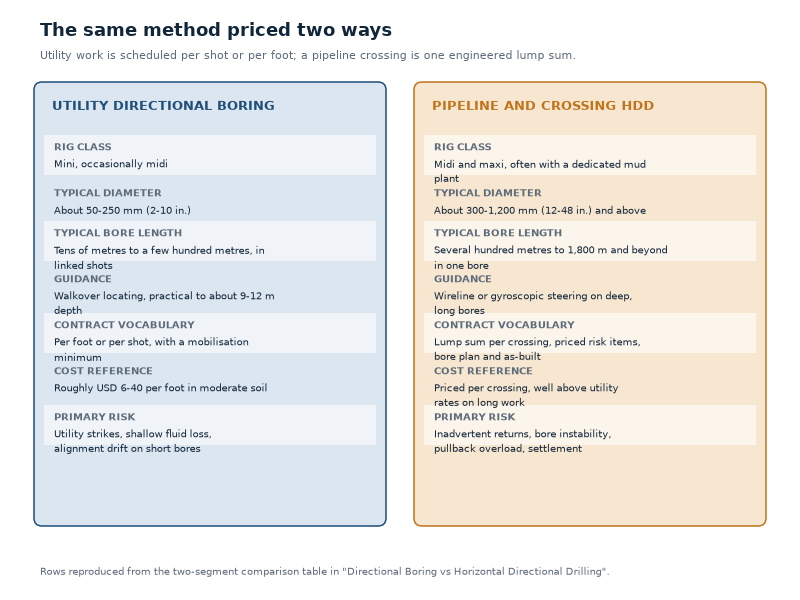
Once the vocabulary is separated, directional boring vs horizontal directional drilling resolves into scale, market and contract language. The technique is shared; what changes is bore size, who pays, and how the work is described and measured.
Scale and rig class: the difference that is real
Rig class drives the rest. A mini rig pulls a service duct under a street; a maxi rig pulls welded steel under a river. Class sets feasible diameter, bore length, guidance, fluid volume and crew, and therefore the price structure.
| Dimension | Utility directional boring | Pipeline and crossing HDD |
|---|---|---|
| Scale of works | Service laterals, fibre, cable ducts, small services | Transmission mains, river, highway and levee crossings |
| Rig class | Mini, occasionally midi | Midi and maxi, often with a dedicated mud plant |
| Typical diameter | About 50-250 mm (2-10 in.) | About 300-1,200 mm (12-48 in.) and above for casing work |
| Typical bore length | Tens of metres to a few hundred metres, in linked shots | Several hundred metres to 1,800 m and beyond in one bore |
| Guidance | Walkover locating, practical to about 9-12 m depth | Wireline or gyroscopic steering on deep, long bores |
| Market and buyer | Telecom and utility contractors, municipalities, developers | Pipeline owners, EPC firms, midstream and water authorities |
| Contract vocabulary | Per foot or per shot, with a mobilisation minimum | Lump sum per crossing, priced risk items, bore plan and as-built |
| Cost reference | Roughly USD 6-40 per foot in moderate soil, per published guides | Priced per crossing, well above utility rates on long or large work |
| Primary risk | Utility strikes, shallow fluid loss, alignment drift on short bores | Inadvertent returns, bore instability, pullback overload, settlement and permit conditions |
Cost figures are published ranges, not quotations. Soil, rock, access, restoration and permits move them further than any rig difference does.
The rig-class envelopes in one table
The mini, midi and maxi classification comes from the trenchless guidance literature and is the simplest way to align a scope with a machine. Treat these as typical published envelopes, not hard limits.
| Class | Typical pullback | Typical diameter | Typical bore length | Typical work |
|---|---|---|---|---|
| Mini | Up to about 20,000 lb (about 9 tonnes) | About 50-250 mm (2-10 in.) | Tens of metres to a few hundred metres | Service laterals, fibre, cable ducts |
| Midi | About 20,000-100,000 lb | About 150-600 mm (6-24 in.) | Several hundred metres | Water and gas mains, larger ducts, urban crossings |
| Maxi | Above about 100,000 lb | About 300-1,200 mm (12-48 in.) and larger | Up to 1,800 m and beyond | River, highway and levee crossings, transmission pipelines |
These ranges follow Federal Highway Administration utility guidance, the HDD Consortium good practices material and the NASTT mini, midi and maxi class structure. They are consistent with ASTM F1962 for maxi installation of polyethylene pipe and ASCE Manual of Practice 108 for pipeline design by HDD.
What a Bore Means in a Utility Contract vs a Pipeline Contract
The word bore is where pricing arguments start, because it is measured and paid differently in the two markets. This is the commercial edge of the directional boring vs horizontal directional drilling distinction.
Bore and bore shot in utility language
In utility work, a bore shot is one completed bore between two defined points, normally the entry and exit pits. A cable route is a chain of shots, each with its own pit and restoration scope.
Our field teams record each shot separately: the unit price is per shot, so a shot crossing a railway, a rock band or a congested duct bank carries a different rate from one in clean soil.
Utility scopes also price in feet of bore with a mobilisation minimum: three 30 m shots on one street can cost more than a single 100 m shot.
Lump sum per crossing in pipeline language
Pipeline work is normally priced per crossing. The scope is defined by a bore plan giving:
- Entry and exit coordinates.
- Design profile and depth of cover.
- Minimum bend radius.
- Reamed hole diameter, typically about 1.2-1.5 times the product pipe outside diameter.
Because the crossing is a lump sum, ground risk becomes the commercial question: differing site conditions clauses, the geotechnical baseline, and who carries the cost of an inadvertent return.
We have seen two bids for a 900 m river crossing differ by more than 30 percent because one priced an unqualified lump sum and the other priced a stated geotechnical baseline.
How the Wording Changes a Specification or a Bid
The label a document uses sets expectations that bidders price. Most of the cost consequence of the directional boring vs horizontal directional drilling wording sits on page one.
- Mobilisation is priced twice, or not at all. Utility pricing assumes a trailer-mounted rig arriving in a day; pipeline pricing assumes a multi-trailer spread, mud plant, pipe string and compound.
- Tolerances are left unstated. Utility bores often accept generous tolerance; pipeline crossings may specify line and grade control and a minimum bend radius.
- Deliverables are ambiguous. A utility bore delivers an installed duct and a path record; a pipeline crossing delivers a bore plan, daily drilling records, fluid records and an as-built survey. Citing ASCE Manual of Practice 108 or ASTM F1962 in the scope settles that list.
- Risk sits with whoever was silent. Inadvertent return, fluid and spoil disposal, utility strikes and pit restoration are cost lines a silent scope leaves unpriced.
On crossings we have supported, the most effective correction to a draft scope is replacing one unqualified method name with the class, diameter, length, guidance and deliverable list it implied.
A Scope-of-Work Checklist So the Term Cannot Be Misread
How do I write a scope that cannot be misread as the wrong method?
Use the items below as a drafting checklist. If each line is answered, a bidder cannot reasonably read the scope as anything but what is intended.
| Item to write | What to state | Why it removes ambiguity |
|---|---|---|
| Method definition | A steerable, surface-launched bore with pilot hole, reaming and pullback | Confirms the words mean this method and exclude auger or thrust boring |
| Rig class expectation | Minimum pullback capacity and fluid handling capability, not just a name | Prevents a mini rig being offered against a midi-scale crossing |
| Diameter and material | Product pipe outside diameter, wall thickness, material and reamed hole ratio | Fixes the pullback load and the reaming passes required |
| Length and shot breakdown | Total length and whether it is one bore or a list of shots | Settles whether the contract is one crossing or a per-shot schedule |
| Depth and cover | Minimum depth of cover, plus scour or future works allowance | Prevents a cheaper, shallower bid that is non-compliant |
| Guidance requirement | Walkover, wireline or gyro, and the survey record to be submitted | Makes depth-related risk explicit before it is priced |
| Fluid management | Source water, recycling, containment, spoil handling and disposal responsibility | Names a major cost line that is otherwise left to interpretation |
| Tolerances | Alignment and grade tolerance, minimum bend radius, and how deviation is measured | Converts a quality expectation into a verifiable requirement |
| Deliverables | Bore plan, daily records, as-built survey, restoration evidence, inspection records | Distinguishes utility record-keeping from pipeline documentation |
| Risk allocation | Differing site conditions, inadvertent return, utility strikes, obstruction handling, restoration standards | Puts each risk in a priced line before the contract is signed |
Scope of Application: When the Wording Changes the Job
The directional boring and horizontal directional drilling distinction matters wherever scope, tolerance or documentation is bought. It does not matter where a crew is simply asked to place a duct under a driveway.
- It changes the job when line and grade, bore records or an as-built survey are specified.
- It changes the job when the pipe is welded steel rather than fused polyethylene.
- It does not change the job when both sides already mean the same machine, the same bore and the same acceptance test.
How This Changes by Project Role
What scope is a utility contractor actually quoting?
Price the scope you are actually being asked for, and say which it is: per bore shot for utility work, per crossing against a bore plan for pipeline work.
How should a procurement engineer compare directional boring and HDD bids?
Make every bidder price the same scope. The wording is the problem, not the price, so put the deliverables, tolerance and survey requirements in the document.
What is missing when a pipeline crossing is briefed like a utility bore?
Check for a bore plan, a reamed-hole basis and an as-built requirement. If they are missing, the brief was written for a small rig and a large crossing.
Frequently Asked Questions
Is directional boring the same as horizontal directional drilling?
Yes, in engineering terms they are the same method. Both names describe a surface-launched rig that drills a steerable pilot bore along a shallow arc, reams it to size, and pulls the product pipe back. Directional boring is the everyday name in utility and telecom work; horizontal directional drilling is the same operation described in larger pipeline and river crossing contracts.
Is directional boring vs horizontal directional drilling just a naming difference?
Mostly, but not entirely. The hardware and the sequence are identical, yet the words carry different expectations about scale and deliverables. A utility owner asking for directional boring expects a small rig, a short bore and pricing per foot. A pipeline owner asking for horizontal directional drilling expects a midi or maxi spread, an engineered bore plan and an as-built survey.
Is thrust boring the same as horizontal directional drilling?
No. Thrust boring, also called auger boring or jack and bore, pushes a casing behind an auger cutting head as one unsteerable straight drive; horizontal directional drilling steers a pilot bore along a designed curve and pulls a flexible pipe back. Thrust boring cannot follow a curve, and HDD cannot hold the tight constant grade a gravity line needs.
What does bore shot mean in a directional boring contract?
A bore shot is one completed bore between two designated points, usually the entry and exit pits. Utility contracts are commonly measured per shot or per foot of installed duct, so a route made of six linked shots is quoted as six separate items. In pipeline contracts the same physical work is more often priced as one lump-sum crossing.
Which is better, directional boring or horizontal directional drilling?
Neither is better in general, because the choice is a scale and scope decision rather than a technical one. Small-rig directional boring suits service laterals, fibre and short utility crossings. Mid-range and maxi HDD suits long crossings, large diameters and pipeline work that needs an engineered bore plan.
Can a directional boring crew deliver a maxi HDD pipeline crossing?
Usually not. Maxi crossings need pullback capacity above roughly 100,000 lb, high-volume fluid handling, mud recycling, deep guidance and a pipe string prepared for pullback. A crew equipped for utility directional boring may own a rig of a few tonnes of pullback and no mud plant, so the scope has to be matched to the spread, not to the label.
Key Takeaways
- Directional boring vs horizontal directional drilling is framed as a technical choice, but both names describe one steerable trenchless method.
- What differs is scope: small-rig utility and telecom work is called directional boring; large-diameter pipeline and river crossings are called HDD.
- Methods that are genuinely different – auger and thrust boring, pipe ramming, microtunneling and direct pipe – are the real source of tender confusion.
- The word bore changes meaning by contract type: a per-shot item in utility schedules, a lump-sum crossing in pipeline scopes.
- A scope stating rig class, diameter, length, guidance, tolerances, deliverables and risk allocation removes the ambiguity one method name leaves.
How JSW Supports Directional Boring and HDD Projects
JSW is a pipeline engineering and construction company that executes trenchless crossings with its own crews and equipment. Our scope covers horizontal directional drilling services, trenchless technologies, microtunneling construction, automatic pipeline welding for pipe string preparation, and the usługi w zakresie montażu rurociągów chain that connects them.
Because we plan, engineer and execute the work ourselves, we can read either vocabulary and price it against the spread that will deliver it. To us, a scope labelled directional boring vs horizontal directional drilling is a question of class and deliverables, not a different package.
- Integrated delivery: bore planning, pipe string fabrication, pullback and restoration under one contract, removing interface risk.
- Auditable process data: daily drilling records, fluid management records and as-built surveys that stand up to owner and regulator review.
- Risk-explicit pricing: fluid disposal, restoration, obstruction handling and differing site conditions priced as separate lines, so a change is a known number rather than a dispute.
- Safety and compliance: utility locating and one-call practice, trial pits and protection of live services as a precondition of mobilisation.
Not sure which words your scope should use? Send your bore scope, contract wording and ground data for a free technical review. Our engineers confirm the correct method, rig class and scope language, and return a scoped recommendation with a budget range.





































 English
  Arabic
  Russian
  Spanish
  French
  Vietnamese
  Polish
  Thai
Thai  Indonesian
  Turkish
  Portuguese