
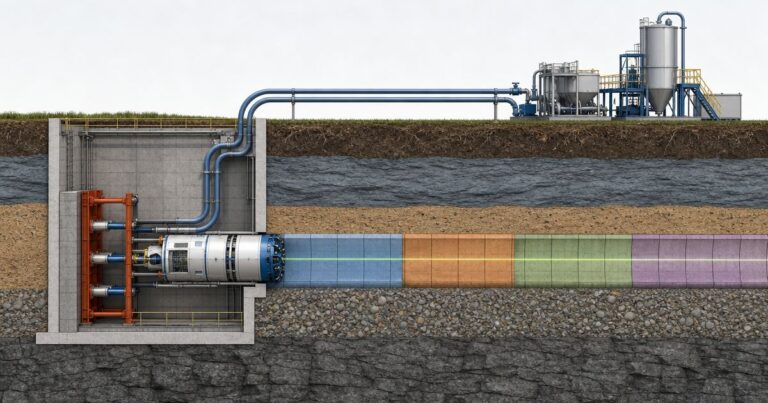
Short answer: the microtunneling cost drivers ranked highest are ground conditions, then shaft depth and shaft count, then pipe diameter, and then drive length and curve radius, with site and market conditions behind them, and the ranking holds across public projects.
Microtunneling cost drivers are the variables that move the price and the programme of a remotely controlled pipe jacking drive, defined by ASCE 36-15. This guide takes each one in turn, shows how geometry, geology, depth and diameter move cost and schedule, and ranks them so a design team knows what to change first. Every range quoted is a published planning-level or industry indication, not a quotation.
Which Variables Move Cost and Schedule the Most?
Four variable groups dominate a microtunneling estimate and its programme: geometry, geology, depth and diameter. They act together: a larger diameter raises excavation volume and jacking thrust while changing the machine class.
Ranked by how much they move a budget, the microtunneling cost drivers run: ground conditions, then shaft construction, then pipe diameter, then drive alignment, then site and market conditions.
Bottom line: characterise the ground, and every other variable becomes estimable.
Geometry: Drive Length, Curve Radius and Alignment
What does geometry actually decide? The physical demand on the machine and the pipe string. Drive length determines how much friction the jacks must overcome, and alignment decides whether those forces spread evenly or concentrate.
Long-distance pipe jacking is generally treated as drives from about 300 m up to 1,000 m or more, while 100-300 m is the conventional single drive. Beyond 1,000 m, force management controls the design.
Jacking force grows approximately linearly with driven length and rises with diameter and curvature. The hard constraint is the compressive capacity of the pipe and its joints; the jacking frame is sized to suit it. Where the required force approaches that limit, intermediate jacking stations break the drive up.
- Intermediate jacking stations: specifications commonly require allowance for one roughly every 100 m on long drives.
- Smaller machines: 600-900 mm class machines are typically limited to 160-200 m per drive without them.
- Lubrication: where lubrication is effective, unit friction on the pipe is commonly taken in the range of 2-5 kPa.
A smaller curve radius raises both jacking force and the complexity of guidance control, so cost and schedule climb together. A straight alignment with a generous radius is usually cheaper.
Bottom line: geometry is a force problem before it is a cost problem; solve the force and the cost follows.
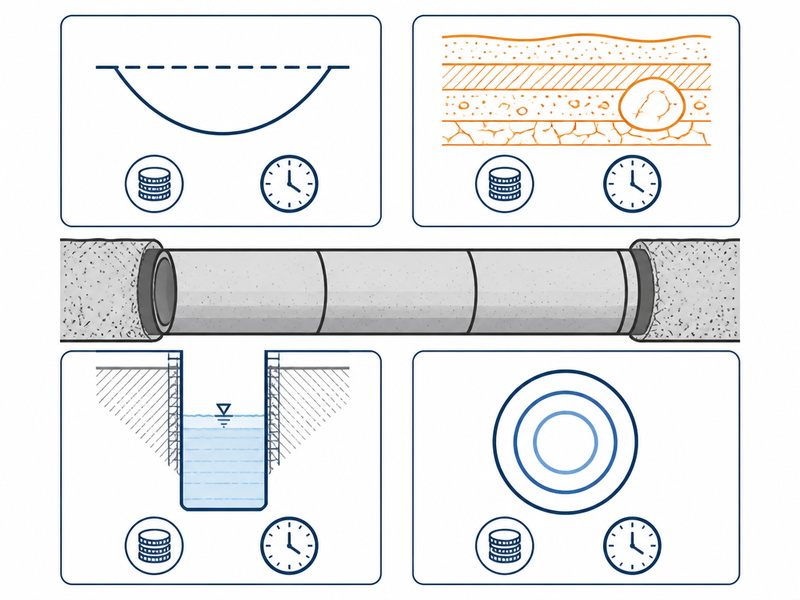
Geology: The Largest Single Uncertainty in the Estimate
Which variable carries the largest single uncertainty in a microtunneling estimate? Ground conditions. Two boreholes a short distance apart can carry different soil, water pressure and obstruction risk, and the machine meets the whole face.
The uncertainty shows up in five ways: face stability, confined water, boulders, rock strength and mixed face.
- Face stability: loose, running or water-bearing sand decides the face support system and the settlement controls.
- Confined water: artesian groundwater raises slurry density, shaft watertightness and dewatering cost.
- Boulders: obstructions up to roughly 30 percent of the face can be handled by a cutterhead designed for them; above that, intervention is likely.
- Rock strength: uniaxial compressive strength (UCS) drives cutter type, penetration and cutter wear.
- Mixed face: rock and soil in one face is the most adverse condition, because no single cutterhead suits both.
In a published review of 29 rock microtunneling cases, rock type and strength drove penetration and cutter wear; as ground hardens or becomes mixed, cutter wear dominates cost.
Our estimating team reads the geotechnical report first and quantifies it last: where the investigation is thin, the honest estimate carries a wider range.
Bottom line: the ground sets the range and everything else only narrows it.
Depth: Shafts, Ground Cover and Groundwater Pressure
Shaft depth is the variable owners most often under-scope, because it is fixed early by the vertical alignment and then left in place. Shaft cost rises approximately linearly with depth, but the water-control requirements do not.
As shaft depth increases, groundwater pressure at the base rises, and dewatering, watertightness and base stability requirements tighten with it. A shaft that is straightforward at 6 m can need a different design at 20 m.
Shallow shafts can matter in the opposite direction. Industry planning guidance places the microtunneling cost crossover at roughly 20 ft (6 m) or more in urban, utility-dense corridors.
Bottom line: every extra metre of depth adds a near-linear cost with a step change in water control.
Diameter: The Compounding Variable
Why is diameter the compounding variable? Excavation volume, pipe material, jacking thrust and slurry pumping capacity all grow approximately with the square of diameter, so a step up in pipe size multiplies several cost lines at once.
Typical product pipe diameters run from about 300 to 3,000 mm (12-120 in.). The same drive distance and ground can carry a different machine class, pipe class and separation plant.
A larger pipe needs a larger shaft and a larger curve radius to pass through the same corridor, which is why large-diameter curved drives are the hardest to price.
For a related method, HDD maximum length and diameter covers where drilling rig capacity stops; for the published cost side of diameter, see how much microtunneling costs per foot.
Bottom line: treat diameter as a multiplier that changes the machine, the pipe and the plant class together.
What Actually Drives the Construction Schedule
A microtunneling programme has two layers: the single-drive cycle and the inter-shaft flow that links the drives. The cycle covers set-up, cutting and jacking, pipe jointing, slurry handling and end-of-shift maintenance.
The inter-shaft flow decides whether the machine moves straight from one reception shaft to the next launch or waits. Over a whole project, the largest schedule uncertainty is usually cutter change.
An intervention means a stoppage, a recovery and a restart whose timing the investigation alone cannot set, and ground conditions feed directly into schedule risk, because harder or more mixed ground slows penetration and accelerates cutter wear.
For the per-shift numbers behind these drivers, see microtunneling productivity and advance rates.
Bottom line: the programme is set by the flow between shafts and by the machine’s ability to keep cutting, and a single fast day changes it very little.
Where the Four Variables Interact
The four microtunneling cost drivers move together, and their interactions are where estimates go wrong: a deeper shaft adds cost but may allow a longer single drive and fewer shafts.
- Depth and ground: deeper cover often means better ground, which can cut support and settlement cost even as shaft cost rises.
- Diameter and alignment: a large pipe needs a larger radius, so a diameter increase can force a realignment.
- Length and machine class: a longer drive can push the machine, the pipe class and the jacking system up a tier together.
Bottom line: optimise the alignment and the shaft positions as one decision, in a single pass.
A Sensitivity Ranking: What to Change First
If you want the largest return from one design change, start with the microtunneling cost drivers ranked below. The order is our engineers’ sequence for opening an estimate, and a site can reorder it.
| Rank | Variable | Why it moves the number |
|---|---|---|
| 1 | Ground conditions | Largest uncertainty; sets support, cutter and settlement requirements |
| 2 | Shaft depth and count | Near-linear cost rise with depth, plus a step change in water control |
| 3 | Pipe diameter | Volume, thrust and plant grow with the square of diameter |
| 4 | Drive length and curve radius | Force, friction and guidance limits on the machine and pipe |
| 5 | Site and market conditions | Access, spoil disposal and regional pricing |
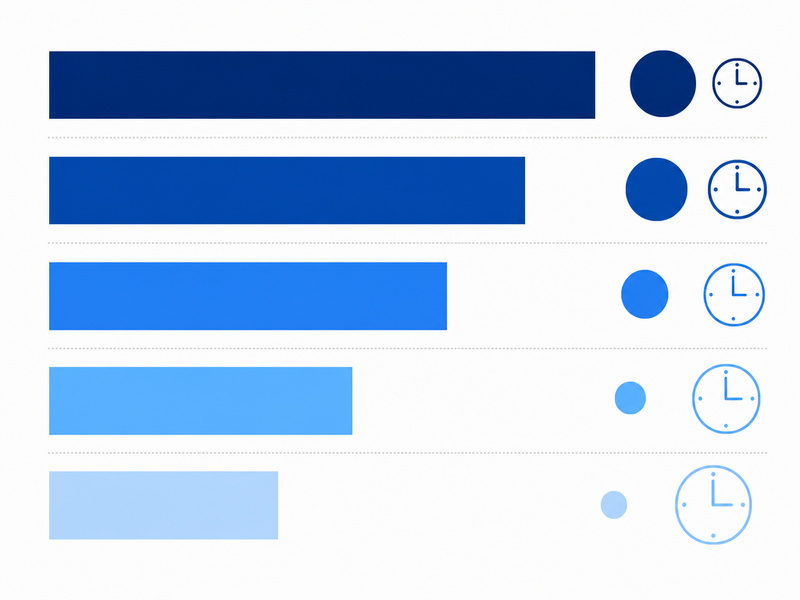
In our drives, changes to the ground and the shafts have moved a programme by more than the lower variables combined. An unmapped boulder zone outranks any realistic alignment change.
Bottom line: spend investigation effort on the ground, then treat drive length and curvature as geometry to optimise once the ground is known.
Microtunneling Cost Drivers and Schedule Drivers Matrix
Why does each variable appear twice in the matrix? Because its cost mechanism and its schedule mechanism are usually the same physical fact seen from two sides.
| Variable | Cost mechanism | Schedule mechanism |
|---|---|---|
| Geology | Face support, cutterhead and settlement control | Stoppages for cutter change and slower penetration |
| Shaft construction | Near-linear shaft cost plus water control | Access, set-up and dewatering time |
| Pipe diameter | Excavation volume, pipe class, thrust and slurry plant | Larger machine, longer set-up, more spoil to move |
| Drive distance | Friction, jacking force demand and pipe class | Longer cycle and more pipe joints |
| Alignment curvature | Lateral friction, guidance complexity and intermediate jacking stations | Slower steering, correction and re-survey |
| Site and market | Access, spoil disposal and regional pricing | Permits, working windows and access restrictions |
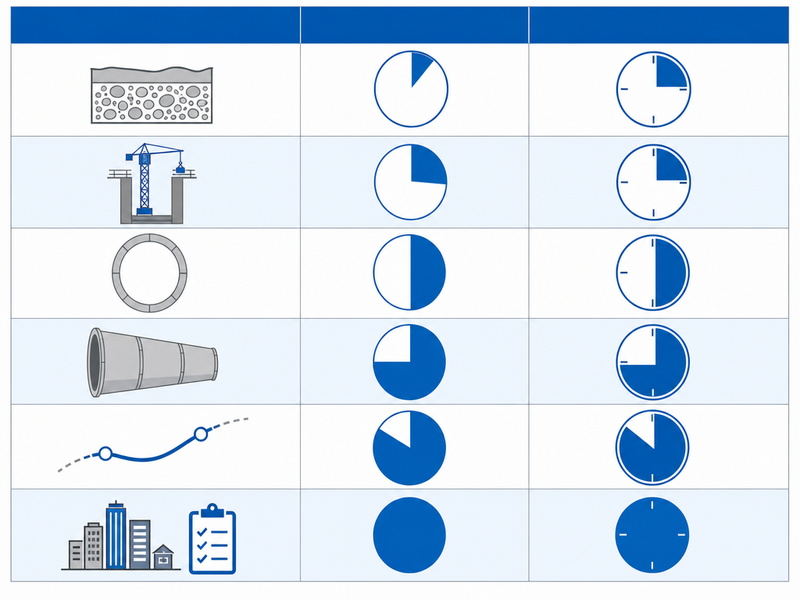
Bottom line: whatever raises cost on this matrix usually raises schedule risk at the same time.
Design Decisions That Reduce Cost and Schedule Risk
Most microtunneling cost drivers are set by design decisions taken before the contract is signed, whether the decision-maker is an owner’s designer, a design-build team or a contractor pricing an alternative. Five carry the most weight.
Ground, depth and diameter are the least reversible of the four variable groups, so they deserve the earliest decision.
- Investigate the ground properly. Ground ranks first in sensitivity, so the investigation is the item that removes the most uncertainty from every later number.
- Choose the deepest practical shaft, because deeper shafts can allow longer drives and fewer launches.
- Keep the alignment straight and the radius generous. Every metre of curve raises lateral friction and guidance work.
- Match diameter to function. Oversizing forces a heavier machine, pipe and plant class across the whole drive.
- Plan for intervention. A method statement that names how cutters will be changed protects the programme.
Allocating the remaining risk is a contract question, covered in risk allocation in microtunneling contracts; the tender requirements sit in the microtunneling specification.
Bottom line: the cheapest design change is usually the one made before the bid.
Want a second opinion on your drive? JSW engineers review your alignment data, shaft positions and the ground, then rank the variables that will move your cost and programme. Send the data and we will respond with a written view.
Frequently Asked Questions
What are the main microtunneling cost drivers?
Ground comes first, then the number of shafts, then pipe diameter, and then the alignment itself. Site access, spoil disposal and regional market conditions sit behind them, so the top variables deserve the most investigation.
Why is geology the largest uncertainty in a microtunneling estimate?
Because the machine meets the whole face, and a borehole describes only one point in it. Two boreholes a short distance apart can differ in soil, water pressure and obstruction content, and boulders, rock strength or a mixed face can each change the cutterhead and the support system.
How does a longer drive change cost and schedule?
Jacking force grows approximately linearly with the driven length, so a longer drive needs more thrust, a stronger pipe class and often intermediate jacking stations, commonly allowed for roughly every 100 m. The hard limit is usually the compressive capacity of the pipe and its joints.
How does a curved alignment affect a microtunneling drive?
A tighter curve increases lateral friction on the pipe string and makes guidance harder. Both effects raise the required thrust and slow the machine, so cost and schedule rise together. Curved drives are practical, but the radius should be as generous as the alignment allows.
Does pipe diameter matter more than shaft depth?
They act differently. Diameter is a multiplier: excavation volume, jacking thrust and slurry plant capacity grow with the square of diameter, so it moves several cost lines at once. Depth is closer to linear but also raises groundwater pressure, and depth is hard to reverse later.
What causes most schedule risk on a microtunneling project?
Cutter changes and maintenance. When the face cannot be reached from the shaft, every intervention means a stoppage and a recovery whose timing is hard to predict. The number and spacing of shafts decides how fast the machine moves between drives.
Can better investigation reduce cost and programme risk?
Yes, up to a point. A proper investigation narrows the range on the largest variable, which lets the design team settle shaft, diameter and alignment decisions with smaller contingencies. It cannot remove geological uncertainty, so the estimate should still carry a range.
Is a straight microtunneling alignment always cheaper?
Usually, but not always. A straight alignment lowers lateral friction and simplifies guidance, cutting both force and risk. The exception is a realignment that removes a shaft or avoids poor ground, where fewer launches can outweigh a perfectly straight drive.
Reviewing Your Drive Geometry
If you are unsure whether the ground is characterised well enough before fixing the geometry, make that check first. Cost and schedule are decided by four variable groups, and the largest is the ground.
Our engineers review drive geometry, shaft positions and the geotechnical basis together, and set out where cost and schedule risk sits before tender, which is the cheapest point at which to change an alignment.
Where a method still has to be chosen, microtunneling vs HDD compared on accuracy, diameter, ground and cost sets the two side by side, and the key differences between microtunneling and HDD explains where the boundary sits. Where the drive moves into delivery, microtunneling construction services covers how jacked drives are built.
Reviewing your drive geometry is where these microtunneling cost drivers become a decision: ground first, then shafts, diameter and alignment.
Get a written view before you tender. JSW’s trenchless engineers review your drive geometry, shaft positions and the ground and rank the variables that will move cost and schedule, whichever service the answer points to.
Sources
The cost, friction and drive-length ranges in this guide follow these published industry standards and guidance documents:
- ASCE 36-15, Standard Design and Construction Guidelines for Microtunneling.
- ASTM D653, Standard Terminology Relating to Soil, Rock, and Contained Fluids.
- NASTT Good Practices Guidelines (Microtunneling).
- FIDIC Emerald Book, Conditions of Contract for Underground Works.





































 English
  Arabic
  Russian
  Spanish
  French
  Vietnamese
  Polish
  Thai
Thai  Indonesian
  Turkish
  Portuguese