
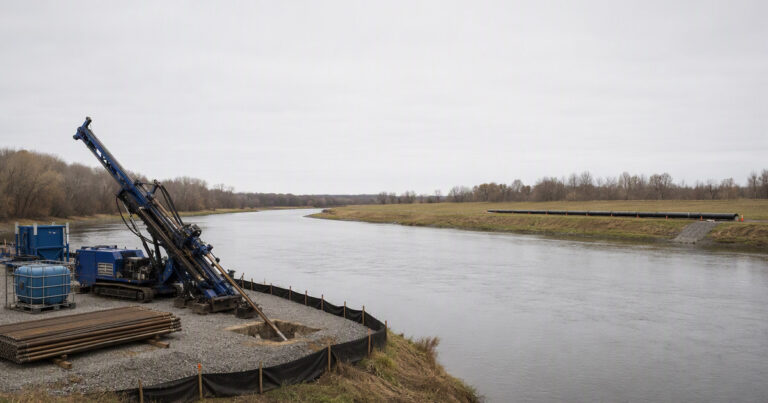
Short answer: Horizontal directional drilling (HDD) is the right choice for a pipeline crossing when open trenching is impractical or unacceptable, the ground can hold a stable bore, the bore geometry fits a real rig, and both ends of the crossing have room for a rig, a pipe string and fluid handling. Those four tests decide HDD feasibility. Where any one of them fails, the crossing is not an HDD crossing: open cut, microtunneling or Direct Pipe applies instead.
This guide answers the question that pipeline engineers, utility owners, EPC teams and municipal authorities actually ask: is HDD feasible on this crossing, and what data is needed before the method is locked in? It sets out the four tests that decide HDD feasibility — method need, ground, geometry and workspace — then the site conditions that let a bore hold, the crossings where HDD is usually the right answer, the geometry, workspace, clearance and permitting constraints that reshape a drive, and a seven-step assessment of horizontal directional drilling feasibility you can run on your own alignment. It is written for the people who have to decide when to use horizontal directional drilling, and then defend that choice at tender.
HDD Feasibility: The Four Tests a Site Must Pass
A site is suitable for HDD when four tests pass at the same time. Each one is answered by data rather than opinion, and the order matters because the cheap tests come first.
- Method need: is there a real obstacle, restriction or stakeholder objection that an open trench cannot satisfy?
- Ground: can the soil or rock hold a stable bore without collapsing, losing fluid or deflecting the drill head?
- Geometry: can the length, diameter, depth and clearance be achieved inside the bend radius and cover limits the pipe allows?
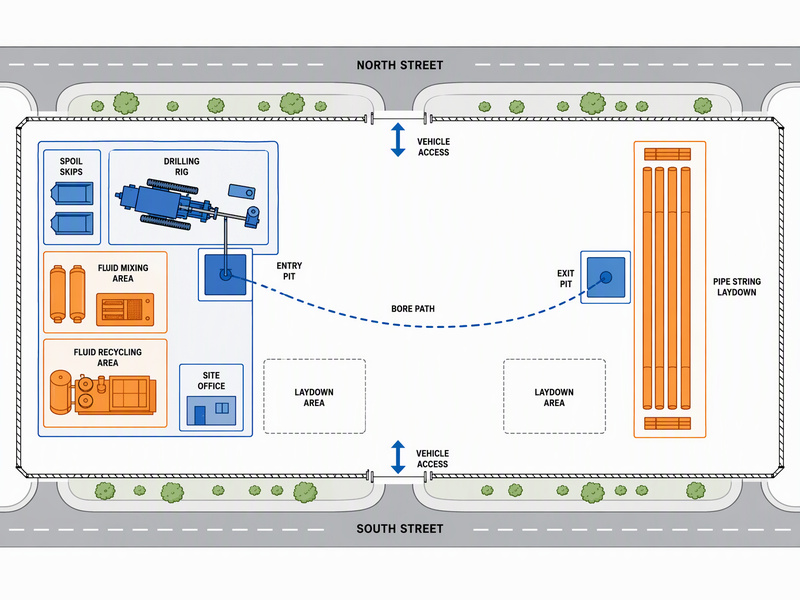
- Workspace: is there room at both ends for the rig, the pits, the pipe string and fluid handling for the duration of the work?
Teams often start with the rig and the price, then discover at week six that the exit end has nowhere to stage a pipe string. In our feasibility reviews, the test that ends or re-routes the most crossings is workspace, not geology.
Who the four tests land on. A utility owner permitting one crossing needs the permit lead time and the workspace answer first. An EPC pricing a lump sum needs the pullback estimate and the fluid volumes it has to carry in the bid. A municipal authority crossing under its own levee needs the separation and pressure case its own engineers will have to defend. A contractor working a confined urban street needs to know whether the string can be laid out and pulled at all. Each is asking a different HDD feasibility question about the same alignment, and each answer changes which of the four tests is likely to fail first.
| Screening factor | Favours HDD | Needs engineering | Usually rules HDD out |
|---|---|---|---|
| Obstacle | River, rail, highway, runway, dense utilities | Single road or drainage channel | Open ground with no obstacle |
| Ground | Stiff clay, silt, competent rock | Fine sand, mixed rock and soil | Boulders, cobbles, karst, loose gravel |
| Pipe and service | Pressure pipe, HDPE or steel, 50-1,200 mm | Large diameter, high-pressure steel | Gravity sewer needing a fixed slope |
| Length | 100-600 m in one drive | 600-1,500 m, or a tight bend radius | Runs too short to amortise mobilization |
| Workspace | Open land at both ends | One end constrained | No room for a pipe string at the exit |
| Fluid and permitting | Contained site, disposal route agreed | Sensitive watercourse nearby | No disposal route, protected habitat |
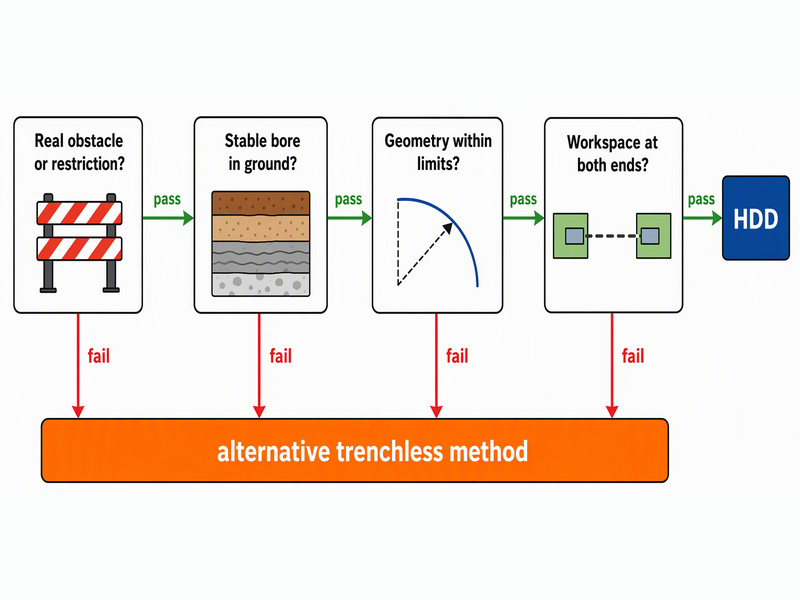
HDD site conditions are rarely uniform, so a negative answer on one test does not always close the option. Re-routing the bore a few metres to stay inside a favourable stratum, or moving the exit pit to a larger plot, converts many marginal crossings into straightforward ones.
What failure looks like on each test. Method need fails when the obstacle can be opened with a short trench and restored in the same week. Ground fails when boreholes return cobbles or voids along the path, or when fluid loss cannot be contained within the working area. Geometry fails when the arc the alignment needs is tighter than the pipe’s allowable curvature, or when the cover the authority requires cannot be reached. Workspace fails when the exit end cannot stage a string as long as the crossing. Of the four, ground and the exit end are the ones that end options; geometry is usually solvable by accepting a longer, deeper route, and method need is normally settled first because everything else depends on it. A horizontal directional drilling feasibility opinion that does not name which test fails is not yet an opinion.
Ground Conditions: What Decides Whether a Bore Will Hold
Ground is the part of HDD feasibility that cannot be engineered around. A rig can be upsized and a path can be moved, but the strata along the bore are fixed by the site, which is why a geotechnical investigation along the full bore path is the highest-value spend in any study.
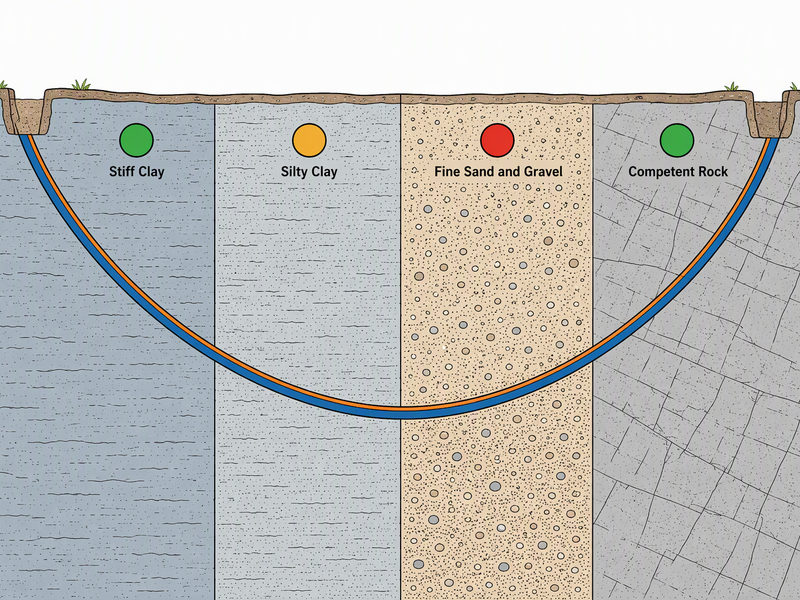
Stiff clays and dense silts are usually favourable: the hole stays open, cuttings return to the pit and the path is predictable. The risks are mechanical, because sticky clay can ball up on reamers, raise torque and slow pullback. Fine sands and silty sands sit in the middle, holding a bore with the right fluid properties but narrowing the margin between a stable hole and fluid loss.
Clean sands, gravels and cobbles are the difficult end of the granular range, where fluid escapes into the formation instead of returning cuttings and a gravel layer can deflect the drill head until steering authority is lost. Boulders, karst and voids are the conditions that most often end an HDD option, because no rig size solves a formation that gives no steering reference and swallows fluid.
Competent rock is often easier to bore than mixed ground, because the hole stays open and the alignment is predictable. In rock, two measured properties decide tooling and production rate: strength, which sets the cutter and reamer class, and abrasivity, normally reported on a graded scale rather than as a single number, which sets tool life and the rate of tool changes. Interbedded rock and soil is harder to steer than uniform rock, because resistance changes along the path and every steering correction is made against a changing formation.
How much investigation is enough. The useful test is not how many boreholes are drilled but whether the gaps between them could hide a feature that changes the method: a lens of cobbles, a void, or a seam of rock that sets the reamer class. A hole at each end of the crossing cannot rule those out, which is why investigation points belong along the path, at the geometry changes, and at the entry and exit where the rig loads the ground. Perched water and artesian conditions change the plan twice over: they change the fluid programme, because inflow has to be balanced rather than carried, and they change the spoil, because wet or contaminated arisings may need a disposal route agreed before mobilization. Getting that wrong is what turns a horizontal directional drilling feasibility study into a construction problem.
- Boreholes along the path, not only at the entry and exit pits, spaced closely enough to detect lenses a single hole would miss.
- In-situ testing and soil classification to ASTM D2487 classification practice, so design, tender and rig crew describe the same material.
- Rock coring and abrasivity testing where rock is expected, because strength and abrasivity drive tooling.
- Groundwater and contamination screening before mobilization, since perched water, artesian conditions and contaminated spoil all change the plan.
| Ground type | Bore stability | Main risk | Design response |
|---|---|---|---|
| Stiff clay, silty clay | High | Balling, high torque, slow reaming | Optimise fluid and reamer type; set torque limits |
| Silt, fine sand | Umiarkowany | Fluid loss, settlement | Higher-viscosity fluid, slower pullback, monitoring |
| Clean sand, gravel | Niski | Inadvertent returns, collapse | Containment plan, casing options, pressure control |
| Cobbles, boulders | Niski | Deflection, lost steering, tooling damage | Re-route, deepen, or change method |
| Competent rock | High | Tool wear, slow rates | Mud motor, rock reamers, abrasivity-based tooling |
| Karst, voids | Very low | Total fluid loss, collapse | Grouting programme, or method change |
Crossing Types Where HDD Is Usually the Right Choice
The strongest case for HDD is a crossing that is expensive or impossible to open up, where the surface cannot be disturbed and HDD site conditions at least allow a bore to be attempted. The question then changes from “is HDD cheaper?” to “is any other method actually available?”
Roads, highways and urban corridors
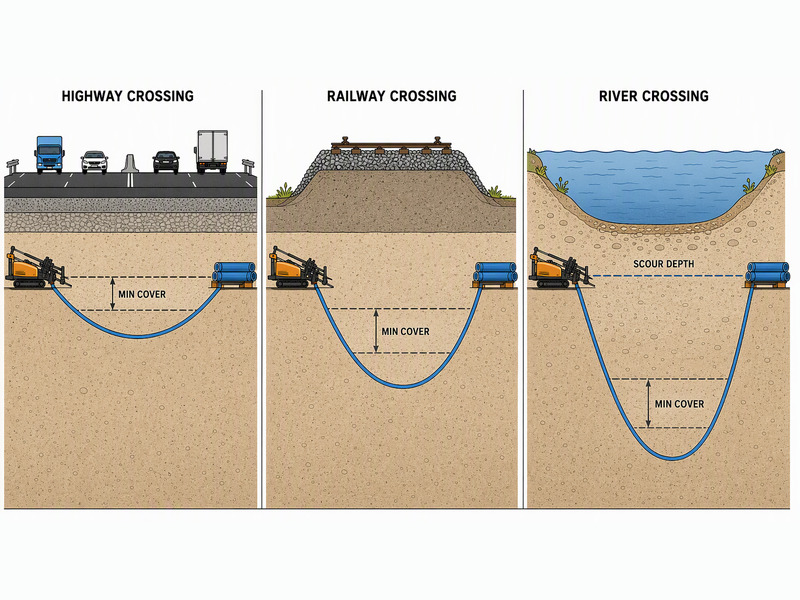
Beneath a paved road, an open trench means traffic management, lane closures, reinstatement and a repair liability that follows the backfill for years. A bore crosses in a fraction of the time and leaves the pavement intact, with only pit-sized repairs at each end. Cover is typically shallow, often around 1.2-1.5 m, which keeps these HDD crossings short and forgiving; the real constraint is usually the density of existing services.
Railways
Rail crossings are among the clearest cases for HDD, because track possession is difficult to obtain and settlement tolerances are tight. Operators typically demand deeper cover than a road, commonly 3 m or more below the track formation, along with monitoring and working windows. That depth means longer bores and larger rigs, but the method itself remains the practical answer.
Rivers, canals and levees
Watercourses are the classic application, because the alternative is damming, fluming or dredging a riverbed. Cover is set below scour depth and any future dredging datum, so horizontal directional drilling feasibility in alluvium turns on the fluid-loss and inadvertent-return assessment, evaluated at the critical points along the bore. Where a levee is involved, the authority’s separation and pressure requirements must be met at design stage, not during construction.
Airports, shore approaches and protected sites
Runways and aprons cannot be opened at all, and landfalls frequently require a trenchless method to keep the pipeline buried across the surf zone. Protected land, heritage ground and sensitive vegetation fall into the same family, because the route is chosen to avoid surface disturbance entirely. These crossings demand early geotechnical and permitting work, since the fallback options are limited once a protected surface is in play.
| Crossing | Typical bore length | Governing constraint | Risk to manage | Data needed before committing |
|---|---|---|---|---|
| Road, street, highway | 50-200 m | Existing services and clearance | Service strike; pit space in traffic lanes | Utility records, potholing, traffic plan |
| Railway | 100-400 m | Cover depth, settlement tolerance, possessions | Track settlement; loss of a possession window | Operator requirements, geotechnical profile |
| River, canal | 300-1,500 m | Cover below scour, inadvertent returns | Frac-out into the watercourse; spoil disposal | Bathymetry, alluvial profile, environmental window |
| Levee or embankment | 200-800 m | Authority separation and pressure limits | Excess annular pressure; embankment stability | Authority criteria, geometry, pressure check |
| Airport, runway, apron | 200-1,000 m | No surface access, security and settlement limits | Rig immobilised in a no-access zone; settlement | Airside permits, geotechnical profile |
| Congested urban corridor | 50-300 m | Service congestion at both ends | Unrecorded services; clearance conflicts | Designation survey, potholing, pit siting |
Ranked by how often HDD is the right answer, crossings beneath railways, watercourses and runways are the least contested, followed by deep pressure mains in paved urban streets. Road crossings are the most competitive, because microtunneling and auger boring can also serve them where tolerance or ground conditions favour a mechanically driven method.
When one crossing takes in more than one controlled feature. Many alignments cross a river behind a levee, or a rail corridor beside a highway, and the requirement is then set by the strictest authority involved rather than by the average: cover is taken below the deepest scour case, the separation and pressure limits of the levee authority govern the whole drive, and the possession window of the rail operator can set the programme. The same alignment can also serve two methods, with a bore under the watercourse and open cut on the two approaches; the horizontal directional drilling feasibility question then applies only to the bored length, which is often the difference between a viable and an unviable scheme.
Constraints That Reshape or Rule Out a Bore
Ground decides whether a bore can exist; constraints decide whether it can be built with the equipment and the land available. Most marginal HDD feasibility cases fail here rather than on soil.
What Limits HDD Length, Diameter, Bend Radius and Cover?
HDD bore length is limited by four things: rig pullback and thrust capacity, cuttings and fluid transport along the bore, the annular pressure the formation tolerates, and the bend radius the product pipe allows. Utility bores commonly run 100-300 m in one drive, while large-rig crossings beyond 1,500 m are delivered with staged reaming, multiple rigs or intersect methods. Product diameter drives everything else: mainstream HDD installs pipe of roughly 50-1,200 mm outside diameter, and the reamed hole is typically about 1.3-1.5 times that outside diameter.
Bend radius sets the shape of a crossing, and the allowable arc differs by pipe material: polyethylene pipe installed by HDD is designed to ASTM F1962, while steel is governed by its own strain limits, so the same obstacle can need a longer, deeper arc in steel. Cover must satisfy the authority that owns the feature being crossed. Entry and exit angles are normally shallow, in the region of 8-20 degrees, with a shallower exit angle favoured as diameter grows.
Rig size is an output of the feasibility work, not an input to it. The rig class follows the estimated pullback, and that estimate is built from the pipe’s weight in air, its buoyancy in the fluid-filled hole, friction along the rollers, the capstan effect of the arc, and the drag of the reamer train behind the head. Two crossings of the same length can therefore need different rigs, and a crossing that is feasible on paper can still fail because the rig that would make it work cannot be mobilised to the site or cannot fit on the pad. Fixing the estimate before the rig is chosen is what keeps the method decision defensible at tender.
Workspace and Pipe String: Why the Exit Side Decides
The most common reason an HDD-feasible crossing is never built is that the pipe string will not fit. Jointed pipe must be laid out, welded or fused, tested and pulled into the bore, so the string area is roughly as long as the crossing itself plus working margin. On a confined urban site that may require a temporary compound, a lane closure for the duration, or a switch to a continuous reel. Drilling fluid volumes are equally easy to underestimate, and they can be checked at feasibility stage with one calculation: a 600 mm reamed hole over a 300 m crossing has a nominal volume of about 85 m³ (π/4 × 0.6² × 300 m), and that volume has to be mixed, circulated, cleaned and either recycled or disposed of, before any losses into the formation are added.
What Separation Does HDD Need From Existing Utilities?
In congested ground, clearances govern the alignment more than geology. Records are a starting point rather than evidence, so the design should rely on subsurface utility engineering practice (ASCE 38) to designate services, and then pothole the conflicts that matter rather than every service on the drawing. Where space allows, a separation of about 1.5 m between the bore and an existing utility is a common working target, and service crossings are verified by exposure rather than assumed from drawings; HDD crossing constraints in congested ground are usually clearance-driven rather than geological.
When Does Drilling Fluid Become an Inadvertent Return?
Drilling fluid makes a bore possible and is also the method’s main environmental exposure. If annular pressure exceeds what the overburden can hold, fluid fractures to the surface as an inadvertent return, sometimes called a frac-out. Prediction methods, including the pressure-based approach adopted in US Army Corps of Engineers guidance for crossings of levees and watercourses, keep design pressures inside safe limits. Feasibility therefore includes a containment and response plan: where spoil and fluid are stored, how returns are monitored, who is notified and what stops work.
What a containment and response plan has to state. The plan is only useful if it answers three things before drilling starts. First, where the monitoring points sit: where the cover over the bore is thinnest, and where a return would reach a watercourse fastest rather than where it would be most visible. Second, what stops the work: a change in return volume or in pressure that anyone on the pad can measure, not a judgement call made on site. Third, what follows a stop: contain the return, notify the authority named in the permit, sample the watercourse if one is involved, and state the conditions under which work may resume. A return to water is a different event from a return to open land, because the notification route and the clean-up obligation change with it.
Which Permits and Seasonal Windows Can Delay a Crossing?
Permits shape the programme and sometimes the method. Crossing agreements, landowner consents, road or rail occupancy, watercourse and floodplain approvals, noise restrictions and protected-species constraints all carry lead times, and several carry seasonal windows. A crossing that is technically perfect but can only be permitted in a four-week window outside the rig’s availability is not a feasible plan. Noise limits and working-hour conditions belong in the same assessment: a residential street that can only be drilled at night carries a different risk profile from a crossing on open land.
| Constraint | What to check | Typical planning limit | If it fails |
|---|---|---|---|
| Bore length | Rig capacity, cuttings transport, annular pressure | 100-300 m utility; 1,500 m+ large rig | Intersect method, or another method |
| Product diameter | Reamed hole size, fluid volume, pullback load | About 50-1,200 mm | Larger rig, or Direct Pipe and microtunneling |
| Bend radius | Material, wall thickness, arc versus land available | Material-dependent; steel and HDPE differ | Longer, deeper crossing or re-route |
| Cover depth | Authority requirement, scour, future works | About 1.2-1.5 m under roads; deeper under rail and rivers | Deepen the path, or open cut if permitted |
| Pipe-string space | Crossing length plus margin, access, welding area | Roughly the crossing length | Reeled pipe, off-site stringing, or another method |
| Fluid and containment | Volumes, disposal route, near-surface pressure | Site-specific | Containment upgrade, or a low-fluid method |
Not sure whether your crossing passes these tests? Send us the alignment, the pipe specification and any geotechnical information you already hold. Our engineers will review HDD feasibility on your site and tell you which additional data is worth paying for before you go to tender, including the crossings where another trenchless method is the better answer.
The Cost Side of HDD Feasibility
Cost does not decide whether an HDD bore is technically possible, but it decides whether the crossing is worth designing. HDD carries an unusual cost structure: mobilization and the surface spread dominate, while the marginal cost of extra length is comparatively low. A long crossing can therefore be competitive, and a short one rarely is.
Published North American cost ranges for small utility HDD bores commonly fall between $50 and $250 per linear foot of installed pipe, before pavement restoration and traffic control; those figures are published regional ranges rather than quotations, and they date quickly as rig rates move. The spread is driven mainly by rig size, ground conditions and product diameter rather than by crossing distance. The comparison that matters is total installed cost against the realistic alternative, including traffic management, reinstatement, utility coordination and the probability of a strike. Where those costs sit with the road owner rather than the pipeline owner, a cheap-looking trench can become the more expensive decision.
The feasibility work itself is small next to the cost of discovering a problem during construction. Geotechnical investigation, designation and potholing, a bore design review and an inadvertent-return assessment are a rounding error on a river or rail crossing, and they are what allow a method recommendation to be defended. For the pipeline that the bore installs, we also handle pipe cold bending and joint preparation with pipe cutting machines in-house.
When HDD Is Not the Right Choice
Failing a horizontal directional drilling feasibility test is not a dead end. Each of the main alternatives covers a case that HDD handles badly, and the decision usually becomes clear once the failure mode is named.
- Open cut remains the right answer for shallow gravity lines, very large diameters, open or unpaved ground, and short runs where HDD mobilization cannot be amortized.
- Microtunneling and pipe jacking take over where a fixed line and grade is required, where HDD site conditions are too variable for a steerable bore, or where a short drive must be precise. Accuracy is typically within tens of millimetres rather than the hundreds usual in HDD, which is why gravity sewers belong here.
- Direct Pipe suits medium-diameter crossings in mixed ground where a single-pass installation is preferred and shallow cover makes a surface-launched bore impractical.
- Auger boring and casing methods fit short, straight crossings under roads where tolerance is tight and the bore is too short to justify a full HDD spread.
- Rehabilitation avoids new construction when an existing host pipe can be renewed, using trenchless pipe rehabilitation instead of a new alignment.
Move the method decision before the survey, not after mobilization. The cost of changing method rises at every stage: at feasibility it costs a further review, at detailed design it costs a re-design and a re-approval, at tender it costs a re-priced bid, and after mobilization it costs a demobilized spread, a re-permitted alignment and a programme that no longer fits the environmental window. The alternatives therefore belong in the feasibility work rather than in tender clarifications, and the cheapest moment to test whether microtunneling or a short open cut would serve the crossing better is the week the first boreholes are reviewed, while a change still costs paper rather than plant.
The honest answer to when to use horizontal directional drilling includes the cases where it is not the right tool, and the contractor worth asking is the one who can price and execute more than one method. Our teams deliver bores through horizontal directional drilling services alongside the alternatives above, under one engineering function, and we will say when a crossing belongs to another method.
Where HDD applies. HDD applies to pressure pipelines and conduits of roughly 50-1,200 mm outside diameter, over crossings from about 100 m up to 1,500 m and beyond with staged reaming, in ground that holds a stable bore, with a string area at one end and a fluid disposal route agreed before mobilization. Where those conditions are met, HDD feasibility is straightforward. Where any one of them is missing, the crossing belongs to another method, and an honest review says so rather than pricing a bore that cannot be built.
How to Run an HDD Feasibility Assessment in Seven Steps
This is the sequence we use when a client asks whether HDD is viable. It is deliberately front-loaded so that the cheap steps are completed before any expensive commitment is made.
- Define the requirement. Fix the product pipe, material, diameter, pressure or gravity service, design life and the obstacle to be crossed. Feasibility is meaningless without a defined pipe.
- Desk study. Collect record drawings, utility maps, survey, previous reports, scour and flood data, and land ownership, then list the risks that only field work can resolve.
- Geotechnical investigation along the path. Drill boreholes on the alignment, test in situ and classify the material, so the profile the designer assumes is the profile the rig will meet.
- Designation and potholing. Designate services to recognised subsurface utility engineering practice, then expose the conflicts that decide clearance rather than every service on site.
- Preliminary bore design. Lay out entry and exit angles, depth and bend radius; check cover against each authority’s requirement; estimate pullback loads and reamed diameters.
- Fluid, containment and workspace plan. Size the fluid system, assess inadvertent-return risk at critical points, plan spoil handling, and confirm the pipe string, access and laydown actually fit.
- Permits, risk register and go/no-go. Map permit lead times and seasonal windows, score residual risks, and compare total installed cost against realistic alternatives before recommending a method.
Two of these seven steps change the most decisions in practice. The geotechnical investigation turns assumptions into constraints, and the workspace plan is where apparently feasible crossings quietly fail. Where the outcome is a decision to proceed, the engineering team that ran the horizontal directional drilling feasibility review can carry the project into delivery through our pipeline construction services.
What a feasibility review can and cannot decide. A review can settle the method, name the data still worth buying, and say whether the risks that remain are ones the project can carry. It can compare the bore with the realistic alternatives on total installed cost, and it can identify the single item that, if it turned out badly, would change the answer. What it cannot do is turn a planning range into a project limit, or convert an untested assumption into a guaranteed outcome: a design that is workable on present information still has to survive the investigation, the permit conditions and the ground the rig actually meets. Those limits belong in the recommendation itself, not in a disclaimer at the end of it.
Frequently Asked Questions About HDD Feasibility
When is HDD the right choice?
HDD is the right choice when an open trench is impractical, unsafe or unacceptable, the ground can hold a stable bore, the bore geometry fits a real rig, and both ends of the crossing have room for a rig, a pipe string and fluid handling. Crossings beneath roads, railways, rivers, runways and congested utility corridors are the classic cases where HDD feasibility is confirmed.
What site conditions rule out HDD?
The conditions that most often rule out or reshape HDD are boulder and cobble zones that deflect the drill head, loose granular ground with high fluid-loss potential, karst or voids, contaminated ground with no disposal route, insufficient pipe-string space at the exit end, and crossings where an existing easement or structure leaves no room for adequate cover.
Can HDD drill through rock?
Yes. Competent rock is often easier to bore than mixed ground because the hole is stable and the path is predictable. The controlling factors are rock strength and abrasivity, which drive tool wear and drilling rates, plus the need for a mud motor and rock-specific reamers. Interbedded rock and soil is harder to steer than solid rock.
How much space does an HDD rig need?
A surface-launched HDD spread needs a rig pad at the entry, a pipe-string area at the exit roughly as long as the crossing itself, entry and exit pits, a drilling-fluid mixing and recycling area, and spoil handling. The pipe string is usually the constraint that decides whether a crossing is feasible on a confined site.
Can HDD install a gravity sewer?
Generally no. HDD follows a curved arc and cannot hold the constant, tight grade a gravity line needs, so gravity sewers are usually built by microtunneling or pipe jacking. HDD is used for pressure pipes, where flow is driven by pressure rather than by fall.
How long can an HDD crossing be?
Utility bores commonly run 100-300 m, and large-rig crossings beyond 1,500 m are achieved with staged reaming, multiple rigs or intersect methods. Length is limited by rig pullback and thrust capacity, drilling-fluid and cuttings transport, annular pressure limits, and the bend radius the product pipe can tolerate.
What does an HDD feasibility review include?
An HDD feasibility review covers the pipe and alignment requirement, a desk study of records and geology, a geotechnical investigation along the bore path, utility designation and potholing, a preliminary bore geometry with bend radius and cover checks, a pullback estimate, an inadvertent-return assessment, a workspace and access plan, and a permitting and go/no-go recommendation.
When is HDD cheaper than open cut or microtunneling?
HDD carries high mobilization and relatively low surface cost, so it becomes the cheaper total-cost option on longer paved corridors where open cut would pay for traffic control, pavement restoration, utility coordination and strike risk. On short, shallow runs in open ground, HDD mobilization cannot be amortized and open cut is usually cheaper. Microtunneling is normally the most expensive of the three on a like-for-like crossing.
Final Verdict: Is HDD Right for Your Crossing?
Horizontal directional drilling feasibility is not a matter of preference. It is a sequence of evidence-based tests: is there a real obstacle, can the ground hold a bore, does the geometry fit the pipe and the land, and is there room to build the job. HDD crossings that pass all four are the ones where a bore is both the practical and the economical answer, and they are almost always the ones beneath something expensive or untouchable.
The fastest way to settle the question is to spend the feasibility budget early, on geotechnical information and the workspace plan, then compare the bore against the alternatives on total installed cost including reinstatement and risk. Where the answer is yes, the programme that follows is predictable. Where the answer is no, learning that at design stage costs a fraction of discovering it at mobilization.
Get an engineering opinion before you commit to a method. JSW is a full-chain pipeline company. Our own crews install pipe by HDD and by open cut, build microtunneling drives, fabricate steel line pipe with automatic welding, and complete in-service tie-ins with hot tapping and plugging services. Because one engineering team prices and plans every route, our reviews reflect real site conditions rather than catalogue capability.
Send your alignment, pipe specification and ground information, and our engineers will tell you whether HDD is the right choice for your site, even when the recommended method is not the one we bid first. For long-term programmes we also support assets after commissioning through our pipeline maintenance services.





































 English
  Arabic
  Russian
  Spanish
  French
  Vietnamese
  Polish
  Thai
Thai  Indonesian
  Turkish
  Portuguese