
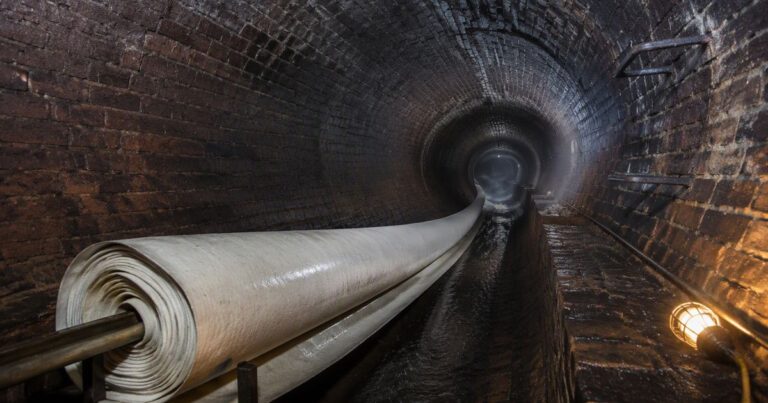
The history of CIPP (cured-in-place pipe) starts with one stubborn repair problem: in 1970–1971, British
agricultural engineer Eric Wood patented a way to insert a resin-impregnated tube into an existing pipeline, press it
against the wall and cure it in place, so the tube became a new pipe inside the old one.
The first CIPP installation is recorded in 1971, in an egg-shaped Victorian sewer in Hackney, London, and is reported to still be in service. This page separates the documented milestones from the disputed ones, follows the Insituform years and the move to North America, and explains how ASTM F1216 turned a patent into an industry standard.
Why the History of CIPP Begins With a Mushroom Grower’s Repair Problem
The commonly told origin is a maintenance problem on a mushroom farm, and accounts of what exactly Wood was repairing vary: some descriptions point to an overhead air duct at a mushroom farm; others describe a leaking line running beneath the mushroom beds.
What the accounts agree on is the constraint: renewing the line meant working without excavation. Wood was not a sewer engineer by training, which may be exactly why he reached for a flexible, fabric-based solution instead of a rigid pipe.
- The problem: a buried or overhead line that had to be renewed without excavation.
- The material available: flexible fabric that could carry resin and follow an irregular shape.
- The insight: if the lining material is cured while it sits against the pipe wall, the pipe wall becomes the mold.
- The name that followed: in situ, “in place,” which later became the company name.
In our bid reviews, a CIPP renewal usually wins or loses on one question: whether the host pipe can hold its own shape while the CIPP liner is inserted and cured.
Who Was Eric Wood, and Why Did an Agricultural Engineer Get There First?
Eric Wood (1935–1994) was a British agricultural engineer, and he is credited with inventing
the CIPP process. NASTT inducted him into its Hall of Fame in 2013, which is the industry’s own acknowledgment that
the method traces to him.
Wood trained as an agricultural engineer, a discipline that works with irrigation, drainage, hoses, pumps and
flexible materials – equipment that bends, folds and can be pushed through awkward spaces. A rigid-pipe mindset
looks for a replacement pipe. A fabric-and-resin mindset looks for a way to rebuild the pipe from the inside.
That framing is why the invention is usually described as a materials idea rather than a machinery idea: the concept came first, the equipment later.
The Idea: A Resin-Impregnated Tube Cured In Place
The method Wood protected is simple to state. A flexible tube, or felt carrier, is saturated with a thermosetting
resin. The saturated tube is then placed inside the damaged pipe, expanded against the wall and held there while the
resin cures and hardens.
He applied for the CIPP process patent in 1970, and the patent was granted in 1971. He coined the name Insituform
from the Latin in situ, meaning “in place,” because the liner is formed inside the host pipe rather than manufactured
elsewhere and inserted as a finished product.
The name choice was not decoration. “In place” is the load-bearing part of the whole method: the host pipe acts as the
mold, the liner takes the shape of the existing bore, and the finished product is a pipe within a pipe.
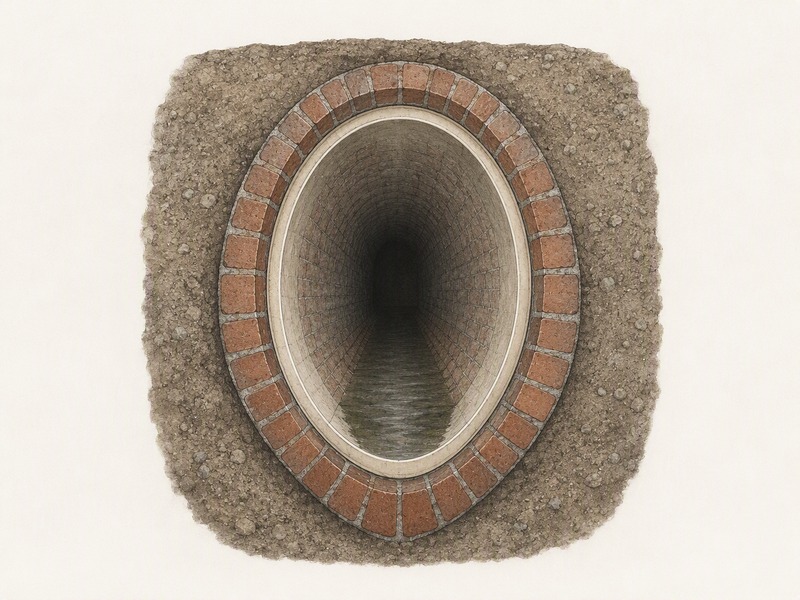
The egg-shaped profile is worth noting. A Victorian ovoid section is non-circular, so a CIPP liner has to conform around a perimeter whose radius varies, and ovality, not only diameter, drives whether a lining design is feasible for a given host.
Timeline: Documented Milestones in the History of CIPP
Cross-checking the accounts leaves a shorter, firmer list.
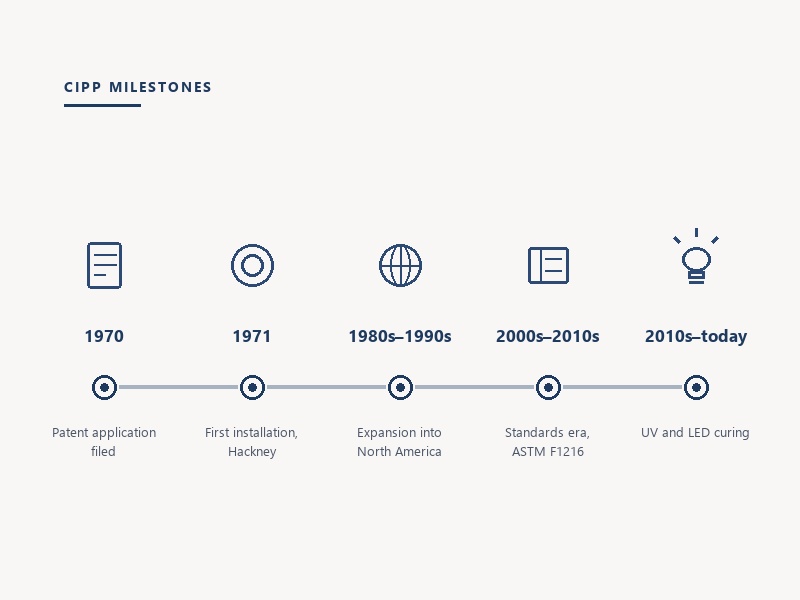
| Year | Milestone | Source basis |
|---|---|---|
| 1935 | Wood is born in Britain. | Documented (biographical record) |
| 1970 | Patent application filed for the resin-impregnated tube process. | Documented |
| 1971 | Patent granted; first installation in an egg-shaped Victorian sewer in the London Borough of Hackney. | Documented (NASTT account) |
| 1971 | The founding company dates its establishment to this year. | Documented (company history) |
| 1980s–1990s | Transfer and growth of the method in North America and Europe. | Documented (trade history) |
| 1994 | Wood dies. | Documented (biographical record) |
| 2011 | The industry marks the fortieth anniversary of CIPP. | Documented (trade press) |
| 2013 | NASTT inducts Wood into its Hall of Fame. | Documented |
| 2023 | NASSCO issues its CIPP Installation Performance Specification Guideline. | Documented |
| 2024 | The inversion and curing standard is revised as F1216-24a. | Documented |
Documented vs Disputed: Where the Accounts Diverge
Two parts of the story remain unsettled. The first is the exact date of the first installation. The second is what Wood was repairing when the idea formed.
On the date, one retrospective states that the first patent application was made in 1970 and that a first test
installation in an egg-shaped Victorian sewer was completed later that year, while several other accounts give 1971.
Retrospectives, company histories and oral recollections define “first”
differently: a field test is not the same event as a first commercial installation, and internal trial work is often
not kept in public documents.
On the origin, the mushroom-bed story itself varies. Some accounts describe an overhead air duct at a mushroom farm;
others describe a leaking line beneath the beds. Both are retold as the commonly told origin rather than as a single
verified record.
| Item | What the documented record says | What varies or is disputed | Why accounts differ |
|---|---|---|---|
| Core concept | A resin-impregnated tube is inserted into an existing pipe and cured in place. | Minor wording only. | Consistent across sources. |
| Invention | Wood (1935–1994), a British agricultural engineer, is credited with the invention. | None material. | The NASTT Hall of Fame entry (2013) supports the attribution. |
| Origin problem | A duct or line on a mushroom farm that was difficult to replace. | Overhead air duct versus a leaking line beneath the beds. | Oral history retold at second hand. |
| Patent dates | Applied 1970, granted 1971. | One account records the US patent grant on February 22, 1977. | National patent filings were made at different times. |
| First installation | 1971, egg-shaped Victorian sewer, London Borough of Hackney, still in service. | One retrospective places a first test installation in late 1970. | Test installation versus commercial installation. |
| Fortieth anniversary | The industry marked it in 2011. | None material. | Consistent with a 1971 commercial start. |
A still-in-service claim of that kind rests on the operating utility’s maintenance records, so read it as a reported service record rather than a verified condition assessment.
How Insituform Carried the Method From London to North America
Insituform, the company Wood founded around the process, dates its establishment to 1971, the same year as the patent grant and
the Hackney lining. It took the method out of London and built a licensing and contracting business that later grew
across Europe and North America.
The transfer to North America is the pivot that turned a British patent into a global practice. When did CIPP reach North America? Through the 1980s and 1990s, CIPP moved from a novel technique into mainstream municipal work: sewer owners adopted it for gravity
sewers, contractors built dedicated equipment and crews, and the trade press began to treat it as a category rather
than a curiosity.
Our crews still inspect liners installed in that period, and the published trade record from the 1980s and 1990s shows the argument had already moved from whether the method worked to cure reliability and quality control.
From Inversion and Hot-Water Cure to Pull-In and UV/LED Cure
The early method installed the saturated tube by inversion and cured it with hot water. Inversion uses fluid pressure
to turn the tube inside out and press it against the pipe wall as it advances. Hot water then circulates through the
liner to cure the resin, typically over about one to four hours.
Steam later became a common cure route for the same inversion method, and ASTM F1743 was written for the pull-in and
inflate route that became the counterpart to the inversion standard. Pull-in installations position the tube by
winching rather than by inverting it, which suits certain lengths and access arrangements.
UV and LED curing changed the installation economics from the 2000s onward. UV light uses a different initiator
package from steam and water curing, so the tube and resin are supplied as a matched UV system, and the tube arrives
with an inner and outer foil. An equipment maker describes a UV light train curing at about one minute per meter of
liner, which is far faster than the hours a steam or hot-water cure takes.
| Era | Installation method | Cure method | Typical duration | Why it changed |
|---|---|---|---|---|
| 1970s–1980s | Inversion | Hot water | About one to four hours | Earliest practical cure with the equipment then available. |
| 1980s–1990s | Inversion | Steam | About one to four hours | Faster and more even heating. |
| 1990s–2000s | Pull-in and inflate | Hot water or steam | About one to four hours | Fits lengths and access where inversion is awkward. |
| 2000s–2010s | Pull-in | UV light | About one minute per meter | Cure speed and a matched resin and tube system. |
| 2010s–2020s | Pull-in | LED | Shorter than thermal cure | Odor control, energy use and tighter cure control. |
| All eras | Any | Ambient | Longest of the methods | Small or hard-to-heat locations. |
Applicability limit: a CIPP liner reproduces the existing line and level. A host sewer that has sagged or lost gradient keeps that profile after lining. The liner also reduces the internal diameter by roughly the wall thickness plus any annular gap the design assumes, so flow capacity has to be re-checked for the lined bore.
The Standards Era: How ASTM F1216 Turned a Patent Into an Industry
Around the 1990s, the history of CIPP stops being only a commercial story and becomes a standards story. Once owners
and engineers had to specify, design and accept liners, the method needed written rules that did not depend on any one
contractor or license holder. CIPP is one of several trenchless technology options – pipeline work carried out with minimal surface excavation. It became the one most owners specify by name.
Two design routes are now accepted in the industry. The first is ASTM F1216, “Standard Practice for Rehabilitation of
Existing Pipelines and Conduits by the Inversion and Curing of a Resin-Impregnated Tube,” whose current revision is
F1216-24a. Its stated scope is the reconstruction of pipelines and conduits from 2 in. to 108 in. in diameter, about
50 mm to 2,750 mm. It covers design for partially deteriorated and fully deteriorated host pipes, with design equations
in Appendix X1 and chemical-resistance requirements in Appendix X2.
The second route is ASCE Manual of Practice (MOP) 145. NASTT’s technical knowledge base presents both the inversion
practice and MOP 145 as accepted alternatives rather than as one being correct, and it offers a decision framework for
choosing between them. Municipal specifications in the United States commonly cite several documents together,
including the pull-in and inflate counterpart and the felt-tube material standard.
- Design: a lining design that suits the host condition, stamped by a professional engineer where the owner requires it.
- Installation: NASSCO’s CIPP Installation Performance Specification Guideline (2023) expects the superintendent, foreman and lead crew for CCTV inspection, resin wet-out, installation, curing and robotic service reconnections to have documented experience, and it cites three years of cumulative experience installing CIPP in pipe of similar size, length and configuration.
- Materials: a pre-liner tube is required unless a pulled-in tube carries an exterior coating, or a UV or LED wet-out tube already contains an inner and outer foil.
- Records: wet-out and cure logs are submitted per liner, recording resin type and cure details.
In our lining crews’ logs, the standards appear as checklists rather than as theory: resin batch, tube identification,
cure temperature and time, and sample records are all captured before a liner is signed off. On the CCTV surveys we
review, the difference between an early lining and a modern one is usually visible in the tube seam and the liner
surface.
What the Next Decades Point To
The next chapters in the history of CIPP are being written around cure control, emissions and data. Four trends are already visible in current practice.
- UV and LED curing. UV light cures fastest and uses a different initiator package from steam and water, so the tube and resin are supplied as a matched system. LED extends that logic with lower running energy and tighter control.
- Styrene control. Odor and styrene emission during installation are real, managed issues. NASSCO’s styrene guidance recommends a 15-foot perimeter around emission points and exhaust stacks a minimum of 6 feet above ground, and hot-water curing releases styrene into the cure water, so cure water handling is part of the site plan. Published commentary notes that some practitioners use styrene barrier products or move to UV curing, which reduces odor emission. Preliminary 2024 measurements reported that non-styrene polyester resins did not exceed OSHA or EPA exposure limits in the cases measured; that is preliminary research, not a general clearance.
- Sensorized cure monitoring. Cure is increasingly monitored continuously along the liner rather than sampled at points, so the cure record becomes a data stream rather than a set of spot readings.
- Digital as-builts. Pre-lining and post-lining CCTV surveys, position-referenced manhole data and cure logs are being combined into a single digital record of the renewed asset.
Published trenchless technology market estimates differ because each source defines the sector differently. Research and Markets puts the market at about USD 5.02 billion in 2025 growing to about USD 5.38 billion in 2026 at a compound annual growth rate of about 7.1%; Stratview Research reached about USD 6.9 billion in 2023 at a compound annual growth rate of about 4.7%; and IBISWorld puts US sewer and pipeline rehabilitation industry revenue at about USD 18.4 billion in 2025.
Frequently Asked Questions About the History of CIPP
Who invented CIPP and when?
Eric Wood (1935–1994), a British agricultural engineer, is credited with the invention. He
applied for the CIPP process patent in 1970 and it was granted in 1971.
Where was the first CIPP installation carried out?
In 1971, in an egg-shaped Victorian sewer in the London Borough of Hackney. The location is reported to still be in service, according to the NASTT Hall of Fame entry, which makes it the earliest service record for a method now designed to a 50-year horizon.
Why do the dates in the history of CIPP differ between accounts?
Because different sources define “first” differently. One retrospective places a first test
installation in late 1970, while other accounts give 1971; a test installation and a first commercial installation are
not the same event, and internal trial work is rarely kept in public records.
What does the name Insituform mean?
It is built from the Latin in situ, meaning “in place.” Wood coined it because the liner is cured
while it sits inside the original pipe, using the host pipe as the mold.
How did CIPP become a standard method?
It became standard once design and installation practice were written down. ASTM F1216 covers
design and inversion, ASTM F1743 covers the pull-in and inflate route, ASTM D5813 covers the felt tube material, NASSCO
publishes installation specification guidelines and ASCE MOP 145 gives a second accepted design route.
What are the honest limitations of CIPP?
A CIPP liner suits a host pipe that still holds its basic shape and structural continuity. It holds the existing line and level rather than correcting gradient, and it narrows the finished bore by the liner wall plus whatever annular gap the design allows, so flow capacity should be re-checked after lining.
Key Takeaways
- The history of CIPP starts with Wood, a British agricultural engineer who applied for the process patent in 1970 and received it in 1971.
- The method was first installed in 1971 in an egg-shaped Victorian sewer in Hackney, London, reported to still be in service; that ovoid profile is why ovality, not only diameter, drives a CIPP lining design.
- Accounts disagree on the earliest trial date and on exactly what Wood was repairing; both are stated here as disputed rather than settled.
- The company he founded, named from the Latin in situ, carried the idea from London into North America and mainstream municipal practice through the 1980s and 1990s.
- Installation shifted from inversion with hot-water or steam cure toward pull-in with UV or LED cure, which is far faster and better controlled.
- Standards such as ASTM F1743, ASTM D5813, NASSCO guidelines and ASCE MOP 145 turned a patent into a repeatable industry method.
How JSW Supports Trenchless CIPP Rehabilitation
JSW is a pipeline engineering and construction company that executes trenchless technology scopes, including CIPP
rehabilitation, with its own crews and equipment. We specify the same method under ASTM F1216 and the NASSCO installation guideline. The history of CIPP shows why we keep the survey, design and cure
records together. Our scope covers pipe restoration solutions, trenchless technologies, inserted hose lining, pipeline repair services e pipeline inspection services.
We work on oil and gas, water and infrastructure pipelines, with in-house capability across inspection, repair,
rehabilitation and installation. Because the same team handles survey, design review, lining and reinstatement, the
process data stays connected from the first CCTV survey to the post-lining acceptance record.
- Integrated delivery: survey, design review, lining and service reinstatement handled by one team.
- Auditable process data: CCTV before and after, wet-out and cure logs, samples and test records.
- Risk-explicit pricing: bypass, access and reinstatement costs stated rather than hidden.
- Standards-based design: thickness and material recommendations reviewed by professional engineers before bid.
Planning a CIPP renewal and unsure where the method fits? Send your pipe size, material and the
latest CCTV survey for a free technical review. Our engineers respond with a scoped recommendation and budget range.





































 English
  Arabic
  Russian
  Spanish
  French
  Vietnamese
  Polish
  Thai
Thai  Indonesian
  Turkish
  Portuguese