
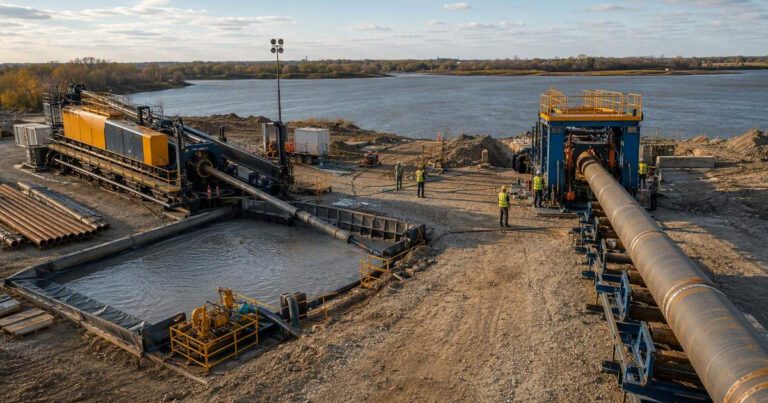
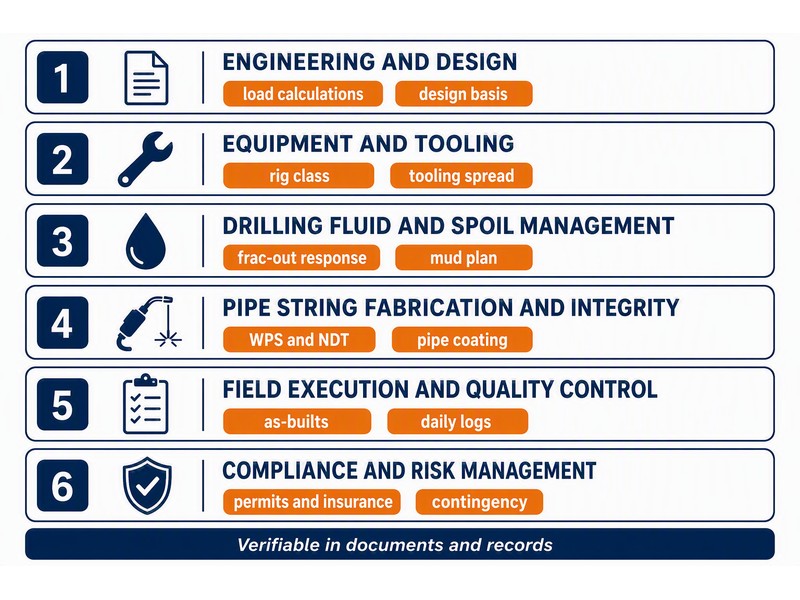
Top HDD and Direct Pipe contractors offer pipeline owners six integrated capability layers: engineering and design, equipment and tooling, drilling fluid and spoil management, pipe string fabrication and integrity, field execution and quality control, and compliance, permitting and risk management; a capable contractor proves every layer with documents, logs and references, not with marketing claims.
This guide defines what those six layers contain, explains how capability requirements differ between the two methods, quantifies what a capability gap costs pipeline owners, and provides a practical verification sequence you can run before award. It draws on the engineering reviews and construction support JSW provides for pipeline owners, EPC firms and crossing contractors across utility, oil and gas and infrastructure sectors.
Key takeaways:
- Judge contractors on six capability layers, not on equipment photos: engineering, equipment, fluids, pipe fabrication, execution and compliance.
- The two methods demand different equipment and skills: a steerable rig and pullback spread versus an MTBM, a Pipe Thruster and a closed-loop slurry plant.
- Verify with documents and records: design packages, spec sheets, mud plans, weld procedures, NDT reports, daily logs and as-builts.
- Capability gaps are the most common root cause of failed crossings, and they are visible before award if you ask the right questions.
Why Contractor Capability Determines Crossing Outcomes
Crossing failures are rarely caused by the method itself. In our reviews of disputed trenchless crossings, the repeated pattern is a capability gap: the selected contractor could not deliver the engineering depth, equipment class, fluid control or pipe fabrication quality the crossing required. Method selection only works when contractor capability matches the design.
The market context raises the stakes. Industry research published in 2026 values the global horizontal directional drilling market at USD 10.33 billion in 2026 and projects it to reach USD 25.11 billion by 2034, a compound annual growth rate of about 11.75 percent. Growth attracts new entrants, and the gap between genuine specialists and general excavators operating a rented rig is widening. The cost of choosing poorly is documented: the Common Ground Alliance estimated in its 2026 economic impact report that damage to buried utilities costs the United States economy about USD 83.2 billion per year, more than USD 227 million every day, and its DIRT data shows the top ten root causes account for 86 percent of damage reports with an identified cause. Damage prevention, fluid containment and documentation all sit inside the contractor capability layers described below.
Six Capability Layers Top HDD and Direct Pipe Contractors Offer
We use the six-layer framework below whenever we evaluate a contractor for an owner or review a competitive bid. Each layer is a distinct deliverable, and each one can be verified in writing. The table gives a one-glance map; the sections that follow explain what real capability looks like in each layer.
| Capability Layer | What It Covers | Documents to Request |
|---|---|---|
| 1. Engineering and design | Geotechnical interpretation, crossing profile, load calculations, code compliance | Design package, crossing profile, calculation notes |
| 2. Equipment and tooling | Rig or MTBM class, thrust and pullback capacity, guidance system, mud plant | Equipment spec sheets, mobilization plan |
| 3. Drilling fluid and spoil management | Fluid plan, containment, recycling, frac-out response, spoil disposal | Written drilling fluid plan, frac-out response procedure |
| 4. Pipe string fabrication and integrity | Welding, NDT, coating, cold bending, buoyancy control | WPS/PQR, welder qualifications, NDT reports |
| 5. Field execution and quality control | Steering control, torque and pullback records, daily logs, as-builts, HSE | Drilling logs, as-builts from comparable crossings, EMR |
| 6. Compliance, permitting and risk management | Permits, environmental approvals, insurance, contingency, change-order discipline | Permit list, certificates of insurance, itemized contingency |
1. Engineering and Design Capability
Engineering is the capability layer owners most often underestimate, because its failures surface weeks after award, buried in the schedule. The design decisions made before spud-in, entry and exit angles, bend radius, depth of cover, pullback or thrust loads, and code basis, determine whether the crossing is installable at all.
Verify that the proposed engineer has interpreted your geotechnical report rather than copied it. A credible package contains a crossing profile with planned depths and clearances, load calculations for the actual pipe wall thickness, a bend-radius check against the pipe’s allowable strain, and a stated code basis such as ASME B31.4 or B31.8 for liquid and gas pipelines. The NASTT and HDD Consortium Good Practices Guidelines describe the design content owners should expect; in our bid reviews, thin design packages correlate with mid-bore surprises.
2. Equipment and Tooling Capability
Equipment capability means the machine class that will actually mobilize matches the design demand, not the largest rig in the contractor’s brochure. For HDD, the Federal Highway Administration’s utility manual, which summarizes the HDD Consortium Good Practices Guidelines, classifies horizontal directional drilling rigs by product diameter, bore length and pullback: mini rigs deliver up to about 20,000 lb (89 kN) for small-diameter products over short bores, midi rigs cover 20,000 to 100,000 lb (89 to 445 kN) for 10 to 24 in (250 to 600 mm) pipe, and maxi spreads start at 100,000 lb (445 kN) and reach beyond 1,000,000 lb (454 t) for 24 to 48 in (600 to 1,200 mm) steel pipeline across crossings of 5,000 ft (1,500 m) or more.
For Direct Pipe, the core equipment is a microtunnel boring machine (MTBM) with a closed-loop slurry system and a hydraulic Pipe Thruster that pushes the welded pipe string forward in one pass. Published installation records show Pipe Thrusters of 500 to 750 tonnes on major crossings, and the guidance system is a gyrocompass mounted inside the machine rather than a walkover locator on the surface. Ask for the spec sheet of the exact machine proposed, its pullback or thrust rating against your design, and the guidance system matched to your bore length and congestion. Whether the bidder is an HDD contractor or a Direct Pipe contractor, the machine on the spec sheet is the machine you should expect at mobilization.
3. Drilling Fluid and Spoil Management Capability
Fluid management is where HDD and Direct Pipe capability diverge most sharply, and where environmental exposure concentrates. HDD circulates large volumes of drilling fluid through an open bore, so containment ponds, recycling equipment and a written frac-out response plan are core deliverables; on mid-size crossings, our bid reviews find that site preparation, drilling fluids and restoration together typically account for 30 to 45 percent of the price. Direct Pipe runs a closed loop at near-hydrostatic pressure, so volumes are lower, but the contractor must still manage slurry separation and spoil disposal.
Verify the mud plan states flow rates, additive program and recycling strategy for your bore, the frac-out response procedure names who stops the job and who notifies regulators, and disposal manifests match the actual spoil volumes. Fluid loss or an inadvertent return near a waterway becomes a major environmental and cost event, and capability in this layer is what prevents it.
4. Pipe String Fabrication and Integrity Capability
For large-diameter steel crossings, pipe fabrication is a parallel workstream that decides pullback or thrust success as much as the machine does. The string must be welded to code, inspected, coated, cold bent to the profile and handled without damage, whether the crossing is an HDD pullback or a continuous thrust installation.
Ask for weld procedures (WPS) and procedure qualification records (PQR) qualified to API 1104 or the applicable code, current welder qualifications, and NDT reports from the contractor’s last comparable steel crossing. Confirm the contractor can execute automatic welding at the required production rate, repair coating at field joints, and perform cold bending where the profile demands it. In our audits, weld quality and NDT hold points are the most common fabrication gaps on large-diameter steel crossings.
5. Field Execution, Survey and Quality Control Capability
Execution capability is visible in the records a contractor keeps, because disciplined crews document what they control. A credible HDD spread produces steering reports for every drill stem, torque and pullback charts for every reaming pass and the pullback, and daily fluid and progress logs. A Direct Pipe spread produces machine data logs, thrust records and slurry reports. Both should close out with as-built drawings that match what was actually installed.
Review logs from two or three completed crossings rather than marketing case studies, and check the safety record: an experience modification rate (EMR) at or below 1.0 and documented near-miss reporting are reliable predictors of field discipline. The Federal Highway Administration cites a typical HDD installation rate of about 100 m (328 ft) per day with a skilled crew, which gives you a schedule-realism check against the contractor’s program.
6. Compliance, Permitting and Risk Management Capability
A capable contractor treats permits and risk terms as engineering deliverables, not administrative overhead. Crossing work typically requires right-of-way agreements, waterway or levee approvals, environmental notifications and utility crossing permits, and the contractor should own that list rather than discovering it after award.
Verify the contractor holds current licenses and insurance that names you as additional insured, including pollution liability where fluid or spoil is involved, and that the bid itemizes contingency and change-order triggers. Damage to buried utilities is largely preventable when crossing plans and locate practices are followed, and the contractor’s damage-prevention process, 811 locates, potholing and positive clearance, is part of this layer. We have seen repeated disputes trace back to a permit or a change-order term that was never written down.
How Capability Requirements Differ Between HDD and Direct Pipe
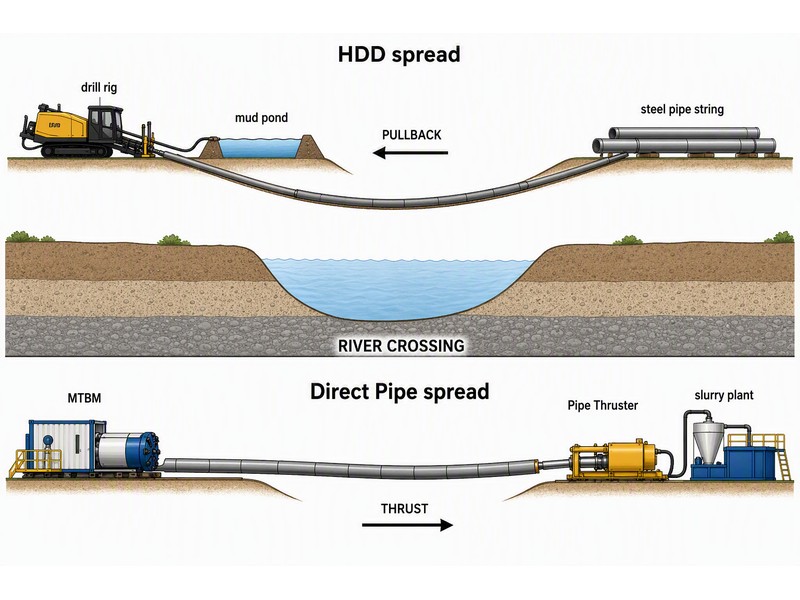
Direct Pipe is a single-pass trenchless method that combines microtunneling with a steerable, HDD-style curved profile: a modified microtunnel boring machine (MTBM) excavates while a Pipe Thruster pushes welded steel pipe forward, so the finished line is installed in one continuous operation. The method was first installed commercially under the Rhine River in 2007 and has since completed roughly 200 crossings worldwide, more than 50 of them in North America, including the longest single pipe string ever installed: 1,496.48 m at Whangaparaoa, New Zealand, driven by a 750-tonne Pipe Thruster in 2018.
Because the two methods install pipe differently, the capability profiles of the contractors who run them differ in equipment, fluid systems, pipe handling and failure modes, while engineering, fabrication and quality control overlap. The table below maps those differences so you can check a bid against the method it proposes.
| Capability Area | HDD Contractor Must Provide | Direct Pipe Contractor Must Provide |
|---|---|---|
| Installation equipment | Steerable rig in the correct class (mini to maxi, 20,000 lb up to over 1,000,000 lb pullback) with mud pump and reamers | MTBM with cutterhead for the ground, Pipe Thruster (records to 750 t), slurry separation plant |
| Guidance and survey | Walkover, wireline or gyro steering matched to bore length | Gyrocompass inside the MTBM for tight control on curved alignments |
| Bore support principle | Fluid-held open bore; stability managed by mud program and reaming passes | Continuously supported face in a closed loop; no open bore at any stage |
| Drilling fluid system | High-volume open circulation, containment ponds, recycling, frac-out response | Closed-loop slurry at near-hydrostatic pressure; lower volumes, slurry disposal |
| Pipe handling | Prefabricated string pulled in one or staged pulls; buoyancy control and pull head design | Continuous string feeding and thrust; fabrication line synchronized with advance rate |
| Typical envelope | Small diameters to 48 in and larger; deep cover with no standard limit; long proven bores | Welded steel pipe roughly 28 to 60 in; standard depth near 100 ft (30 m, 3 bar); single-string record 1,496.48 m |
| Ground handling | Broad soil and soft rock range; coarse ground raises wear and steering risk | Can ingest boulders up to about one-third of the face diameter; proven in sticky clays and coarse ground |
| Records and QA | Pilot logs, torque and pullback charts, fluid logs, as-builts | Machine data logs, thrust records, slurry reports, as-builts |
| Dominant execution risks to manage | Frac-out, stuck pipe, steering loss in unstable or coarse ground | Thrust limits, face instability, slurry loss in permeable ground |
For pipeline owners, the practical consequence is that a bid must name the method and the specialist who will execute it. Many owners evaluate HDD contractors for a crossing that later proves better suited to the closed-loop method; when that happens, capability in the other method must be sourced, verified and priced before award, not discovered mid-bore.
What a Capability Gap Costs Pipeline Owners
A capability gap converts a sound method choice into an expensive failure, and the cost shows up in five places: remediation, rescue, schedule, claims and regulatory exposure. A horizontal directional drilling program that cannot control fluid pressure in weak ground risks a frac-out near a waterway, with containment and restoration costs that can exceed the crossing price. A spread that under-rates pullback or thrust risks stuck pipe, and recovery operations consume the contingency that should have funded the work.
The wider statistics put these project-level costs in context: the Common Ground Alliance’s 2026 estimate of USD 83.2 billion in annual buried-utility damage is damage that is largely avoidable when crossing plans, locates and containment practices are executed properly. In bid reviews we have supported, the pattern repeats: the lowest-priced proposal with the thinnest capability documentation produced the most change orders, while proposals that documented all six layers rarely overran. Capability verification is not procurement bureaucracy; it is the cheapest risk control available to a pipeline owner.
How to Verify Contractor Capabilities Before Award
Capability claims are easy to make and hard to check, so run one structured verification pass before you compare bids. The five steps below mirror the process we run on behalf of owners, and each step produces a document you can keep.
- Audit the capability statement against the six layers. Ask every HDD contractor or Direct Pipe contractor to map their proposal to the layers in Table 1 and attach the evidence documents listed there. Bidders who cannot produce a written drilling fluid plan or weld procedures are telling you what their next project will look like.
- Inspect logs and as-builts from comparable crossings. Select two or three completed projects of the same method, similar pipe diameter and similar geology, and review the actual drilling logs, thrust or pullback charts and as-builts, not the marketing summary.
- Verify the proposed equipment and crew. Confirm the exact rig, MTBM, Pipe Thruster and guidance system that will mobilize, their ratings against your design, and the names and experience of the drill operator, mud engineer and weld leads.
- Hold a technical meeting with the people who will run the job. Ask how they would execute your crossing: entry and exit angles, reaming program or thrust plan, fluid containment, frac-out or slurry-loss response, and restoration. Vague answers at this meeting predict vague execution on site.
- Score the layers against your project’s risk profile and document the reasoning. Weight engineering and fluid control heavily for shallow or waterway crossings; weight fabrication and NDT heavily for large-diameter steel. A written scoring record protects the decision and gives you a baseline for change-order disputes.
Independent engineering review of the capability package is optional but worthwhile on large or environmentally sensitive crossings; owners routinely ask us to perform this review in parallel with their procurement process.
Contractor Capability Red Flags
The warning signs below have appeared repeatedly in our audits. Any one of them justifies a deeper look; two or more justify removing the bidder from the list.
- A capability statement with no named engineer, project manager or crew leads.
- Refusal to share drilling logs, as-builts or NDT reports from completed crossings.
- A proposed rig, MTBM or Pipe Thruster rated below the design pullback or thrust demand.
- No written drilling fluid plan or frac-out response procedure.
- Welder qualifications or WPS that cannot be produced on request.
- An EMR above 1.0 or no safety record at all.
- Bids that omit fluid management, restoration or contingency line items.
- Years in business claimed as experience in your geology, diameter and length.
HDD and Direct Pipe Contractor Capabilities FAQ
What is the difference between HDD and Direct Pipe capabilities?
HDD capability centers on a steerable drill rig, open-bore fluid management and pullback of a prefabricated pipe string. Direct Pipe capability centers on a microtunnel boring machine, a Pipe Thruster and a closed-loop slurry system that installs welded steel pipe in a single pass. Engineering, pipe fabrication and quality control overlap; equipment, fluid systems and failure modes do not.
Can the same contractor deliver both HDD and Direct Pipe?
A few large specialty contractors own both spreads, but most capable firms deliver one method in-house and partner or subcontract the other. Subcontracting is acceptable when the prime contractor holds single-point accountability, names the specialist in the bid, and verifies that specialist’s logs, equipment and references in writing.
What documents prove a contractor’s capabilities?
Ask for a design package and crossing profile, equipment spec sheets with pullback or thrust ratings, a written drilling fluid plan, weld procedures and welder qualifications, NDT reports, daily drilling logs with as-builts from comparable crossings, permits, certificates of insurance, and references from owners or engineers. Documents survive; verbal assurances do not.
Is equipment ownership a reliable capability signal?
Ownership is weaker evidence than availability, condition and operator experience. A contractor who owns a maxi rig but has not run it in your geology is riskier than a contractor who rents a well-maintained machine and runs it with a crew that completed three comparable crossings last year. Verify the machine that will actually mobilize and the people who will operate it.
Which capability layer matters most for my crossing?
It depends on the dominant risk. Coarse, shallow or waterway ground makes drilling fluid and frac-out capability decisive. Large-diameter steel pipe makes fabrication, welding and NDT capability decisive. Congested alignments make guidance and survey capability decisive. Weight each layer against your geotechnical report and crossing profile before you compare bids.
How do owners verify capabilities without over-engineering the process?
Run one structured pass: audit the capability statement against the six layers, request the evidence documents, inspect logs and as-builts from two comparable crossings, verify the proposed equipment, and hold one technical meeting with the named project manager and crew leads. A disciplined owner can complete this in one to two weeks without a formal audit.
How JSW Supports Pipeline Owners and Crossing Contractors
JSW is a pipeline engineering and construction partner that supports owners and contractors across the full lifecycle of HDD and Direct Pipe crossings. We provide pipeline construction services, trenchless pipeline repair technology and pipeline maintenance services, alongside the specialized capabilities crossings depend on: horizontal directional drilling support, microtunneling support, pipeline automatic welding technology, pipeline cold bending, and pipeline hot tapping and plugging services. Our fabrication and tooling layer includes pipeline hot tapping equipment, pipeline plugging pigs and pipeline cutting machines used to prepare, join and isolate pipe strings on entry spreads.
What distinguishes our support is that we evaluate contractor capability the same way we would want our own capability evaluated, layer by layer, on documents:
- Method-neutral engineering review – we assess HDD and Direct Pipe proposals against your ground truth and risk profile, without a vested interest in one method.
- Full-chain integration – bore planning, pipe string fabrication and automatic welding, cold bending, pullback or thrust support, and restoration in one accountable delivery.
- Auditable records – design packages, weld and NDT documentation, daily logs and as-builts that stand up to owner and regulator review.
- Explicit risk pricing – itemized fluid management, contingency and restoration, no hidden change orders.
- International field experience – utility, oil and gas and infrastructure crossings across multiple continents, from small utility bores to major river crossings.
Evaluating contractors for an HDD or Direct Pipe crossing?
Send your pipe diameter, crossing length, geotechnical report and proposed method to the JSW engineering team, and we will review the capability package of your shortlisted contractors against the six-layer framework, typically within five working days. Reach us via our contact page or sales hotline.





































 English
  Arabic
  Russian
  Spanish
  French
  Vietnamese
  Polish
  Thai
Thai  Indonesian
  Turkish
  Portuguese