jasonsong889@gmail.com

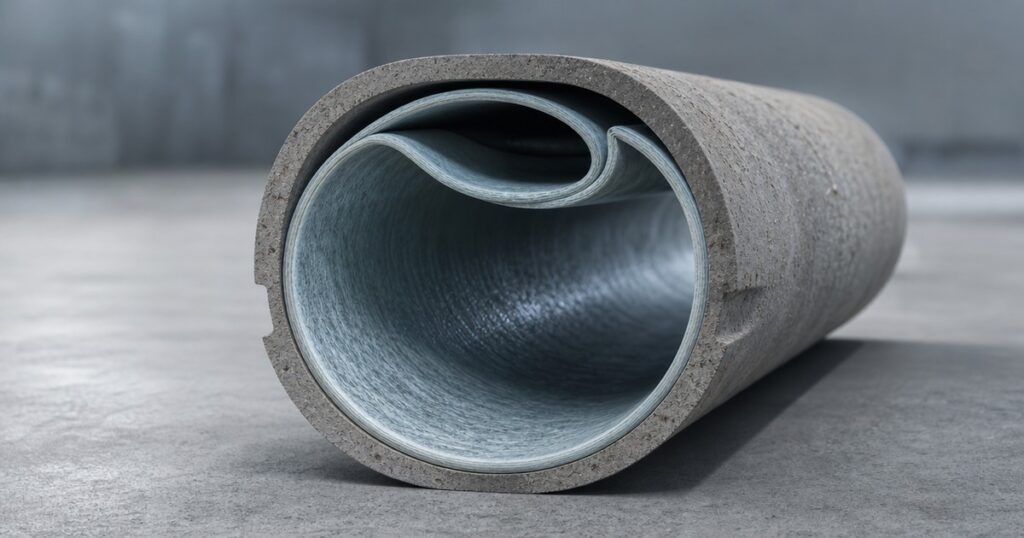
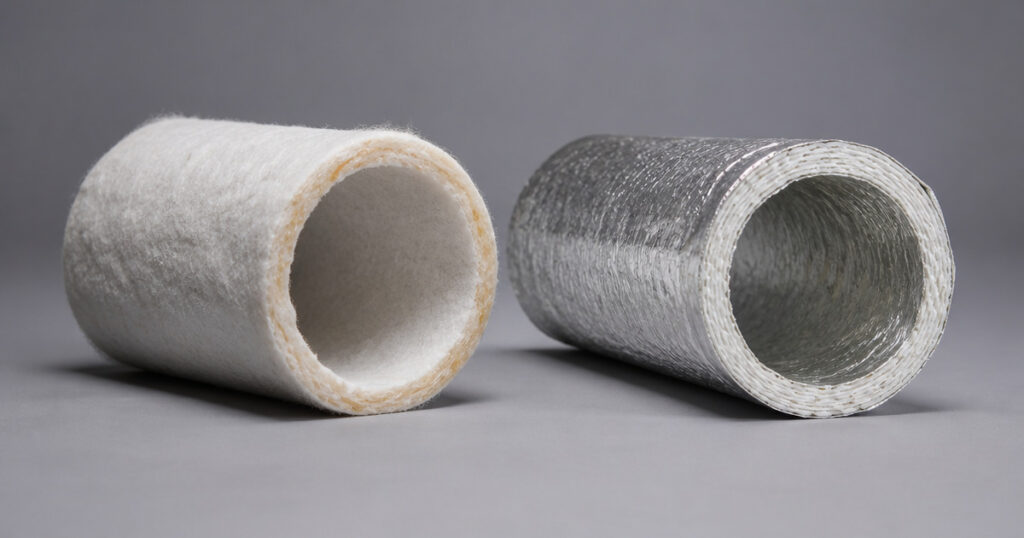
Needle-punched polyester felt CIPP tube beside a glass-fiber reinforced CIPP tube with inner and outer foil

Felt vs. Fiberglass CIPP Liners: Which Tube for Which Job

Choosing between a felt vs fiberglass CIPP liner is really a conversation about the carrier, not the finished pipe. A cured-in-place pipe (CIPP) is built from two parts: the tube that arrives at site, and the thermoset resin that is forced into it during wet-out. The tube holds the resin while it cures, and the

Felt vs. Fiberglass CIPP Liners: Which Tube for Which Job Read More »
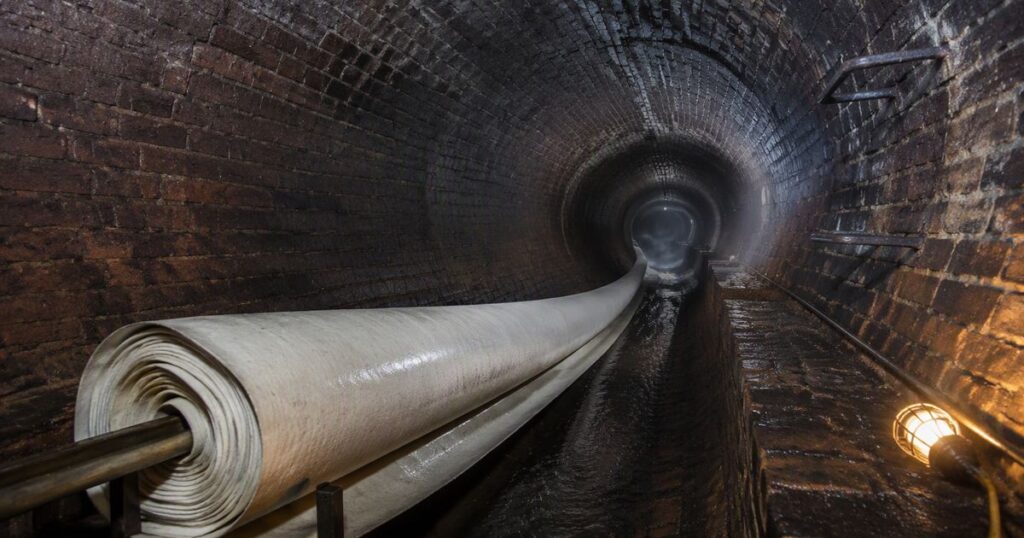
Historical CIPP cover image showing a resin-impregnated liner being installed in an old brick sewer

The History of CIPP: Eric Wood’s 1971 London Invention That Became an Industry Standard

The history of CIPP (cured-in-place pipe) starts with one stubborn repair problem: in 1970–1971, British agricultural engineer Eric Wood patented a way to insert a resin-impregnated tube into an existing pipeline, press it against the wall and cure it in place, so the tube became a new pipe inside the old one. The first CIPP

The History of CIPP: Eric Wood’s 1971 London Invention That Became an Industry Standard Read More »

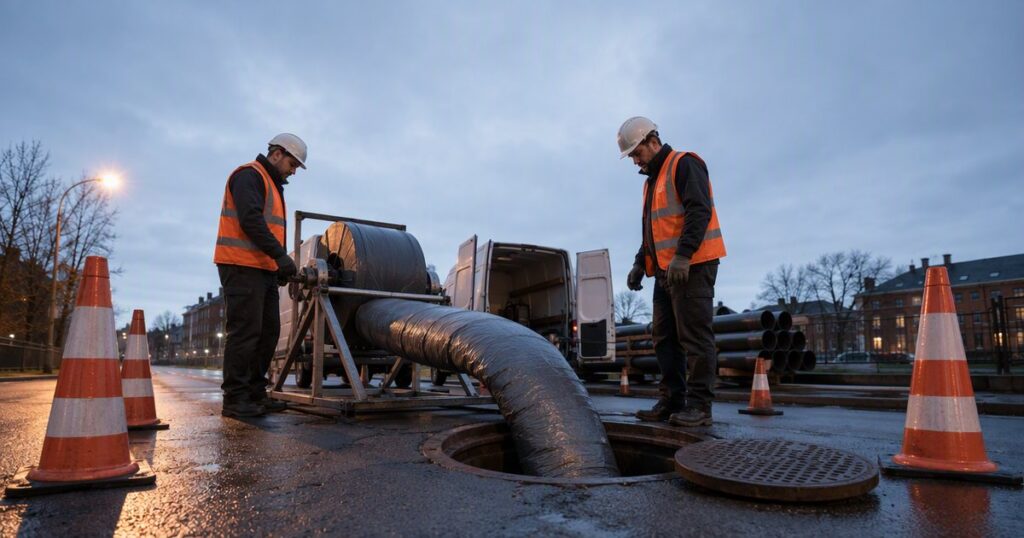
CIPP lining crew staging a resin-impregnated liner above a manhole before installation

How Does CIPP Lining Work? Step by Step From CCTV Inspection to Service Reinstatement

How does CIPP lining work? It works by inserting a resin-impregnated tube into a cleaned host pipe and curing it in place, so the tube and resin become a new structural pipe inside the old one. CIPP lining runs as a numbered 14-step sequence: CCTV inspection, cleaning, flow control and resin wet-out, then inversion, curing,

How Does CIPP Lining Work? Step by Step From CCTV Inspection to Service Reinstatement Read More »

Cured-in-place pipe liner being installed inside an existing sewer pipe

What Does CIPP Stand For in Pipe Rehabilitation? (And What It Doesn’t)

In pipe rehabilitation, CIPP stands for cured-in-place pipe: a resin-impregnated liner is installed inside an existing pipe and cured there, so the liner and the resin form a new structural pipe within the old one. In pipeline work the letters name one method, not a material or a contractor. Most readers meet what does CIPP

What Does CIPP Stand For in Pipe Rehabilitation? (And What It Doesn’t) Read More »

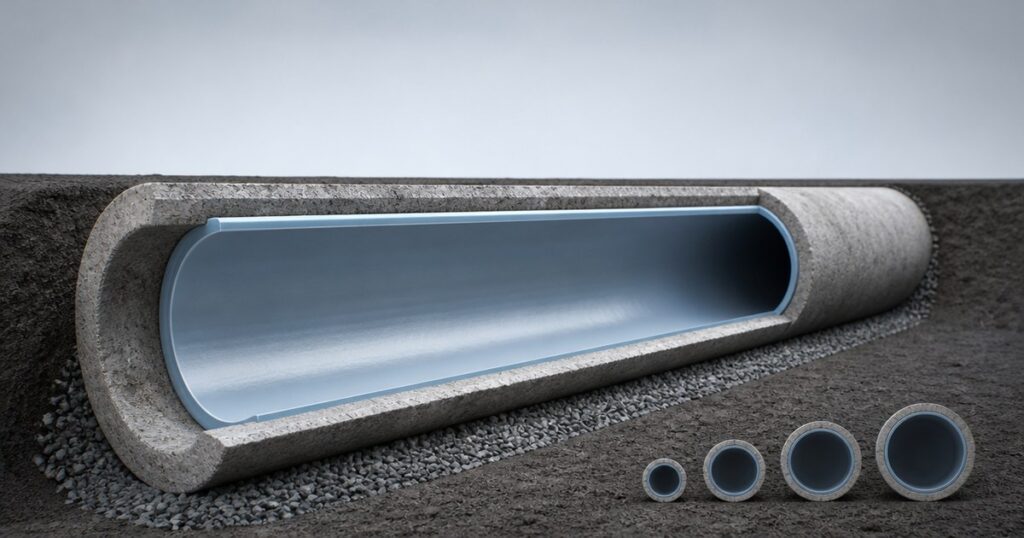
Cured-in-place pipe lining: a resin-impregnated tube cured inside an existing sewer pipe

What Is Cured-in-Place Pipe Lining? Definition, Diameter Range and How It Works

Cured in place pipe lining is a trenchless rehabilitation method. The acronym CIPP stands for cured-in-place pipe, and the same method is written CIPP lining, cure-in-place pipe, CIPP pipe lining or CIPP renewal across the industry. This guide answers what is CIPP lining and what is a CIPP, then sets out the CIPP diameter range,

What Is Cured-in-Place Pipe Lining? Definition, Diameter Range and How It Works Read More »

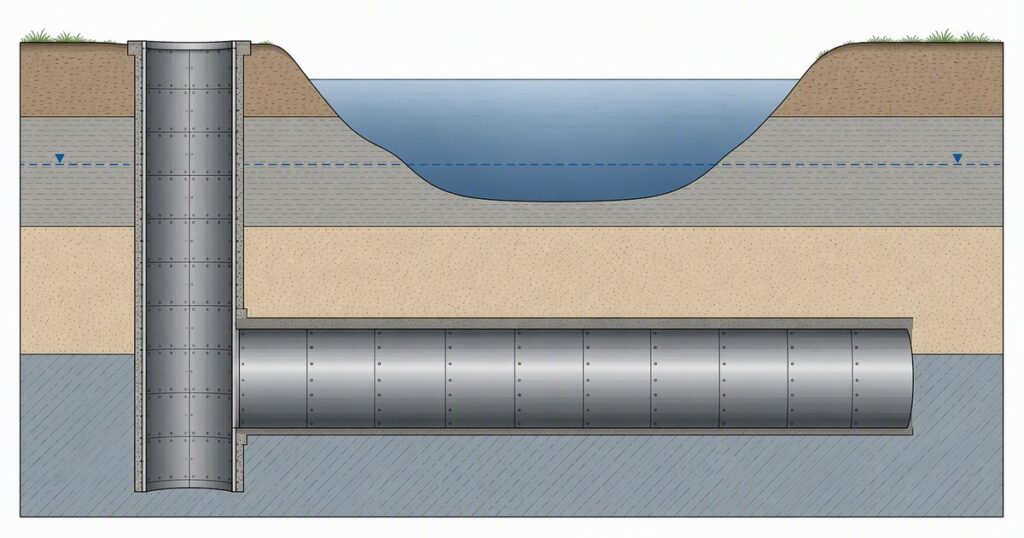
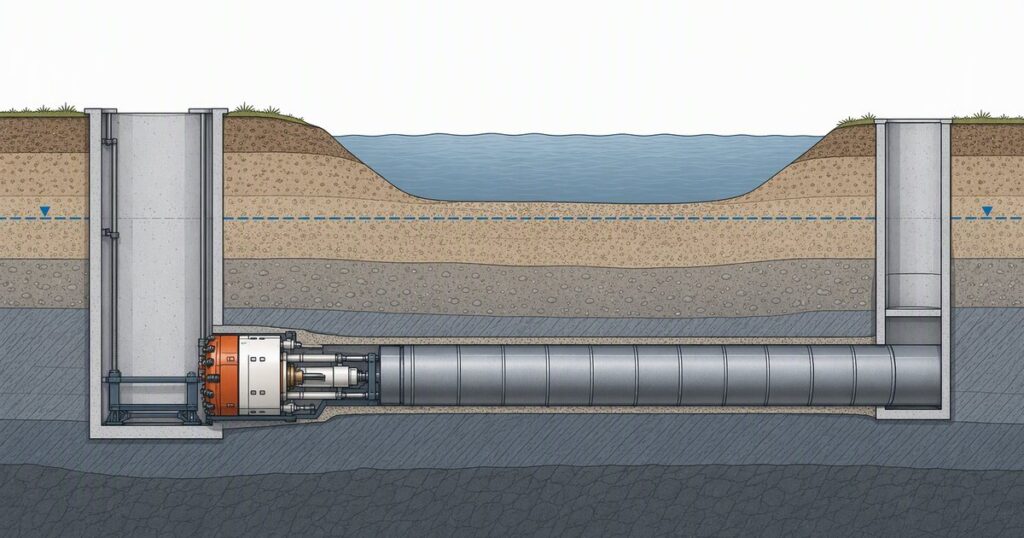
Cross-section of a 99.5-inch steel casing microtunnel launched from a deep liner plate shaft beneath a waterway, with the drive running below the water table through lean clay and sand

Case Study: 99.5-Inch Steel Casing Jacked Beneath a River – What It Took

This microtunneling case study covers four steel casing crossings on the West Harris County Regional Water Authority supply project in Houston: 99.5-inch outside diameter casing jacked behind a RASA machine, out of 36-foot liner plate shafts roughly 55 feet deep, beneath roadways and waterways below the water table. Bidding a large steel casing drive beneath

Case Study: 99.5-Inch Steel Casing Jacked Beneath a River – What It Took Read More »

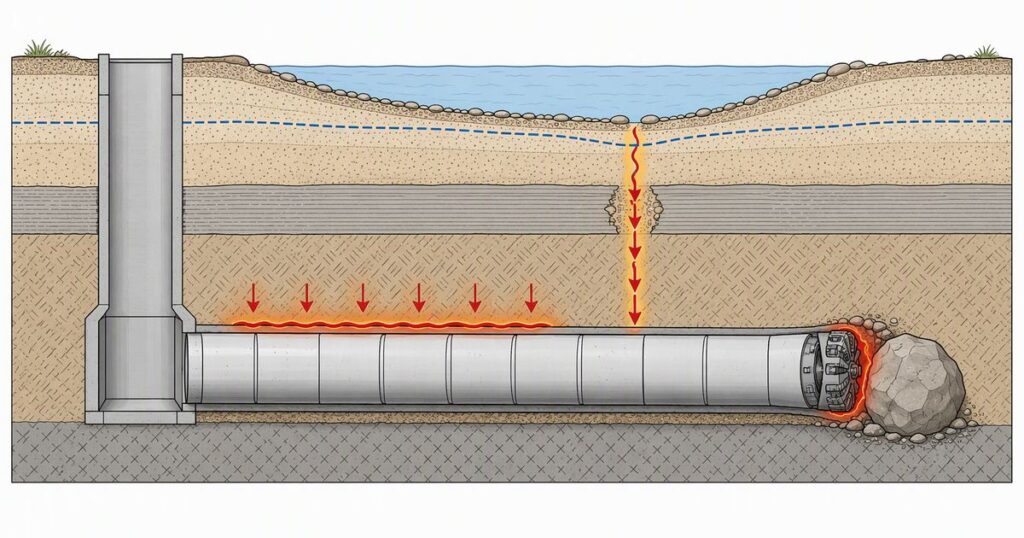
Cutaway diagram of a microtunneling drive showing the failure paths that stop it: a shallow cover zone above the pipe, seepage along a breached clay layer, and a cutterhead blocked by an obstruction

Lessons Learned From Difficult Microtunneling Projects: What Goes Wrong and Why

Most microtunneling problems are symptoms rather than causes. In published forensic cases the real faults were a water model that missed an artesian aquifer, a shaft that breached the clay layer sealing it, and a design grade with no tolerance for error. Microtunneling problems are rarely caused by the machine; the published record points at

Lessons Learned From Difficult Microtunneling Projects: What Goes Wrong and Why Read More »

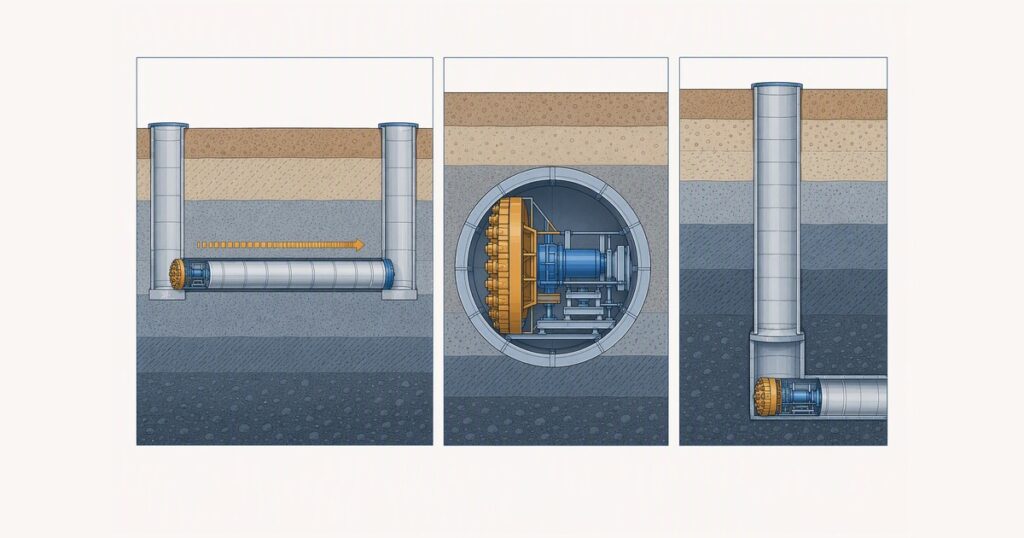
Cutaway diagram comparing three microtunneling record categories: a long single drive between two distant shafts, a very large diameter jacked pipe, and a deep drive reached from a deep shaft

Microtunneling Records: The Longest, Largest and Deepest Drives

Published microtunneling records are claims, not certificates: about 7,369 ft (2,246 m) for the longest drive worldwide, 5,600 ft (1,707 m) in North America, and 3.4 m (11.2 ft) inside diameter for the largest microtunnel. No recognized depth record exists. If you are weighing a microtunneling records figure against your own drive, the definition matters

Microtunneling Records: The Longest, Largest and Deepest Drives Read More »

Technical section view of a remotely operated slurry machine pushing jacking pipe through the ground beneath a river.

North American Microtunneling Job Log: The Projects That Define the Market

Microtunneling projects in North America are tracked through an annual trade-press job log of notable drives in the United States and Canada. Read together, the 1980s Florida first crossing, the 3,947 ft Painesville lake intake, Calgary’s 3.4 m storm pipe and Winnipeg’s 5,600 ft boulder drive map a market growing in diameter, length and difficulty.

North American Microtunneling Job Log: The Projects That Define the Market Read More »

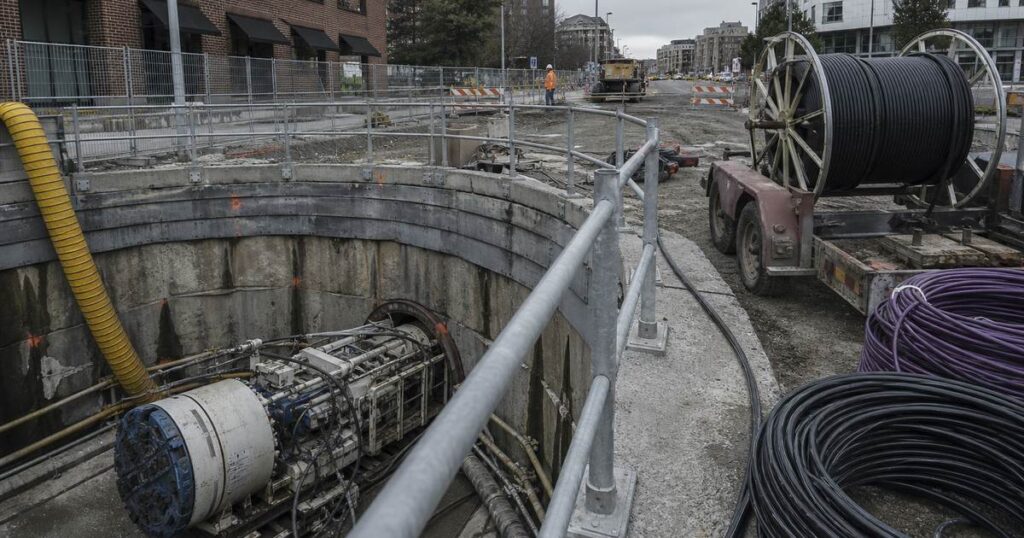
Guided microtunneling machine installing a small-diameter conduit casing for fiber optic and power cables below a city street

Microtunneling for Cable, Fiber and Electrical Conduit Crossings

Microtunneling for fiber optic cable, power ducts and other conduit crossings installs a small-diameter casing below a road, railway or watercourse under remote, laser-guided control, with almost no surface disruption. This article explains when that method is the right choice for cable, fiber and electrical duct work, and when it is not. It sets out

Microtunneling for Cable, Fiber and Electrical Conduit Crossings Read More »