

Short answer: in a trenchless method comparison, three facts decide the method — the accuracy the pipe needs, the drive length, and the ground at the face.
- การขุดอุโมงค์ด้วยวิธีไมโคร — holds grade at about ±10 mm; the method for gravity sewers, large diameters and unstable, water-bearing ground.
- HDD (horizontal directional drilling) — reaches the longest drives at about ±100 mm; the method for long, curved, cost-sensitive crossings in stable soil.
- Direct Pipe — installs one long, large-diameter welded steel string in a single pass, with no open bore to frac out (drilling fluid escaping to the surface); the method for shallow, unstable and mixed-face crossings.
This trenchless method comparison covers the methods engineers actually shortlist for a difficult crossing. It is written for the stage before the bid, when the alignment is fixed but the method is not yet committed.
The comparison explains how each method works, where their accuracy, ground tolerance, diameter and length envelopes differ, and how the cost and risk structures compare.
It closes with the seven-factor framework plus real crossings where the method decision decided the outcome.
Microtunneling, HDD and Direct Pipe all install pipe with no open trench, and all three cross the same obstacles — rivers, highways, railways, runways, levees and dense urban corridors.
What separates them is how the bore is held open, how the pipe is moved into place, and how tightly the drive can be steered.
1. Microtunnel vs. HDD vs. Direct Pipe at a Glance
Read this trenchless method comparison in three parameters: the accuracy the finished line must hold, the drive length, and how the ground behaves when the bore is opened.
Table 1 gives the decision outcome on each of them, so you can see which method wins before reading the detail.
| Decision parameter | การขุดอุโมงค์ด้วยวิธีไมโคร | HDD | Direct Pipe |
|---|---|---|---|
| Accuracy | Wins — tightest line and grade of the three | Loosest tolerance; accept it when slope does not control flow | Middle band, tighter than HDD, short of sewer grade |
| Ground tolerance | Wins in soft, wet and unstable ground | Needs ground that holds a bore on fluid pressure | Wins in shallow, mixed-face and bouldery ground |
| Comfortable drive length | Wins on short, large-diameter drives | Wins on the longest single bores | Wins on long drives in hostile ground |
| Comfortable diameter | Wins at large diameters | Wins at small and medium diameters | Fixed welded steel band only |
| Depth of cover | Governed by shaft cost and dewatering, not by the machine | Deep cover is routine | Capped by the standard shaft seal |
| Bore stability | Closed loop, face continuously supported | Open bore held on fluid pressure | Closed loop, face continuously supported |
| Guidance | Laser and gyroscopic, remote controlled | Walkover or wireline survey | Gyrocompass inside the machine |
| Shaft requirement | Wins where a launch and a reception shaft can be built | Wins where no shaft is possible | One launch shaft plus a pipe stringing corridor |
| Surface footprint | Largest working area | Smallest working area | Medium, with a long stringing corridor |
| Bid ranking on a short, stable crossing | Second | Wins — usually the lowest bid | Third — heaviest equipment spread |
| When the premium disappears | Long, large-diameter drives where one setup replaces many | On unstable ground or gravity service | Where it removes a shaft, a dewatering spread or a re-drive |
| Failure mode to budget for | Face instability and groundwater control | Fluid loss and bore instability | Thrust capacity and cutterhead impact |
| Classic application | Gravity sewers and storm drains | Pressure mains, cables and conduits | Long large-diameter crossings under waterways and levees |
Which method is which, in one line
- Microtunneling: a remotely controlled machine bores from a launch shaft while pipe sections are jacked forward behind it — precision and face control first.
- HDD: a steerable rig on the surface drills a curved pilot bore, reams it to size, and pulls a pre-fused pipe string back through — reach and mobility first.
- Direct Pipe: a microtunnel machine excavates while a hydraulic Pipe Thruster pushes a welded steel pipe string forward behind it. The crossing is completed in a single pass along an HDD-style curve — a genuine hybrid of the other two.
The ranges and tolerances in Table 1 follow published industry practice for three documents.
ASTM F1962 (Standard Guide for Use of Maxi-Horizontal Directional Drilling for Placement of Polyethylene Pipe or Conduit Under Obstacles, Including River Crossings) covers maxi-HDD design.
ASCE Manual of Practice 108 (Pipeline Design for Installation by Horizontal Directional Drilling) covers HDD pipeline design, and the NASTT good practices guidelines cover both HDD and microtunneling.
Final capability always depends on site geology and machine configuration.
2. What Is Microtunneling and How Does It Work?
Microtunneling is a pit-launched, remotely controlled form of pipe jacking.
A microtunnel boring machine (MTBM) is lowered into a launch shaft and cuts the ground ahead of it. The product pipe is then jacked forward section by section behind the machine, so excavation and pipelaying happen as one continuous operation.
Crews do not enter the bore during the drive. Microtunneling is the process; a single drive is a microtunnel, and the two words are used in that sense throughout this page.
Microtunneling is the accuracy benchmark because of two things: laser and gyroscopic guidance, and a machine that sits rigidly inside the pipe string. Nothing between the control system and the cutterhead can drift.
Because of that rigid geometry, microtunneling routinely holds line and grade (horizontal alignment and vertical slope) to about ±10 mm — an order of magnitude tighter than HDD.
Slurry pressure at the face continuously supports the excavation, so the method works in soft, wet and cohesionless soils where an unsupported bore would collapse.
Practical envelope, as published in NASTT microtunneling good practices and ASCE Manual of Practice 108:
- Diameter: about 300-3,000 mm (12-120 in.), in concrete, clay, steel or GRP (glass-reinforced plastic) jacking pipe.
- Drive length: 100-300 m per drive is the typical trouble-free range; intermediate jacking stations and lubrication extend drives beyond 1,500 m.
- Accuracy: microtunneling holds the tightest alignment; Section 5 gives the tolerance, and that tolerance is the number that decides gravity-flow projects.
- Ground: soft clays, silts, sands, high water tables and rock cut with a cutterhead are the home territory. Boulder fields and a rapidly changing mixed face need a purpose-built cutterhead, or a different method.
The costs that come with line-and-grade accuracy are shafts and spoil handling.
Because microtunneling is a form of pipe jacking, the pipe itself is the jacking medium. Every drive therefore needs a launch shaft and a reception shaft, a thrust wall, a jacking frame and a surface slurry separation plant.
On a short drive in open ground, those fixed costs dominate and make microtunneling the most expensive of the three.

Applicability — microtunneling: use it for gravity sewers, storm drains and large-diameter pressure mains from 300 to 3,000 mm, and for any drive where settlement above the bore must be controlled. It needs a buildable launch shaft and a reception shaft.
Where no shaft can be built, or where the line is a pressure main in stable ground, HDD or Direct Pipe applies instead.
Bottom line: microtunneling buys line-and-grade accuracy and face support at the price of two shafts, a jacking frame and a larger surface footprint.
3. How Does Horizontal Directional Drilling (HDD) Work?
Horizontal directional drilling (HDD) is a steerable, surface-launched trenchless method. The rig stays on the surface and the bore follows a controlled arc between an entry pit and an exit pit, so no launch or reception shaft is excavated.
HDD was born in 1971, when Martin Cherrington crossed the Pajaro River in California. The bore was about 150 m (500 ft) and carried a 100 mm (4 in.) gas line. That crossing is generally treated as the first commercial HDD river crossing.
HDD is executed in three stages. This sequence is why the method reaches distances the other two cannot match, and also why its tolerance is measured in tens of centimetres rather than millimetres:
- Pilot bore. A steerable drill head bores a pilot hole along the planned path, typically 50-125 mm (2-5 in.). A walkover or wireline locating system tracks it, while drilling fluid lubricates the hole and carries cuttings out.
- Reaming. A reamer is pulled back through the pilot hole, usually in several passes, until the bore is roughly 50 percent larger than the product pipe.
- Pullback. The pre-fused or pre-welded pipe string is attached to the drill string and pulled through the finished bore in one continuous operation.
Typical published ranges via ASTM F1962 and ASCE Manual of Practice 108:
- Diameter: 50-1,200 mm (2-48 in.); above roughly 1,200 mm HDD stops being practical.
- Length: single bores exceeding 1,800 m are achieved with large rigs and staged reaming.
- Depth: 15 m of cover or more is routine, and deeper crossings are feasible with careful fluid management.
- Accuracy: about ±100 mm, which is irrelevant for a pressure pipe and fatal for a gravity sewer.
HDD’s scale in the market explains why it is the default first option on most crossings, and why HDD remains the most widely deployed trenchless technology by installed volume.
Industry research published in 2025-2026 values the global horizontal directional drilling market at roughly USD 9.2-9.6 billion. Forecasts for the same market sit near USD 25 billion by 2034, a compound annual growth rate of about 11.7 percent.
The growth is driven largely by grid, fibre and water replacement programmes that must cross existing infrastructure.
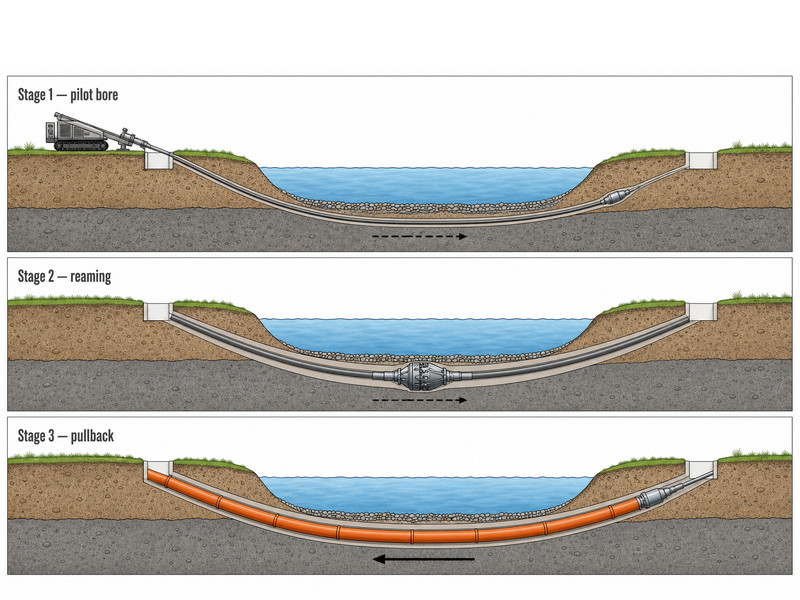
Applicability — HDD: use it for pressure mains, cables and conduits from 50 to 1,200 mm, for long drives in stable ground, and for crossings where no shaft is available. It needs ground that holds a bore on fluid pressure, and it accepts a curved alignment.
For gravity-flow lines, specify microtunneling.
Bottom line: specify HDD when reach and mobilization cost matter more than tolerance, and when the ground can hold a bore on fluid pressure alone.
4. What Is Direct Pipe and How Does It Work?
Direct Pipe is a hybrid trenchless method. A microtunnel machine excavates the bore while a hydraulic Pipe Thruster (a thrusting unit that pushes the pipe string forward) drives a welded steel pipe string in behind it. It is a method name, not direct-buried pipe installation.
Direct Pipe combines an HDD-style curved bore path with a microtunneling-style machine, so the finished pipeline is installed in one continuous pass instead of a separate pullback stage.
Because the machine supports the excavated face and the fluid circuit is closed, the bore never stands open.
Direct Pipe depends on a continuously welded steel string, so automated welding systems set the joint quality that the whole thrust load passes through.
Two properties follow from Direct Pipe’s design, and they are the reasons the method exists.
First, fluid is circulated in a closed loop at pressures only slightly above hydrostatic. The formation is never asked to contain high-pressure drilling fluid, and in our risk reviews that single difference removes most fluid-escape scenarios.
Second, the pipe is pushed rather than pulled, which avoids the tensile load limits and bore-collapse risks that constrain large-diameter HDD pullbacks.
US Army Corps of Engineers guidance reflects the same reasoning for levee crossings. An HDD bore must penetrate a competent cohesionless layer (a granular, non-cohesive soil) beneath the levee.
Where that layer cannot be achieved, the guidance identifies Direct Pipe as the viable alternative.
Verified envelope and track record for the method:
- First commercial installation: 2007, a 48-inch casing driven under the Rhine River.
- Installed base: roughly 200 installations worldwide, more than 50 of them in North America.
- Longest single string: 1,496.48 m (about 4,910 ft) at Whangaparaoa, New Zealand, completed in 2018 with a 750-tonne (about 827 US tons) Pipe Thruster.
- Pipe: welded steel, typically 28-60 in. (about 700-1,500 mm). Below 28 in., the method needs a purpose-built machine and shaft seal.
- Guidance: gyrocompass inside the machine, which removes the walkover or wireline survey error that complicates long HDD bores.
- Depth: about 30 m (100 ft) of cover with standard sealing; beyond that, the crossing needs a modified, higher-pressure seal system.
- Obstructions: the machine can pass boulders up to roughly one third of the face diameter, which is a meaningful advantage in glacial and mixed-face ground.
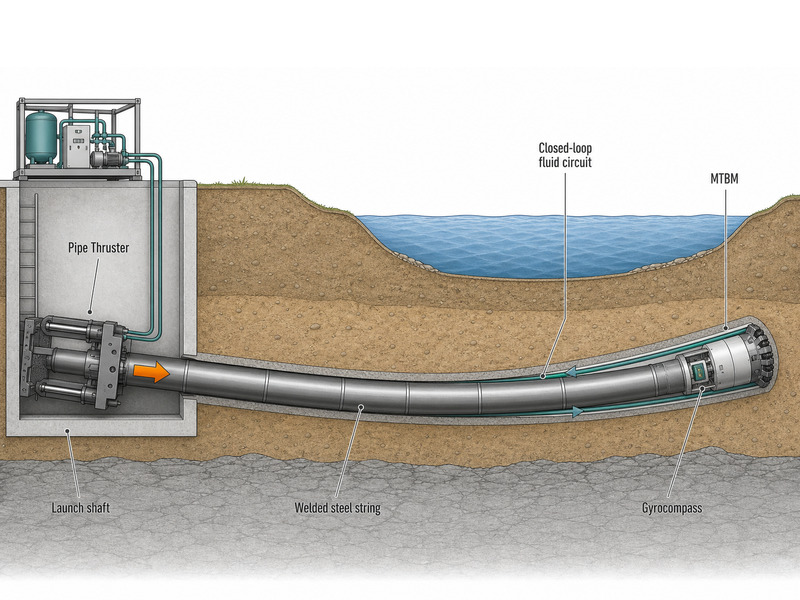
Applicability — Direct Pipe: use it for welded steel strings from 28 to 60 in. in a single pass, for shallow cover under waterways and levees, and for unstable, mixed-face or bouldery ground where a failed bore cannot be tolerated.
Direct Pipe needs one launch shaft and a pipe stringing corridor, and standard sealing sets a firm ceiling on how deep the crossing can go. For gravity-sewer grade, specify microtunneling.
Bottom line: Direct Pipe is the answer where an open bore is the problem and a shaft is available — the price is the heaviest equipment spread of the three.
5. Accuracy and Line and Grade: The Deciding Difference
In any trenchless method comparison, accuracy is the fastest parameter for shortlisting a method, because microtunneling, HDD and Direct Pipe sit on different rungs rather than in a continuum. Microtunneling holds about ±10 mm on line and grade.
HDD holds about ±100 mm. Direct Pipe holds intermediate accuracy — tighter than a typical HDD survey, because the gyrocompass sits inside a machine that is continuously supported and pushed along a planned curve. For gravity-sewer grade, specify microtunneling.
These are typical published tolerances for standard equipment. The microtunneling figure assumes laser or gyro guidance on a single drive; the HDD figure assumes a walkover or wireline survey on a single bore.
For a pressure pipe, a 100 mm deviation over a 500 m crossing rarely matters; the pipe does not care about slope.
For a gravity sewer, the design grade is 0.5-1 percent, a fall of 5-10 mm per metre of pipe. The same deviation there is the difference between a line that flows and a line that ponds.
Gravity sewers are installed by microtunneling or pipe jacking, because they must hold a constant slope. HDD suits pressure pipes, cables and conduits, where slope does not control flow.
Second-order accuracy questions matter too, and they are the ones most often missed in a bid review:
- Settlement control. Microtunneling and Direct Pipe continuously support the excavation face, which limits ground loss above the bore. HDD relies on fluid pressure and reaming discipline, so surface settlement is harder to guarantee in loose, dry or gravelly soils.
- Clearance to existing utilities. A tighter tolerance envelope means a smaller stand-off is needed from live services, which matters in urban corridors. If the alignment must thread between utilities at shallow depth, that requirement alone can rule out a method.
- Curved vs constant grade. HDD’s arc is an advantage when avoiding an obstruction and a limitation when the design requires a constant slope.

Bottom line: if the pipe flows by gravity, microtunneling is effectively mandatory; if it flows under pressure, accuracy is a cost variable rather than a constraint.
Accuracy is what eliminates a method first — how HDD and Direct Pipe compare on tolerance is answered in the FAQ.
6. Ground Conditions: Which Method Survives Your Soil?
Ground conditions can eliminate a method before cost is discussed, and microtunneling, HDD and Direct Pipe fail in different ways. HDD fails when the bore cannot be held open. Microtunneling fails when the machine cannot cope with the face.
Direct Pipe fails when the ground is too strong or too deep for its thrust and sealing limits.
| Ground condition | การขุดอุโมงค์ด้วยวิธีไมโคร | HDD | Direct Pipe |
|---|---|---|---|
| Soft clay, silt | Excellent | Excellent | Good |
| Loose sand and gravel | Good, with face support | Difficult; bore collapse risk | Good, supported face |
| High water table | Excellent, closed loop | Manageable, frac-out risk | Excellent, near-hydrostatic loop |
| Cobbles and boulders | Difficult but workable | Problematic; reaming stalls | Best suited to this ground; boulders to about one third of face diameter |
| Hard rock | Rock cutterheads, slower advance | Soft to medium rock with a rock-capable reamer; for hard rock, specify microtunneling | Specify another method: Direct Pipe is a soft-ground and mixed-face method |
| Mixed face, rapidly changing | Steering and cutter wear challenges | High risk of fluid loss and collapse | Designed for this case |
| Shallow cover under a waterway or levee | Possible, with shaft and grade constraints | High frac-out exposure | Frequently the only viable method |
A geotechnical investigation is required whenever microtunneling, HDD and Direct Pipe are all on the table. At minimum it must cover:
- Soil classification along the full alignment.
- Groundwater levels and permeability.
- Standard penetration or cone penetration test data at shaft and cover-check locations.
- A boulder or cobble assessment.
In our experience the geotechnical report, not the budget, settles a method debate. In most trenchless method comparisons we run, it changes the answer more often than any other single input.
Where the report is thin, all three methods are priced against assumptions that may not survive the first drive.
Settlement monitoring: what to install before the bore starts
Settlement is the risk that most often decides a method in an urban corridor, and it is the one risk that can be managed with instruments rather than assumptions.
The monitoring scope follows the method, because the mechanisms differ. A supported face limits ground loss directly, while an open bore depends on fluid pressure and reaming discipline holding the soil in place.
- Identify the settlement-sensitive structures first — buildings, buried services, rail and runway pavements — and set a monitoring point on each.
- Fix a baseline survey before mobilisation, so movement is measured against a known condition rather than an assumed one.
- Instrument the alignment directly: surface points over the bore, plus subsurface points where the cover is thin.
- Monitor during the drive and for a defined period after it, because post-drive consolidation is where open-bore settlement usually appears.
- Agree the trigger levels and the reaction to each one in advance: what stops the drive, what changes in the fluid programme, and who is contacted.
- Record every reading against the drive chainage, so any movement can be tied to the machine position that caused it.
Applicability: this monitoring scope applies to all three methods. It is most valuable where microtunneling or Direct Pipe is selected for settlement control, because the instruments are what prove the choice worked.
Project-specific trigger values are set with the asset owner and the geotechnical engineer, and they are not transferable between sites.
Bottom line: unstable, wet and mixed ground moves the answer towards microtunneling or Direct Pipe; stable clay and soft rock keep HDD in play.
7. Drive Length, Diameter and Depth Envelope
Each method has a comfortable envelope and a stretched envelope, and bids should be compared inside the comfortable one. Length, diameter and depth eliminate more options than any other numbers in a trenchless method comparison.
Table 3 gives the practical ranges we use when screening an alignment, together with the mechanism that sets each limit for microtunneling, HDD and Direct Pipe.
| Limit | การขุดอุโมงค์ด้วยวิธีไมโคร | HDD | Direct Pipe |
|---|---|---|---|
| Comfortable drive length | 100-300 m | 300-1,200 m | 300-1,000 m |
| Stretched drive length | 1,500 m+ with intermediate jacking stations | 1,800 m+ with large rigs and staged reaming | Record 1,496.48 m single string |
| What sets the length limit | Jacking force, friction, pipe strength in compression | Rig pullback capacity, drilling fluid returns, survey accuracy | Thrust capacity and lubrication; no tensile limit on the pipe |
| Comfortable diameter | 300-3,000 mm (12-120 in.) | 50-1,200 mm (2-48 in.) | 28-60 in. (about 700-1,500 mm) |
| What sets the diameter limit | Shaft size and jacking force scale with diameter squared in mass terms | Bore stability and pullback loads rise sharply above 1,200 mm | Machine and Pipe Thruster sizing; smaller systems need a purpose-built machine |
| Depth of cover | Set by shaft cost and dewatering, not by the machine | 15 m typical, deeper achievable | About 30 m with standard sealing; deeper with modified seals |
Two practical rules follow from this. First, diameter and length trade against each other. A 1,500 mm drive is unremarkable for microtunneling at 200 m, and a serious engineering exercise for any of the three at 1,200 m.
Second, the stretched lengths all depend on auxiliary systems — jacking stations, lubrication, staged reaming, larger thrust units. Those systems carry their own mobilization and risk, so compare a stretched bid against a comfortable alternative rather than as a like-for-like rate.
On tightly curved alignments, pipeline cold bending is what lets a welded steel string follow the bore profile without adding field joints.
Bottom line: length is HDD’s advantage, diameter and accuracy are microtunneling’s, and Direct Pipe trades both against ground risk in the 28-60 in. band.
8. Trenchless Method Comparison: Cost Structure by Method
There is no universal rate for microtunneling, HDD or Direct Pipe. Any quoted figure that ignores diameter, length, shaft depth, ground conditions and disposal requirements should be treated as a placeholder.
What can be compared honestly is the cost structure — which components dominate each method and how they respond to the same project variables. That is what this cost comparison sets out to do.
| Cost component | การขุดอุโมงค์ด้วยวิธีไมโคร | HDD | Direct Pipe |
|---|---|---|---|
| Mobilization and demobilization | High: machine, jacking frame, separation plant | Lowest: rig and support equipment only | Highest: machine plus large Pipe Thruster and pipe stringing spread |
| Shafts (launch and reception) | Major: two shafts, thrust wall, dewatering | Minimal: entry and exit pits | One launch shaft plus a surface stringing corridor |
| Excavation and spoil handling | High: slurry separation and off-site disposal | Moderate: fluid recycling and cuttings | Moderate: closed-loop slurry, similar to microtunneling |
| Pipe material and joints | Segmented jacking pipe, many joints | Continuously fused or welded string | Welded steel string, high material cost |
| Depth sensitivity | Very high: deeper shafts and dewatering dominate | Moderate | High, and capped by the standard shaft seal |
| Restoration and surface disturbance | Largest working area | Smallest working area | Medium, with a long stringing corridor |
| When the premium disappears | Long, large-diameter drives where one machine replaces repeated setups | On gravity service or unstable ground | Where it removes a shaft, a dewatering spread or a re-drive risk |
In practice, the bid ranking on a straightforward crossing in stable ground is HDD first, microtunneling second, Direct Pipe third, because mobilization dominates the difference on a short job.
On a long, large-diameter crossing in difficult ground the ranking frequently inverts. HDD’s reaming passes and fluid management can multiply, and a failed or abandoned bore is the most expensive line item in any trenchless budget.
Lifecycle cost deserves the same honesty as bid cost. A segmented microtunneled line carries more joints to inspect over its service life than a continuously fused HDD string.
Set against that, its straight, grade-accurate alignment keeps operating and maintenance costs predictable on gravity service. Operators of sewer networks tend to value the method beyond its construction cost.
Our pipeline repair services and inserted hose lining teams work on both: on the assets we maintain, joints are the recurring maintenance item and alignment is the recurring operating saving.
Bottom line: compare your two candidate methods on your own alignment, with the same contingency rules, and judge them on installed cost including failure risk.
Cost is the second filter, not the first — which method is usually the lowest bid is answered in the FAQ.
Comparing two bids on the same basis
A cost comparison is only as good as the basis it is priced on, and most bid gaps on trenchless work come from scope differences rather than from rates. Before two numbers can be compared honestly, six items must be identical:
- The same alignment, including shaft positions and pipe stringing areas.
- The same pipe material, grade and wall thickness.
- The same settlement acceptance criteria and monitoring scope.
- The same spoil and slurry disposal route and permitted destination.
- The same contingency allowance for obstructions and for a failed drive.
- The same construction window, working hours and permit conditions.
Where one of the six differs, price it separately rather than absorbing it into the rate. A bid that looks lower usually differs on one of these lines, and the difference is a scope difference rather than an efficiency difference.
Comparing two methods on your own alignment? Send the alignment and geotechnical data to JSW and we will price the two closest options on the same contingency basis.
9. Risk Profile: Frac-Out, Settlement and Third-Party Damage
The risk profiles of microtunneling, HDD and Direct Pipe are not variations of the same risk; they are different failure mechanisms. A useful trenchless method comparison therefore compares failure modes rather than failure rates, because the mode is what a design can mitigate.
The characteristic risk of horizontal directional drilling is fluid escape from an open bore. Microtunneling’s is settlement or face instability in soft ground, together with shaft and dewatering risk.
Direct Pipe’s risk is thrust and sealing — it removes the frac-out mechanism but adds a thrust capacity limit and a depth cap tied to seal pressure.
Frac-out, also called inadvertent return, occurs when drilling fluid pressure in the bore exceeds the confinement of the overlying ground. The fluid then escapes to the surface, into a watercourse or into a root zone.
Frac-out is the reason environmental regulators scrutinise shallow HDD crossings closely, and the reason the closed-loop methods are preferred where cover is thin.
Because microtunneling and Direct Pipe both circulate fluid at roughly hydrostatic pressure inside a supported bore, most frac-out scenarios are removed by design rather than by control measures.
The wider stakes are documented. The Common Ground Alliance’s 2026 DIRT (Damage Information Reporting Tool) Report estimated that damage to buried utilities costs the United States economy about USD 83.2 billion per year.
The USD 83.2 billion figure covers accidental strikes rather than trenchless works specifically, but it sets the context for method selection.
On a congested corridor, the cost of a damaged utility or a failed crossing dwarfs the difference in bid price between two methods.
| Risk | การขุดอุโมงค์ด้วยวิธีไมโคร | HDD | Direct Pipe |
|---|---|---|---|
| Frac-out / fluid escape | Low, closed loop | Highest exposure, open bore under pressure | Low, closed loop at near-hydrostatic pressure |
| Surface settlement | Low with face support and grouting | Moderate; depends on soil and reaming discipline | Low, face continuously supported |
| Bore collapse | Low, the bore is continuously supported | Real risk in cohesionless and gravelly soils | Low, the bore is continuously supported |
| Pipe load risk during installation | Compressive jacking load, controlled by pipe design | Tensile pullback load, limits large diameters | Compressive thrust load, no tensile limit |
| Depth of cover | Shaft and dewatering driven | Set by rig capacity and fluid management; no fixed cover limit | Standard seal limit — see Table 3 |
| Main residual risk | Face instability, shaft and groundwater control | Fluid loss, reaming stall, bore instability | Thrust capacity, boulder impact on cutterhead |
One honest limitation applies to all three: a geotechnical model is a model. Boulders, old foundations, unmapped services and abrupt rockhead changes appear during drives regardless of the method.
The operators who manage those surprises best are the ones with a documented contingency — diversion plans, spare cutterheads, additional thrust capacity, and a pre-agreed variation mechanism in the contract.
What happens if a drive fails
A failed drive is a cost event rather than an engineering mystery, and the rescue route differs by method. The decision that matters is taken long before mobilisation, not during a stalled drive.
- Microtunneling: the machine is recovered from the reception shaft and the pipe already installed stays in place. A stalled drive is usually resolved by adding jacking stations, lubrication or thrust capacity rather than by abandoning the alignment.
- HDD: a lost pilot bore can be re-steered from the entry side, or completed from a rescue shaft sunk on the alignment. A reaming or pullback failure in collapsing ground is the case where the bore itself may become unusable.
- Direct Pipe: the machine is retractable and the string is advanced from one end, so a stop is a pause rather than a lost asset. That property is why the method is attractive where a failed bore cannot be tolerated.
Three things must be written into the contract before the drive starts:
- Who pays for a rescue shaft or a re-drive.
- Who secures an abandoned bore.
- What variation mechanism applies when the ground differs from the geotechnical model.
Agreeing them in advance costs less than negotiating them during a stalled drive.
Bottom line: choose the method whose failure mode you can afford, not the one whose strengths look best on a specification sheet.
10. How to Choose: A Seven-Factor Selection Framework
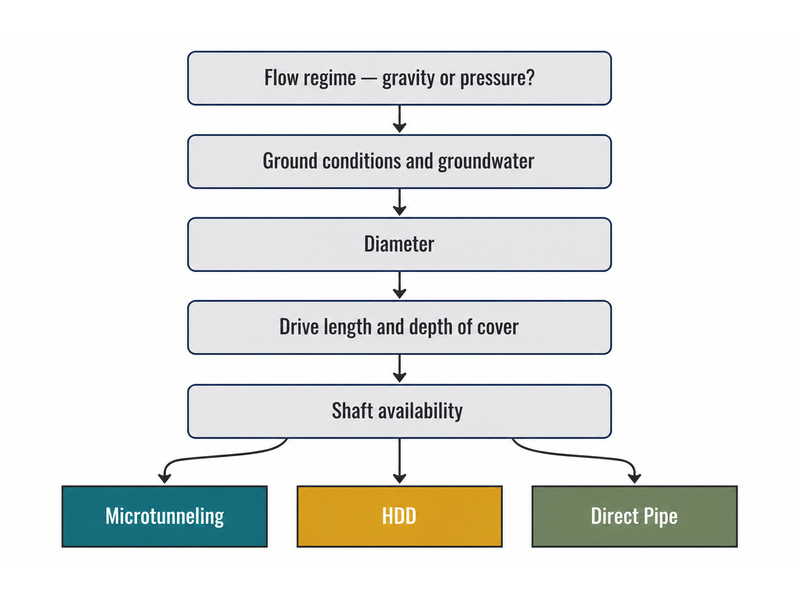
When we screen an alignment, we score it against the same seven factors in the same order. The first three usually eliminate at least one method; the remainder only fine-tune the answer.
The seven-factor sequence is the working core of any trenchless method comparison we run, and it is the part we ask clients to complete before a bid review meeting.
- Flow regime. Gravity or pressure? Gravity flow requires a constant, precise grade, which makes microtunneling the default and rules out HDD.
- Required accuracy and clearance. How much deviation can the design tolerate, and how close are live utilities? Tolerances below about 50 mm point to microtunneling or Direct Pipe.
- Ground conditions and groundwater. Unstable, wet or mixed ground favours microtunneling or Direct Pipe. Stable clay and soft rock keep HDD in play, and a competent cohesionless layer beneath a levee is the condition USACE guidance requires before HDD is acceptable there.
- Diameter. Above about 1,200 mm HDD leaves the comparison. Between 700 and 1,500 mm all three may be viable, and the ground decides.
- Drive length and depth of cover. Long single drives favour HDD, or Direct Pipe where the ground is hostile. Where Direct Pipe cover exceeds about 30 m (100 ft), the crossing needs a modified seal system (Table 3).
- Surface and shaft constraints. Where no shaft can be built, HDD is the only option. Where a shaft is available and settlement-sensitive structures sit above the alignment, the supported methods are safer.
- Budget, schedule and risk allocation. Compare installed cost including failure risk and the value of a shorter, more predictable programme, not bid price alone.
Permits and the construction window
The seven factors in Section 10 decide which method is technically viable; the permit and the construction window decide which one can be built this season. Three constraints sit outside the scoring and are worth checking before the shortlist is finalised.
- In-water and near-water work windows. Crossings under a watercourse are often restricted to a defined period of the year, which can rule out a method whose surface works need longer than the window allows.
- Levee and embankment approval. A crossing under a flood defence needs the asset owner’s approval, and the method affects the approval route. An open bore under a levee carries a different review from a supported, closed-loop bore.
- Urban working hours and noise. Night and weekend restrictions change the programme for shaft excavation and spoil removal far more than they change the drive itself. The penalty falls on the method with the largest surface footprint.
Two conclusions follow. First, permit conditions belong inside the method comparison, because a method that cannot be permitted is not a candidate however well it prices.
Second, the permit decides the programme rather than the programme deciding the permit — work the submission date backwards from the window, not forwards from mobilisation.
11. Trenchless Method Comparison: When to Choose Each Method
The seven-factor framework in Section 10 produces a shortlist, not always a single answer. The three lists in this section are the conditions under which we would commit to each of these trenchless methods on a bid.
Choose microtunneling if…
- The line is a gravity sewer or storm drain that must hold grade.
- The diameter is large — roughly 300 mm up to 3,000 mm — or the alignment passes under railways, runways and sensitive structures where settlement must be controlled.
- The ground is soft, sandy or below a high water table, and shafts can be built.
Choose HDD if…
- The line is a pressure main, cable or conduit that can tolerate a curved profile.
- The crossing is long and the alignment benefit of a curve matters — under a river, wetland, highway or airport.
- The ground is stable enough to hold a bore, and no shaft can be justified.
Choose Direct Pipe if…
- The pipe is welded steel in the 28-60 in. band and the drive is long and single-pass.
- Cover is shallow, or the crossing is under a levee or waterway where HDD frac-out risk is unacceptable.
- The ground is unstable, mixed-face or bouldery, and the design cannot tolerate a failed bore.
Which reader are you?
- Utility or sewer network owner: your constraint is grade and settlement above the bore, so start at microtunneling. Direct Pipe is the alternative where a reception shaft cannot be built or the ground will not hold a two-shaft drive.
- EPC contractor at FEED stage: your constraint is the permitting window and the cost of a failed drive, so price two methods on the same basis before you commit.
- Municipal engineer crossing under a railway or runway: your constraint is settlement control and a buildable shaft, so the choice sits between microtunneling and Direct Pipe.
- Contractor bidding a levee or waterway crossing: your constraint is levee approval, so confirm early whether the HDD bore can reach a competent cohesionless layer beneath the defence.
Not sure which method fits your alignment? Send the alignment data and the geotechnical report. Our engineers will run this framework against your project and tell you which method to bid, including when it is not the one we would build.
12. Real Crossings Where the Method Decision Mattered
Debates between trenchless methods are settled faster by precedent than by theory. Four documented crossings illustrate how microtunneling, HDD and Direct Pipe divide the work.
- Pajaro River, California, 1971. A 100 mm (4 in.) gas line under about 150 m (500 ft) of river was installed by Martin Cherrington’s steerable rig. It is generally regarded as the first HDD river crossing, and the beginning of HDD’s use on obstacles that open trenching could not economically cross.
- Rhine River, 2007. The first commercial Direct Pipe installation drove a 48-inch casing under the river, establishing the hybrid as a practical alternative where the closed-loop bore was required.
- Czeszów–Wierzchowice, Poland, 2016. Direct Pipe installed two natural gas pipelines under fish ponds in sticky clay. The 700 m line was finished in 13 working days and the 464 m line in 16. Best daily progress reached 147 m, on a gyrocompass-guided machine with a 500-tonne (about 551 US tons) Pipe Thruster. An HDD attempt there would have risked fluid loss into the ponds and weeks of lost schedule.
- Whangaparaoa, New Zealand, 2018. A 1,496.48 m (about 4,910 ft) sea outfall was installed as a single Direct Pipe string driven by a 750-tonne (about 827 US tons) Pipe Thruster. It is still the longest single pipe string installed by the method, and a useful benchmark for what a large thrust capacity makes possible.
Alongside those, microtunneling’s track record is quieter but larger in volume. It is the standard pipe jacking method for the gravity sewer and storm drain networks of dense cities, because it holds grade under railways, highways and buildings without disturbing them.
13. Microtunnel vs. HDD vs. Direct Pipe: Frequently Asked Questions
The eleven questions in this section are the ones that come up most often in trenchless work, answered at the level a project engineer needs to act on them.
What is the main difference between microtunneling, HDD and Direct Pipe?
Microtunneling jacks segmented pipe behind a remotely controlled machine from a launch shaft, holding line and grade an order of magnitude tighter than HDD. HDD drills a curved pilot bore, reams it, and pulls a pre-fused string back through. Direct Pipe does both in one pass, excavating while a Pipe Thruster pushes a welded steel string behind it.
Can HDD install a gravity sewer?
No. A gravity sewer must hold a constant, precise slope, and the HDD bore follows a curved arc with tolerance measured in tens of centimetres. Gravity lines are installed by microtunneling or pipe jacking, or in specific short cases by pilot tube microtunneling.
Is Direct Pipe more accurate than HDD?
Yes. Direct Pipe is steered by a gyrocompass inside a continuously supported machine, so alignment control is tighter than a typical HDD walkover or wireline survey. It is not intended to hold gravity-sewer grade, which remains a microtunneling application.
Which trenchless method is cheapest?
For a given crossing in stable ground, HDD is usually the lowest bid: it needs no shafts, no slurry separation plant and a smaller crew. Microtunneling costs more because of shafts, the machine and spoil handling. Direct Pipe carries the heaviest equipment spread, but it can undercut both when it removes a shaft, a dewatering spread or a re-drive risk.
What is frac-out and which methods are exposed to it?
Frac-out is the escape of drilling fluid to the surface when fluid pressure in the bore exceeds the confinement of the ground above it. HDD is exposed because its bore is open and held by pressurised fluid. Microtunneling and Direct Pipe circulate fluid in a closed loop at roughly hydrostatic pressure, which removes most frac-out scenarios.
What pipe materials and diameters does each method install?
HDD installs continuously fused or welded strings of HDPE (high-density polyethylene), steel or PVC from about 50 to 1,200 mm (2 to 48 in.). Microtunneling installs segmented jacking pipe — concrete, clay, steel or GRP (glass-reinforced plastic) — from about 300 to 3,000 mm (12 to 120 in.). Direct Pipe installs welded steel from 28 to 60 in.
How deep can each method go?
HDD installs at 15 m of cover or more and goes deeper with larger rigs. Microtunneling depth is governed by shaft cost and dewatering, not by the machine. Direct Pipe depth is capped by the working pressure of its shaft seal; Table 3 gives the limit, and deeper crossings need a modified seal system.
Which method should be specified under a levee or waterway?
US Army Corps of Engineers guidance requires an HDD bore under a levee to penetrate a competent cohesionless layer beneath it. Where that layer cannot be reached or does not exist, the guidance identifies Direct Pipe as the viable alternative, because its supported, closed-loop bore removes the fluid-escape mechanism.
How long does a microtunnel drive take compared with an HDD bore?
A microtunnel drive advances at a controlled jacking rate but carries shaft construction at both ends. An HDD bore mobilises faster because it needs only entry and exit pits, yet a long drive adds a pilot bore, several reaming passes and a pullback. Match the machine to the drive: Section 12 shows 700 m finished in 13 working days.
When should an HDD crossing be switched to Direct Pipe?
Switch when the ground will not hold a bore open on fluid pressure. Collapsing gravel, boulders or uncontrolled fluid loss are the triggers. Direct Pipe then completes the crossing from one launch shaft, because its supported, closed-loop bore carries its own face support. Section 9 sets out the contract terms to settle first.
Do microtunneling, HDD and Direct Pipe all need a geotechnical investigation?
Yes. All three are priced against the ground. HDD loses fluid or stalls in reaming; microtunneling meets a face the machine cannot cut; Direct Pipe meets rock or a boulder that stops the thrust. The minimum scope in Section 6 applies to all three methods.
14. How JSW Supports Trenchless Crossings
JSW delivers underground pipeline work end to end. For the crossing itself we build horizontal directional drilling services and microtunneling construction, and we install the pipeline behind them through บริการติดตั้งท่อส่ง.
Post-construction, our pipeline repair, inserted hose lining and inspection teams keep the assets we build in serviceable condition. That is why we can speak to lifecycle cost as credibly as bid cost.
What that means for a method decision is practical rather than promotional. Because we build crossings, our estimates are based on our own crews, our own rigs and our own recent drives instead of a rate table.
We work with trenchless technologies across microtunneling, HDD and Direct Pipe, so we have no reason to steer your project towards a single technique.
We will say so when a method is outside its envelope on your site rather than bid it and manage the risk later.
A typical method review at JSW answers four questions in writing:
- Which method the ground and flow regime allow.
- What the accuracy requirement eliminates.
- What the realistic envelope is for your diameter and length.
- What the two closest options would cost on the same alignment with the same contingency rules.
The trenchless method comparison in this guide is the same framework we run internally before quoting. The difference is that we run it against your geotechnical data rather than generic ranges.
Where the crossing is a river, levee or congested urban corridor, the review includes a fluid-pressure and settlement assessment for the open-bore option.
Weighing microtunnel vs. HDD vs. Direct Pipe on a live project? Send your pipe diameter, drive length, crossing type and geotechnical report.
JSW engineers will return a technical method comparison and a scoped proposal. We will recommend the method that fits the site even when it is not the service we bid first.





































 English
  Arabic
  Russian
  Spanish
  French
  Vietnamese
  Polish
  Thai
Thai  Indonesian
  Turkish
  Portuguese