
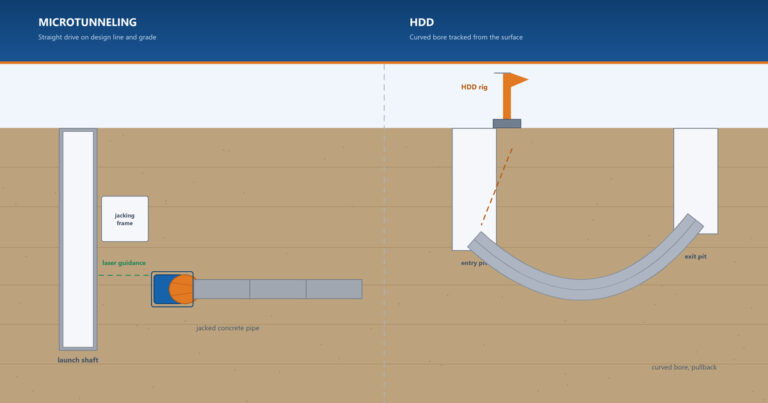
In the microtunneling vs HDD decision, microtunneling wins on accuracy (±10-25 mm), large diameters and unstable water-bearing ground, while HDD wins on cost, speed and long curved crossings where no gravity grade is required.
The two methods are compared below on the four criteria that decide most trenchless method selection work: line-and-grade accuracy, workable pipe diameter, ground compatibility, and cost structure. Each section gives the typical ranges and the engineering reason behind them, including the cases where a gravity sewer rules HDD out entirely. A five-check selection list and a full comparison table follow.
What Is the Core Difference Between Microtunneling and HDD?
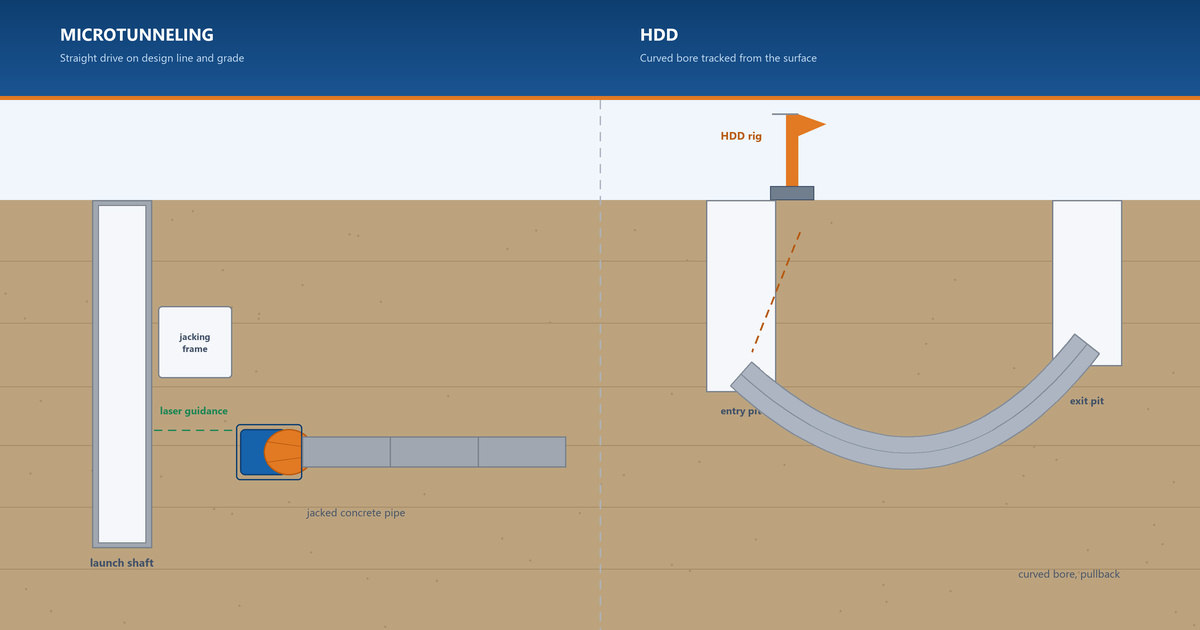
Microtunneling (spelled microtunnelling in UK and Australian usage) is pit-launched pipe jacking under remote control: a microtunnel boring machine (MTBM) excavates the face while hydraulic jacks push pipe sections behind it. Horizontal directional drilling (HDD), also called directional drilling, is surface-launched: a rig drills a pilot bore, reams it, then pulls a flexible pipe back through the hole.
That single difference – pushing pipe versus pulling it – drives everything else. The MTBM’s guidance and face support hold a straight, precise line; the HDD drill string, steered from the surface, flexes along an arc to cover long distances on a looser line.
- Microtunneling: shafts, jacking frame, laser or gyroscopic guidance, closed-face excavation, remote control.
- HDD: surface rig, entry and exit pits, walkover or wireline locating, pilot bore – reaming – pullback.
For a wider view of how these methods sit alongside other options, see what trenchless technologies are.
Is Microtunneling More Accurate Than HDD?
Yes, by roughly an order of magnitude. On the drives we have priced, continuous-guidance slurry and pilot tube machines hold the design line to within roughly 10-25 mm, and mixed ground or long drives commonly widen that band to 25-50 mm. HDD typically holds around ±100 mm (4 in.) at the exit point of a single bore over a comparable length, and can drift further on long bores in variable ground.
The reason is guidance, not operator skill. An MTBM carries a laser target or gyroscopic system that reports its position continuously, and the machine steers against that reference metre by metre. An HDD drill head is tracked from the surface, and the bore path is a curve, so position at the far end depends on the accumulated path of a flexible string. Boundary: those figures describe machine capability, not the contractual line and grade tolerance, which the project specification sets and is usually looser.

Whether the gap matters depends on what flows through the pipe:
- Pressure lines (water mains, gas, force mains) tolerate ±100 mm. A small deviation changes nothing about hydraulic performance.
- Gravity lines (sanitary sewers, storm drains) do not. At a working grade of around 1 percent, a 100 mm deviation is the difference between flow and standing water, which is why gravity sewers are a microtunneling application.
- Crossings near sensitive structures often specify a tight tolerance for settlement and cover reasons, even on pressure lines.
Bottom line: accuracy is the fastest filter in the microtunneling vs HDD comparison – if the line must flow by gravity, the choice is effectively made.
Which Method Handles Which Pipe Diameter?
Microtunneling covers roughly 300-3,000 mm (12-120 in.) and HDD covers roughly 50-1,200 mm (2-48 in.), so the two ranges overlap between about 300 and 1,200 mm. Inside that band, cost and ground decide. Outside it, the method is forced.
The physical reason is the excavation system. A microtunneling drive needs pipe joints that carry the jacking force and a microtunnel boring machine sized to the finished bore. HDD needs a reamed hole roughly 1.4-1.5 times the product pipe diameter, and cuttings and drilling fluid grow with the square of that diameter.
- Below 300 mm: HDD, or a small-diameter guided boring system. Remote-controlled microtunneling machines exist at these sizes, but shafts often dominate the cost.
- 300-1,200 mm: both methods are viable; the deciding factors are grade tolerance, ground and length.
- Above 1,200 mm: microtunneling, pipe jacking or Direct Pipe. HDD reaming volumes become impractical.
For the reaming and pullback side, our guide to horizontal directional drilling maximum length and diameter covers where rig capacity stops.
Which Method Handles Which Ground?
In the microtunneling vs HDD comparison, ground conditions rarely change cost – they change feasibility. Each method fails in a different soil, and a geotechnical report is what separates a design from a guess.
| Ground condition | การขุดอุโมงค์ด้วยวิธีไมโคร | HDD |
|---|---|---|
| Stiff clay, silt | Suitable | Suitable, usually fastest and cheapest |
| Loose sand and gravel above the water table | Suitable with face support | Suitable, but bore stability needs fluid control |
| Loose, running or water-bearing sand | Preferred: slurry or earth pressure balance face support | High risk of collapse and inadvertent returns |
| Soft rock, weathered rock | Suitable with a rock cutterhead | Suitable with the correct reamer and mud programme |
| Hard rock, long continuous drive | Possible but slow; cutter wear and intervention dominate | Limited; reaming hard rock is slow and tool-intensive |
| Boulders and cobbles | Handles obstructions up to roughly 30 percent of the face with the right cutterhead | Frequent obstructions, steering corrections and fluid loss |
| Mixed face (rock and soil in one face) | Difficult: the hardest case for cutterhead design | Very difficult: unpredictable steering and reaming |

The pattern is consistent: microtunneling is at its best where the ground cannot support itself, because the machine supports the face continuously. HDD is at its best in ground that holds a hole well enough for a bore supported by drilling fluid.
On the drives we have priced, the two conditions that most often move a project off its first-choice method are an artesian water table and an unmapped boulder zone, both resolved only by a geotechnical investigation.
Bottom line: unstable or water-bearing ground favours microtunneling; stable clay, silt and soft rock favour HDD.
Why Does Microtunneling Cost More per Metre Than HDD?
For the same crossing, microtunneling is usually the higher bid. The difference sits in fixed site costs that HDD does not carry: the microtunnel boring machine, engineered launch and reception shafts, a thrust wall and jacking frame, a slurry separation plant, and a larger operating crew.
The premium is not constant. It is widest on short, shallow, simple drives, where the fixed cost of shafts and machine dominates. It narrows, and can reverse, when the HDD alternative carries its own hidden costs:
- Depth. Shaft cost rises with depth, but so does the cost of deep fluid management or a deep open trench; against open cut the crossover sits at roughly 20 ft (6 m), as set out in our microtunneling vs open-cut cost and surface impact comparison.
- Ground. Running sand, high water tables and boulder zones add dewatering, fluid loss and rework to HDD, and slower advance rates to microtunneling. The first cost rises faster.
- Diameter. Above about 1,200 mm, HDD ceases to be a realistic comparator.
- Surface value. Where the surface is a live carriageway, a rail corridor or a retail frontage, the value of not excavating it can exceed the construction difference.
- Lifecycle. A microtunnelled line sits on a straight, precise alignment on line and grade, with undisturbed bedding, which reduces long-term maintenance on gravity assets. See our pipeline maintenance services for how that is assessed over an asset’s life.
Municipal microtunneling work is commonly quoted at roughly USD 150-500+ per linear foot, against lower unit rates for HDD on short, shallow crossings. They are planning-level only: diameter, depth, ground, shaft count and disposal route move them by multiples.
Bottom line: HDD wins the bid on short, shallow, stable-ground crossings; microtunneling wins the whole-life comparison on deep urban gravity lines.
Drive Length and Depth: Where Each Method Stops
HDD wins on single-drive length; microtunneling wins on grade control and shaft-depth tolerance.
| Parameter | การขุดอุโมงค์ด้วยวิธีไมโคร | HDD |
|---|---|---|
| Typical single drive | 100-300 m per drive | 300-1,500 m; longer with large rigs |
| Longest practical drive | 1,500 m+ with intermediate jacking stations | In excess of 1,800 m in one bore |
| What limits length | Jacking force, pipe compressive capacity, friction along the pipe string | Rig pullback capacity, drill string torque, fluid returns |
| Typical depth | Set by shaft design; 20 m and deeper is routine on trunk sewers | 15 m and deeper with large rigs and fluid management |
| Curves | Straight or very large-radius curves only | Continuous curves by design |
The length limit for microtunneling is a force problem. Every metre of jacked pipe adds friction, and the pipe can only carry so much compressive load. Intermediate jacking stations reset that limit, and specifications commonly require one roughly every 100 m.
HDD is not limited by jacking force, because the pipe is pulled rather than pushed; its length limit is rig pullback capacity and drilling fluid returns.
How Do Microtunneling and HDD Compare Side by Side?
The table below condenses the comparison into the criteria a trenchless method selection report normally covers, so it can be lifted directly into a method statement.
| Criterion | การขุดอุโมงค์ด้วยวิธีไมโคร | HDD |
|---|---|---|
| Launch arrangement | Launch and reception shafts with thrust wall | Surface rig, entry and exit pits |
| Guidance | Laser or gyroscopic, continuous | Walkover or wireline locating |
| Typical accuracy | 10-25 mm; 25-50 mm in mixed ground | ±100 mm |
| Product pipe diameter | 300-3,000 mm | 50-1,200 mm |
| Alignment | Straight or large-radius | Curved by design |
| Gravity sewer suitability | Yes | No |
| Ground strengths | Unstable, water-bearing, soft rock | Stable clay, silt, sand, soft to medium rock |
| Ground weaknesses | Mixed face, boulder zones, cutter access | Running sand and gravel, artesian water, boulders |
| Relative bid cost | Higher | Lower |
| Surface footprint | Shafts plus separation plant | Two small pits |
| Principal risk | Cutterhead obstruction and intervention | Inadvertent return and bore collapse |
- Accuracy: on a controlled drive microtunneling holds the line to 10-25 mm, widening to 25-50 mm in mixed ground, against about ±100 mm for HDD measured at the reception shaft.
- Diameter: microtunneling covers roughly 300-3,000 mm (12-120 in.), HDD roughly 50-1,200 mm (2-48 in.).
- Single-drive length: microtunneling runs 100-300 m typical, 1,500 m+ with intermediate jacking stations, against HDD bores in excess of 1,800 m.
- Cost: HDD is the lower bid on the same crossing when grade is not critical; microtunneling carries the higher rate but removes the gravity-grade risk.
When Neither Method Fits: Direct Pipe and Segmental Tunnelling
A binary comparison is not a complete option set. For long, large-diameter crossings in difficult ground, Direct Pipe and segmental tunnelling take over; that branch is set out in microtunneling vs direct pipe in difficult ground.
Where the microtunneling vs HDD question is close, the city above usually decides.
Which Five Checks Decide the Method?
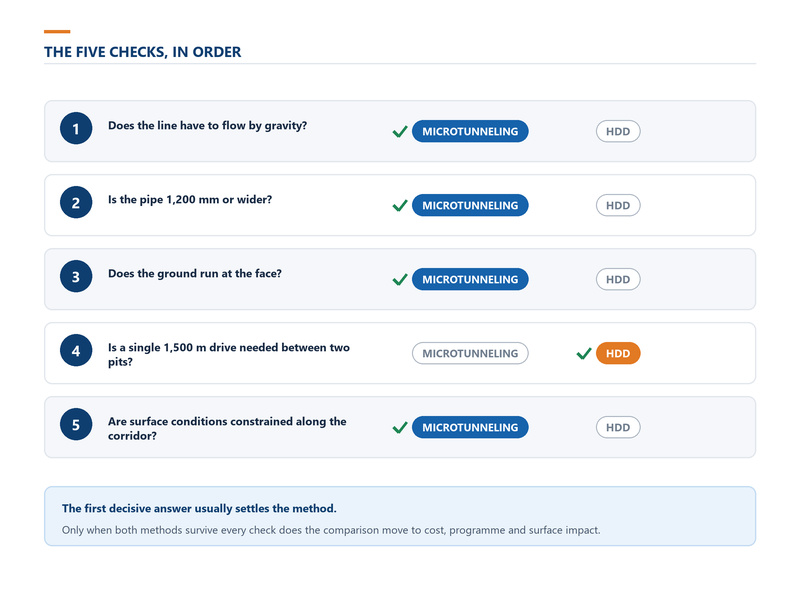
Work through these five questions in order. The first decisive answer usually settles the method, and the list doubles as the agenda for a trenchless method selection meeting.
- Does the line have to flow by gravity? If it does, microtunneling or pipe jacking is the only method that holds the line and grade.
- If the line is 1,200 mm or wider, does horizontal directional drilling still fit, or is microtunneling or pipe jacking the practical choice?
- If the drive is 250 m at 8 m depth under a live dual carriageway with a 1 percent grade, which method should I bid?
- What does the ground do at the face? Running, running-wet or unstable ground means face support, which means microtunneling.
- If one 1,500 m drive is needed between two pits, does that point to HDD rather than a series of 150 m jacked drives between manholes?
An assessment should end with a written method statement referencing the geotechnical basis, the tolerance required, and the shaft strategy – not a preference.
Not sure which method fits your site? Send your alignment data and geotechnical report for a free method review, and our engineers will tell you which method to bid.
Frequently Asked Questions
Is microtunneling more accurate than HDD?
Yes. Microtunneling holds line and grade to roughly ±10-25 mm on a controlled drive, widening to 25-50 mm in mixed ground, because a laser or gyroscopic guidance system steers the machine continuously. HDD typically holds about ±100 mm, because the bore is steered from the surface and the drill string flexes along a curve. The gap is the most common reason a gravity sewer is microtunneled rather than drilled.
Can HDD install a gravity sewer?
Generally no. An HDD bore follows a curved arc between an entry and an exit pit, so it cannot hold the constant, continuous slope a gravity sewer needs to flow. Gravity lines are almost always installed by microtunneling or pipe jacking.
What is the maximum diameter for HDD?
Typical HDD installations range from 50 to 1,200 mm (2-48 in.) in product pipe diameter. Larger diameters are possible with very large rigs, but reaming volume, drilling fluid volumes and pullback loads rise steeply, which is why microtunneling usually takes over above about 1,200 mm.
Which is cheaper, microtunneling or HDD?
For the same crossing, HDD is usually the lower bid. It needs a smaller crew and simpler equipment, and there is no launch shaft, jacking frame or slurry separation plant to mobilize. Microtunneling closes the gap, and often overtakes, on deep drives in urban ground where shafts and surface disruption dominate the cost.
My trunk sewer is 1,500 mm at 20 m depth below the water table – microtunneling or HDD?
Microtunneling. A 1,500 mm gravity trunk sewer cannot be drilled on a continuous grade, and 20 m below an artesian water table suits a slurry or earth pressure balance machine. Horizontal directional drilling can reach that depth with a large rig and careful drilling fluid management, but it cannot hold a sewer on grade.
Can microtunneling work in rock?
Yes, with a rock cutterhead, but the envelope is set by tool wear and access – the full treatment is in microtunneling in rock and mixed ground.
How deep can microtunneling go?
There is no fixed depth limit. A microtunnel boring machine is launched from a shaft, so practical depth is set by ground, groundwater and shaft cost.
Does microtunneling need a shaft at each end?
Yes. A drive needs a launch shaft and a reception shaft, and the reception shaft is usually the smaller of the two.
How to Get a Project-Specific Comparison
If you are the municipal owner scoring bids, the tolerance figure and the shaft strategy matter most; if you are the contractor pricing the drive, the machine class and jacking-force allowance do. A reliable microtunneling vs HDD comparison needs five inputs: geotechnical investigation results, utility locates, crossing length and depth, pipe material and diameter, and the tolerance the design actually requires. Without the tolerance figure, the comparison cannot be closed.
We price two options on the same alignment and state in writing which assumption would change the answer.
For HDD work, see horizontal directional drilling services; jacked drives use our microtunneling construction services. Both sit inside a wider delivery chain that includes pipeline construction services.
Our comparison work starts from the geotechnical report, not the equipment list. The same two methods are compared from a risk angle in microtunneling vs HDD: the key differences and, from first principles, in HDD vs microtunneling: which is better for your project.
To request a free method review, send your alignment data and geotechnical report, and our engineers return a method comparison and budget estimate.
Microtunneling vs HDD: Which Method Should You Pick, and Why?
Neither method is better in the abstract, and any trenchless method selection that ends with a preference rather than a reason is a risk to the project. Choose microtunneling when the line must hold a grade, the diameter is large, or the ground will not stand up on its own. Choose HDD when the line carries pressure, the crossing is long and curved, and the ground and surface conditions allow a fluid-supported bore.
On a project where the answer is still unclear after the five checks, the tie-breaker is the geotechnical report and a priced alternative, in that order.
Get a second opinion at no cost. Our engineering team reviews the alignment, the ground and the tolerance requirement before any method is named.
Related: microtunneling vs jack and bore, when to use microtunneling and microtunnel vs HDD vs direct pipe.
Sources
The accuracy, diameter and drive-length ranges in this guide follow these published industry standards and guidance documents:
- ASTM F1962, Standard Guide for Use of Maxi-Horizontal Directional Drilling for Placement of Polyethylene Pipe or Conduit Under Obstacles, Including River Crossings. (Supports the HDD diameter and crossing limits here.)
- ASCE/CI 36-15, Standard Construction Guidelines for Microtunneling. (Supports the microtunneling accuracy and drive-length ranges here.)
- ASCE Manual of Practice 108, Pipeline Design for Installation by Horizontal Directional Drilling. (Supports the HDD design and bore-stability guidance here.)
- NASTT Good Practices Guidelines (HDD and Microtunneling). (Supports the ground-compatibility and method-selection checklist here.)





































 English
  Arabic
  Russian
  Spanish
  French
  Vietnamese
  Polish
  Thai
Thai  Indonesian
  Turkish
  Portuguese