
Water alone completes only very short, small-diameter bores in stable, non-reactive ground; every other crossing takes an engineered fluid, and the decision is about which one. That single rule is why the choice of bentonite vs polymer drilling fluid, rather than plain water, is the decision most crossings actually face. This guide compares the two engineered systems on cutting transport, borehole support, filter cake, lubrication, torque, fluid loss, mixing and disposal cost, and pumping pressure.
Should I use bentonite or polymer drilling fluid, or can water alone finish the bore?
Water is a legitimate drilling fluid inside a narrow band of work. Water-only drilling suits competent, stable, non-reactive ground: typically a short, small-diameter utility bore with good cover, where the fluid only has to cool the tooling and flush loose cuttings back to the pit. There is no mixing plant, no hydration time and no additive cost.
In sand, gravel, clay or rock, water stops behaving like an engineered fluid. It has no yield point to suspend cuttings when circulation stops, no filter cake to seal permeable ground, and very little lubricity. Fresh water weighs about 8.34 lb/gal while drilling fluid is normally held between 9 and 10 lb/gal, so water gives the bore less support.
Water is realistic only where the bore is short, the ground is stable, cover is adequate and returns can be monitored. Our own tender reviews usually attach water-only proposals to short service crossings in stiff, stable clay, and they can be defensible there; the same wording reappears on long river crossings, where it is not.
In a bentonite vs polymer drilling fluid comparison, what does each family actually do that water cannot?
The two engineered families do different jobs rather than compete on one axis: a bentonite drilling fluid builds the filter cake and supports permeable ground, while a polymer system raises viscosity and controls fluid loss with or without clay. Drilling fluid selection starts with the ground in front of the reamer, not with a preference for either family; the PAC, PHPA and xanthan roles, and the API 13A, OCMA and API RP 13B-1 specifications behind both families, follow that ground.
| Fluid system | Typical application | Main limitations |
|---|---|---|
| Water only | Very short, small-diameter bores in stable ground | No gel strength, no filter cake, almost no lubricity; about 8.34 lb/gal gives less support; needs an engineered fluid in sand, gravel, clay or rock |
| Bentonite-based slurry | Sands, gravels, cobbles and mixed ground needing a filter cake and support | Adds solids loading and disposal volume; longer mixing; needs solids control |
| Polymer (PAC / PHPA) | Reactive clay and shale with PHPA; fluid-loss control in sands with PAC | Sensitive to downhole conditions and to saline water; poorer filter cake than bentonite |
| Bentonite plus polymer blend | Mixed ground needing both a filter cake and clay inhibition | Highest management demand: mixing sequence, testing and solids control |
How does cutting transport separate water-only drilling from an engineered fluid?
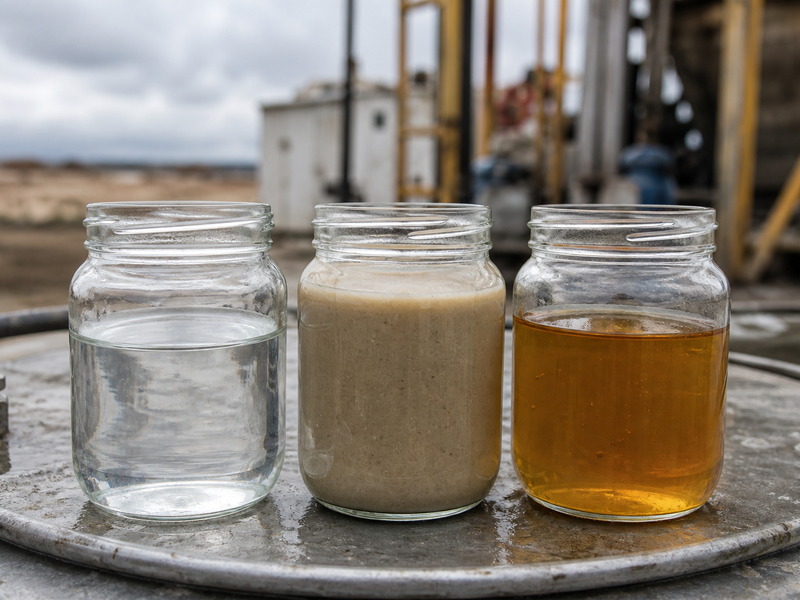
Cutting transport is the first place water-only drilling separates from an engineered fluid. Marsh funnel viscosity for water reads about 26 seconds, while HDD fluid is commonly held in the 30 to 60 second band, and equipment-maker guidance for most drilling applications targets 45 to 60 seconds. Viscosity and annular velocity lift cuttings while the pumps run; gel strength holds them when the pumps stop.
The bentonite vs polymer drilling fluid question matters most here, because properties decide whether cuttings move at all. The published failure signatures are consistent: fluid that is too thin drops heavier cuttings into a cuttings bed, which degrades return flow and can lead to excessive product stress and inadvertent returns; fluid that is too thick raises downhole pressure and can itself trigger an inadvertent return.
Volume matters too. The working method multiplies a per-foot hole-volume factor by rod length and a soil safety factor, then divides by rig pump output to give minutes per rod; the worked example behind the method is set out in the companion HDD fluid science guide. Use less than the method requires and the crew outruns the reamer, and the result is an inadvertent return, ground heave or stuck tooling.
When does a bore need a filter cake and positive differential pressure to stay open?
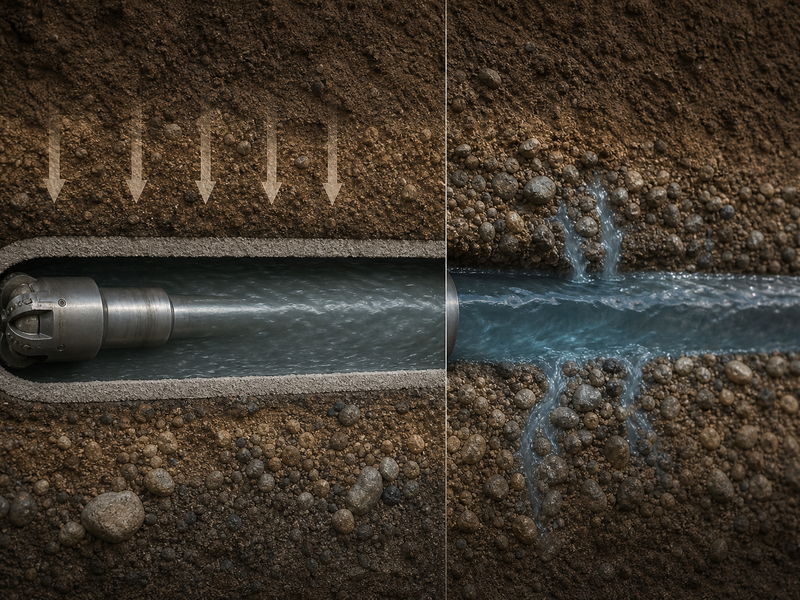
Borehole support rests on three things at once: a low-permeability filter cake, a positive differential pressure from the fluid column, and enough cover above the bore. Remove the filter cake, the positive differential pressure or the cover, and the hole begins to close. A bentonite drilling fluid supplies the first two directly; water supplies neither, and that is the practical difference in most bentonite vs polymer drilling fluid comparisons.
What happens as fluid seeps into permeable sand or gravel? The solids it carries are deposited on the bore wall as a thin membrane that limits further loss. PAC is added to control fluid loss where the formation is coarse, and that is what keeps returns alive in mixed ground. Without a cake, water disappears into the formation.
Lubrication, Torque and Pullback Loads
An engineered fluid cools and lubricates downhole tooling and reduces torque and pullback loads; that is a defined function, not a side benefit. Water provides little of it, so hole friction rises, torque climbs and pullback force follows.
Pullback speed is typically on the order of 1 to 3 m/min, governed by pipe stress limits, buoyancy control and rig pump output, so a rough, unlubricated bore slows the pull and raises the load on the product pipe and its coating. Surfactants and detergents are commonly added to reduce torque and inhibit reactive clays.
Cooling matters too. Drill-head temperatures above about 220 °F permanently damage the transmitter that provides depth and pitch data. Reamers are commonly sized at 1.5 × product outside diameter up to 9 in and 1.3 × at 10 in and above, with broader good practice at about 1.2 to 1.5 × product OD, so a larger reamed hole means more fluid to pump.
Mixing, Disposal and Pumping Pressure: The Cost Side
Cost comparison depends on where you draw the boundary. Water has the lowest purchase cost and the simplest logistics, so the bentonite vs polymer drilling fluid comparison is really a comparison of two management systems.
Bentonite drilling fluid has to be mixed to a measured target at pH 8 to 9; pond and well water often sits below that band, which is why soda ash (sodium carbonate) is added to stretch the additive. Bentonite also adds solids, and solids mean disposal volume.
Solids control is where the ongoing cost sits. Used fluid passes a shale shaker, then desanders and desilters, and on larger spreads a decanter centrifuge, with the cut point tightening at each stage; a packaged unit is sized against rig flow rate. Reclaimer selection and daily maintenance is covered in our mud recycling guide.
Pumping pressure completes the trade. A thicker, denser fluid takes more pump pressure to circulate and raises annular pressure toward the fracture-gradient limit, while water circulates easily and supports almost nothing. Polymer systems sit between the two: lighter than a heavily solids-loaded bentonite slurry, but sensitive to downhole conditions and to make-up water with high salinity. That sensitivity is the honest caveat in any bentonite vs polymer drilling fluid comparison.
Water-Only Failure Symptoms and What an Engineered Fluid Fixes
Pushed past its limit, a water-only programme fails in a predictable order, and the bentonite vs polymer drilling fluid question is really a question about which symptom you are preventing. The first symptoms are usually a cuttings bed and lost returns.
| Water-only failure symptom | What the engineered fluid does about it | Field-observable threshold |
|---|---|---|
| Cuttings settle and form a cuttings bed that drags on the pipe during pullback | Gelled fluid holds cuttings in suspension with yield point and gel strength, and fluid volume per rod is planned against pump output | Return flow below pump output; pullback force above the plan for the same rod |
| Bore collapses or tightens in sand and gravel | Fluid at 9 to 10 lb/gal plus a filter cake supports the bore and limits loss into permeable ground | Hole takes fluid faster than the pumped volume predicts |
| Fluid disappears, returns are lost, or the ground heaves | PAC and bentonite build a filter cake that seals pore throats, and higher viscosity keeps the fluid-to-soil ratio under control | Returns at the entry pit fall below the pumped volume; heave or seepage above the alignment |
| Torque and pullback force climb | Lubricants and surfactants cut friction; a smoother cake leaves a cleaner hole | Torque above the plan for the same rod |
| Reactive clay swells and grips the reamer | PHPA wraps the clay and inhibits swelling, so the ground stops tightening | Marsh reading drifting outside the band at the formation change |
| Tooling overheats and depth data is lost | Circulating fluid cools the drill head; above about 220 deg F the transmitter is permanently damaged | Drill-head temperature rising toward the transmitter limit |
The Honest Counter-Arguments on Both Sides
Neither system is universally better, and the honest version of the bentonite vs polymer drilling fluid comparison includes the weaknesses of each. Polymer-only systems are more sensitive to downhole conditions: they respond poorly to saline make-up water, they require the mixing sequence and water chemistry to be correct before the rod starts, and they build a poorer filter cake than bentonite. In coarse, permeable ground, that weakness matters more than the handling advantages.
Bentonite systems have their own costs. They add solids loading, which increases disposal volume and the demand on solids control, and they need hydration time and correct water chemistry to perform.
Should drilling fluid selection be revisited when the ground changes mid-crossing? It is formation-driven. We have seen crossings that started in stiff clay and entered loose sand with no change to the fluid programme; returns were lost within a few rods.
How do you choose on a real crossing when ground, length and diameter point different ways?
Applies to water-only in one case only: a bore up to about 300 ft, a small-diameter product, and stable, non-reactive ground with adequate cover. Every other combination takes an engineered fluid, and the bentonite vs polymer drilling fluid decision then follows the ground behaviour, length and diameter set out below. Water-only also requires monitored returns and a stop rule agreed before the rod starts.
Drilling fluid selection is a decision tree built from four inputs: ground behaviour, bore length, product diameter and the consequence of losing returns.
- Very short, small diameter, stable and non-reactive: water-only drilling may be adequate, with returns monitored and a stop rule agreed in advance.
- Sand, gravel or cobbles: a bentonite-based drilling fluid with PAC for fluid-loss control, because the filter cake and slightly higher density hold the bore open.
- Reactive clay or shale: a PHPA-inhibited polymer system with bentonite limited or omitted so the clay does not swell.
- Rock: a fluid that can lift uniform rock flakes, with foam where it suits the formation.
- Long length or large diameter: an engineered fluid with a recycling spread and a written volume-per-rod plan.
- Saline make-up water: treat or re-source the water first and verify polymer hydration.
- Utility contractor pricing a short service bore: water-only is defensible only inside the thresholds above, so qualify it in the bid with a monitored-returns stop rule.
- Municipal crew entering reactive clay mid-alignment: switch to a PHPA-dominated polymer system and re-test gel strength at the formation change.
- Remote site on saline make-up water: treat or re-source the water before mobilising, and verify polymer hydration on site rather than on the sack label.
Whatever the fluid, our field teams record Marsh funnel viscosity, unit weight, gel strength and sand content against the plan, and compare the volume pumped with the volume planned for each rod.

Frequently Asked Questions
Can you drill an HDD bore with water only?
Yes, but only in a narrow set of conditions. Water can complete a very short, small-diameter bore in stable, non-reactive ground with good cover, where the only jobs are cooling the tooling and flushing loose cuttings. Once the bore crosses sand, gravel, reactive clay or rock, or becomes long or large, an engineered fluid is required to transport cuttings and support the hole.
Which is better for a given crossing, bentonite or polymer drilling fluid?
Neither is universally better; the ground decides. A bentonite-based drilling fluid is the usual choice where a filter cake and borehole support matter most, such as sands and gravels. Polymer fluids, particularly PHPA, suit reactive clay and shale where clay inhibition is the priority, while PAC controls fluid loss. This is the practical core of any bentonite vs polymer drilling fluid comparison.
Why does water-only drilling fail in sand and gravel?
Because water has no filter cake and no gel strength. In permeable, coarse ground it leaks into the formation, returns are lost and the bore loses support, while cuttings settle as soon as the pumps slow. A bentonite-based fluid builds a cake that limits loss and carries cuttings out.
Do polymer fluids replace bentonite completely on a reactive clay crossing?
Only in specific formations. PHPA often replaces bentonite in reactive clay and shale because it inhibits swelling. However, polymer-only systems are sensitive to downhole conditions and to saline make-up water, and they build a weaker filter cake than bentonite, so many projects still run a blend.
Why does a water-only fluid let cuttings settle faster in coarse ground?
A water-only fluid has no yield point or gel strength. Because of that, cuttings settle on the low side of the bore and build a cuttings bed. An engineered fluid is selected for the yield point the ground demands.
How does the fluid choice affect frac-out risk on a long river crossing?
The fluid choice sets the annular pressure the crossing has to live within. Fluid weight, viscosity and gel strength all add to downhole pressure, and published guidance estimates the fracture gradient at roughly 0.7 to 1.0 psi per foot of overburden. Too thick a fluid can exceed that limit; too thin a fluid fails to carry cuttings.
Key Takeaways
- Water-only drilling applies to very short, small-diameter bores in stable, non-reactive ground; every other crossing takes an engineered fluid.
- Drilling fluid selection follows formation behaviour first, then length, diameter and the consequence of losing returns.
- The bentonite vs polymer drilling fluid choice is measured, not habitual: viscosity, weight, gel strength and volume per rod belong on a record sheet.
How JSW Supports HDD Fluid Selection and Crossings
JSW is a pipeline engineering and construction company that executes trenchless crossings with its own crews and equipment. Our scope covers HDD crossing services, trenchless technologies, microtunneling construction, บริการติดตั้งท่อส่ง and pipeline inspection service.
Fluid selection is decided with the bore plan, not after it, so the volume, mixing and disposal case is transparent before mobilisation.
- One contract covers the work: engineering, drilling, installation and inspection sit under a single agreement.
- Readings a client can check: viscosity, unit weight, gel strength, sand content and pumped volumes compared with the plan.
- Costs stated before mobilisation: inadvertent return, storage and disposal provisions priced and explained up front.
- Permits built into the procedure: containment and monitoring are part of the field method, not an afterthought.
Not sure whether water alone will hold your bore? Send your bore plan, ground information, product diameter and length for a free technical review. Our engineers respond with a scoped fluid recommendation and budget range.





































 English
  Arabic
  Russian
  Spanish
  French
  Vietnamese
  Polish
  Thai
Thai  Indonesian
  Turkish
  Portuguese