
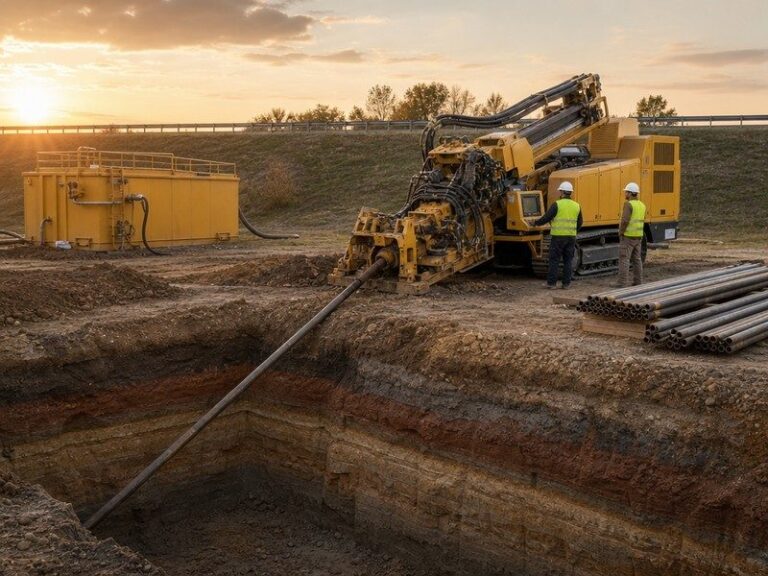
Horizontal directional drilling (HDD) can drill through nearly every soil type, from soft clay to coarse gravel, and through most rock formations, from weak shale to the hardest granites approaching or exceeding 30,000 psi. The real limits are rock strength, abrasiveness and fracturing, not the method itself.
The guidance reflects our field experience supporting pipeline construction, HDD crossings and trenchless repair projects across utility, oil and gas and infrastructure sectors.
- How HDD behaves in different soil and rock types
- How rock strength is classified and measured for bore planning
- Which downhole tooling makes rock drilling practical
- Which ground conditions remain difficult or uneconomical
How Does Horizontal Directional Drilling Behave in Different Ground Conditions?
Ground behaviour in HDD ranges from stable, self-supporting clays to collapsing sands and unsteerable boulder zones. Horizontal directional drilling (HDD), also called directional boring, is a steerable trenchless method that installs pipelines, conduits and cables along a controlled underground arc without open-cut excavation. The HDD rig rotates and thrusts a string of drill pipe while a bent-housing steering tool or a downhole mud motor deflects the bit, so the pilot hole follows the planned alignment. Drilling fluid carries cuttings back to the entry pit, stabilizes the open hole and lubricates the string during pullback.
The ground profile along the bore path dictates bit selection, penetration rate, the reaming schedule and pullback loads. That is why the first question on any HDD project is not pipe diameter but the soil and rock types the bore must cross. In our experience, a bore planned from a proper geotechnical investigation costs less and fails less often than one started on assumptions.
What Soil Types Can HDD Drill Through?
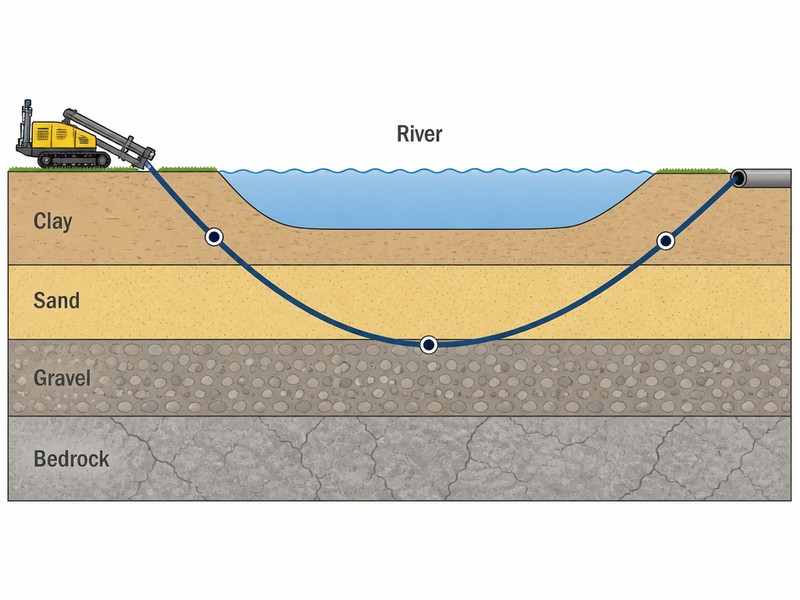
The soil types HDD can drill through span the full range of the Unified Soil Classification System (USCS), from fine-grained clays to coarse gravels. Each soil type imposes a different combination of hole stability, cuttings removal and steering response, which is why experienced crews classify the ground conditions before selecting tooling.
| Soil Type | USCS Class | Typical Drillability | Main Challenges |
|---|---|---|---|
| Clay | CL, CH | Good to excellent | Swelling clay can grip the drill string during pullback |
| Silt | ML, MH | Good | Low strength; hole can slump if fluid pressure drops |
| Sand | SP, SW | Good with fluid control | Borehole collapse and surface frac-out if mud properties are wrong |
| Gravel | GP, GW | Fair to good | Fluid loss into voids; cuttings settle around the string |
| Cobbles (75–300 mm) | — | Difficult | Steering deviation, bit damage, localized collapse |
| Boulders (>300 mm) | — | Very difficult to marginal | Stuck pipe, tool damage and unsteerable bores |
| Glacial till | Variable | Variable | Unpredictable mixes of clay, sand, gravel and boulders |
Clay and Silt
Clay is among the easiest ground for HDD. The borehole stays open, cuttings suspend well in the drilling fluid, and steering response is predictable. Highly plastic swelling clays (CH) are the exception: they can swell around the drill string and grip the pipe during pullback, so crews maintain circulation and keep the bore open with properly conditioned mud.
Silt behaves similarly but has lower strength and finer particles. If drilling fluid pressure drops, a silt bore can slump and bury the string. In soft silts we keep the bore fluid-supported from pilot hole to final ream and avoid long pauses between stages.
Sand and Gravel
Sand and gravel demand tighter drilling fluid control than clay. Cohesionless soils collapse into the borehole when fluid pressure is too low, and they lose fluid to surrounding voids when pressure is too high, which can produce inadvertent returns, known as frac-outs, at the surface. A well-built mud system with the right viscosity and gel strength bridges the gap between those two failure modes.
In our crossings through river gravels, we increase mud viscosity, maintain circulation until the reamer passes, and mix coarse sand and gravel into the cuttings train instead of letting it settle. Gravel can also pack around the string at the entry and exit pits, so crews flush the annulus continuously during pullback.
Cobbles and Boulders
Cobbles (75–300 mm) and boulders (over 300 mm) are the hardest soil materials for HDD. Scattered cobbles can usually be pushed aside or ground through, but a dense cobble or boulder zone can deflect the bit, stall rotation and make the pilot hole unsteerable. Boulders larger than about 300 mm are the point where many HDD contractors draw the line.
We are straightforward about this limit: some boulder fields simply cannot be crossed economically with HDD. When the geotechnical investigation shows a thick boulder bed, owners and engineers often switch to microtunneling or open-cut construction instead of risking a stuck string and a lost bore.
What Rock Types Can HDD Drill Through?
Rock drilling is routine in modern horizontal directional drilling. Sedimentary, metamorphic and igneous rocks are all drillable with the right combination of mud motor, rock bit and steering system, and the limits are set by rock strength, abrasiveness and fracturing rather than by the method itself.
| Rock Type | Category | Typical UCS | Drillability | Notes |
|---|---|---|---|---|
| Shale and mudstone | Sedimentary | 2,000–15,000 psi | Good | Can soften and swell on contact with water |
| Siltstone | Sedimentary | 5,000–15,000 psi | Good | Often interbedded with shale |
| Sandstone | Sedimentary | 5,000–20,000 psi | Good | Abrasive; accelerates cutter wear |
| Limestone and dolomite | Sedimentary | 5,000–25,000 psi | Good to fair | Karst voids cause severe fluid loss |
| Gneiss and schist | Metamorphic | 15,000–30,000 psi | Fair | Abrasive minerals shorten bit life |
| Granite | Igneous | 15,000–35,000 psi | Fair | Slow penetration; high cutter cost |
| Basalt | Igneous | 20,000–40,000+ psi | Difficult | High UCS and fractured columns |
| Quartzite | Metamorphic | 25,000–40,000+ psi | Difficult | Highly abrasive; near practical limit |
Sedimentary Rock: Shale, Sandstone and Limestone
Sedimentary rock is the most common rock crossed by HDD because it underlies most urban and riverine corridors. Shale and mudstone drill quickly but can soften or swell when exposed to water, so the mud system is adjusted to limit hydration. Sandstone drills well but its quartz grains wear cutters fast, and crews budget for more frequent bit changes.
Limestone presents a different risk. Karst limestone contains voids, solution channels and caves that can swallow drilling fluid and destabilize the bore. In karst terrain we plan for high fluid consumption, carry extra mud, and in severe cases re-route the bore around the void zone identified in the geotechnical investigation.
Metamorphic and Igneous Rock: Gneiss, Granite and Basalt
HDD drilling in hard metamorphic and igneous rock is possible but slow. Gneiss, granite and basalt typically range from 15,000 to over 40,000 psi compressive strength, which means penetration rates measured in feet per hour rather than the tens of feet per hour common in soil. The trade-off is usually economic, not technical.
For these rocks, crews run a mud motor with a rock bit, hold the bore path with measurement-while-drilling (MWD) steering, and ream in multiple passes with rock reamers fitted with tungsten-carbide cutters. A 1,000 ft crossing through granite can take weeks, so the method makes sense when the surface constraint, such as a protected river or a highway, justifies the cost.
How Is Rock Strength Measured for HDD Planning?
Unconfined compressive strength (UCS) is the standard measure used to classify rock for horizontal directional drilling. UCS is obtained from laboratory tests on core samples (e.g., per ASTM D7012), and the HDD industry commonly groups rock into four classes, shown below.
| Rock Class | UCS Range (psi) | UCS Range (MPa) | Typical Drilling Response |
|---|---|---|---|
| Soft rock | Under 5,000 | Under 35 | Drills with standard rock bits; fast progress |
| Medium rock | 5,000–15,000 | 35–105 | Mud motor recommended; moderate rates |
| Hard rock | 15,000–30,000 | 105–210 | Mud motor and rock reamers; slow progress |
| Very hard rock | Over 30,000 | Over 210 | Specialized tooling; feet per hour rates |
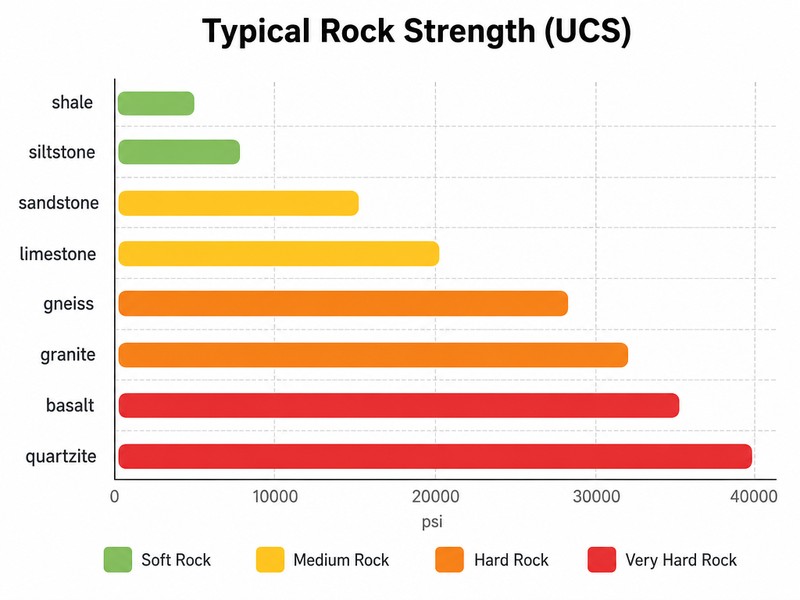
Two more numbers matter. Rock quality designation (RQD), the percentage of intact core pieces longer than 100 mm measured per ASTM D6032, indicates how fractured the rock is; heavily fractured rock loses drilling fluid and can collapse even when its UCS is high. The Cerchar abrasivity index (CAI) predicts cutter wear, which drives bit cost on abrasive sandstones and quartzites. Together, UCS, RQD and CAI define the boreability of a rock profile.
What Tooling Makes HDD Rock Drilling Possible?
Soil drilling uses simple jet bits steered by walkover locators, but rock changes the tooling list, and directional drilling in rock is a different discipline. Horizontal directional drilling through rock depends on five components.
- Mud motor: a positive displacement motor that rotates the bit without rotating the drill pipe, allowing a bent housing to steer through rock.
- Rock bits: slant-face and flat-face rock bits for pilot holes, plus roller-cone bits with tungsten-carbide inserts and PDC bits for harder rock.
- Rock reamers: prereaming tools with cutter assemblies that open the hole to the required diameter in successive passes.
- MWD steering: measurement-while-drilling tools transmit inclination and direction to the surface so the crew can steer in rock where walkover locators cannot see the bit.
- Fluid system: bentonite-based drilling fluid (drilling mud) with polymer additives, or foam in hard rock, to cool the bit, carry cuttings and stabilize the hole.
In our rock crossings, the mud motor and the rock reamer selection usually decide whether the bore finishes on schedule. Matching cutter type to the UCS and abrasivity measured in the geotechnical investigation is the single highest-leverage equipment decision on a rock drilling program.
What Ground Conditions Are Difficult or Impossible for HDD?
Honest capability statements matter more than marketing claims, so here is the list of conditions where HDD drilling struggles or fails.
- Dense boulder fields: boulders above about 300 mm deflect bits, stall rotation and can make the bore unsteerable.
- Karst limestone with large voids: drilling fluid disappears into caves and the bore can collapse.
- Heavily fractured or faulted rock: fluid loss and hole instability even at high UCS.
- Running sand: water-bearing cohesionless sand flows into the bore and buries the string.
- Highly swelling clays: ground movement can grip the pipe and prevent pullback.
- Abandoned mine workings and unknown voids: sudden loss of support and fluid.
- Very hard rock over very long bores: technically feasible but economically impractical.
None of these conditions automatically kills a horizontal directional drilling project; they change the risk profile, the tooling and the price. The professional approach is to define them in the contract before drilling starts, so ground-condition risk is shared explicitly rather than discovered as a change order. That is also why we always recommend a geotechnical investigation before finalizing a bore design.
Not sure whether your ground profile is drillable? Send us your geotechnical report via [email] or [phone] and our engineering team will confirm HDD feasibility as part of our free technical review, within five working days.
How Do Contractors Investigate Soil and Rock Before a Bore?
A geotechnical investigation converts unknown ground into a drillable plan for horizontal directional drilling. The scope depends on bore length, depth and diameter, but a standard HDD geotechnical program includes the following.
- Desk study and route walkover to identify known geology, utilities and sensitive areas.
- Soil borings with standard penetration tests (SPT) to log soil type and N-values along the proposed alignment.
- Rock coring with RQD logging and UCS laboratory testing where the bore enters bedrock.
- Fluid-loss and frac-out risk assessment for shallow crossings under roads, rivers and levees.
- Groundwater level measurement, which affects mud weight and hole stability.
Owners sometimes skip the investigation to save money. In our experience that saving is a false economy: the cost of one stuck string or one frac-out typically exceeds the full geotechnical program, and the delay damages the schedule far more than the survey would have.
HDD Soil and Rock FAQ
Can HDD drill through granite?
Yes. Horizontal directional drilling can bore through granite using a mud motor, a rock bit and MWD steering. Granite typically has a UCS of 15,000–35,000 psi, so progress is slow and cutter costs are high, but feasibility is proven on long crossings worldwide.
Can HDD drill through boulders?
Small scattered boulders can often be pushed aside or ground through, but dense boulder fields are the main limitation of the method. Boulders larger than about 300 mm can deflect the bit and stall rotation, and many contractors treat thick boulder zones as uneconomical or unsteerable, recommending microtunneling or open cut instead.
How fast can HDD drill through rock compared with soil?
HDD drilling in rock is typically an order of magnitude slower than in soil. In soil, a pilot bore can advance tens of feet per hour; in hard rock, rates of a few feet per hour are common, and very hard rock can fall below that. The schedule impact is why rock crossings cost more per foot than soil bores of the same length.
What is the hardest rock HDD can drill through?
Quartzite and basalt, with UCS values ranging from about 25,000 psi up to 40,000 psi or more, are near the practical limits for directional drilling. They are drillable, but the combination of strength and abrasiveness makes progress slow and tooling expensive, so feasibility depends on bore length, diameter and the value of the crossing.
Do I need a geotechnical survey before HDD?
Yes, for any bore longer than a few hundred feet or any crossing where the geology is unknown. The geotechnical investigation tells the contractor which soil and rock types to expect, what tooling to mobilize and how to price the risk; skipping it converts a manageable project into a series of expensive surprises. We review geotechnical reports as part of our free technical review — send yours with your bore plan.
What happens if the bore hits unexpected rock?
The contractor stops, reviews the drilling logs and usually switches tooling, for example from a soil bit to a mud motor with a rock bit. The change order covers the additional time and equipment, which is why ground conditions should be defined in the contract before drilling starts.
How JSW Supports HDD Projects in Every Ground Condition
JSW is a pipeline engineering and construction partner that supports owners and contractors across the full lifecycle of directional drilling and trenchless work. We provide pipeline construction services, trenchless pipeline repair technology and pipeline maintenance services. Our HDD support also covers pipeline automatic welding technology, pipeline cold bending and pipeline hot tapping and plugging services.
Our teams also supply the fabrication and tooling layer of the work, from pipeline hot tapping equipment and pipeline plugging pigs to pipeline cutting machines used to prepare pipe strings on the entry spread.
What distinguishes our support is integrated execution: bore planning that starts from the actual soil and rock profile, pipe string fabrication and welding coordinated with the reaming schedule, drilling fluid management that respects environmental limits, and restoration that returns the site to a defensible condition. We publish our engineering basis, document as-builts and price ground-condition risk explicitly rather than hiding it.
If you are planning a horizontal directional drilling crossing through difficult ground, contact our engineering team via [email] or [phone] with your bore plan and geotechnical data. We offer a free technical review and will respond with a scoped proposal within five working days.





































 English
  Arabic
  Russian
  Spanish
  French
  Vietnamese
  Polish
  Thai
Thai  Indonesian
  Turkish
  Portuguese