
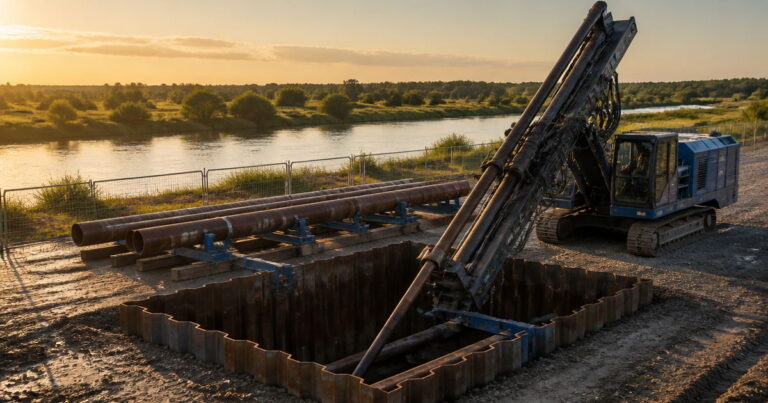
Oil and gas companies choose horizontal directional drilling for oil and gas pipelines because it takes the crossing off the surface: it avoids shutdowns and hot work on live systems, leaves right-of-way, crops and roads undisturbed, protects wetlands and watercourses, sets the pipe below river scour, and completes a long obstacle in a single bore.
Oil and gas owners specify horizontal directional drilling for oil and gas pipelines when a live system, a right-of-way, a wetland or a river bed cannot be crossed at the surface without an outage, a permit delay or a restoration claim. The unit rate is higher than open cut, so compare total installed cost against outage risk, permit conditions and restoration liability.
Why Horizontal Directional Drilling for Oil and Gas Pipelines Gets Specified at Project Level
- Schedule certainty at the constraint. A river or highway crossing sits on the critical path; if it slips, the spread moves with it.
- Surface goodwill. Open cut is visible and litigated; a drilled crossing is localised.
- Permit defensibility. No in-stream works, fewer conditions and post-commissioning obligations.
- Lower long-term exposure. Deeper, documented cover under the most erosion-prone feature.
Published estimates of the horizontal directional drilling market differ by scope, but most place it at roughly USD 5 billion to USD 11 billion in 2024 to 2025, forecast to roughly USD 9 billion to USD 16 billion by 2030 to 2033.
The method is rarely settled on the drilling rate; it is settled on a shutdown window, a restored access road, crop and tile drain compensation, and the risk that a permit condition pushes the crossing out of season. That is the frame owners use when they specify horizontal directional drilling for oil and gas pipelines.
Avoiding Shutdowns, Throughput Loss and Hot Work on Live Systems
HDD’s strongest case is brownfield and loop-line work, where the crossing is built across an operating system and open cut would force pressure reduction, isolation, purging and hot work permits.
- Lost throughput. An isolated line moves no nominated volume, and its value is project-specific.
- Contractual exposure. Firm transport and take-or-pay obligations convert an outage into a commercial claim.
- Hot work near a live corridor. Heavier permits, gas testing, fire watch and higher consequence.
The new crossing is drilled, welded and tested as a complete string while the existing system keeps running, so the live-line interface becomes a planned tie-in inside a window the operator chooses. On crossings we have supported, that sequencing was why horizontal directional drilling for oil and gas pipelines was selected; it converted an unplanned outage risk into a scheduled tie-in. Where the tie-in touches a live corridor, weld procedure and pressure control follow API RP 2201 practice. Our field teams set the tie-in window before the bore is priced.
Avoiding Open-Cut Restoration, Right-of-Way Damage and Landowner Compensation
Open cut is cheaper to excavate, rarely cheaper in total owner cost: it exports cost into restoration, compensation and time.
- Wider easements, with compensation changing from a crossing to a working strip for a season.
- Topsoil and drainage repair, including tile drain failures that surface for years.
- Fencing, gates and access road reinstatement across the working width.
- Pavement cutting and reconstruction where the crossing meets a highway.
- Traffic management and detours for the excavation duration.
The surface between entry and exit is never opened, so the negotiation is about a temporary site rather than a strip across the property. Every HDD pipeline crossing buys the same reduction in restoration liability.
Reducing public and stakeholder opposition to the route
Opposition is a project risk, not a communications problem: a crossing that visibly tears up a riverbank generates objections that follow the project into later permit hearings.
| Cost driver | Open cut | HDD | Who wins |
|---|---|---|---|
| Direct installation | Lower unit rate | Rig, fluids, guidance, skilled crew | Open cut on short, shallow runs |
| Surface restoration | Full working width plus pavement rebuild | Two compounds | HDD on paved or landscaped ground |
| Land and crop compensation | Strip easement plus multi-season yield claims | Temporary site at two locations | HDD on high-value farmland |
| Watercourse works | In-stream excavation, cofferdams, turbidity control | No in-stream work | HDD on regulated watercourses |
| Construction window | Tied to low-flow or seasonal windows | Decoupled from in-water timing | HDD when a missed window costs a year |
| Shutdown and throughput | Isolation, purge, hot work, repressurisation | Installed live, tied in on plan | HDD on operating systems |
| Geotechnical and design | Modest investigation; dig out surprises | Substantial front-end investigation | Open cut where ground is well known |
Protecting Wetlands and Watercourses to Protect the Permitting Programme
On a cross-country project the permit is often the longest lead item, and the method chosen at design stage decides how heavy it is. Open cut through a wetland or watercourse triggers temporary fill, bank disturbance, sediment control and years of restoration inspection.
- A narrower permit application with fewer regulated discharges and conditions.
- Freedom from in-water timing windows, a common reason a drilled crossing beats open cut on schedule.
- Fewer environmental commitments to fund, inspect and report after commissioning.
- Less restoration liability, because an untouched bank needs no monitoring.
In the United States, interstate natural gas projects reviewed by the Federal Energy Regulatory Commission (FERC) require an HDD monitoring plan and an inadvertent return contingency plan. In-stream work that HDD avoids still needs authorisation under the Clean Water Act framework administered by the US Army Corps of Engineers.
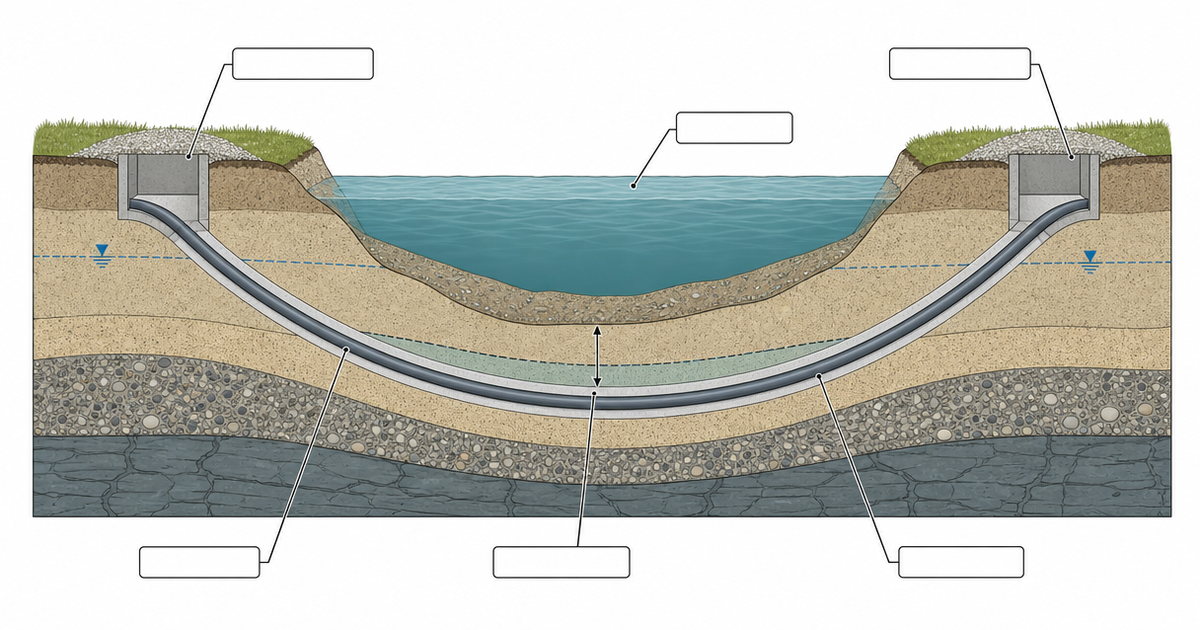
Burying Deep Beneath Rivers: Scour, Channel Migration and Single-Span Crossings
Flood flows scour a river bed downward, and channels migrate laterally. A pipeline buried at the surveyed bed elevation is exposed to both, and the answer is usually rock riprap, bank protection and inspection.
HDD inverts that exposure. Published practice for completed crossings sits at a depth-of-cover-to-diameter ratio around 1.5, assessed against maximum scoured depth, not the present bed. In the United States, federal rules for hazardous liquid pipelines require specific cover below the river bottom at inland water crossings wider than about 30 m (100 ft) from high-water mark to high-water mark. PHMSA has funded dedicated river scour research.
- Depth is engineered. Cover below maximum scour sets the bore length, entry angles and rig class.
- Cover is verified. As-built survey is the evidence a regulator will ask for years later.
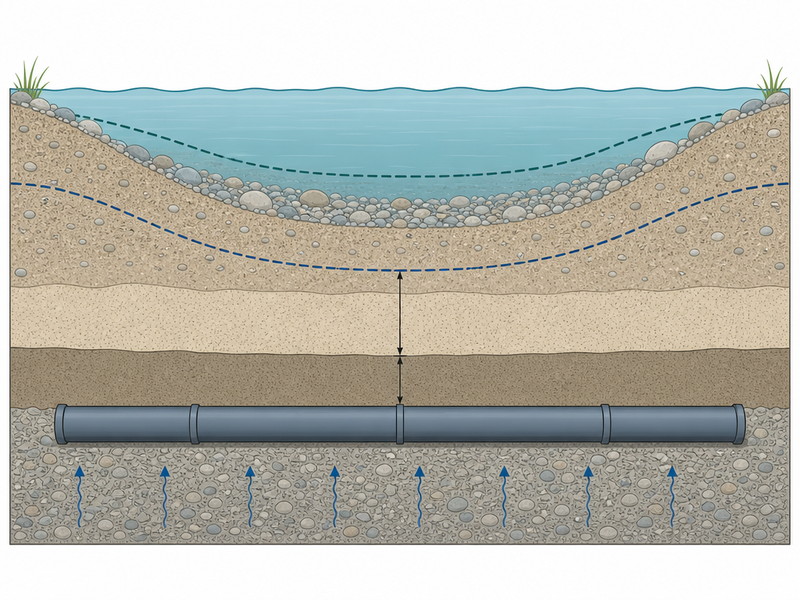
- Uplift is checked. A bored crossing in saturated ground is a submerged pipe, so cover-to-diameter and the weight of an empty string both matter.
A single bore routinely reaches 1.8 km and beyond, so a wide river, its floodplain and a levee are crossed as one item, without a second in-water season.
Supporting Integrity Goals: Deeper Cover, Third-Party Damage and ILI Access
- Third-party damage resistance. Excavation damage is a leading cause of serious pipeline incidents, and damage probability falls with depth. The crossing gains deeper, documented cover where a future repair would be hardest.
- Piggability and ILI access. The crossing is welded on the surface into one continuous string and pulled through, so it holds fewer girth welds, each made in a controlled position, and the whole length is pressure-tested with the installed line under the applicable code (ASME B31.4 or B31.8 by service).
An HDD crossing is curved, and an inline inspection tool can only pass a bend of a given radius for a given tool length. If the arc is not checked against the intended tools, the crossing cannot be fully inspected – a permanent constraint. State the minimum bend radius and verify it on as-built.
The Honest Counter-Case: Where HDD Loses on Cost, Schedule and Certainty
What makes an owner choose open cut instead of horizontal directional drilling?
We have seen specifications that assume HDD is automatically cheaper, and they hide the risk in a contingency line.
- Higher unit cost on short, shallow runs. Rig transport, crew, pits and fluid handling are largely fixed, so over 60 m they can make HDD several times the open-cut rate.
- Inadvertent return and frac-out risk. Fluid reaching the surface or a watercourse is the defining environmental risk, highest in shallow cover and high-permeability ground.
- Geological uncertainty. The bore cannot be inspected before it is drilled; cobbles, boulders, karst and squeezing ground are discovered by the reamer.
- Higher technical and supervision demand. Fluid engineering, guidance and pullback control need experienced supervision, and failures are expensive to recover.
- No gravity grade. The method cannot hold a constant fall, so it is unsuitable for any line drained by gradient.
- Fluid, cuttings and contingency obligations. A regulated waste stream with a disposal route, priced standby for a stuck tool or lost bore, and non-zero compound reinstatement.
Choose HDD When, Choose Open Cut When: A Decision Table with Risk
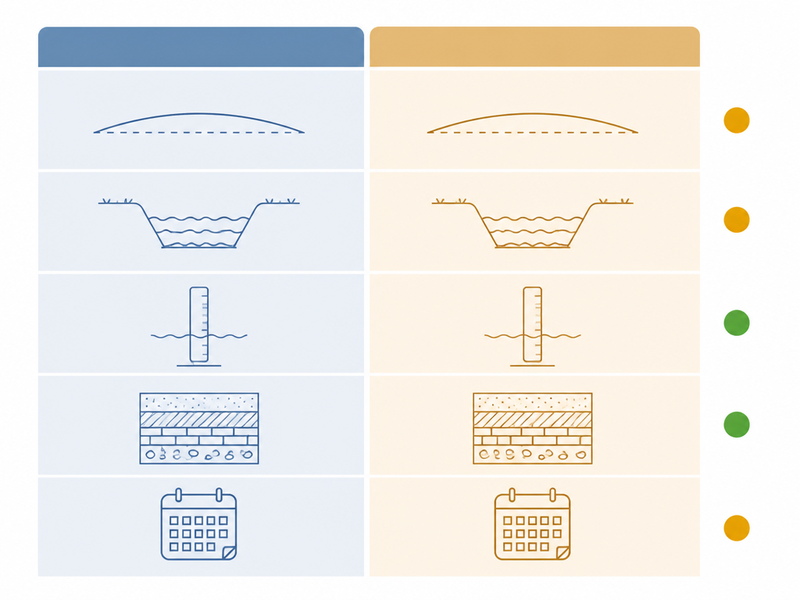
| Input | What it changes | Who holds it |
|---|---|---|
| Outage or throughput cost | Whether a shutdown is available at all, and what a day of it costs | Operations |
| Permit conditions and season | Whether in-stream or wetland work is allowed, and in which window | Environment and permitting |
| Restoration and landowner liability | The real cost of an open trench across crops, roads or gardens | Land and stakeholder team |
| Scour and channel-migration data | The burial depth HDD must achieve to stay below the design event | Hydraulics and civil design |
Method selection should be recorded with a reason and a named residual risk, not a preference.
| Condition | Choose HDD when | Choose open cut when | Residual risk if wrong |
|---|---|---|---|
| Crossing length | Long, multi-feature crossings and spans past 1.8 km | Short crossings needing hours of trenching | Under-drilling adds permits and seasons; over-drilling wastes mobilisation |
| Watercourse or wetland | Any regulated in-stream or wetland crossing | Dry, unregulated drainage | Open cut turns a programme item into a seasonal permit item |
| Depth of cover | Cover must sit below maximum scoured depth | Normal 0.9 to 1.2 m cover on stable ground | Shallow placement under a mobile bed creates permanent scour obligations |
| Live system nearby | Isolation or hot work on an operating line is unacceptable | The line is already out of service | Open cut beside a live line imports shutdown risk |
| Ground conditions | Clay, silt, sand or soft to medium rock, confirmed by investigation | Cobbles, boulders or karst the bore cannot rely on | Drilling without ground data causes stalled or lost bores |
| Alignment and grade | Pressure service where flow does not depend on fall | Gravity service needing a constant fall | HDD on a gravity line produces a crossing that cannot drain |
Regulatory and Permitting Drivers Owners Should Plan Around
Regulation rarely forces HDD, but it tilts the comparison, pricing activities that open cut must perform and that horizontal directional drilling for oil and gas pipelines can avoid. For interstate natural gas projects in the United States, environmental review and construction conditions are set by the Federal Energy Regulatory Commission. Pipeline safety requirements sit with the Pipeline and Hazardous Materials Safety Administration under the federal pipeline safety rules, supported by ASME B31.4 for liquid lines, ASME B31.8 for gas lines and API 1104 for weld acceptance. State agencies add conditions on top.
- Inadvertent return detection with stop-work thresholds.
- Pressure and return-volume monitoring retained as evidence.
- Environmental inspection with stop-work authority.
- Hydrostatic testing of the completed crossing.
- Clean Water Act authorisation for any remaining in-stream work.
What an Owner Should Require in an HDD Scope and Bid
How does an owner price the risk of an HDD river crossing?
The most effective way to protect the outcome is to write the obligations that govern horizontal directional drilling for oil and gas pipelines into the scope, so they are priced rather than discovered. Their absence predicts a difficult HDD pipeline crossing, a disputed right-of-way settlement, or a river crossing that misses its season.
- A defined geotechnical investigation with borehole spacing and depth agreed before the alignment is fixed.
- A fluid and cuttings management plan covering density control, recycling, testing and a licensed disposal route.
- An inadvertent return contingency plan with numeric stop-work triggers and containment materials on site.
- A monitoring plan stating what is recorded, at what interval, by whom and where records are held.
- Pullback and pipe stress analysis with an agreed maximum pull load and a described swivel and roller arrangement.
- Minimum bend radius stated against the intended ILI tools, so the crossing stays piggable.
- As-built survey and guidance records showing bore profile and achieved cover.
- API 1104 weld acceptance with the non-destructive testing level, coverage and reporting stated.
- Priced contingency and standby rates for stuck tooling, lost bore and extended fluid handling.
- Single-point responsibility for permitting support, environmental compliance and compound reinstatement.
Our field teams answer these with costed lines, because a bid that answers with narrative leaves the risk unpriced.
Scope of Application: When Owners Should Specify HDD
Owners should specify horizontal directional drilling for oil and gas pipelines where the crossing cannot be opened without unacceptable outage, permit or restoration consequences, and where the ground, diameter and length fall inside the method’s envelope.
- Specify HDD for river, wetland and live-corridor crossings where open cut is not permitted or not affordable.
- Compare both where a short land crossing has space for a trench and no live system to protect.
- Do not force HDD where diameter exceeds roughly 1,200 mm, the ground is loose gravel or cobbles, or a gravity line must hold a constant fall.
How This Changes by Project Role
How should an owner compare HDD with open cut on a pipeline project?
Compare total installed and whole-life cost, not unit rate, and put outage risk, permit conditions and restoration liability in the same table as the construction price.
What should a project engineer document to defend the crossing method?
Document the constraints that made open cut unavailable – throughput, permits, season, stakeholders – because that record is what justifies the method later.
What should an operations engineer check in an HDD river crossing design?
Check that the burial depth sits below the design scour, that ILI access and inspection are preserved, and that the tie-in sequence protects a live system.
Frequently Asked Questions
Why do oil and gas companies choose HDD for river crossings?
Because HDD places the pipe below the mobile river bed in one continuous bore. That removes in-stream construction, keeps the crossing below the depth regulators assess against maximum scour, and avoids a construction window tied to low-flow periods. For a pressure line, the loss of precise grade is not a functional penalty.
Is HDD more expensive than open-cut construction for pipelines?
On a direct unit basis, usually yes, and the gap is worst on short, shallow runs where set-up cost cannot be spread. Published modelling of large transmission routes has put whole-route HDD at roughly 1.1 to 1.9 times cut-and-cover cost, and a published academic comparison of a 1,000 m water main found a premium of about 12.5 percent. At project level the comparison only holds when restoration, compensation and schedule exposure are priced in.
What is frac-out and how is it managed on a pipeline crossing?
Frac-out, or inadvertent return, is drilling fluid escaping from the bore to the surface or into a watercourse when annular pressure exceeds the confining strength of the ground above the hole. Management is a planned package: fluid density control, pressure and volume monitoring, shallow-cover avoidance, agreed stop-work triggers, on-site containment and permit notification duties.
What should an owner require in an HDD bid package?
At minimum: a defined geotechnical investigation, a fluid and cuttings management plan, a written inadvertent return contingency plan with stop-work triggers, and a monitoring plan. Add pullback and pipe stress analysis, an as-built survey with guidance records, priced contingency and standby rates, and API 1104 weld acceptance with a stated non-destructive testing level.
Does HDD reduce long-term pipeline integrity risk on a crossing?
It can, mainly through deeper controlled cover and a better-documented installation. Deeper cover lowers exposure to third-party excavation damage, and the crossing is installed as one welded string with the whole length pressure-tested after installation. The caveat is design discipline: bend radius must suit the inline inspection tools the owner intends to run, so the crossing stays piggable for life.
Key Takeaways
- Owners specify horizontal directional drilling for oil and gas pipelines for its effect on the risk register: schedule certainty at a critical-path crossing, less surface disruption, a lighter permit and lower long-term integrity exposure.
- The strongest case is on operating systems and regulated watercourses, where open cut forces shutdown, hot work and a seasonal window.
- HDD cannot hold gravity grade, and it carries unit-cost premiums on short shallow runs, plus inadvertent return, geological uncertainty and fluid disposal obligations.
- Every HDD pipeline crossing decision should be recorded with a named residual risk; under-drilling a long regulated river crossing and over-drilling a short dry one are both project-level errors.
How JSW Supports Oil and Gas Pipeline Owners on HDD Crossings
JSW is a pipeline engineering and construction company that delivers horizontal directional drilling for oil and gas pipelines with its own crews and equipment rather than reselling it. Our scope covers HDD crossing services, trenchless technologies including the alternatives we compare against HDD, automatic pipeline welding for the surface string and tie-ins, pipeline inspection services for the integrity baseline, and the full boru hattı döşeme hizmetleri chain that connects them.
Because we plan, engineer and execute the work ourselves, our recommendations reflect site and permit conditions rather than catalogue pricing, and we will recommend open cut where HDD does not earn its premium on your alignment. We price risk explicitly and record the process data a regulator or integrity group will later ask for.
- Integrated delivery: engineering, drilling, welding, installation, testing and restoration under one scope.
- Auditable process data: pullback load, fluid pressure and volume, guidance records, bore profile and as-built cover.
- Risk-explicit pricing: priced contingency and standby lines plus a documented inadvertent return plan.
- Compliance and safety: work planned against the applicable pipeline safety, weld acceptance and environmental requirements.
Choosing between HDD and open cut for a river, wetland or highway crossing? Send your alignment, pipe specification, geotechnical information and known permit conditions for a free technical review. Our engineers return a scoped recommendation, the residual risks attached to it, and a budget range.





































 English
  Arabic
  Russian
  Spanish
  French
  Vietnamese
  Polish
  Thai
Thai  Indonesian
  Turkish
  Portuguese