
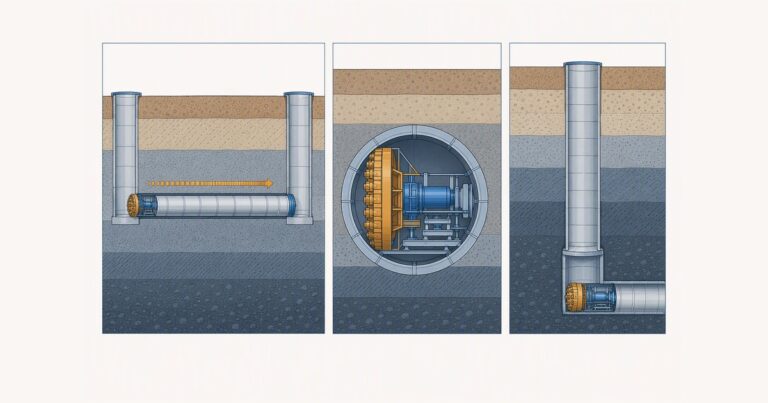
Published microtunneling records are claims, not certificates: about 7,369 ft (2,246 m) for the longest drive worldwide, 5,600 ft (1,707 m) in North America, and 3.4 m (11.2 ft) inside diameter for the largest microtunnel. No recognized depth record exists.
If you are weighing a microtunneling records figure against your own drive, the definition matters more than the number. This page collects the longest drives, the largest diameters and the deepest documented work for your own comparison, names whoever reported each figure, and separates what a claim proves from what it does not. Every number comes from published industry reporting, and none has been certified by an independent body, so each figure is used as engineering case data with a scope attached.
What Counts as a Microtunneling Record?
A record has no meaning unless its definition travels with it. Drive length depends on diameter, ground, pipe material, curve count and whether the crossing is single pass or two pass, so two drives of equal length can sit at opposite ends of the difficulty scale. The reason is mechanical: jacking force grows with the pipe surface area in contact with the ground, so a short large drive and a long small one can demand comparable thrust. Five parameters must accompany any figure:
- Finished inside diameter, not the excavated diameter.
- Pipe material and class: concrete jacking pipe, steel casing or fiber reinforced pipe.
- Single pass or two pass: whether the jacked pipe is the permanent carrier or a sleeve.
- Ground conditions, and whether the drive sits above or below the water table.
- Curves: how many, and at what radius.
ASCE/CI 36-15 states that microtunneling describes a method and does not impose size limitations on diameter, while market convention puts standard jacking pipe at 150 mm to 2,400 mm. In trenchless technology, a claim describes a method and site conditions, not a universal limit.
What Is the Longest Microtunneling Drive on Record?
The longest figure in circulation is Terratest’s Altamira Landfall crossing in the Gulf of Mexico, reported in trade press as a 7,369 ft drive of 10.5 ft diameter pipe. The newest North American claim is a 5,600 ft drive on Winnipeg’s Ferry Road storm sewer, announced by the contractor on 31 August 2026.
The two longest microtunneling drive claims have little in common. The Winnipeg drive used 2,400 mm pipe and ran 24 hours a day for 16 weeks. It carried two curves on 500 m radii, and crossed ground where the contractor reports 10 to 15 boulders crowding the face at once.
| Drive | Reported by | Çap | Length | What makes it notable |
|---|---|---|---|---|
| Terratest Altamira Landfall, Gulf of Mexico | Trade press, 2019 | 10.5 ft | 7,369 ft | Longest figure in circulation; quoted second hand |
| Ferry Road storm sewer, Winnipeg | Contractor, 2026 | 2,400 mm inside | 5,600 ft (1,707 m) | Two 500 m radius curves; boulder rich ground |
| Painesville intake, Ohio | Trade press, 2019 | 60 in. | 3,947 ft | Under Lake Erie; 67 ft shaft; full face shale |
| East Side CSO, Portland, Oregon | Trade press, 2019 | 84 in. | 3,000 ft | Held the US length record from 2008 until 2019 |
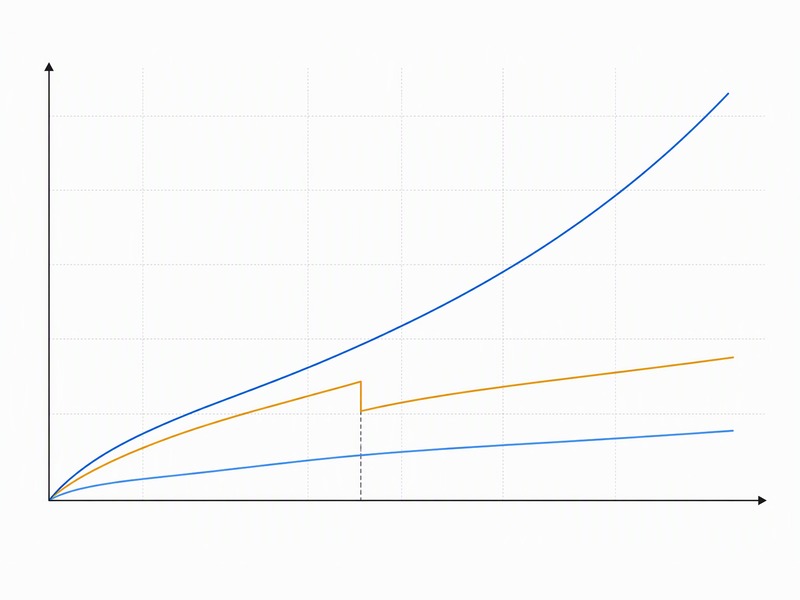
Indicative jacking lengths bound those figures: about 150 m at diameters under 0.9 m, 450 m at 1.2 m and 2,000 m at 2.4 m. Lengths can exceed 1 km, but only after project specific risk analysis.
What Is the Largest-Diameter Microtunnel Ever Built?
The largest diameter microtunnel reported in North America is the 3.4 m (11.2 ft) inside diameter stormwater trunk on Calgary’s Northwest Inner City Upper Plateau Separation Project. That pipe is a single 760 m drive completed in December 2022. The engineering firm that led the design reported it that way.
Size was not the hardest part. The alignment crossed roughly 550 m of full face bedrock, an 80 m transitional zone and about 135 m of cohesionless channel fill, all below the water table. A microtunnel boring machine (MTBM) working at that section needs cutter access designed in from the start, because intervention underground is the risk that cannot be recovered.
| Item | Reported by | Diameter (basis) | Scope note |
|---|---|---|---|
| Calgary Upper Plateau Separation | Engineering firm on the project | 3.4 m (3,400 mm) minimum inside | Reported as North America’s largest diameter microtunnel |
| South Surrey Interceptor, Metro Vancouver | Concrete pipe association | 3 m inside | Reported as Canada’s largest diameter microtunneling project |
| Metropolitan Water District, California | 2025 job log | 120 in. OD steel casing | Machine upsized to a 123.5 in. cutting diameter |
| Slurry machines with cone crusher | Manufacturer literature | 0.4 m to about 4 m cutting diameter | Equipment market statement, not a claim |
Two competing “largest” claims coexist because the scopes differ. Diameter also stresses pipe supply more than machine capability: the Metro Vancouver pipe was designed to resist more than 4,000 tons of jacking force.
What Is the Deepest Microtunneling Drive?
Microtunneling records for depth do not exist, and the reason is structural: depth is set by the launch and reception shafts, not by the machine. A machine that can drive 1,000 m horizontally will work at 30 m depth unchanged. The constraint is excavating, sealing and dewatering a shaft that deep, and building a thrust wall able to take the reaction.
Published depth figures cluster around shaft engineering rather than machine limits:
- Atoka Pipeline, Oklahoma: two 34 ft diameter shafts to a final shaft depth of 125 ft.
- North City Pure Water, San Diego: drive depth up to 90 ft, with underwater machine retrieval.
- Tampa, Clarksville and Painesville: shaft depth 80 ft for launch shafts, and a 67 ft shaft with the drive about 25 ft below the bottom of Lake Erie.
Shaft design tables cover dry ground to about 15 m for sheet piled shafts and 20 m for secant piled shafts, the point where shaft cost and groundwater control dominate. Deep shafts lengthen the string to steer and slow any rescue, so shaft depth and diameter are inseparable from recovering the microtunnel boring machine.
How Are Microtunneling Records Reported and Verified?
In the ordinary case they are not verified at all: claims reach the public through four channels of differing weight.
- Annual job logs: compiled by trade publishers from project submissions; reliable on scope and parties.
- Contractor announcements: a party reporting its own drive.
- Manufacturer statements: a machine supplier reporting a drive that used its microtunnel boring machine.
- Engineering papers: the most detailed trenchless technology source, and the most self critical.
The Winnipeg tally of more than 2,000 boulders is the contractor’s estimate, not a measurement. The Irving, Texas claim of a 2,100 lf single drive is stated as the longest using fiber reinforced Hobas pipe across all diameters, true within that scope and meaningless outside it.
Bottom line: we have seen these microtunneling records cited as engineering case data without the scope attached. In trenchless technology the scope is the claim, so always ask which definition the number was earned under.
Why Is Drive Length Harder to Achieve Than Diameter?
Diameter is a supply question; length is a force question. As a drive advances, friction accumulates along the full external surface of the pipe string and the jacking frame must overcome all of it. Frictional forces in pipe jacking typically run between 0.5 and 2.5 tonnes per square meter of external circumferential area, and lubrication can reduce that to as little as 0.1 tonnes. Pipe jacking design is therefore driven by lubrication and thrust wall capacity rather than by diameter.
Three consequences explain almost every long drive above:
- Lubrication becomes a discipline. A tenfold friction reduction is the difference between a long drive and a stalled one.
- Intermediate jacking stations become necessary. Nine of twelve drives on the Western Bays scheme exceeded 1,300 ft, which drove that decision.
- Stoppages are expensive. On the Jacko Lake drive in British Columbia, the contractor reported that stoppages exponentially increased skin friction, forcing a change to the mud design and jacking stations.
Curves compound all three effects: every extra meter adds pipe contact, another chance for the annulus to collapse, and more guidance drift.
What Do These Records Tell You About Your Own Drive?
Very little about feasibility, and a great deal about what to check. These microtunneling records prove a combination was achievable once, under conditions the reporting party documented.
Scope: a published figure describes one combination achieved once. Confirm the diameter, pipe class, curves and water table against your alignment.
In our bid reviews, the most common error is treating a published longest microtunneling drive figure as a target rather than a ceiling. The frame a designer can work with is the indicative jacking length for your nominal diameter, paired with the thrust your shaft and pipe class can resist. When a record figure disagrees with both, the record loses, and a largest diameter microtunnel claim is equally conditional: a microtunnel boring machine sized for one diameter band will not stretch to another without new tooling.
- If your drive is 1,700 m at 2.4 m diameter, does the published record tell you it is achievable, and under what conditions was it done?
- If your drive is 400 m at 3 m diameter below a water table, what does the record leave for your own design to resolve?
Key Takeaways
- These microtunneling records are reported claims, not certified measurements, and trenchless technology has no body that certifies them.
- The longest drive in circulation is about 7,369 ft in the Gulf of Mexico; the newest North American claim is 5,600 ft in Winnipeg.
- The largest diameter microtunnel in North America is the 3.4 m inside diameter Calgary trunk, a single 760 m drive.
- There is no depth record, because depth is governed by shaft construction.
- Our field teams record that length is the hardest claim to hold, because jacking friction accumulates along the whole pipe string.
- Read every number with its scope: diameter, pipe class, curves and water table decide its meaning.
Frequently Asked Questions
What is the longest microtunneling drive ever completed?
The longest figure quoted is about 7,369 ft of 10.5 ft diameter pipe on the Altamira Landfall crossing. The newest North American claim is a 5,600 ft drive of 2,400 mm pipe on Winnipeg’s Ferry Road storm sewer, announced on 31 August 2026. Neither has been certified independently.
What is the largest diameter microtunnel in North America?
A 3.4 m (11.2 ft) inside diameter stormwater trunk on Calgary’s Northwest Inner City Upper Plateau Separation Project, completed in December 2022. Metro Vancouver’s South Surrey Interceptor, with 3 m inside diameter pipe, was reported separately as Canada’s largest, so the two claims differ by scope and date.
Is there a depth record for microtunneling?
No. Depth is set by shaft construction rather than by the machine. Documented deep work includes drive depths up to 90 ft on San Diego’s North City Pure Water pipeline and 80 ft shafts in Tampa and Clarksville. The Atoka crossing used 34 ft diameter shafts to 125 ft.
Who certifies a microtunneling record?
Nobody, in the ordinary case. Claims come from the four channels above. No body in trenchless technology certifies drive length, diameter or speed, so treat every microtunneling records claim as engineering case data with a scope attached.
Why is drive length harder to achieve than diameter?
Because length accumulates friction. Frictional forces in pipe jacking run roughly 0.5 to 2.5 tonnes per square meter of external circumferential area, reducible to 0.1 tonnes with lubrication. Diameter sets available thrust and pipe strength; length decides how much thrust is spent before breakthrough.
Do large diameter microtunnels need intermediate jacking stations?
Often, when the drive is long as well as large. On the Western Bays scheme in New York, nine of twelve drives exceeded 1,300 ft, which drove the decision to use them. Stations add cost and a stop in the pipe jacking sequence, so the decision is taken on calculated friction rather than diameter alone. Guidance on trenchless technologies sets the wider context.
Does a record drive prove the same thing is possible on my alignment?
No. Microtunneling records prove that a combination was achievable once, under documented conditions. Check the finished diameter, pipe class, pass count, curves and water table before treating a published longest microtunneling drive figure as evidence about your own drive. Confirm that the machine can be mobilized within your thrust and torque envelope.
How JSW Supports Projects Like These
JSW is a pipeline engineering and construction company that executes trenchless crossings with its own crews and equipment. Our scope covers microtunneling construction, trenchless technologies, horizontal directional drilling services, boru hattı döşeme hizmetleri and pipeline inspection services.
We do not quote microtunneling records as capability. What we offer is a drive assessment built on the same figures: the indicative jacking length for your nominal diameter, the thrust your shaft can resist, and the friction your ground is likely to develop. That assessment also selects the microtunnel boring machine, because machine choice follows the thrust and torque envelope, not the headline diameter.
- Integrated delivery: design, shaft construction, jacking and carrier pipe installation under one scope.
- Auditable process data: jacking force, guidance deviation, lubrication volume and advance rate logged as the drive proceeds.
- Risk-explicit pricing and compliance: obstructions, mixed face and groundwater control priced as identified risks, delivered under ISO 9001:2015, ISO 14001:2015 and ISO 45001:2018 certified management systems.
Planning a drive and unsure whether the length is achievable? Send your alignment, nominal diameter, pipe class and geotechnical report for a free technical review. Our engineers respond with a scoped recommendation and budget range.
Sources and Standards
Project and record data on this page is drawn from published industry reporting. The annual North American Microtunneling Job Logs are compiled by Trenchless Technology. Trade press reporting supplies the record drives, and contractor, pipe supplier and engineering paper accounts supply the rest.
Standards referenced in the text are ASCE/CI 36-15, Pipe Jacking Association guidance on jacking lengths, friction, overcut and shaft design, NASTT good practice material, and EN 12889. No external link or citation marker is used, so readers can verify figures against the original publications.





































 English
  Arabic
  Russian
  Spanish
  French
  Vietnamese
  Polish
  Thai
Thai  Indonesian
  Turkish
  Portuguese