
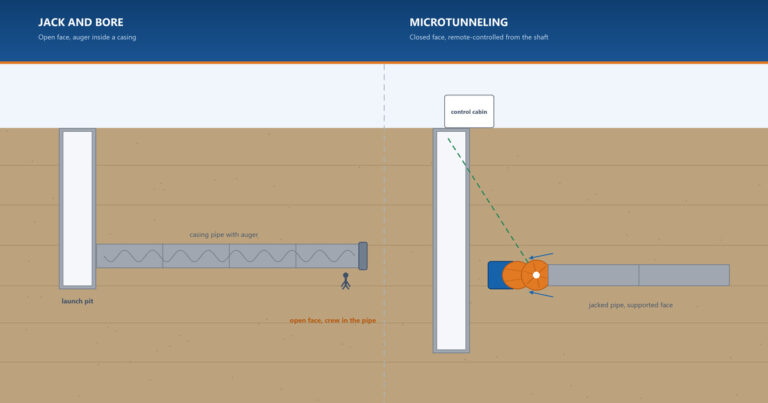
In the microtunneling vs jack and bore decision, the ground decides before anything else – jack and bore suits short, straight, dry drives in stable soil above the water table, while microtunneling suits longer drives, controlled grade, and ground below the water table or containing cobbles and boulders.
The two methods are compared below as a ground-first decision: water table and soil stability first, then cobbles and boulders, grade control, diameter and drive length. A ground decision matrix and a decision flow follow.
Which Method Suits Which Ground?
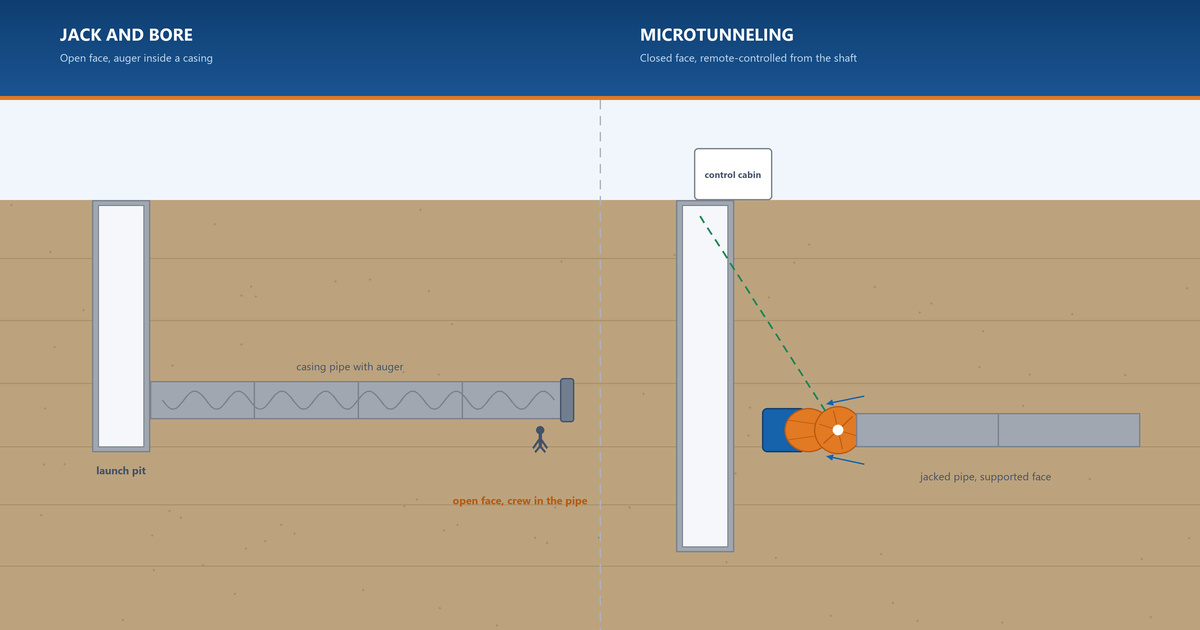
Jack and bore suits short, straight, dry drives in self-supporting soil above the water table; microtunneling takes over below the water table, in running ground and where a tight grade must hold. Jack and bore – also called auger boring – cuts an open face inside a casing pipe and removes the spoil with a rotating auger, whereas microtunneling cuts a closed face under remote control and supports it continuously. That single difference sets which ground each can handle.
- Jack and bore fits: short, straight drives; stable, self-supporting soil; ground above the water table; a casing large enough for a crew to enter.
- Microtunneling fits: longer drives; a grade that must be held tightly; unstable, running or water-bearing soil; and ground with boulders and cobbles that would stop an auger.
Where those overlap – a short, dry, stable drive at a generous diameter – jack and bore is usually the simpler and cheaper option.
Bottom line: read the geotechnical report for water table and soil stability first; those two answers decide most of these projects before cost is discussed.
How Jack and Bore Removes Spoil
Auger boring drives a casing pipe through the ground with a rotating auger inside it. The auger carries spoil back to the pit, and the casing holds the hole open behind the face. Because the face is open, a crew can enter the casing to work at it – which is both the method’s strength and its hard limit.
Microtunneling works the other way round. A microtunnel boring machine excavates with a closed cutterhead, and slurry or earth pressure balance provides face support. The machine is steered and monitored from the surface, so nobody enters the drive; the working definition is set out in microtunneling vs pipe jacking. For the wider family of trenchless options this sits within, see what trenchless technologies are.
The practical consequence is simple: jack and bore depends on the ground standing up by itself, while microtunneling creates the support the ground cannot provide.
Which Ground Conditions Decide Microtunneling vs Jack and Bore?
In the microtunneling vs jack and bore decision, the matrix below maps the ground conditions that most often decide a method, following the soil and rock descriptions used in ASTM D653.

| Ground condition | Jack and bore / auger boring | Mikrotünel açma | Failure mechanism |
|---|---|---|---|
| Stiff clay, dry silt | Suitable, and usually the lower-cost option | Suitable; a closed face handles the clay well | Rare; the face stands |
| Dense, dry sand and gravel above the water table | Suitable where the face holds | Suitable; slower but more controlled | Face dries and runs |
| Running or water-bearing sand | Requires dewatering and a stable open face | Preferred: mechanical face support | Inflow softens the face |
| Below the water table | Only with full dewatering | Preferred: a closed face | Inflow softens the face |
| Soft rock, weathered rock | Possible only at low strength and short length | Suitable with a rock cutterhead | No self-support |
| Hard rock, long drive | Not practical | Possible but slow; cutter wear dominates | Cutter wear and jacking force |
| Boulders and cobbles | High risk: a boulder above 305 mm (12 in.) stops the auger | Handles up to roughly 30 percent of the face | Obstruction stops the auger |
| Mixed face (rock and soil) | Not suitable | Difficult, but manageable | Face not held evenly |
Bottom line: match the method to the worst ground along the drive, not the average – one cobble band or one wet lens is enough to rule jack and bore out.
The Water Table Is the Hard Line
Applicability – open-face methods: self-supporting ground above the water line, stable enough to stand unsupported for the drive length. Every other case: a machine that supports its face continuously.
The groundwater table is the single most useful dividing line in this comparison. Above it, an open face in stable soil can stand long enough for a crew to work. Below it, water flows into the face, softens the soil and starts to run.
That is why soil stability and the position of the groundwater table are read together. Jack and bore has no way to hold back water at the face; microtunneling holds it back by pressure, using slurry or an earth pressure balance chamber, so it can drive below the groundwater table without dewatering the whole alignment.

| Question | Jack and bore | Mikrotünel açma |
|---|---|---|
| Face type | Open | Closed |
| Above the water table, stable soil | Preferred method | Suitable |
| Below the water table | Not suitable without dewatering | Viable with face support |
| Dewatering | Often required; adds cost and a discharge permit | Usually avoided |
| Collapse risk | High in running ground | Controlled by face pressure |
Confined water and the seasonal line. Design against the seasonal high water level and any piezometric head (typical published industry ranges), not the level recorded on the day of the investigation. In a confined aquifer the piezometric level can stand above the tunnel invert, so water rises into the drive even where the face looks dry. Where the piezometric level is above the invert, specify a method with a pressurised face. Perched water above the main water table behaves the same way on a smaller scale.
Rule: where the piezometric level stands above the tunnel invert, the drive needs continuous support at the face; perched water alone changes the dewatering plan, not the method.
Bottom line: jack and bore needs a dry, stable face above the water table; microtunneling is the option once the face is below it. Safe dewatering is the only exception, and it is rarely practical in an urban corridor.
Do Cobbles, Boulders and Mixed Face Rule Out Jack and Bore?
Obstructions are where jack and bore fails most sharply. A boulder cannot pass through an auger, and a cobble band can stall the casing. Clearing an obstruction means sending a crew into the casing, which is slow and carries its own risk.
The size threshold is set by definition: ASTM D653 puts the limit at 12 in. (305 mm). Anything at or above that size is an obstruction rather than spoil, so it has to be broken or removed.
Microtunneling approaches obstructions differently. On a closed-face machine, the correct cutterhead can handle obstructions up to roughly 30 percent of the exposed face area, and it removes them through the excavation circuit. Large obstructions still slow the drive and raise cutter wear, but they do not stop it outright.
A single obstruction band is enough to move the drive to a machine that supports its own face.
Grade Control: Can Jack and Bore Hold a Sewer Grade?
Accuracy tracks the machine and the ground: guided slurry and pilot tube systems typically hold line and grade to roughly 10-25 mm, while jack and bore typically holds about ±50-100 mm and depends on the open face, the operator and how the casing reacts to the drive.
The mechanism explains the gap. A microtunneling machine is a steerable shield; an auger head is pushed on a pre-set line and cannot correct much once the casing has wandered. For a gravity sewer on a shallow grade, that difference decides the method.
For a microtunneling vs jack and bore comparison on a gravity line, grade control is usually the deciding criterion rather than cost.
The neighbouring comparison with drilling is set out in microtunneling vs HDD: the key differences.
Where Do Diameter, Drive Length and Worker Entry Set the Limit?
Because a crew must enter the casing to remove the auger and work at the face, jack and bore needs a casing pipe of roughly 42 in. (1,050 mm) or larger. Microtunneling is remotely controlled, needs no entry, and can work down to about 10 in. (DN250).
| Boundary | Jack and bore | Mikrotünel açma |
|---|---|---|
| Minimum practical diameter | About 42 in. (1,050 mm) | About 10 in. (DN250) |
| Typical drive length | Short, in the tens of metres | Set by jacking force for the machine size |
| What limits length | Line and grade, spoil removal | Jacking force, pipe compressive capacity |
| Entry requirement | Crew enters the casing pipe | Remote; no entry |
Drive length is a jacking-force question, and the force envelope for each machine size – including intermediate jacking stations – is set out in microtunneling vs pipe jacking. On the ground side, jack and bore is held to short drives by its line-and-grade behaviour, not by a documented force limit.
In the microtunneling vs jack and bore choice, this is what puts small-diameter and long drives firmly on the microtunneling side.
Cost and Risk: Where the Cheap Bid Gets Expensive
Cost follows the ground here, not the other way round. Where the water table is high or soil stability is poor, jack and bore needs dewatering and a stable open face, and if the face runs, the drive can stall or the ground above it can settle.
Two risks sit specifically with jack and bore in difficult ground: collapse of the open face, and surface settlement as the unsupported soil relaxes. Microtunneling replaces both with a supported, pressurised face, but carries its own risks – cutter wear in abrasive ground, which is examined in microtunneling in rock and mixed ground, and the cost of spoil separation.
The rate and tolerance comparison itself is covered in microtunneling vs jack and bore: cost and accuracy, which focuses on cost and precision. This guide deliberately stays on ground behaviour.
Which Ground Questions Decide the Method First?
Work through these in order. The first question that fails usually settles the method. This flow handles the ground axis only; the full method screen, including cost and shafts, is set out in when to use microtunneling.
- Is the invert below the water table? Yes means microtunneling, because the face has to be supported.
- Is the soil self-supporting and stable? Running sand or soft, flowing ground favours microtunneling; dry, stable soil keeps jack and bore in play.
- Are boulders and cobbles expected? Scattered obstruction points to microtunneling; a clean, uniform face favours auger boring.
- Does the line need a tight grade? A gravity sewer on a shallow grade points to microtunneling.
- Is the drive short, straight and large-diameter? If yes, and the ground is dry and stable, jack and bore is the economical choice.
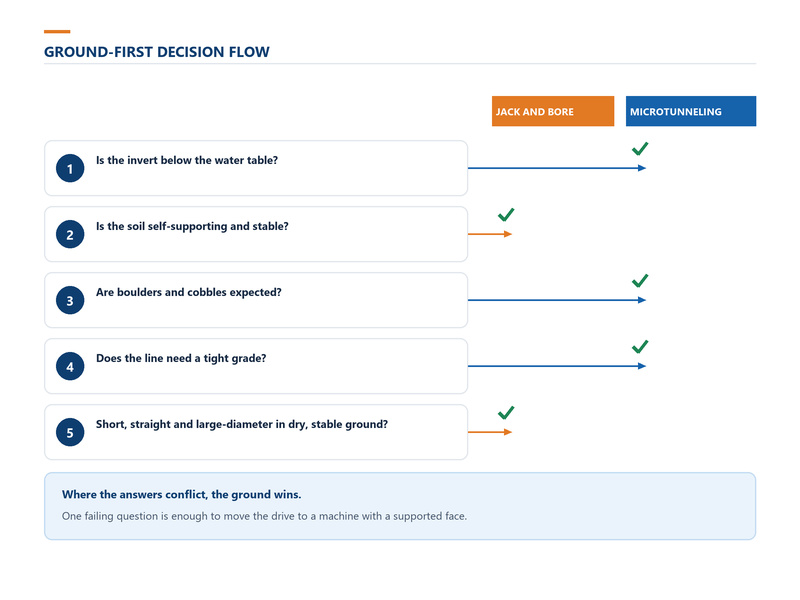
Where the answers conflict, the ground wins. In any microtunneling vs jack and bore decision, a single failing question is enough to move the drive to a machine with a supported face.
Not sure what your ground allows? Send your geotechnical report and alignment for a free method review, and our engineers will tell you which method the ground supports.
Frequently Asked Questions
Our 1,200 mm sewer crosses under a highway with groundwater 2 m above the invert – can jack and bore still work?
Applicability: an open face suits self-supporting ground above the water line. Here the water line sits 2 m above the invert, so the drive needs continuous support at the face – a machine with a pressurised face, or an approved dewatering scheme. Jack and bore and auger boring cut an open face, so below that line the face runs wet and unstable and inflow can undermine the casing and the drive.
Is jack and bore more accurate than microtunneling?
No. Microtunneling holds line and grade far more tightly than jack and bore. For a gravity sewer on a shallow grade, that gap usually decides the method; the tolerance bands themselves belong to the cost and accuracy comparison.
A 900 mm casing has to cross under a two-track rail line in stiff clay for 90 m – is a crew-at-face method acceptable here?
A 900 mm casing is below the roughly 42 in. (1,050 mm) that a crew needs to enter and work at the face, so a crew-at-face method does not fit here; a remotely controlled machine, which needs no entry, is the safer match. Jack and bore reaches down to about 42 in. (1,050 mm) only, while microtunneling can work to about 10 in. (DN250).
We expect boulders and cobbles of 400 mm in the middle of the drive – does that change the method, or only the cutterhead?
Only the cutterhead: a 400 mm obstruction band changes the tooling, not the method. Microtunneling manages obstructions up to roughly 30 percent of the face with a dedicated cutterhead. Jack and bore struggles: a boulder or a cobble band stops the auger, and clearing it means sending a crew into the casing.
What size is a boulder by definition?
ASTM D653 defines a boulder as a particle larger than 12 in. (305 mm). That threshold matters: anything at or above it is a machine-stopping obstruction rather than a spoil particle, and it changes how the face is designed.
Our route drops 2 m below the water line for 40 m in running sand – can an open face be used at all?
Rarely. Soil stability decides this more than diameter: running sand and soft, flowing ground collapse an open face, which is exactly what mechanical face support is designed to prevent. Jack and bore suits ground that stands on its own – dry and above the water line.
Does the ground or the machine set the drive-length limit?
Both, and they meet at the jacking force: friction on the casing rises with unstable, wet ground and with the length behind the face, so the ground helps set what the machine can push. The machine-size drive envelope and the intermediate jacking station rule belong to the pipe jacking guide, not to ground selection.
How Do You Match the Method to Your Geotechnical Report?
A reliable microtunneling vs jack and bore decision needs four things from the investigation: the water table position, the soil and rock description, the expected obstruction sizes, and the drive length and the required casing pipe diameter. If you are writing the specification, the water table line and the obstruction sizes drive the choice; if you are pricing the drive, the casing diameter and the entry requirement drive the cost.
Then ask each bidder to price the drive the ground allows, and to name the ground condition that would change their method. That answer is worth more than the rate. The services behind jacked drives are set out in jacked drives and the services behind them; the surrounding scope sits in pipeline construction services, and the machine-side view is in microtunneling services.
Before we recommend anything, the geotechnical report is read line by line and the method that survives it is the one we put our name to.
Contact our engineering team with your geotechnical report for a ground-based method review.
Final Verdict: Which Method for Which Ground?
Jack and bore is the simpler and often cheaper method when the ground allows an open, self-supporting face: short, straight, dry, stable, and large enough for a crew. Microtunneling takes over wherever the ground does not – below the water table, in running or soft soil, through boulders and cobbles, or wherever the line must hold a tight grade that only a machine with continuous face support can manage.
Where the two are close, let the geotechnical report decide, not the rate. The ground always has the final word.
Get a second opinion at no cost. Send us the geotechnical report and the alignment, and our engineers will tell you which method the ground actually supports.
Related: microtunneling vs pipe jacking and microtunneling vs HDD.
Sources
Each section draws on a specific source: the ground and soil descriptions follow ASTM D653 and ASTM D2487, the machine and support rules follow ASCE/CI 36-15, and the drive-length envelope follows the NASTT guidance listed below.
- ASCE/CI 36-15, Standard Construction Guidelines for Microtunneling.
- ASTM D653, Standard Terminology Relating to Soil, Rock, and Contained Fluids (boulder size definition).
- ASTM D2487, Standard Practice for Classification of Soils for Engineering Purposes (Unified Soil Classification System), which underpins the ground and soil descriptions used in this guide.
- NASTT Good Practices Guidelines (Microtunneling, Auger Boring and Pipe Jacking).





































 English
  Arabic
  Russian
  Spanish
  French
  Vietnamese
  Polish
  Thai
Thai  Indonesian
  Turkish
  Portuguese