jasonsong889@gmail.com

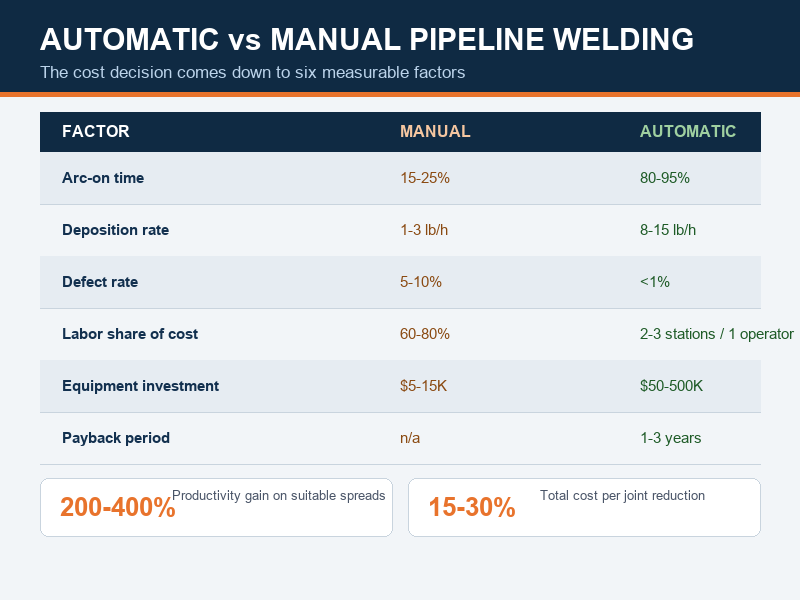
Comparison infographic of automatic welding vs manual welding for pipelines: arc-on time, deposition rate, defect rate, labor share of cost, equipment investment, and payback period on either side

Automatic Welding vs Manual Welding: Which Is More Cost-Effective?

Automatic welding vs manual welding: for new mainline construction with a high number of girth welds, automatic welding is more cost-effective, typically cutting total cost per joint by 15-30%. The advantage comes from higher deposition rates, longer arc-on time, and lower defect rates, which outweigh the higher equipment investment. For short tie-ins, repairs, and small-diameter

Automatic Welding vs Manual Welding: Which Is More Cost-Effective? Baca Selengkapnya »
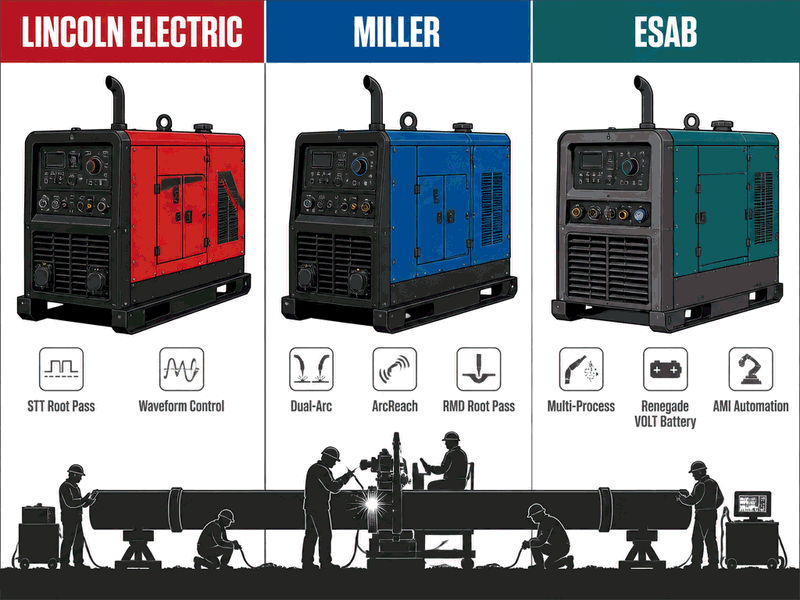
Comparison infographic of the three leading pipeline welding equipment suppliers: Lincoln Electric, Miller Electric, and ESAB, with their pipeline machine lines and key technologies

Pipeline Welding Equipment Suppliers: Lincoln Electric vs Miller vs ESAB Comparison

The three leading pipeline welding equipment suppliers are Lincoln Electric, Miller, and ESAB, and the right choice depends on your welding process, fleet size, and service network rather than brand reputation alone. Lincoln Electric vs Miller is the comparison most contractors ask first, because both build the 500-amp class diesel engine-driven welders that dominate mainline

Pipeline Welding Equipment Suppliers: Lincoln Electric vs Miller vs ESAB Comparison Baca Selengkapnya »

Quality audit of pipeline welding services: a welding engineer inspecting a girth weld on a large-diameter pipeline while the welding crew works on site

How to Evaluate the Quality of a Pipeline Welding Service Provider

High-quality pipeline welding services are identified by four measurable signals: a first-pass acceptance rate of 95 percent or higher, a weld repair rate below 5 percent, welding procedure specifications backed by valid procedure qualification records, and welder qualifications that match the exact process, pipe grade, and position of your project. This guide explains how to

How to Evaluate the Quality of a Pipeline Welding Service Provider Baca Selengkapnya »

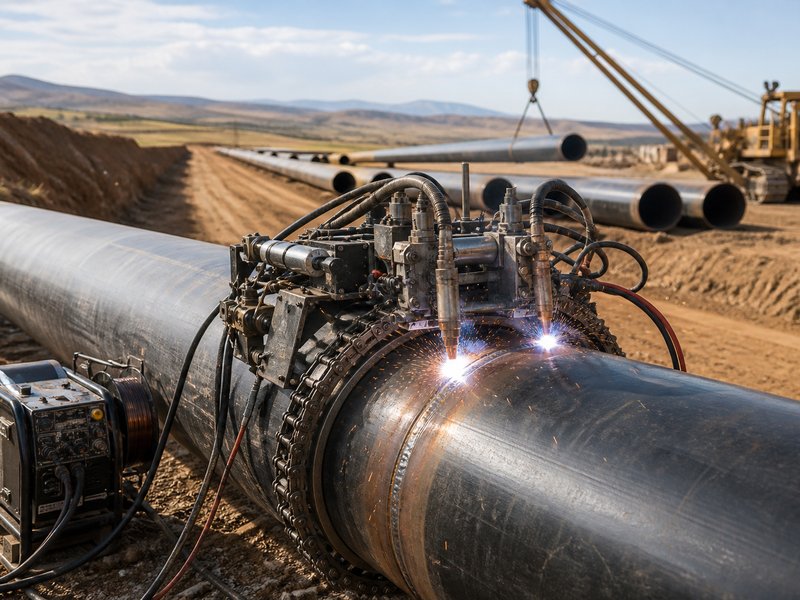
Automatic pipeline welding system with a dual-torch welding bug running on an external band around a large-diameter pipe

Which Pipeline Welding Process Offers the Best Productivity and Quality Balance?

Automatic pipeline welding, meaning mechanized dual-torch gas metal arc welding on an external band, offers the best balance of productivity and quality for long mainline construction. A mechanized spread typically completes 60 to 120 girth welds per day while holding first-pass acceptance rates above 95 percent, performance that manual stick welding cannot match at scale.

Which Pipeline Welding Process Offers the Best Productivity and Quality Balance? Baca Selengkapnya »

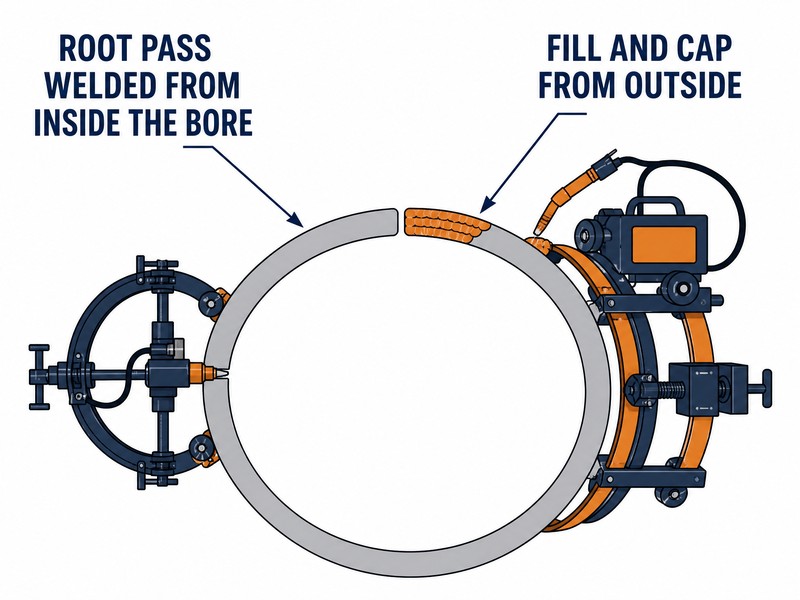
Side-by-side comparison of welding from inside the pipe bore and welding from outside on a large-diameter pipeline joint, with an alignment clamp at the bore and an external bug welder on a band

Internal Pipe Welding vs External Pipe Welding: Which Approach Is Right for Your Project?

For large-diameter mainlines with high weld counts, the internal-root method cuts root defects and lifts productivity; for small diameters, tie-ins, and repair work, welding from outside is the only practical option. Internal pipe welding and the outside approach answer the same question, how to make a sound girth weld, but they work from opposite sides of

Internal Pipe Welding vs External Pipe Welding: Which Approach Is Right for Your Project? Baca Selengkapnya »

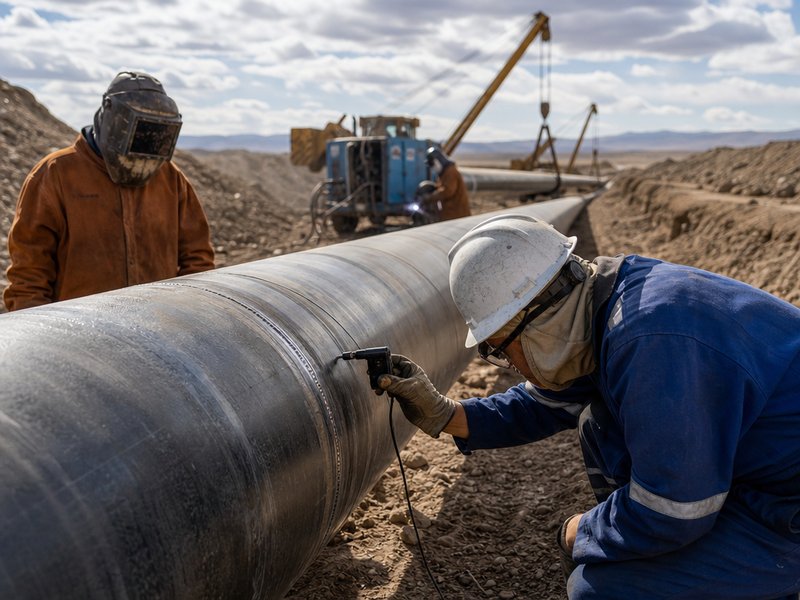
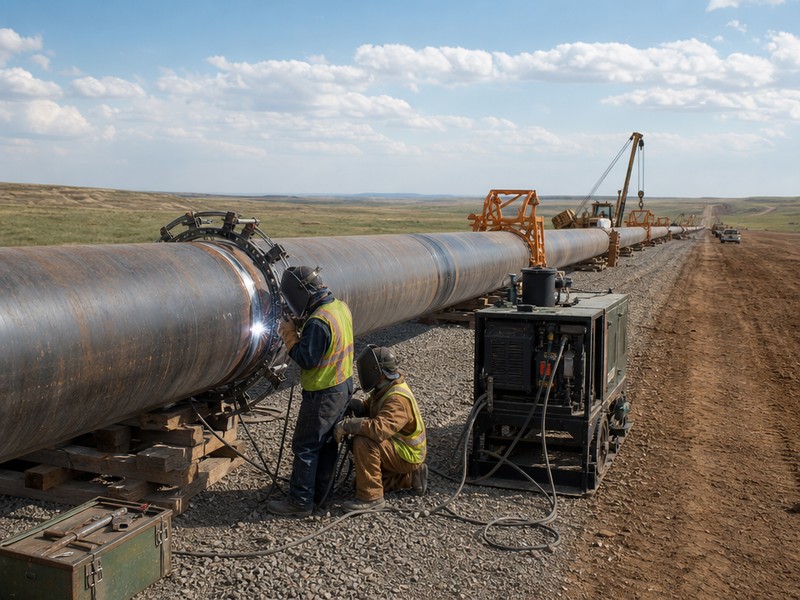
Pipeline welding contractor crew performing girth welds on a large-diameter cross-country pipeline with welding machines and a line-up clamp on site

How to Choose the Right Pipeline Welding Contractor for a Cross-Country Project

The right pipeline welding contractor for a cross-country project is the one that passes a six-point evaluation: verifiable welder qualification to API 1104, approved welding procedure specifications backed by procedure qualification records, managed non-destructive testing, equipment and production capacity that match the schedule, a safety record at or below the industry median, and references from

How to Choose the Right Pipeline Welding Contractor for a Cross-Country Project Baca Selengkapnya »

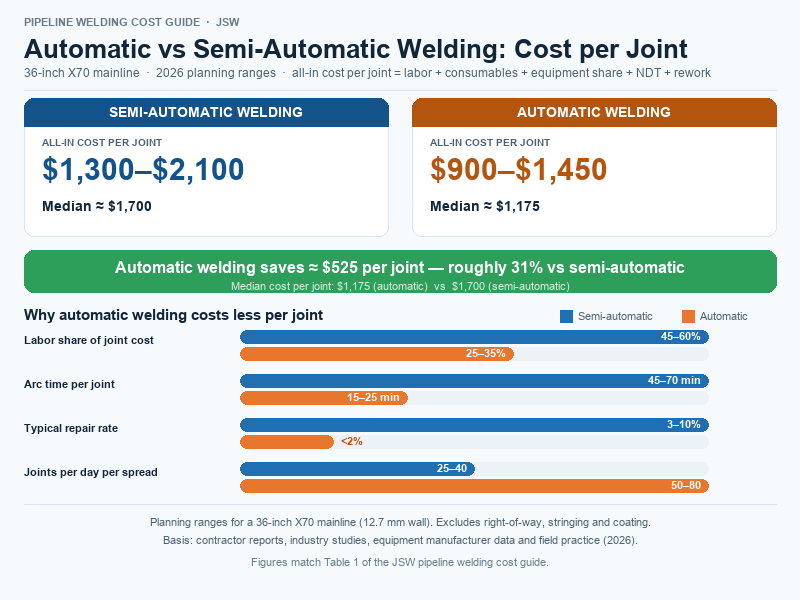
Automatic Welding vs Semi-Automatic Welding for Long-Distance Pipelines: Cost Comparison

Automatic welding is typically 25-40 percent cheaper per completed joint than semi-automatic welding on long-distance mainline construction, with the largest savings in labor and rework. The saving holds once the project passes roughly 1,500 to 3,000 girth welds; below that volume, the comparison reverses and semi-automatic welding is usually the lower-cost option. Semi-automatic welding, which

Automatic Welding vs Semi-Automatic Welding for Long-Distance Pipelines: Cost Comparison Baca Selengkapnya »

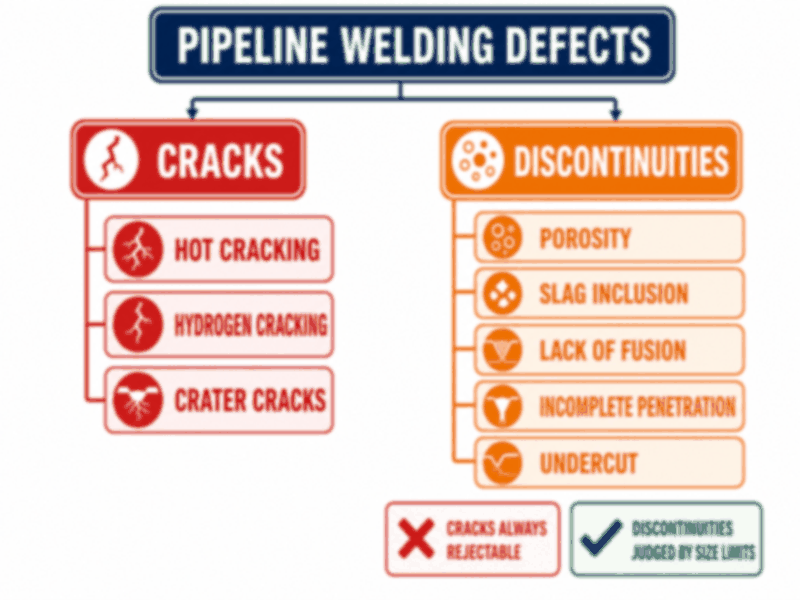
Classification diagram of common pipeline welding defects: cracks (hot cracking, hydrogen cracking, crater cracking) and discontinuities (porosity, slag inclusion, lack of fusion, incomplete penetration, undercut)

Common Pipeline Welding Defects and How to Prevent Them

Pipeline welding defects are the discontinuities that make a girth weld fail acceptance or leak in service, and the most common ones are porosity, slag inclusion, lack of fusion, incomplete penetration, and weld cracking. You prevent them by qualifying your welding procedure, controlling consumable storage and joint cleanliness, welding inside the qualified parameter window, and verifying

Common Pipeline Welding Defects and How to Prevent Them Baca Selengkapnya »

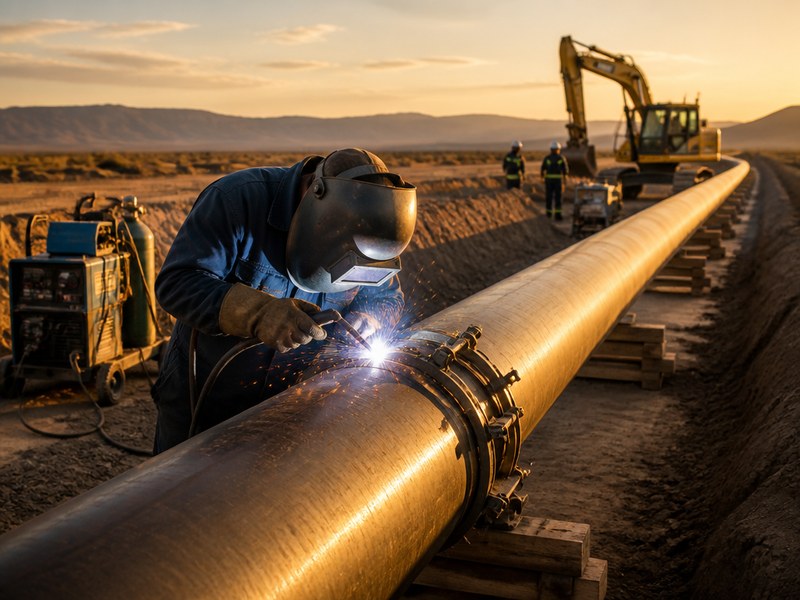
Pipeline welder performing a girth weld on a large-diameter cross-country gas pipeline during construction

What Is Pipeline Welding? Definition, Processes, and Techniques

Pipeline welding is the process of joining pipe sections end to end with a continuous fused metal joint that contains the full operating pressure of the line. The joint must be free of cracks and voids, because a failed girth weld (the circumferential joint between two pipe ends) releases the line pressure at a single

What Is Pipeline Welding? Definition, Processes, and Techniques Baca Selengkapnya »

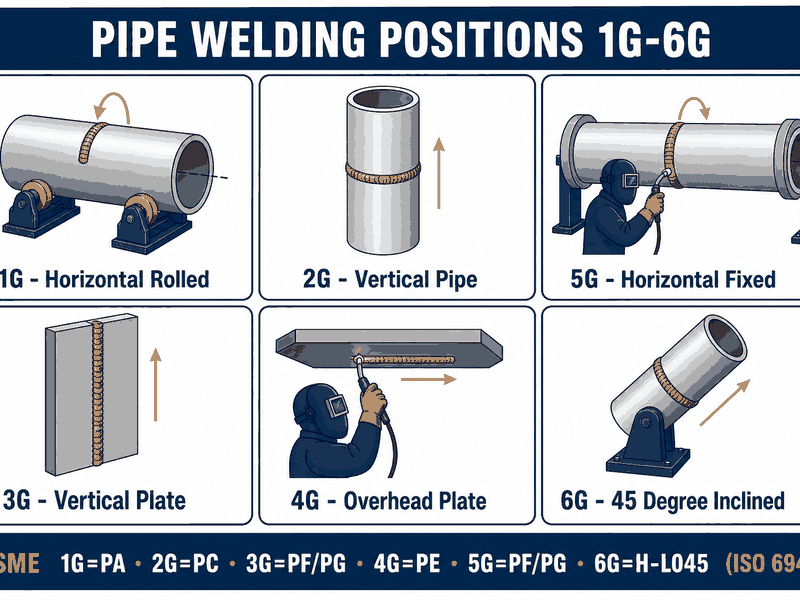
Welding position chart showing pipe positions 1G, 2G, 5G, and 6G with pipe orientation diagrams and the plate positions 3G and 4G

Pipeline Welding Positions: 1G to 6G Explained

Pipeline welding positions from 1G to 6G are the standardized orientations used to classify, test, and qualify pipe welds, with 1G (horizontal rolled), 2G (vertical pipe), 5G (horizontal fixed), and 6G (45-degree fixed) applying to pipe and 3G and 4G applying to plate. This guide explains what every pipeline welding position means, how the codes

Pipeline Welding Positions: 1G to 6G Explained Baca Selengkapnya »