jasonsong889@gmail.com

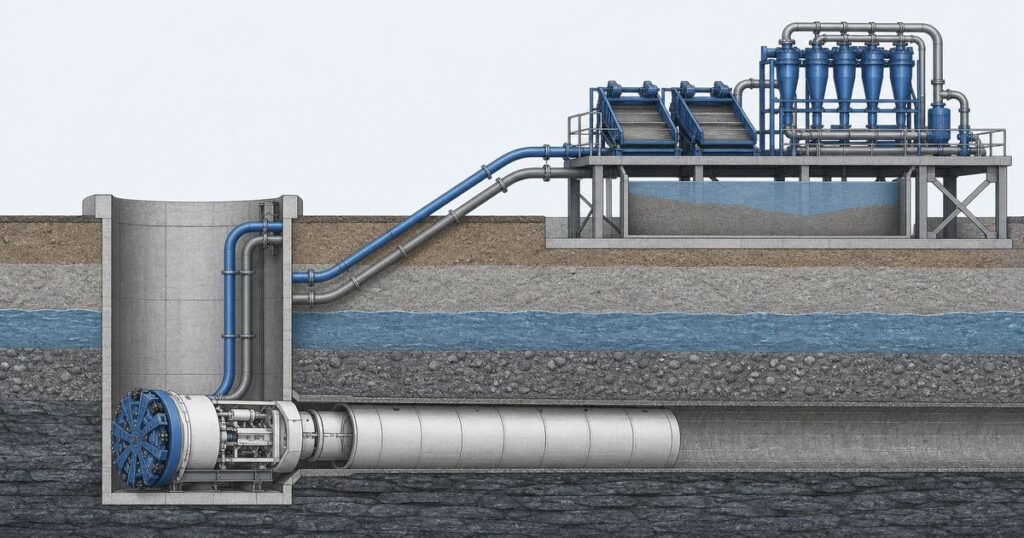
Slurry microtunneling machine with feed and return slurry lines and a separation plant on the surface

Face Support and Ground Conditioning in Slurry Microtunneling

Slurry microtunneling – a microtunneling method in which a pressurized slurry holds the excavation face and carries the spoil back to the surface – lets a drive advance below the water table without dewatering the ground around it. Its defining control is face pressure: the support pressure held in the machine chamber, which balances the

Face Support and Ground Conditioning in Slurry Microtunneling Baca Selengkapnya »
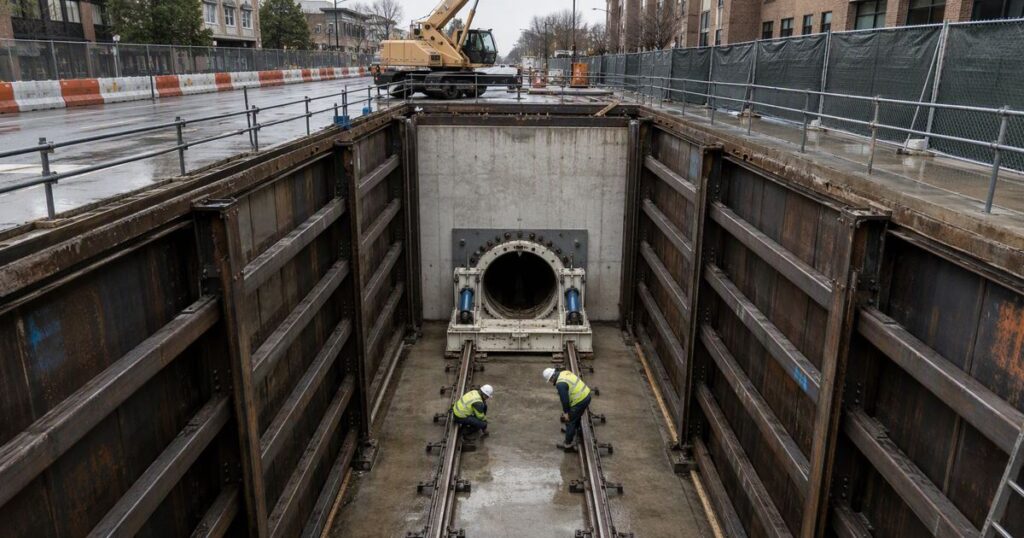
Microtunneling launch shaft under construction with jacking frame and thrust wall visible

Microtunneling Shafts: How to Size Launch and Receiving Shafts

Microtunneling shafts are sized from the pipe outward, and the two types are sized differently: the launch shaft carries the thrust wall (the structure that provides the jacking reaction), the jacking frame and rams, the thrust ring, the jacking cradle and guide rails, the machine or the first pipe, the entry seal or gland, and

Microtunneling Shafts: How to Size Launch and Receiving Shafts Baca Selengkapnya »

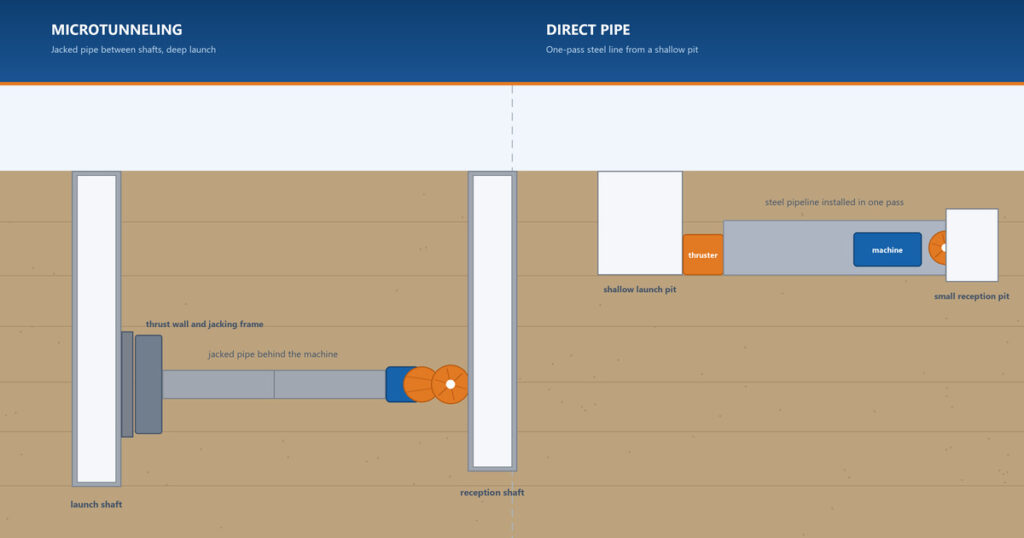
Cross-section comparison of a microtunneling drive jacking pipe between two shafts and a Direct Pipe drive installing a steel pipeline in one pass from a near-surface launch pit

Microtunneling vs. Direct Pipe: Which Handles Difficult Ground Better?

The microtunneling vs direct pipe choice is decided by the ground and the pipe, not by preference. Direct Pipe bores and installs a steel pipeline in one pass with only static pressure in the hole, so it handles unstable and mixed ground with a low blowout risk; microtunneling holds a tighter line and grade but

Microtunneling vs. Direct Pipe: Which Handles Difficult Ground Better? Baca Selengkapnya »

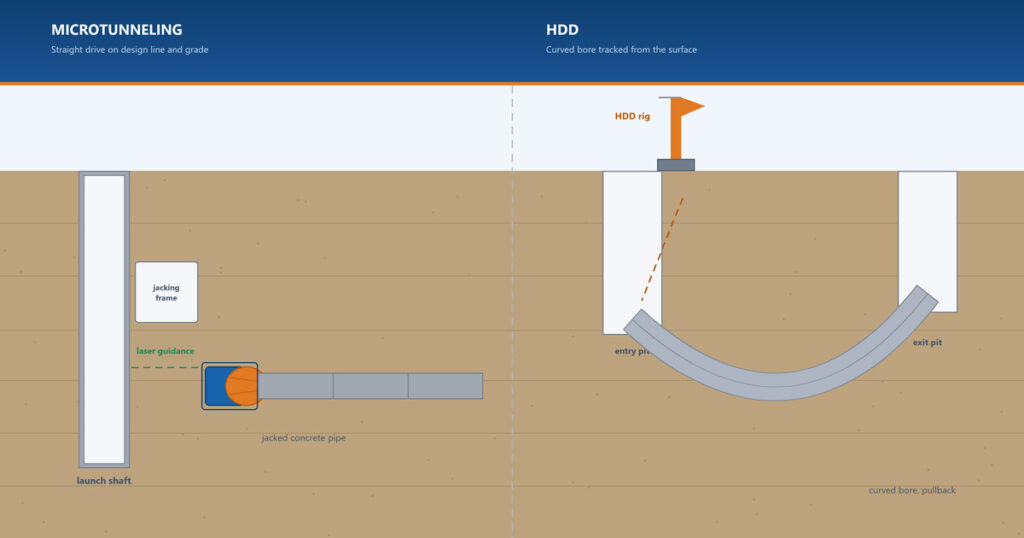
Cross-section comparison of a microtunneling drive advancing straight on grade from a launch shaft and an HDD bore curving between an entry and exit pit

Microtunneling vs. HDD: Accuracy, Diameter, Ground and Cost Compared

In the microtunneling vs HDD decision, microtunneling wins on accuracy (±10-25 mm), large diameters and unstable water-bearing ground, while HDD wins on cost, speed and long curved crossings where no gravity grade is required. The two methods are compared below on the four criteria that decide most trenchless method selection work: line-and-grade accuracy, workable pipe

Microtunneling vs. HDD: Accuracy, Diameter, Ground and Cost Compared Baca Selengkapnya »

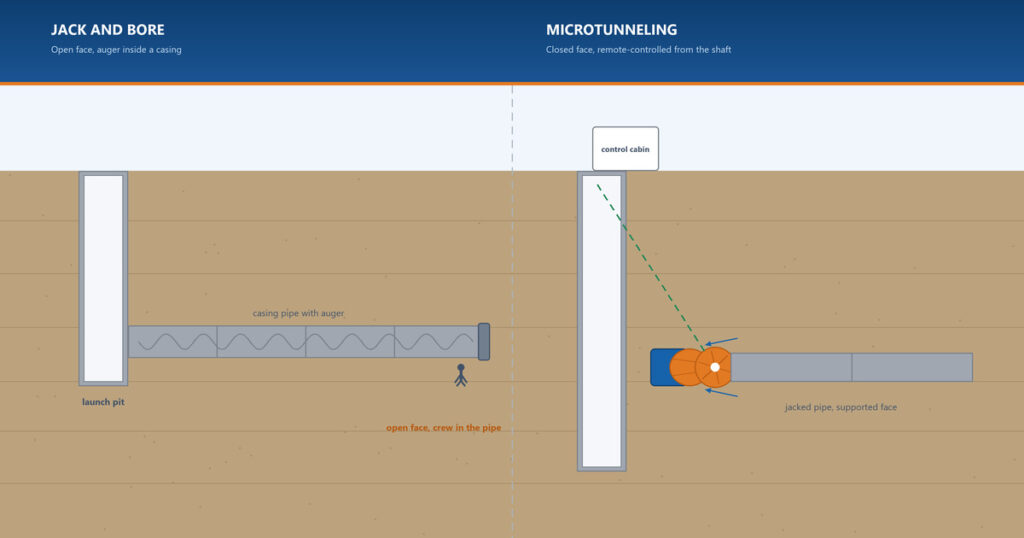
Cross-section comparing a jack and bore drive with an auger inside a casing pipe and a crew at an open face against a remote-controlled microtunneling machine with a supported face and laser guidance

Microtunneling vs. Jack and Bore: Which Method for Which Ground?

In the microtunneling vs jack and bore decision, the ground decides before anything else – jack and bore suits short, straight, dry drives in stable soil above the water table, while microtunneling suits longer drives, controlled grade, and ground below the water table or containing cobbles and boulders. The two methods are compared below as

Microtunneling vs. Jack and Bore: Which Method for Which Ground? Baca Selengkapnya »

Side-by-side cross-section comparing an open cut excavation trench with reinstated pavement above a line and a microtunneling drive launched between two shafts with the surface left intact

Microtunneling vs. Open-Cut: Cost, Programme and Surface Impact Compared

Short answer: in the microtunneling vs open cut decision, open cut is usually the lower bid on short, shallow, stable-ground runs, but microtunneling becomes the lower whole-life cost once a crossing runs deeper than 20 ft (6 m), sits under live roads or utilities, or runs through contaminated or water-bearing ground. This guide compares the

Microtunneling vs. Open-Cut: Cost, Programme and Surface Impact Compared Baca Selengkapnya »

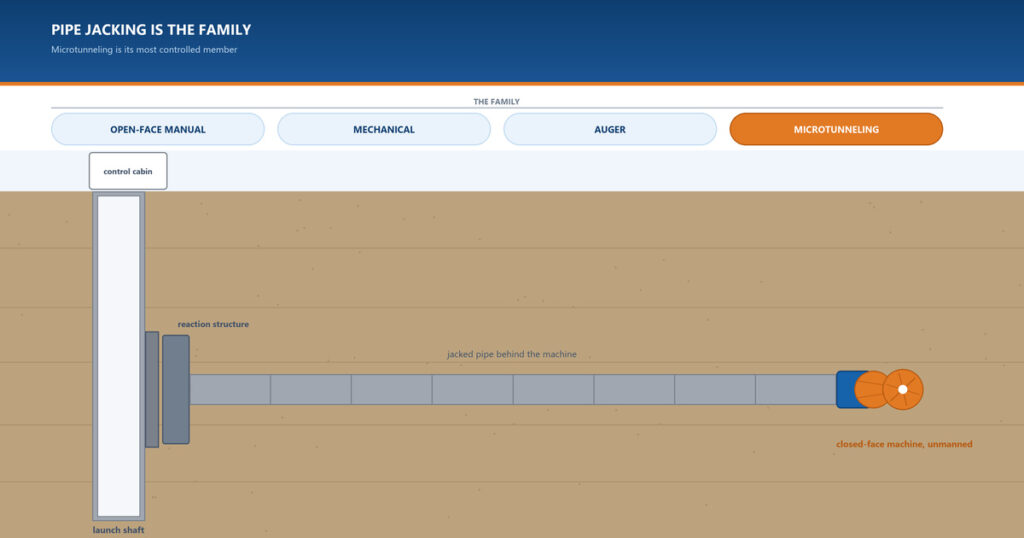
Cross-section diagram showing pipe jacking as a broad family with a microtunneling machine as its unmanned member, jacked pipe behind the machine and a reaction structure in the launch shaft

Microtunneling vs. Pipe Jacking: Same Family, Different Rules

Short answer: microtunneling is not a different method from pipe jacking – it is the unmanned, guided form of it. Pipe jacking is the family, and microtunneling is the member that adds a guidance system and continuous face support to the same jacked-pipe idea. This page settles the relationship between the two terms, sets out

Microtunneling vs. Pipe Jacking: Same Family, Different Rules Baca Selengkapnya »

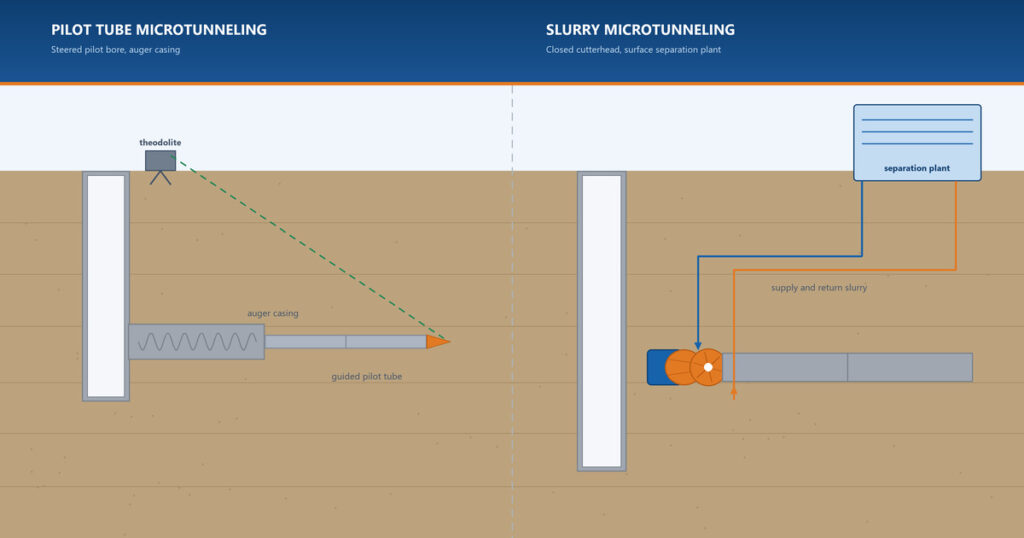
Cross-section comparison of a pilot tube microtunneling drive with a small steered pilot tube and auger casing beside a slurry microtunneling drive with a closed cutterhead and slurry circuit

Pilot Tube Microtunneling vs. Slurry Microtunneling: Choosing the Right System

Short answer: the pilot tube system suits small-diameter gravity sewer drives in firm, displaceable ground where a tight grade matters, while the slurry system suits larger-diameter, below-water-table drives in unstable ground that need continuous face support and a surface separation plant. Pilot tube microtunneling is a guided boring system built around a steered pilot tube

Pilot Tube Microtunneling vs. Slurry Microtunneling: Choosing the Right System Baca Selengkapnya »

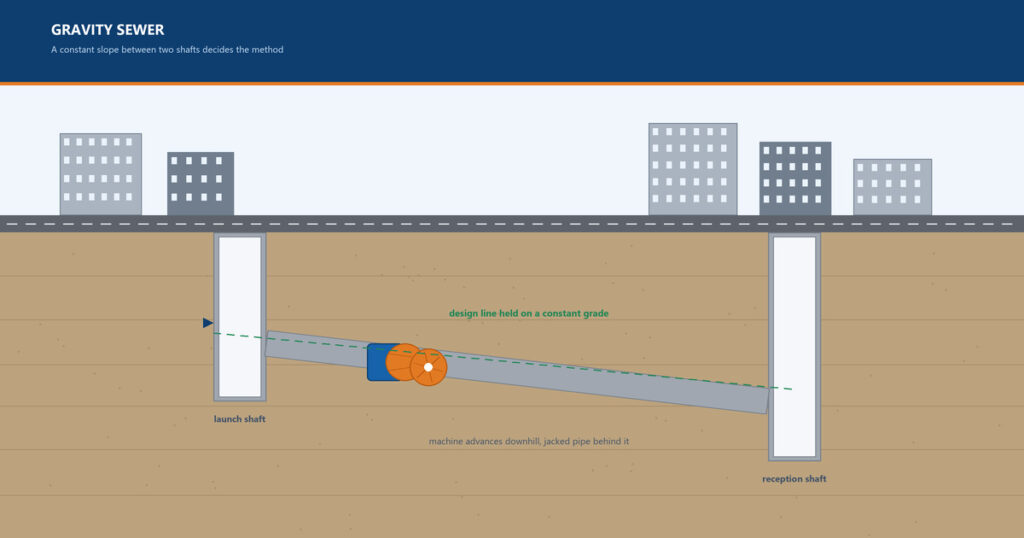
Decision diagram for a gravity sewer showing a microtunneling machine advancing on a constant slope between a launch shaft and a reception shaft beneath a city street

When Is Microtunneling the Right Choice? A Decision Guide for Gravity Sewers

Short answer: when to use microtunneling comes down to four conditions – a continuous gravity grade, manageable ground at depth, buildable shafts, and a drive length inside the jacking envelope. If any one of those fails, another method usually fits better. This decision guide answers one question for sewer projects: is microtunneling the right method,

When Is Microtunneling the Right Choice? A Decision Guide for Gravity Sewers Baca Selengkapnya »

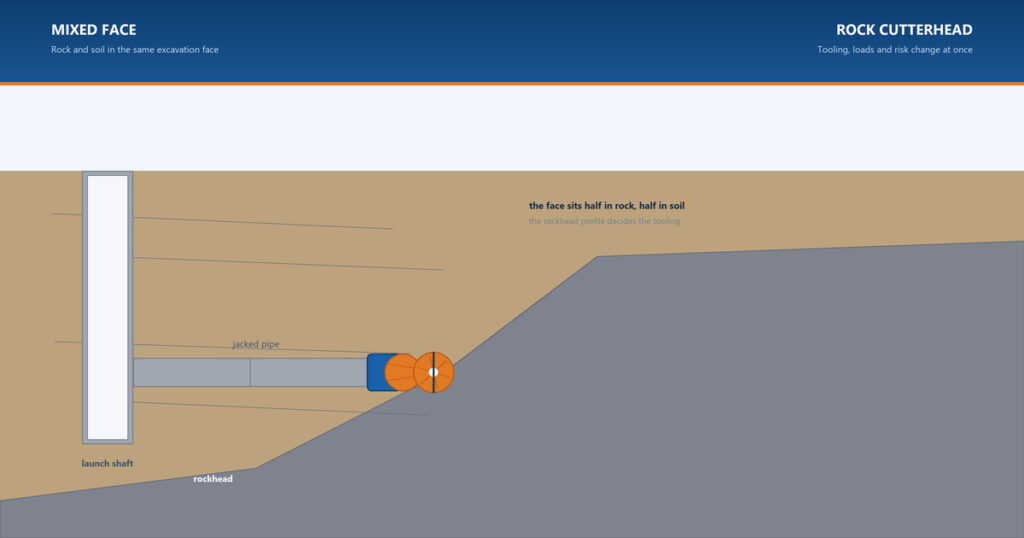
Cross-section of a microtunneling drive entering a mixed face where a rock cutterhead meets layered rock and soil, with jacked pipe and a launch shaft behind the machine

Microtunneling in Rock and Mixed Ground: When to Change Methods and Why It Costs More

Short answer: microtunneling in rock is feasible with a rock-tooled machine, but intact rock and mixed ground reset thrust, torque, cutter wear and advance rate, so cost rises and the risk of an unplanned stop comes forward. Mixed face is the hardest case, and continuous hard rock over a long drive is usually a different

Microtunneling in Rock and Mixed Ground: When to Change Methods and Why It Costs More Baca Selengkapnya »