jasonsong889@gmail.com

Directional boring and horizontal directional drilling shown as one steerable trenchless method, with a small utility rig beside a large maxi pipeline rig

Directional Boring vs. Horizontal Directional Drilling: Is There a Difference?

In most markets, directional boring vs horizontal directional drilling is not a contest between two methods – they are the same steerable, surface-launched trenchless technique, and the two names are used interchangeably. The difference that carries real weight is scope. Directional boring names small-rig utility, telecom and service work; horizontal directional drilling describes longer, larger-diameter

Directional Boring vs. Horizontal Directional Drilling: Is There a Difference? Read More »
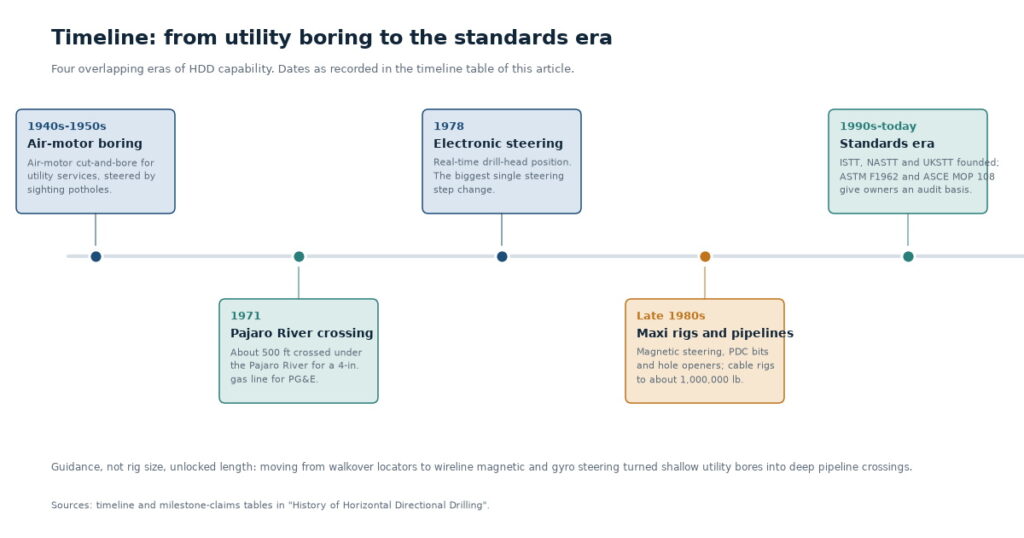
Timeline graphic of horizontal directional drilling history showing 1950s air motor boring, the 1971 Pajaro River crossing, 1978 electronic steering, 1980s maxi rigs and the modern standards era

The History of Horizontal Directional Drilling (HDD): How HDD Changed Pipeline Construction

The history of horizontal directional drilling runs from 1950s hand-held air-motor boring and 1930s oilfield steering tools, through the first purpose-built rigs of the 1960s and the 1971 Pajaro River crossing, to a method that today installs steel and polyethylene pipelines of roughly 1,200-1,400 mm in single bores of 1,800 m and beyond. Each era

The History of Horizontal Directional Drilling (HDD): How HDD Changed Pipeline Construction Read More »

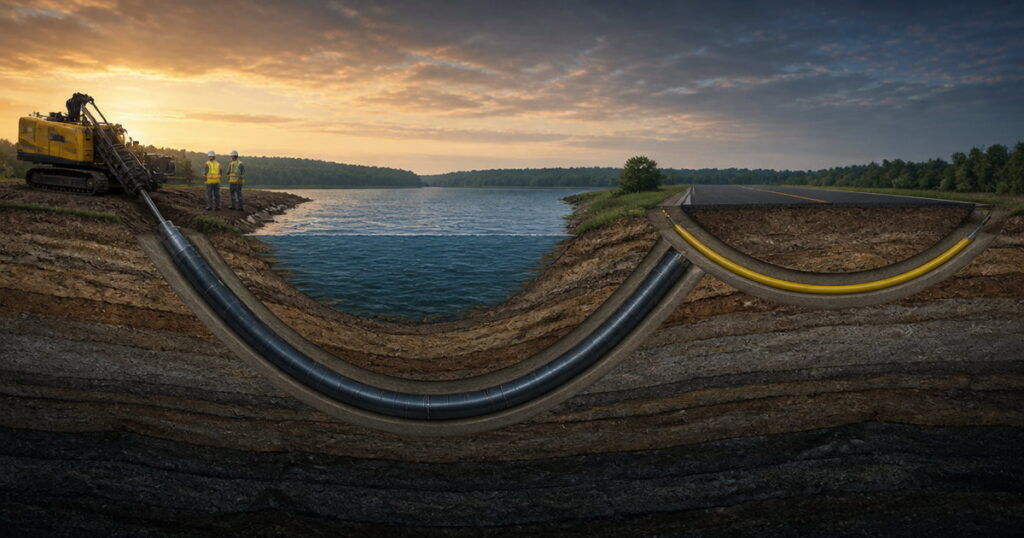
Cutaway cross-section of gas pipeline crossings showing an HDD bore pulling a steel transmission main under a river and a shallower bore for a polyethylene distribution main under a road

Trenchless Construction for Gas Pipelines: Where HDD Fits In

Trenchless construction for gas pipelines is the practice of installing or renewing gas mains and transmission lines below ground without a continuous open trench, and horizontal directional drilling (HDD) fits it wherever a long or curved crossing must carry a pressure line. Which method fits which gas job is decided by the gas itself: high-pressure

Trenchless Construction for Gas Pipelines: Where HDD Fits In Read More »

HDD glossary cover illustration showing a horizontal directional drilling rig and a curved bore path under a river

A Beginner’s Guide to HDD: 20 Key Terms Every Pipeline Engineer Should Know

Horizontal directional drilling terms are the shared vocabulary of an HDD crossing: the bore-path geometry (pilot hole, entry angle, bend radius, depth of cover), the downhole tools and steering systems, the drilling fluid, the installation loads and the final records. This guide defines 20 of them in the order a crossing happens, gives each the

A Beginner’s Guide to HDD: 20 Key Terms Every Pipeline Engineer Should Know Read More »

Anatomy of an HDD crossing depth profile beneath a river, showing entry angle, bore depth and depth of cover

How Deep Do HDD Pipelines Go? Depth of Cover and River Scour Explained

How deep do HDD pipelines go? Utility and small-rig bores typically run about 3-6 m (10-20 ft) below ground, while large river, highway and channel crossings commonly sit at 15-30 m (50-100 ft) or more. What governs a design, though, is depth of cover: the soil left above the pipe after the crossing’s own scour,

How Deep Do HDD Pipelines Go? Depth of Cover and River Scour Explained Read More »

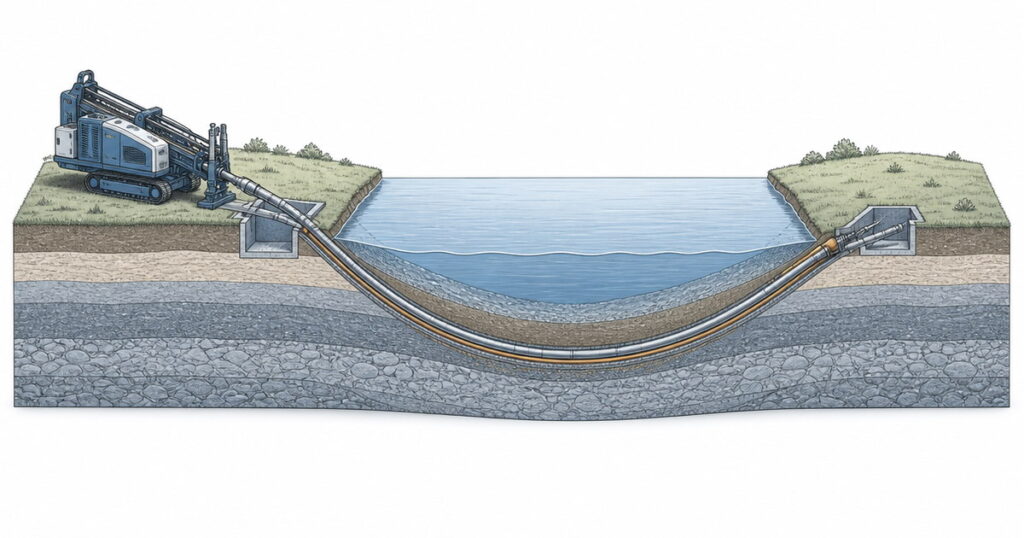
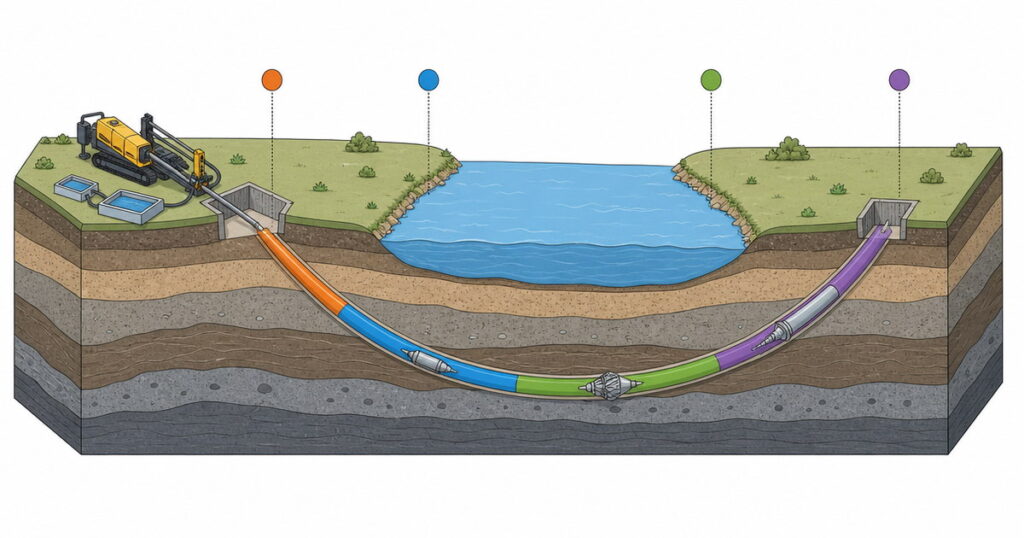
Horizontal directional drilling four stage diagram showing site set-up, a steerable pilot hole, reaming passes and pipe pullback along a curved bore

How Does Horizontal Directional Drilling Work? The 4 Stages of an HDD Crossing

How does horizontal directional drilling work? It drills a small, steerable pilot hole along a designed arc from an entry point to an exit point, enlarges that hole with reaming passes, then pulls the prefabricated product pipe back through the fluid-filled bore in one continuous operation. The horizontal directional drilling process is easiest to follow

How Does Horizontal Directional Drilling Work? The 4 Stages of an HDD Crossing Read More »

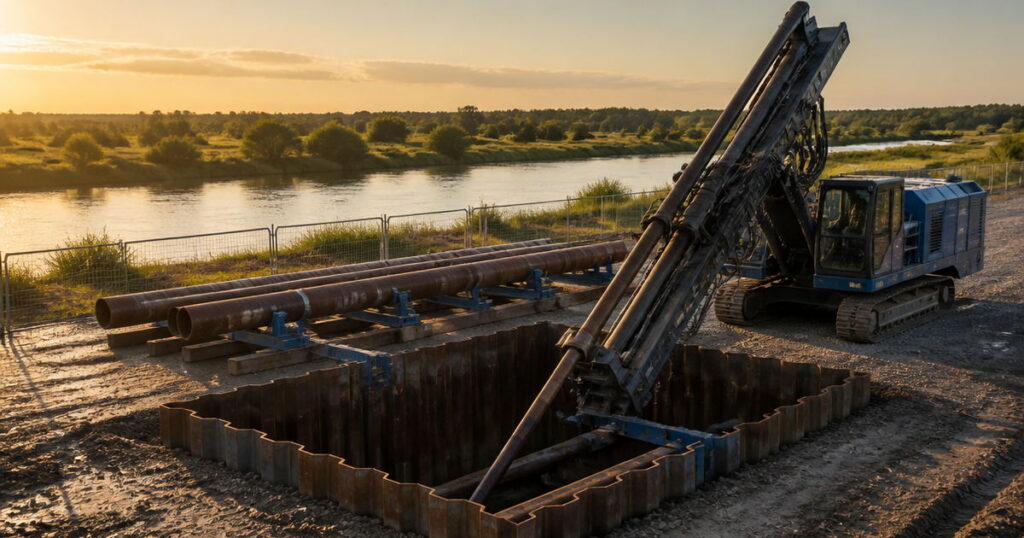
Horizontal directional drilling rig operating at a pipeline crossing entry point

What Is Horizontal Directional Drilling (HDD)? A Complete Guide for Pipeline Engineers

What is horizontal directional drilling? It is a surface-launched trenchless method that drills a steerable, curved bore between an entry and an exit point, then pulls a prefabricated product pipe back through the enlarged hole. Unlike open-cut construction, HDD never opens the surface along the crossing. A crossing suits horizontal directional drilling when the service

What Is Horizontal Directional Drilling (HDD)? A Complete Guide for Pipeline Engineers Read More »

Horizontal directional drilling rig installing an oil and gas pipeline beneath a river crossing

Why Oil and Gas Companies Choose HDD for Pipeline Crossings

Oil and gas companies choose horizontal directional drilling for oil and gas pipelines because it takes the crossing off the surface: it avoids shutdowns and hot work on live systems, leaves right-of-way, crops and roads undisturbed, protects wetlands and watercourses, sets the pipe below river scour, and completes a long obstacle in a single bore.

Why Oil and Gas Companies Choose HDD for Pipeline Crossings Read More »

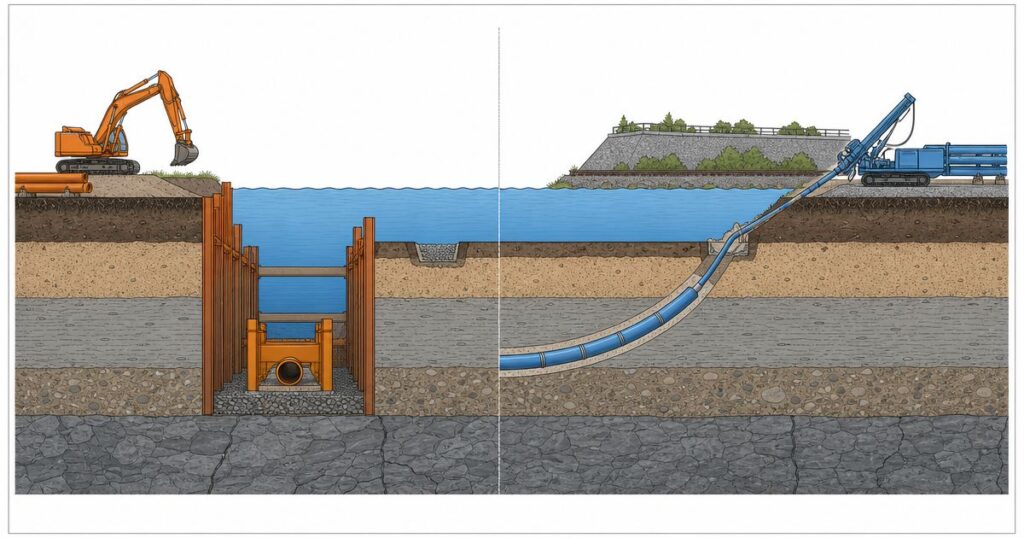
HDD advantages and disadvantages in one cross-section: an HDD rig pulling a pipeline beneath a river with no open trench, beside an open-cut trench crossing the same river

HDD Advantages and Disadvantages: An Honest Assessment for Pipeline Owners

Horizontal directional drilling (HDD), also called directional boring, is a steerable trenchless method that installs pipe without opening the surface. Short answer: HDD advantages and disadvantages come down to one trade. Directional drilling crosses roads, railways, rivers and built-up areas without an open trench, buries the line deeper where third-party excavation is less likely, and

HDD Advantages and Disadvantages: An Honest Assessment for Pipeline Owners Read More »

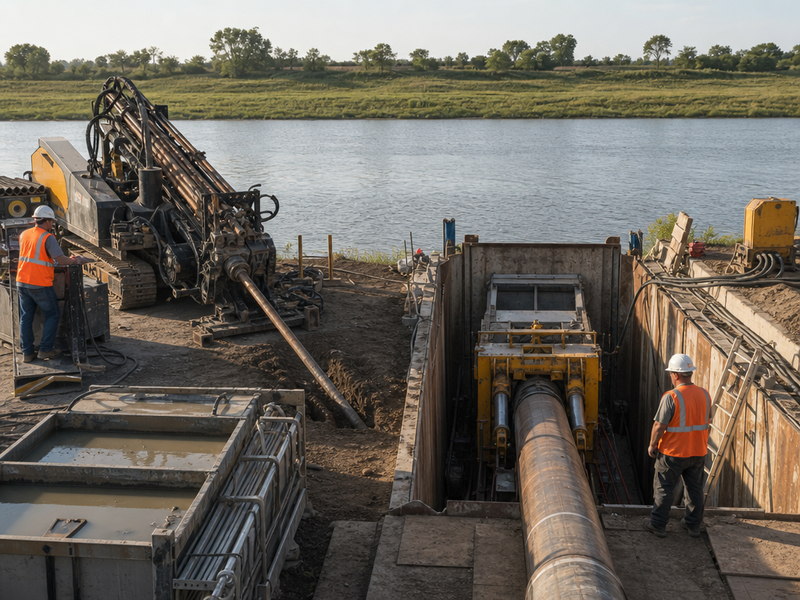
HDD drill rig and Direct Pipe pipe thruster on the same trenchless crossing site, shown for method comparison

HDD vs. Direct Pipe: Which Trenchless Method for Your Crossing?

Choose Direct Pipe (a single-pass, thrust-based trenchless method) where a drilling-fluid return to the surface cannot be tolerated — levees, watercourses, shallow cover and congested urban corridors — and horizontal directional drilling (HDD) for long bores, small-diameter products and competent ground, where its lower unit rate holds. This guide is written for owners, EPC engineers

HDD vs. Direct Pipe: Which Trenchless Method for Your Crossing? Read More »