
Short answer: microtunneling in rock is feasible with a rock-tooled machine, but intact rock and mixed ground reset thrust, torque, cutter wear and advance rate, so cost rises and the risk of an unplanned stop comes forward. Mixed face is the hardest case, and continuous hard rock over a long drive is usually a different method.
Rock is where a microtunneling bid is often wrong. The machine can be configured for rock, but the ground decides how fast it cuts, how often it stops and whether tools survive. This guide covers what changes when microtunneling in rock, why mixed face causes most of the delay, how tooling and intervention are chosen, and when to change methods.
What Actually Changes When Microtunneling in Rock?
In soil, a microtunnel boring machine cuts with scrapers and teeth and relies on face support. In rock, the face resists in compression, so the machine must fail intact material before it can remove it. That one change moves thrust, torque and cutter wear together.
Thrust and torque rise because rock is failed, not excavated. The jacking system works harder, the motor draws more power, and the spoil system carries a heavier, abrasive load. In microtunneling in rock, industry ranges put the effect on penetration at an order of magnitude, not a percentage, against typical soil rates; the cost effect follows from tool consumption and stops.
| Parameter | Soil drive | Rock drive |
|---|---|---|
| Cutting tools | Scrapers, teeth and rippers | Rolling tools, carbide tools and gauge protection |
| Face support | Slurry or earth pressure support is the main control | Competent face; control shifts to spoil and water |
| Thrust and torque | Set by friction and jacking force | Raised by rock strength and tool penetration |
| Advance rate | Set by excavation and the jacking cycle | Set by penetration, tool wear and stops |
| Intervention | Rare, usually handled at a shaft | Regular; access depends on machine diameter |
The cost structure changes with the tooling: soil cost follows shafts, drive length and cycle time, while rock cost follows tool consumption and stops.
Read the two columns as two maintenance models: a soil drive changes at the face, a rock drive at the tool.
Why Is a Mixed Face the Hardest Case?
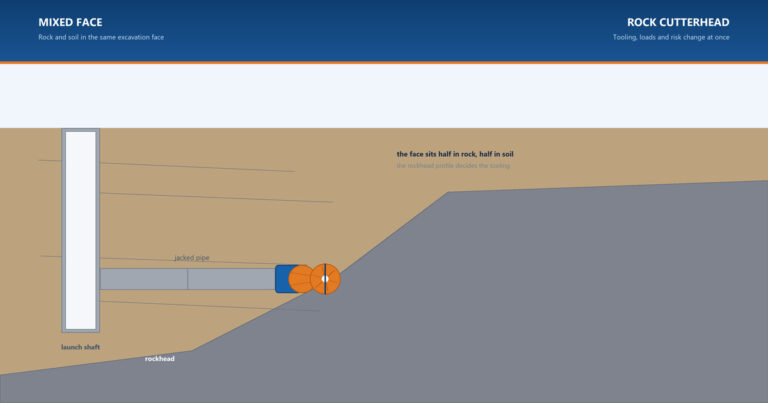
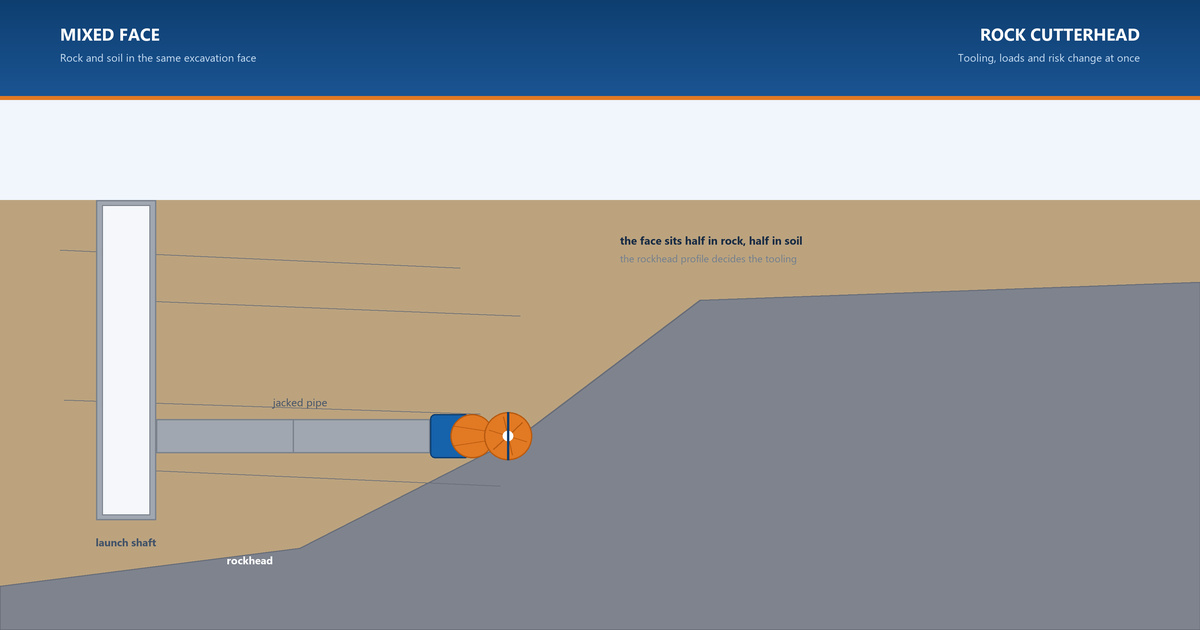
A mixed face means rock and soil stand in the same excavation face. A mixed reach means one drive passes from soil into rock and back. Both are the typical source of delay in microtunneling in rock.
A head optimised for soil is ineffective in rock, and a head built for rock cannot support an unstable soil face.
A short rock band near the launch shaft is manageable because intervention is possible; a mixed face beneath a river or a live carriageway is the case to plan around.
Every such reach should be described as a rockhead profile, not as one rock strength value; the geotechnical investigation should report where the interface sits and how steeply it rises or falls.

Bottom line: mixed face is a geometry problem before it is a strength problem, which is why the rockhead profile matters as much as the rock.
Which Cutterhead Do You Choose for Rock?
A rock cutterhead (also called a rock head) is designed around one question: how does this rock fail? Three tool families cover most microtunneling in rock, and most heads combine them.
- Disc cutter: a rolling steel ring that crushes rock under high point load. Suited to competent hard rock, and to mixed ground where the face is mostly rock.
- TCI cutters: tungsten carbide insert tools that drag and scrape. Suited to softer, weathered or abrasive rock where a disc cutter would need frequent changes.
- Rippers and scrapers: hard-faced drag tools for soft rock and mixed face, where rolling tools would clog.
Wear protection matters as much as the cutting edge. Hard-facing overlay on the head body, the gauge area and the tool holders extends life, and a worn disc cutter can often be rebuilt with a new ring.

The cutterhead is a bet on the ground, and cutter wear is the bill for getting that bet wrong.
What Decides Whether You Can Reach the Face?
Tools wear, and worn tools must be changed. Whether that can be done at the face is the defining maintenance problem of microtunneling in rock, and it is decided by machine diameter rather than preference. The mechanism sits here; the method-level choice sits with the difficult-ground comparison.
Large machine heads can carry access doors that let a crew enter a supported face to change tools. Public case descriptions put the threshold above about 60 in. (1,500 mm) of machine diameter, where there is room for a person, a tool and a disc cutter ring to pass, a constraint that scales with diameter, not rock strength.
Below that, intervention is limited: small-diameter drives are usually recovered at a shaft or a manhole, and both stop the drive and add cost.
Wear therefore matters most on a long rock drive, where the tooling may still be capable but cannot be reached.
Bottom line: tool wear is a schedule risk, but cutter access is a feasibility risk, and feasibility outranks schedule.
Do the Shafts Cost More Than the Rock?
Rock does not stop at the face: launch and reception shafts are excavated through the same material, and that work sits on the programme before the machine starts.
Shafts in rock commonly need drilling and blasting, rock sawing or a raise-boring machine, then rock bolts, shotcrete or a lined caisson; vibration limits, groundwater control and nearby services add cost.
The fair comparison is machine plus shaft against machine plus shaft, and a rock drive can lose its case at the shafts before the cutterhead is discussed.
In our own planning, the shaft excavation method is fixed before the machine is selected, because it sets the launch date and the shaft size.
When to Change Methods, and to What?
Applicability: a rock-tooled machine suits rock sections that are short, mapped and reachable for tool changes; a mixed face under a river or live carriageway is a method-change case.
| Scenario | Method to evaluate | Why |
|---|---|---|
| Short rock crossing, competent and mapped | Rock cutterhead microtunneling | The rock section finishes within a normal tool life |
| Rock band in a mixed reach with unstable soil | Combination head microtunneling, reviewed case by case | Neither a soil head nor a rock head is fully matched |
| Continuous hard rock over a long drive | Rock tunnel boring machine with a segmental lining | Crews can reach the face to change tools; the lining supports the bore |
| Long mixed alignment with unstable ground | Direct Pipe or a segmental tunnel | One-pass installation supports the borehole and avoids a deep shaft chain |
| Mixed face at shallow cover under a live corridor | Whichever method allows intervention at the face | If the face cannot be reached, the drive cannot be maintained |
Read the table by distance, then by reachability. A short rock band is a cutterhead problem; kilometres of hard rock is a tunnelling project with a different machine, lining and crew.
Where the alignment allows it, realigning the drive to keep the rockhead clear of the tunnel, or shortening the rock section, can be cheaper than a machine change; see microtunneling vs direct pipe.
Bottom line: the method should follow the ground, and the ground is described by the geotechnical investigation, not by the bid form.
Is your alignment heading into mixed ground? Send your geotechnical report and alignment data for a free method review, and our engineers will tell you whether the drive suits microtunneling, Direct Pipe or a segmental tunnel.
Where Does a Rock Drive Spend Its Money?
Rock raises cost through a few lines, and each behaves differently; knowing which dominates separates a priced risk from a hopeful bid.
| Cost line | What happens in rock | How it is controlled |
|---|---|---|
| Cutting tools | Consumption rises with uniaxial compressive strength and abrasiveness | Tool mix, hard-facing overlay, rebuildable rings |
| Cutter changes | Each change is a stop with labour and risk | Access doors on large machines; planned changes at shafts |
| Advance rate | Falls as penetration drops and stops accumulate | Tool selection, thrust and torque control, spoil management |
| Spoil and slurry | Heavier, abrasive cuttings load the separation plant | Slurry specification and wear protection on pumps and lines |
| Shafts | Rock excavation adds method, time and support | Early shaft decision; an alignment that reduces rock cut |
| Programme risk | Unplanned stops move the completion date | Contingency for tool life and for intervention |

The indicative range of about USD 150-500+ per linear foot that is quoted for municipal microtunneling assumes soft ground; rock drives should be priced from the geotechnical baseline, not from that range. For the wider cost framework, see microtunneling vs jack and bore: cost and accuracy e trenchless technology vs open-cut excavation.
Read the table by its control column: in rock, cost is managed through tooling selection and planning where the stop happens.
Which Risks Should a Rock Bid Carry?
A rock drive should go to bid with a written risk register, not a single rate figure. Each line pairs a risk source with its trigger, control and allowance.
| Risk | Trigger | Control | Allowance |
|---|---|---|---|
| Mixed face met early or late | The rockhead differs from the profile | Rockhead profile and an anticipated change of face conditions | A priced face-condition change |
| Tool wear ahead of plan | Abrasive rock, longer than mapped | Hard-facing, rebuildable rings and a spare disc cutter set | A spare tool set on site |
| Loss of access | A small-diameter drive | An alignment that permits recovery at a shaft | Priced recovery |
| Groundwater in a rock band | Inflow above estimate | Inflow estimates, a grouting allowance and sized pumping | A grouting float |
| Shaft excavation overrun | Hard rock at the shafts | An early shaft decision and a float before launch | A shaft float |
Read across a row: the trigger is a ground condition, the control an operational choice, and the allowance what the bid must carry – a relative judgment, not an amount, priced at tender.
What the Geotechnical Investigation Must Answer
A rock drive cannot be priced from one strength value: the geotechnical investigation has to answer several questions, and a thin answer moves risk into the bid without a price.
| Question | Why it matters | What it changes |
|---|---|---|
| Uniaxial compressive strength (UCS), and its range | Strength sets penetration and required thrust | Tool type and machine power |
| Rock quality designation (RQD) and jointing | Discontinuities decide how the rock fails | Tool spacing and cutting method |
| Rockhead profile and slope along the alignment | The interface position creates mixed face | Reach sequence, intervention plan and alignment |
| Boulder size distribution | Oversize blocks stall the head or the spoil system | Cutterhead openings and handling provision |
| Mixed face position | Locates where the hardest conditions sit | Method choice and contingency |
| Groundwater and inflow | Water changes support and spoil handling | Face support mode and dewatering |
Read the table as a chain: each answer changes one decision, and any unanswered row is a risk.
There is no single uniaxial compressive strength threshold: beyond the order of magnitude where a conventional rock cutterhead cuts economically, a strong, massive rock section is a different method scenario – a rock tunnel boring machine with segmental lining – not a harder version of the same drive.
A steep rockhead rise warns of a mixed face; a flat profile says there is none.
For isolated oversize blocks, the acceptable size is a ground-selection question, not a cutterhead one; see microtunneling vs jack and bore.
Bottom line: the investigation must answer strength, structure, geometry and water together, because it is the combination, not any single value, that decides the method.
Frequently Asked Questions
Our 700 m drive crosses 90 m of hard rock – does that stay a microtunneling job?
Yes, within an envelope. A microtunnel boring machine fitted with a rock cutterhead can advance through rock and mixed ground. The practical limits are tool wear, tool-change access and the length of continuous rock.
What is a rock head and when is it used?
A rock head is the rotating head of the machine, fitted with tools designed to break rock rather than scrape soil. It usually combines rolling cutters, tungsten carbide tools and hard-faced rippers, selected when the face is competent rock or a mixed face, with a tool mix matched to strength and abrasiveness.
Why does cutter wear matter so much in rock?
Cutter wear controls both the pace of the drive and the number of stops. A blunt tool cannot penetrate efficiently, so thrust and torque rise and the drive may need intervention. Tool changes dominate the cost and programme of a rock drive, more than the excavation itself.
What is mixed face in microtunneling?
Mixed face means rock and soil are present in the same face, and a mixed reach means the drive passes from soil into rock and back. It is the most typical source of delay in hard-rock microtunneling: a head matched to one material fits the other poorly. Its cost arrives as stops and tool changes, not a higher rate, and where the interface sits matters as much as its thickness.
How does rock affect advance rate and cost?
Rock lowers the advance rate and raises cost through tooling, power, spoil handling and stops for intervention. Published industry ranges put the effect on penetration at an order of magnitude, not a percentage, against a conventional soft-ground rate, once the rock is intact and abrasive. Actual performance depends on the rock, the machine configuration and the shaft strategy.
What should a geotechnical investigation cover for a rock drive?
It must report uniaxial compressive strength and its variability, rock quality designation and jointing, the rockhead profile and its slope, boulder size distribution, the position of any mixed face, and groundwater. Without the rockhead profile a mixed-face risk cannot be priced, and without uniaxial compressive strength and abrasiveness the tooling cannot be selected with confidence.
Our 400 m drive crosses 120 m of hard rock under a river: should we bid microtunneling in rock or switch methods?
Switch when the rock is continuous over a long distance, when the mixed face sits where crews cannot reach it, or when shaft excavation adds cost the drive cannot recover. A short rock crossing is usually a rock cutterhead microtunneling job; long continuous hard rock is normally evaluated as a rock tunnel boring machine with segmental lining, or as Direct Pipe.
What rock strength is too hard for microtunneling?
No single value rules it out: past the order of magnitude where a conventional cutterhead cuts economically, a strong, massive rock section is treated as a different method, not a harder drive.
How Are Rock Drives Priced?
Rock drives are priced from the geotechnical baseline, not from a unit rate, and we will say which parameters we need before a number is firm.
Send four things for a defensible comparison: the ground investigation report, the alignment and rockhead profile, the pipe diameter and depth, and the tolerance and reach constraint the design requires.
Each reader carries a different risk: those pricing the works watch tool consumption and intervention, owners the programme risk of unplanned stops, and designers the rockhead profile.
For delivery, see microtunneling construction services and, for one-pass crossings, microtunnel vs. HDD vs. direct pipe, inside a wider chain that includes pipeline construction services; see what trenchless technologies are e microtunneling vs HDD: the key differences.
Final Verdict: When Microtunneling in Rock Is the Right Answer
There is no preference to defend, only a fit. Choose microtunneling when the rock section is short, mapped and accessible, when a rock head can be specified from the investigation, and when the shafts will not dominate the cost.
Change method when the rock is continuous over a long drive, when the mixed face sits where no crew can reach it, or when the programme cannot absorb a stop.
Get a second opinion at no cost. Send us the borehole logs and the alignment, and our engineers will tell you what the rock will cost before you commit.
Related: microtunneling vs direct pipe and microtunneling vs HDD.
Sources
The rock, tooling and drive-length ranges in this guide follow these published industry standards and guidance documents:
- ASTM D653, Standard Terminology Relating to Soil, Rock and Contained Fluids.
- ASCE/CI 36-15, Standard Construction Guidelines for Microtunneling.
- Akkerman published guidance on microtunneling machines and cutting tools for rock and mixed-face conditions.
- NASTT Good Practices Guidelines for Microtunneling and Trenchless Construction.
- Herrenknecht published technical material on rock and mixed-face cutting tools.





































 English
  Arabic
  Russian
  Spanish
  French
  Vietnamese
  Polish
  Thai
Thai  Indonesian
  Turkish
  Portuguese