
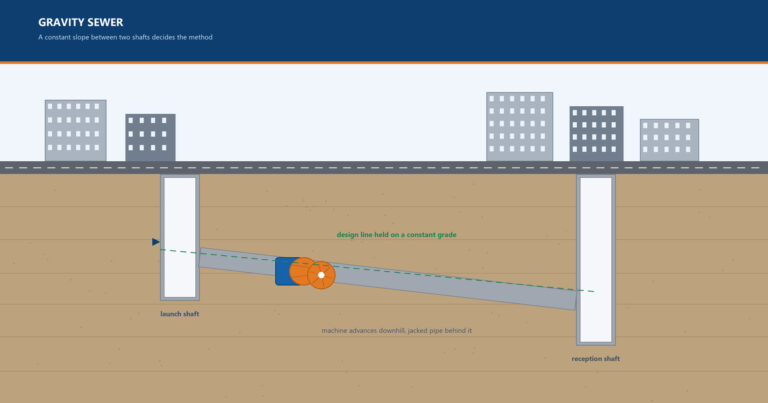
Short answer: when to use microtunneling comes down to four conditions – a continuous gravity grade, manageable ground at depth, buildable shafts, and a drive length inside the jacking envelope. If any one of those fails, another method usually fits better.
This decision guide answers one question for sewer projects: is microtunneling the right method, or is another option a better fit? It works through the four conditions that must all be true, the situations where microtunneling is the wrong choice, and the alternatives that remain on the table. Deciding when to use microtunneling is a screening exercise, not a pricing exercise, so the sections below stay at the level of site conditions and design requirements.
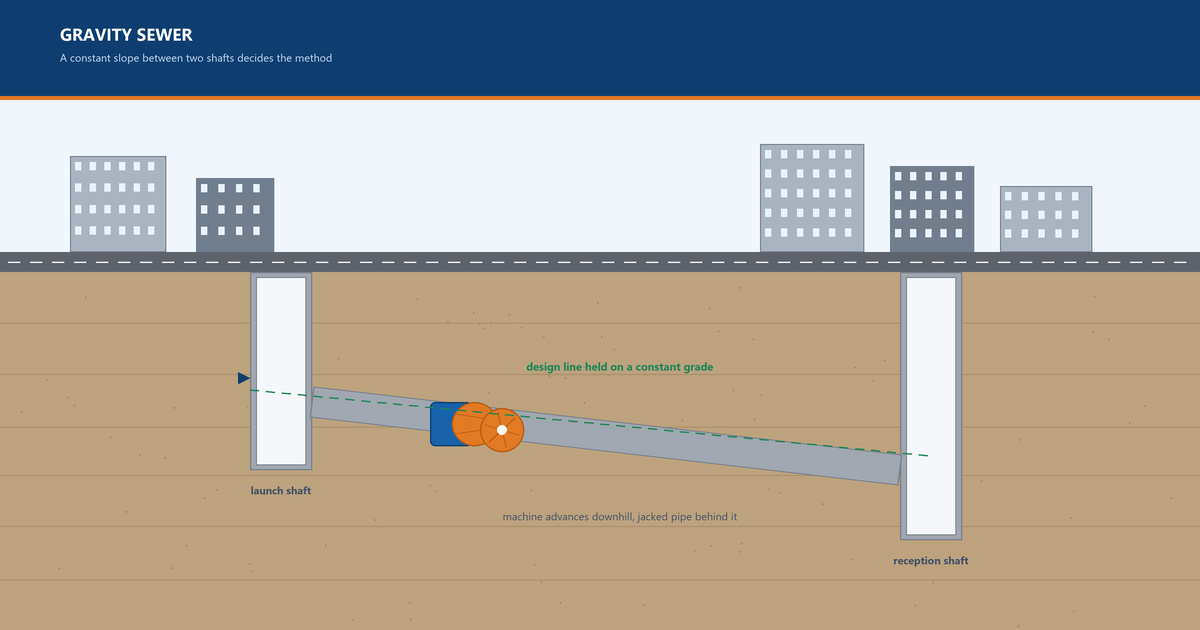
The Short Answer: Four Conditions Decide When to Use Microtunneling for a Gravity Sewer
Microtunneling is the right choice when four conditions are all true at once. The list is short on purpose, because in a decision guide one failed condition is enough to redirect the project.
- The line must hold a gravity grade. Gravity flow sets a precise line and grade that only an accurately steered method can deliver.
- The ground must be manageable at depth. Unstable or water-bearing soil at the tunnel horizon favours a machine that supports the face, which is why microtunneling and pipe jacking share this logic.
- You must be able to build and live with shafts. A launch shaft and a reception shaft are part of the method, not an add-on.
- The drive length must fit the envelope. Shaft-to-shaft spacing has to sit inside the practical jacking range.
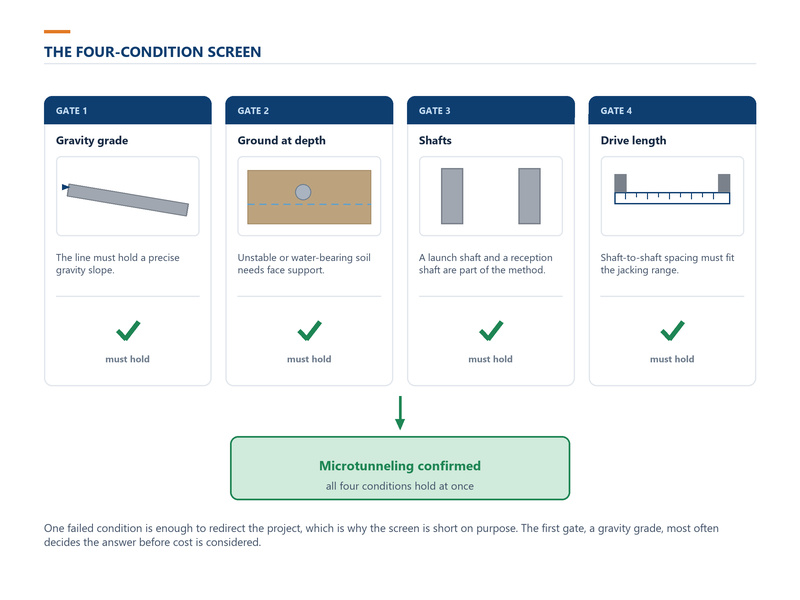
Bottom line: when to use microtunneling is a four-gate test, and the first gate – a gravity grade – is the one that most often decides the answer before cost is considered.
Condition 1: The Line Must Hold a Gravity Grade
A gravity sewer flows because it falls, so its alignment must hold a continuous slope from one end to the other. Design codes commonly set a minimum slope on the order of 1 percent for small-diameter lines, with the exact value taken from the governing local standard for the pipe material and diameter in use.
Microtunneling holds line and grade by steering continuously against a laser or gyroscopic reference. For a gravity line the test is whether the guided drive holds its design band across the run, so the pipe arrives inside the envelope rather than near it.
An HDD bore is a different proposition. It follows a curved arc between an entry and an exit pit and is tracked from the surface, so it cannot hold the constant slope a gravity line needs. The accuracy gap is compared in more detail in microtunneling vs jack and bore: cost and accuracy.
- Gravity lines need a continuous slope; grade control, not speed, is the governing requirement.
- Pressure lines tolerate far more deviation, because a small offset changes nothing about hydraulic performance.
- Sensitive crossings may specify a tight tolerance for cover and settlement control reasons even where flow is not gravity-driven.
If the line must flow by gravity, line and grade control is the requirement that narrows the method set to microtunneling, pipe jacking or a guided boring system.
Condition 2: The Ground Must Be Manageable at Depth
At depth the ground usually behaves worse than near the surface: pore pressures rise, cohesion falls, and running soil becomes a live risk at the face. Microtunneling answers that with continuous face support, using a slurry or earth pressure balance system to hold the excavation stable while the machine advances.
The table below sets out how the common ground types behave at the sewer horizon.
| Ground condition | Behaviour at the tunnel horizon | Preferred method |
|---|---|---|
| Stiff clay, silt | Stands well; low permeability | Microtunneling or open-cut if shallow |
| Loose sand and gravel above the water table | Manageable with controlled face support | Microtunneling or pipe jacking |
| Running or water-bearing sand | Will not stand; collapse risk at an open face | Microtunneling with slurry or earth pressure balance support |
| Soft and weathered rock | Slow but stable; cutter wear is the main variable | Microtunneling with a rock cutterhead |
| Mixed face (rock and soil in one face) | Erratic steering and tool loading | Evaluate case by case; often reconsider the method |
Unstable, running or water-bearing ground is the strongest technical argument for microtunneling and pipe jacking, because face support is built into these methods rather than added to them.
Condition 3: You Can Build and Live With Shafts
Microtunneling is a shaft-based method. The machine is launched from a launch shaft with a thrust wall behind the jacking frame, and it is received in a second shaft at the far end.
Those shafts are the largest single constraint on when to use microtunneling.
On a gravity line the shafts usually become the permanent manhole structures, so the cost of building them is shared with the asset rather than written off.
- Space: a working shaft needs room for the machine, the jacking frame, spoil handling and lifting plant, which is difficult on a narrow frontage.
- Ground and water: shaft excavation at depth needs support, and often dewatering or a sealed base.
- Surface use: the shaft footprint must be acceptable for its duration, including access, noise and traffic management.
Where the alignment can place each shaft in a location that suits the permanent manhole, the surface impact is concentrated rather than continuous. That is also why microtunneling is often chosen where settlement control decides the method: a supported shaft and face move less ground than a long open trench.
Shafts are the gate that usually fails last: if a starter shaft and a reception access chamber can be sited, the other three conditions decide the method.
Condition 4: The Drive Length Fits the Envelope
Each drive runs from one launch shaft to the next reception shaft, and its length is limited by jacking force, pipe compressive capacity and friction along the pipe string. A typical single drive is 100-300 m, and specifications commonly require allowance for an intermediate jacking station roughly every 100 m.
| Parameter | Typical range | What sets the limit |
|---|---|---|
| Pipe diameter | 300-3,000 mm (12-120 in.) | Machine class and pipe availability |
| Pilot tube microtunneling maximum | About 48 in. | Guided boring system size |
| Typical single drive | 100-300 m | Jacking force and pipe compressive capacity |
| Intermediate jacking station | Allowance at friction-controlled spacing | Friction control practice in the specification |
Long drives and large diameters are usually evaluated together, because both raise jacking force. Diameter is set by machine class and pipe availability, and the smallest sizes are limited mainly by shaft cost.
- Short drives (under about 100 m): often better served by open-cut or a smaller guided system, because shaft cost dominates.
- Typical drives (100-300 m): the natural shaft-to-shaft rhythm of a gravity line, matching manhole spacing.
- Long drives (beyond 300 m): feasible with intermediate jacking stations and lubrication, and evaluated against the pipe’s compressive capacity.
Drive length is a force problem before it is a distance problem, and the intermediate jacking station allowance exists to reset that limit.
When Microtunneling Is the Wrong Choice – and What to Use Instead
A decision guide is only useful if it says no as clearly as it says yes. Microtunneling is the wrong method in several recognisable situations, and each has a better answer.
| Situation | Why microtunneling loses | Better fit |
|---|---|---|
| Shallow crossing in open ground | Shaft cost is not recovered on a short, simple run | Open-cut excavation |
| Pressure line with no grade requirement | Accuracy beyond grade is not needed; the cost premium buys little | Directional drilling |
| No space for a shaft or reception pit | The method depends on shafts that cannot be built | Directional drilling or Direct Pipe |
| Short drive between close structures | Shaft and mobilisation cost per metre is too high | Guided boring or open-cut |
| Continuous hard rock over a long drive | Cutter wear and tool access dominate programme and risk | Segmental tunnelling or Direct Pipe |
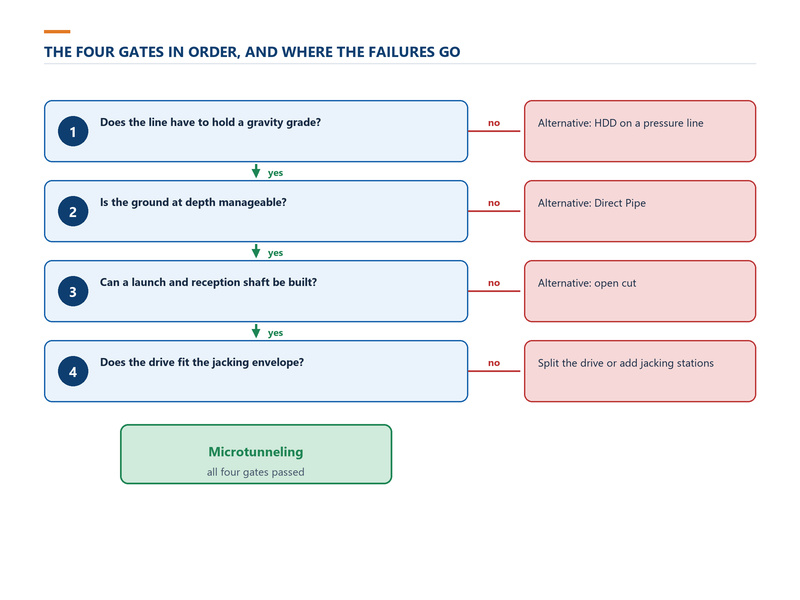
Where the ground is open, trenchless technology vs open-cut excavation is a straight comparison of cost and surface impact. Where the line carries pressure and can curve, directional drilling usually wins. Where the ground is difficult but a shaft is impossible, Direct Pipe installs a steel pipeline in one pass, as set out in microtunnel vs. HDD vs. direct pipe. For hard rock and mixed faces, see microtunneling in rock and mixed ground.
For readers who want the wider context before choosing, what are trenchless technologies places microtunneling alongside the other trenchless families.
Bottom line: when to use microtunneling is easier to answer once the wrong-choice list is applied first, because eliminating the mismatches leaves a short, honest shortlist.
Does the Depth Threshold Still Apply to Your Project?
Cost is a screen here, not a topic in itself. When deciding when to use microtunneling, the single most useful threshold is depth. The rule of thumb we use is directional: at 20 ft (6 m) of cover and deeper, microtunneling usually carries the lower total cost in a built-up corridor, while a shallower crossing in open ground usually stays cheaper by open cut.
In a built-up corridor the cost balance usually flips toward microtunneling, because the work concentrates at the launch shaft while the corridor above stays open; the line-by-line cost structure is set out in microtunneling vs open cut.
- Depth: at depth, shoring and dewatering push open-cut cost up sharply.
- Urban density: traffic, access, business continuity and utility conflicts all add indirect cost to an open trench.
- Risk exposure: the longer the trench is open, the longer the safety, settlement control and third-party risk is carried.
Bottom line: under a live surface at depth, the shaft-based option is normally the one that survives the screen.
Which Seven Factors Decide the Screening?
The four conditions decide whether shaft-based construction is possible at all; the seven factors rank it against the alternatives. The screening scorecard is filled in with the owner before any method is named, so the decision is documented rather than assumed.
- Grade requirement: does the line demand a continuous gravity slope?
- Depth at the crossing: is the invert deep enough to rule out open-cut?
- Ground at the face: will it stand at an open face, or does it need continuous support?
- Shaft feasibility: can a launch shaft and a reception manhole be built and accessed?
- Drive length: does the shaft-to-shaft spacing sit inside the 100-300 m envelope, or need intermediate stations?
- Surface sensitivity: are there rail, highway, building or utility constraints that favour settlement control?
- Duration and exposure: is the surface able to tolerate the time an alternative would occupy it?

Bottom line: the scorecard keeps the decision on site conditions and off preference, which is what a defensible method statement requires.
What Should You Put in the Tender to Get Comparable Bids?
Once the question of when to use microtunneling is settled, the tender documents decide whether the bids that come back are comparable. Vague wording lets each contractor price a different method and a different risk allocation.
- Tolerance: state the required line and grade tolerance in millimetres, since it drives machine class and guidance system.
- Drive lengths: list the shaft-to-shaft distances so intermediate jacking station allowances are priced on the same basis.
- Ground information: include the geotechnical investigation and the interpreted tunnel horizon.
- Shaft strategy: confirm which shafts become permanent manhole structures and who holds the ground-risk for each.
- Settlement limits: name the structures and the movement limits that settlement control must respect.
- Surface constraints: set out access, hours, noise and traffic requirements so they are priced, not discovered.
- Alternative pricing: require a priced comparison against the two most credible alternatives on the same alignment, so the decision is defended rather than asserted.
These seven items make the returned bids comparable and the method decision defensible.
Need a decision, not a sales pitch? Send your alignment data and geotechnical report for a free method review, and our engineers will confirm whether microtunneling is the right choice.
Frequently Asked Questions
When should microtunneling be used instead of open-cut?
Use shaft-based construction when the line must hold a gravity grade, the ground at depth needs support, the shafts can be built, and the corridor above cannot be opened – the depth threshold that usually triggers it is set out in microtunneling vs open cut.
Can microtunneling hold a gravity sewer grade?
Yes. Microtunneling holds line and grade to a deviation band of 10-25 mm on a well-controlled drive with a guided machine, widening to 25-50 mm where the ground is mixed or the drive is long.
What minimum slope does a gravity sewer need?
Design codes commonly set a minimum slope on the order of 1 percent for small-diameter gravity sewers, although the exact figure depends on pipe material, diameter and the governing local standard. The controlling point is that the slope is continuous, which is why an accurate method such as microtunneling or pipe jacking is normally used.
Our 600 mm sewer is 6 m deep under a main street with traffic running – is microtunneling still the right choice?
At 6 m under a main street, two gates – depth and surface constraint – are already met, so the method turns on the ground and the shafts. The cost comparison behind that depth threshold is set out in microtunneling vs open cut.
Our line runs under a rail corridor – what pipe diameters can a tunnel drive install?
Typical published ranges place microtunneling between about 300 and 3,000 mm (12-120 in.). Pilot tube microtunneling generally stops near 48 in., while slurry and earth pressure balance machines cover the larger diameters. The smallest sizes are limited mainly by shaft cost rather than by the machine.
How long can a single microtunneling drive be?
A single drive typically runs a few hundred metres; beyond that the jacking envelope decides, and station spacing follows the jacking rules shared across the family.
The sewer must pass 7 m beneath a hospital that stays open – can a tunnel drive keep the ground within settlement limits?
It can. Because the machine supports the face continuously and is driven by remote control, ground movement is easier to hold within tight limits than with an open-face method. Settlement monitoring is still required, and the acceptable limit is set by the asset owner for each structure.
How Do You Get a Written Method Decision?
If you are preparing a method statement, the four gates are the structure to defend; if you are scoring bids, the tolerance and drive-length definitions are what make them comparable.
A method review answers the question of when to use microtunneling from five inputs: the geotechnical investigation, utility locates, the crossing length and depth, the pipe material and diameter, and the tolerance the design actually requires.
We apply the four gates to your alignment and put the answer in writing, including the gate that failed.
For gravity work, see our microtunneling services and the wider microtunneling construction services that deliver the drive, within a delivery chain that includes pipeline construction services for the connections either side of the crossing.
From a water utility’s side of the table, the two conditions that most often send a sewer drive back to the drawing board are an artesian water table and a boulder zone that the geotechnical investigation never found. Both are cheaper to resolve before the tender than after award.
Final Verdict: When to Use Microtunneling – and When You Should Not
Microtunneling is the right choice for a gravity sewer when the line must hold a continuous grade, the ground at depth needs continuous face support, shafts can be built, and the drive lengths sit inside the jacking envelope.
Those four conditions are the whole test.
It is the wrong choice when the crossing is shallow and open, when the line carries pressure and needs no grade, when no shaft or reception pit can be built, or when continuous hard rock makes cutter access the dominant risk. In each case a simpler method exists, and a decision guide is only trustworthy if it names them.
The discipline behind deciding when to use microtunneling is simple: name the governing condition, then defend it in writing.
Get a second opinion at no cost. Bring us the alignment and the ground report, and our engineers will set out which method the ground supports and which one it does not.
Related: microtunneling vs open cut.
Sources
Each section names its source: construction and drive length follow ASCE/CI 36-15, machines follow Herrenknecht, and practice follows NASTT.
- ASCE/CI 36-15, Standard Construction Guidelines for Microtunneling.
- ASTM International, standards for pipeline materials and installation.
- Herrenknecht technical guidance on microtunneling and pipe jacking.
- NASTT Good Practices Guidelines (Microtunneling).





































 English
  Arabic
  Russian
  Spanish
  French
  Vietnamese
  Polish
  Thai
Thai  Indonesian
  Turkish
  Portuguese