
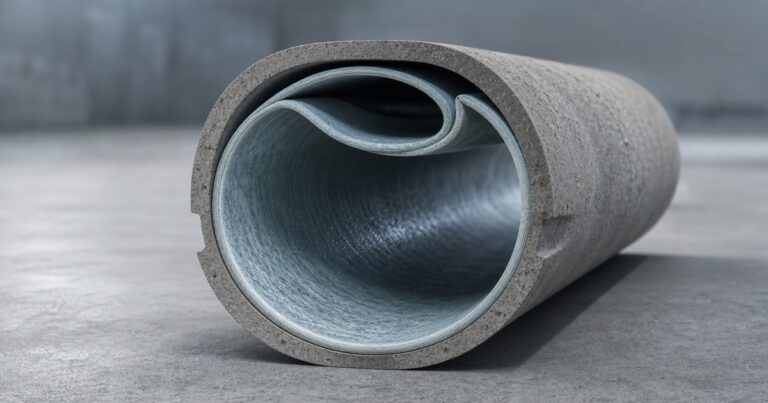
In pipe rehabilitation, CIPP stands for cured-in-place pipe: a resin-impregnated liner is installed inside an existing pipe and cured there, so the liner and the resin form a new structural pipe within the old one. In pipeline work the letters name one method, not a material or a contractor. Most readers meet what does CIPP stand for in a specification, a bid or a search box, and the real question is whether the scope is a lining or a replacement. CIPP is a generic method specified in ASTM F1216 and offered by many contractors rather than owned by one supplier.
What Does CIPP Stand For, Word for Word?
CIPP is an acronym, so each letter maps to a word. Read from front to back, the four parts describe a sequence of steps rather than a product name, and the sequence explains the method better than any marketing description.
- Cured: a liquid resin changes into a solid. The change is chemical and is triggered by heat, ultraviolet light or time, and it happens while the liner is already inside the pipe. That chemical change is not paint drying on a surface.
- In: the liner is placed inside the existing pipe. The host pipe stays where it is and acts as the outer boundary that the new wall forms against.
- Place: curing happens at the liner location, not in a factory yard. The finished wall follows the line of the host pipe, including its bends and its service connections.
- Pipe: once cured, the resin-filled wall carries internal and external loads as a pipe. Engineers therefore design a wall thickness, not a coating thickness.
The order matters. The liner is cured, and it is cured in place, and both facts shape how the method is designed, installed and tested. A specification that treats the finished liner as a structural element, as ASTM F1216 does, is describing a new pipe rather than a surface treatment.
The acronym is a fixed term of art, but the engineering behind it is not identical from one job to the next. ASTM F1216 is written for pipes from about 2 in. to 108 in. (about 50 mm to 2,750 mm) in diameter, and it separates partially deteriorated hosts, where the old pipe still carries some share of the load, from fully deteriorated hosts, where the liner is designed to carry the load by itself.
NASTT presents two accepted design routes, ASTM F1216 and ASCE MOP 145, and municipal specifications often cite ASTM F1743 and ASTM D5813 alongside F1216. The letters CIPP do not change across those documents; the calculations behind them do. Liner designs under these standards are commonly written against a 50-year service life, the customary design horizon for the method.
Why “In Place” Is the Load-Bearing Word
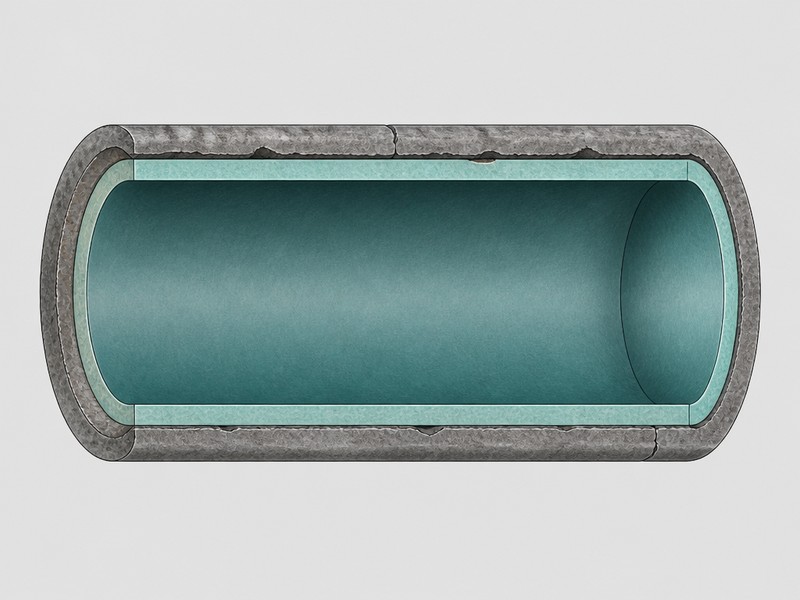
Of the four words, “in place” does the most work. Any liner can be shaped and soaked in a workshop; what defines CIPP is that the cure happens where the pipe will stay.
- The host pipe becomes the mold. The liner cures against the existing wall, so the new pipe inherits the line, the bends and the connections of the old one.
- The renovation has few joints. Because the liner is continuous over the length that is installed, there is no long run of new joints that can leak.
Lining a pipe in place carries two limits. First, a CIPP lining does not restore a lost gradient: a sagging sewer is still sagging after it is lined. Second, the finished liner reduces the internal diameter by about its wall thickness plus any annular gap the design assumes, so flow capacity must be checked against the lined bore rather than assumed. On the sewers we survey, the reduced internal diameter is the first figure we re-confirm when a pipe already runs close to its design flow.
The diameter effect is easy to underestimate. A liner wall a few millimeters thick looks small against a large sewer, but it lowers the cross-sectional area, and a partly filled pipe often runs at a higher stage after lining than before. Engineers handle this by choosing a liner thickness that satisfies both the structural and the hydraulic duty, because the two are separate calculations; a proposal that quotes only one of them is incomplete.
What CIPP Does Not Stand For
The acronym is specific, and several common guesses are wrong. In precise terms, what does CIPP stand for? It points to one method – not a company and not a pipe material.
- Not a brand. CIPP is a generic technology. Insituform is a company name, not a synonym for the method. The process was coined by Eric Wood, a British agricultural engineer who applied for a patent in 1970 and took the name from the Latin in situ, meaning in place.
- Not cast iron pipe replacement. The acronym does not stand for cast iron pipe replacement, and it has nothing to do with concrete, copper or cast iron pipe as product names. A liner can be installed inside a cast iron, clay, concrete or plastic host pipe, but the acronym names the process, not the host material.
- Not a coating. A coating seals a surface and does not carry load. A CIPP liner is designed as a structural wall and is thick enough to span defects, which is why the industry calls it a lining rather than a paint.
CIPP is not shorthand for replacement. It installs a new pipe inside the old one, so the host stays in the ground and the result is a pipe within a pipe rather than a re-cut trench. That is why CIPP belongs to the trenchless pipe rehabilitation family rather than beside open-cut excavation.
CIPP was commercialized early under a trade name, and for a time the trade name and the technology traveled together in the market. Today the same principle is offered by many manufacturers of felt, fiberglass and other carrier tubes, and by many contractors working to the same standards. A specification that names a product brand instead of the generic method leaves the owner with less competition and less ability to compare, which is one reason public owners write generic CIPP language and keep brand names to a pre-qualified list.
CIPP Is Not a Synonym for Pipe Bursting, Slip Lining, or Grouting
Bidders often treat trenchless method names as interchangeable, but the difference decides which method a given pipe actually needs. CIPP belongs to the wider family of trenchless technologies, but it is only one member of it.
| Term | Full name | What it is | What it is not |
|---|---|---|---|
| CIPP | cured-in-place pipe | A resin-impregnated tube cured inside the host pipe to form a new structural pipe. | Not a brand, a coating, or a synonym for another method. |
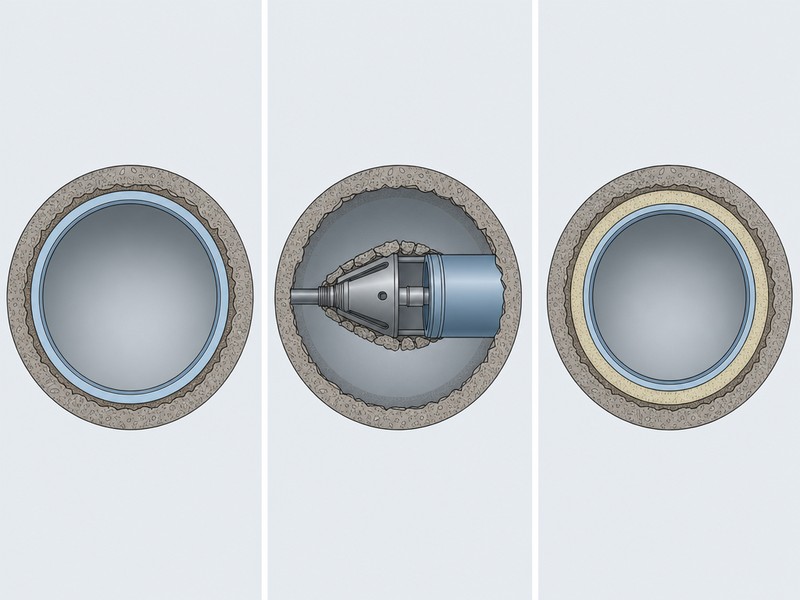
| Pipe bursting | pipe replacement by bursting | A static or pneumatic head splits the old pipe outward while a new pipe is pulled in behind it. | Not a liner; the old pipe is destroyed and the bore is replaced. |
| Slip lining | slip lining, also written sliplining | A smaller pre-made pipe is pulled into the host, leaving an annulus between the two. | Not bonded to the host and not cured in place; it reduces diameter further. |
| Fold-and-form (FIPP) | folded-in-place pipe | A folded thermoplastic pipe is inserted and re-rounded with heat and pressure. | Not resin-cured, so it is not CIPP. |
| Spray lining | spray-applied lining | Cementitious or resin mortar is sprayed onto the pipe wall. | Not a structural tube; load capacity depends on the host. |
| Grouting | chemical grouting | Joints and voids are sealed with chemical grout. | Not a new pipe; no structural wall is added. |
Each method in Table 1 can be the right answer in the right conditions, and a sound proposal names the one it is offering rather than using an acronym as a general label. When a description cannot say whether the pipe is lined or replaced, the reader cannot tell what is being sold.
In our bid reviews, the clearest proposals name the method first and the product second. The clearest proposals state the host material, the design route, the cure method and the service-life assumption on the first page, so whether the reader is an owner’s engineer, a contractor pricing the work or a bidder closing out a specification, the scope is legible within minutes. Vague language is not only a technical risk; it makes pricing hard to compare, because different methods carry different excavation, bypass and reinstatement costs that a single number cannot capture.
Adjacent Acronyms a Bidder Meets: CCTV, UV-CIPP, FIPP, HDD and CI
Five acronyms sit alongside CIPP in a typical bid document, and each names a different kind of object.
- CCTV: closed-circuit television, the camera survey used to inspect and code the pipe before and after lining. On the CCTV surveys we review, the survey is the evidence that decides whether a liner can be installed at all, which is why it belongs to CCTV inspection rather than to the lining specification itself.
- UV-CIPP: a liner cured with ultraviolet light instead of hot water or steam. UV liners cure quickly, on the order of about one minute per meter of pipe, and they use a different initiator package in the resin. UV curing is a cure method, not a separate technology.
- FIPP: folded-in-place pipe, also called fold-and-form, a different trenchless lining method that re-rounds a folded thermoplastic pipe.
- HDD: horizontal directional drilling, a new-installation technique, not a rehabilitation method.
- CI: in pipe records, CI almost always means cast iron, the host material. CI is an abbreviation for a material, not for a method.
When a bidder asks what does CIPP stand for, the cure method is usually the next question. Hot water, steam and UV share the same acronym but differ in cure mechanics, and the liner resin is specified to match.
The cure method also drives the site program. Steam and hot-water cures typically run for one to four hours depending on thickness and length, while UV curing works much faster and shortens the bypass window. Each method has trade-offs: hot-water cure is well established and produces a measured cure profile, but it releases styrene into the cure water and needs water handling; steam cures quickly with less water but needs careful temperature control; UV needs the right liner chemistry and equipment. The right choice depends on site conditions, the liner design and the owner’s constraints, not on a blanket rule.
Cured-In-Place, Cure-In-Place, CIPP Lining: How the Naming Variants Differ
Specifications, search results and bids do not spell the term the same way. The CIPP acronym is not standardized across documents, so the naming variants in Table 2 all point to the same method but carry slightly different senses.
| Variant | Where it is used | Sense |
|---|---|---|
| cured in place pipe | Standards and formal text | The full name of the method, written unhyphenated. |
| cure-in-place pipe | Occasional typographic variant | A loose spelling of cured; still read as the same method. |
| CIPP lining | Field and bid shorthand | The lining operation itself, and the installed product. |
| CIPP renewal | Asset-management language | Frames CIPP as renewing an asset rather than installing new pipe. |
| CIPP | Everyday abbreviation | The acronym, once it has been defined. |
The CIPP acronym is rarely the real problem in the bids we see; the method names around it cause the confusion. Owners sometimes compare a liner with inserted hose lining, a factory-made alternative, because both add a new wall inside the host.
Whatever the spelling, the practical test is the same. Ask whether the liner is bonded to the host or free-standing, whether it is cured on site or pre-manufactured, and whether it is designed to carry load. A specification is safest when it names the full term on first use and the acronym after that; the naming test separates the methods better than the words printed on a cover sheet.
What CIPP Cannot Do: Honest Limits
Four limits decide whether CIPP fits, and what does CIPP stand for has a plain answer for each: gradient, bore, host condition and site control.
- A CIPP liner reproduces the existing line and level, so a sagging or back-graded sewer stays sagging after it is lined.
- The finished CIPP wall reduces the internal diameter, so flow capacity has to be re-derived against the lined bore.
- Suitable hosts keep their basic shape and structural continuity. Where a section is collapsed or missing, repair or replacement comes first, and lining follows.
- Odor and styrene emission during cure are a real, managed issue. Published guidance from NASSCO sets a fifteen-foot (about 4.6 m) perimeter and exhaust stacks at least six feet (about 1.8 m) above ground for styrene, and UV curing reduces the emission.
Scope limit: CIPP applies where the host pipe keeps its basic shape and continuity. Where published code language treats the piping as compromised, repair or replacement comes first. Our field teams record the lined bore on every close-out so the flow check is not forgotten. The honest summary is that CIPP is a strong renewal method and a poor fit for a pipe that has already lost its shape.
Resin choice is a boundary on this page rather than a topic. The saturating resin is usually one of four families – polyester, vinyl ester, epoxy or silicate – and where a pipe carries a strong industrial effluent the resin has to be matched to that specific chemical load before the liner is specified. Preliminary 2024 measurements found that non-styrene polyester resins stayed inside OSHA and EPA exposure limits in the cases measured, and that finding should still be treated as preliminary.
Frequently Asked Questions About the CIPP Acronym
What does CIPP stand for?
CIPP stands for cured-in-place pipe. A resin-impregnated liner is installed inside an existing pipe and cured in place, so the liner and the resin form a new structural pipe within the old one.
If a specification names CIPP, is it naming a brand or a generic method?
CIPP is a generic method, not a brand. Insituform is a company name, while the acronym describes the technology, and many contractors and material suppliers work with the same method under different names.
Is CIPP the same as cast iron pipe replacement?
No. The acronym does not stand for cast iron pipe replacement; it names a renewal method, not a material. A liner can be installed inside a cast iron, clay, concrete or plastic host pipe without replacing the material itself.
Is CIPP a coating, or does the liner carry structural load?
A coating seals a surface and does not carry load. A CIPP liner is designed as a structural wall with a defined thickness, so it carries load and is a lining rather than a coating.
Is CIPP the same as pipe bursting or slip lining?
No. Pipe bursting destroys the old pipe and pulls a new one behind it, and sliplining pulls a smaller pre-made pipe into the host. CIPP cures a resin-impregnated tube in place, so it is a distinct method.
Does CIPP reduce the pipe diameter, and what happens to flow capacity?
Yes. The finished liner reduces the internal diameter by about its wall thickness plus any annular gap the design assumes, so flow capacity should be checked after design rather than assumed unchanged. In the proposals we review, the most common gap is a flow check run against the original bore instead of the lined bore.
Key Takeaways
- The answer to what does CIPP stand for is a method, not a brand: a cured liner installed and set inside an existing pipe.
- In the acronym CIPP, the load-bearing words are “in place”: the cure happens where the pipe stays, so the host pipe acts as the mold.
- CIPP is not cast iron pipe replacement, not a coating, and not a synonym for the other trenchless methods in the table.
- Adjacent acronyms such as CCTV, UV-CIPP, FIPP, HDD and CI all describe different things.
- A CIPP liner keeps the existing grade and reduces the internal diameter, so flow must be checked against the lined bore after design.
How JSW Supports CIPP and Trenchless Work
JSW is a pipeline engineering and construction company that executes trenchless rehabilitation with its own crews and equipment. Our scope covers pipe restoration solutions and pipeline repair services, alongside the trenchless methods described above.
Because CIPP sits inside a longer chain of inspection, design and reinstatement, we deliver it as an integrated scope: the same team that surveys the pipe also designs the liner and returns to prove the finished bore. Every project is documented, so the owner can audit the decisions rather than take them on trust.
On acronym questions in particular, we would rather spend ten minutes clarifying the scope than have an owner compare a lining bid against a replacement bid. Our estimates name the method, the liner family and the cure method, and they flag any assumption that would change the price if it proves wrong.
- Integrated delivery: survey, design, installation and post-lining verification handled by one contractor.
- Auditable process data: CCTV before and after, wet-out and cure logs, and sample records kept for each liner.
- Risk-explicit pricing: assumptions about access, flow control and host condition stated up front.
- Design review by engineers: wall thickness and material recommendations reviewed by professional engineers before bid.
Need to confirm what a CIPP proposal actually offers? Send your pipe size, host material, the design route named in the bid and the latest CCTV survey. Our engineers reply with a scoped recommendation, the basis for the wall thickness, and a budget range, so you can compare a lining bid against a replacement bid on the same terms.





































 English
  Arabic
  Russian
  Spanish
  French
  Vietnamese
  Polish
  Thai
Thai  Indonesian
  Turkish
  Portuguese