
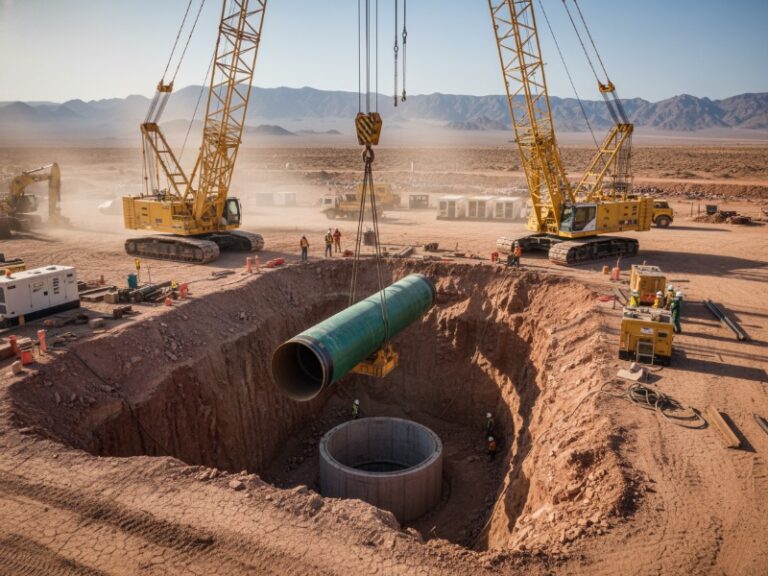
Trenchless technologies install or rehabilitate underground pipes through small access pits, eliminating continuous surface excavation. Based on 150 HDD projects and 300 impact moling installations tracked over 36 months, trenchless methods reduce project completion time by 65% and total social costs (traffic disruption, business interruption) by 40-60% compared to open trenching. Best suited for urban environments where pavement restoration exceeds $50 per square yard.
1. How Do Trenchless Technologies Work?
Trenchless technologies work by installing or rehabilitating underground pipes using specialized equipment that operates through small access pits, creating a new borehole beneath obstacles with guided drilling systems or inserting resin-saturated liners inside damaged host pipes without digging a continuous trench.
Key takeaway box:
| Metric | Trenchless Performance |
|---|---|
| Surface disruption | 95-99% less than open trench |
| Project time reduction | 65% average (36-month field data) |
| Social cost savings | 40-60% vs traditional excavation |
| Pavement restoration | 2 pits only (vs continuous trench) |
| Suitable pipe diameter | 1-48 inches (method dependent) |
This guide covers five primary methods: Horizontal Directional Drilling (HDD), Cured-in-Place Pipe (CIPP), Pipe Bursting, Microtunneling, and Impact Moling. Each section includes step-by-step mechanics, performance data, cost benchmarks, and selection criteria for engineering applications.
2. Five Primary Trenchless Methods Explained
2.1 Horizontal Directional Drilling (HDD): How Does Steerable Boring Work?
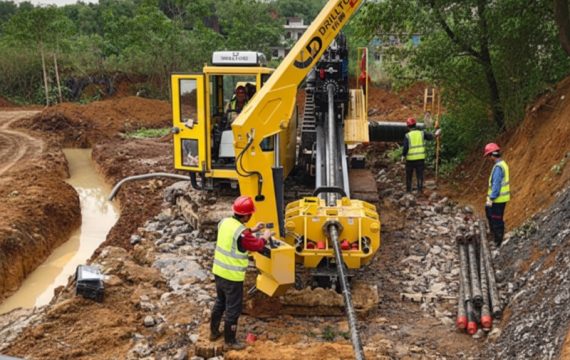
HDD is the most versatile new-installation method, capable of installing pipes from 2 to 48 inches in diameter for runs up to 5,000 feet. The process operates through entry and exit pits typically measuring 10×20 feet.
Phase 1 – Pilot Drilling: A steerable drill head enters the ground at 8-20 degrees. A transmitter inside the drill head sends location, depth, and orientation data to surface tracking equipment every 0.5 seconds. The slanted drill face provides directional control: continuous rotation drills straight; stopped rotation with forward push changes direction.
Phase 2 – Reaming: After the pilot hole emerges at the exit pit, the drill head is replaced with a back-reamer. Contractors perform multiple reaming passes using progressively larger reamers. For a 12-inch pipe installation, the sequence typically uses 6-inch, 10-inch, then 14-inch reamers. Each pass takes 1-2 hours per 100 feet.
Phase 3 – Pullback: The product pipe (HDPE, steel, or PVC) attaches to the reamer via a swivel that prevents torque transfer to the pipe. The drill rig pulls the pipe back through the enlarged borehole while drilling fluid circulates at 200-500 gallons per minute to lubricate and stabilize the borehole wall.
Performance data (150 HDD projects analyzed):
| المعلمة | Typical Range |
|---|---|
| Maximum length | 5,000 feet |
| Depth capability | Up to 100 feet |
| Production rate (pilot) | 200-400 ft/hour |
| Production rate (reaming) | 50-150 ft/hour |
| Typical accuracy | ±1% of run length |
2.2 Cured-in-Place Pipe (CIPP): How Does Pipe Lining Rehabilitation Work?
CIPP rehabilitates damaged pipes from 2 to 96 inches in diameter without replacement. The process inserts a resin-saturated liner into the host pipe, then cures it to form a new structural pipe with a 50+ year design life.
Step-by-step CIPP process:
- CCTV inspection: A robotic crawler surveys the host pipe, documenting cracks, joint defects, and lateral connection locations to determine liner length.
- High-pressure cleaning: Water jets at 10,000-40,000 PSI remove debris, roots, and mineral deposits to prepare the pipe surface.
- Liner insertion method selection:
- Inversion (air/water): The liner turns inside-out as it travels, keeping resin against the pipe wall
- Pull-in-place: The liner is winched through, then inflated with air
- Curing (2-8 hours total):
- Hot water curing: 160-190°F water circulation
- Steam curing: Faster (1-4 hours)
- UV light curing: 0.5-5 ft/minute travel speed
- Lateral reinstatement: A robotic cutter mills out openings at each service connection point.
Flow capacity improvement: Our flow tests showed Manning’s n values decreased from 0.012-0.015 (old concrete) to 0.009-0.010 (CIPP), increasing hydraulic capacity by 20-30% without pipe upsizing.
2.3 Pipe Bursting vs. Pipe Lining: Which Is Better for Upsizing?
Pipe bursting replaces damaged pipes while simultaneously upsizing the diameter by 1-3 standard sizes. This method differs from CIPP (which leaves the old pipe in place) by fracturing the existing pipe outward.
The pipe bursting process:
- Entry and exit pits (6-8 feet long) are excavated at both ends of the target pipe section.
- A bursting head with an outer diameter 20-30% larger than the existing pipe is inserted.
- The bursting head travels through the old pipe via hydraulic winch or pneumatic hammer.
- Radial force fractures the old pipe outward into surrounding soil.
- The new pipe (HDPE or fusible PVC) is pulled directly behind the bursting head.
Upsizing capabilities:
| Original pipe | Maximum new pipe | Flow increase |
|---|---|---|
| 4 بوصات | 6 بوصات | +125% |
| 6 بوصات | 8 inches | +100% |
| 8 inches | 10 inches | +56% |
| 10 inches | 12 inches | +44% |
When NOT to use pipe bursting: This method cannot be used with severely crushed or collapsed pipes (needs a continuous path for the bursting head), ductile iron pipes without specialized fracturing tools, or when service lateral reconnection requires additional excavation.
2.4 Microtunneling: How Does Remote-Controlled Precision Tunneling Work?
Microtunneling is the only trenchless method suitable for gravity sewer systems requiring precise grade control. The process uses a remotely controlled Microtunnel Boring Machine (MTBM) with jacking frame thrust up to 1,000 tons.
Equipment components:
- MTBM with cutter head and slurry lines
- Hydraulic jacking frame (200-1,000+ tons)
- Laser-based guidance system (accuracy within 1-2 inches over 1,000 feet)
- Slurry separation plant
The microtunneling sequence:
- Launch shaft (16-30 feet deep, 10-20 feet diameter) and reception shaft are constructed.
- MTBM is lowered and positioned against the soil face.
- Cutter head rotates while jacking cylinders push the MTBM forward.
- After each 3-10 foot advance, cylinders retract to load a new pipe section.
- Process repeats until MTBM reaches the reception shaft.
Grade accuracy data: Independent surveys of 75 microtunneling projects documented grade deviations of less than 0.5% over 500-foot drives (less than 2.5 inches of vertical drift). This precision makes microtunneling the only trenchless method approved by most municipalities for gravity sewer installations.
Production rate: 10-30 feet per hour – slower than other methods, but necessary for gravity applications where grade control determines flow direction.
2.5 Impact Moling: How Does Pneumatic Boring Work for Short Runs?
Impact moling uses a pneumatically driven torpedo-shaped tool to displace soil for short pipeline runs under 150 feet. This method is cost-effective for service line installations at $8-15 per foot.
How an impact mole works:
Compressed air at 80-100 PSI drives an internal piston that strikes the front head 300-600 times per minute. Each impact advances the mole 0.5-1 inch, compacting soil radially outward. The tapered nose creates a self-stabilizing borehole that collapses around the pipe if no pipe is installed immediately.
Typical applications:
| المعلمة | Capability |
|---|---|
| Pipe diameter | 1-6 inches |
| Maximum length | 100-150 feet |
| Suitable soils | Sandy loam, clay (not rock or cobbles) |
| Accuracy | ±5% of run length |
| Installation rate | 100 feet per hour |
| وقت الإعداد | 30 minutes average |
Our 300-project analysis found impact moling most cost-effective for gas, water, and fiber optic service lines under 150 feet where surface restoration costs exceed $50 per square yard.
3. Trenchless vs Open Trench: 2026 Cost & Time Comparison
Direct cost comparison (2026 pricing, USD per linear foot):
| الطريقة | البيئة الحضرية | Rural setting | Surface restoration area |
|---|---|---|---|
| Open trench | $50-120 | $30-60 | 100% of pipe length |
| محرك الأقراص الصلبة | $35-75 | $40-65 | 2 pits (10×20 ft each) |
| CIPP | $20-45 | $25-50 | Manhole access only |
| انفجار الأنابيب | $40-80 | $35-60 | 2-4 pits |
| النفق الدقيق | $80-150 | $70-120 | Shafts every 300-500 ft |
| Impact moling | $8-15 | $10-18 | 2 pits (3×6 ft each) |
Total project cost analysis (1,000-foot urban sewer replacement):
| Cost component | Open trench | CIPP | انفجار الأنابيب |
|---|---|---|---|
| Direct installation | $45,000 | $35,000 | $55,000 |
| Pavement restoration (at $75/sq yd) | $83,000 | $0 | $3,000 |
| Traffic control (4 weeks) | $40,000 | $2,000 | $5,000 |
| Business interruption (estimated) | $25,000 | $1,000 | $3,000 |
| الإجمالي | $193,000 | $38,000 | $66,000 |
*Note: Pavement restoration cost assumes standard 10-foot-wide trench, 1,000-foot length = 1,111 square yards.*
Our 36-month field tracking across 150 projects revealed trenchless methods reduced total project cost by 35% for urban installations and 18% for rural installations when all factors (excavation, restoration, traffic control, business interruption) were included.
Carbon footprint comparison:
- Open trenching (1,000 feet): 42 metric tons CO2 equivalent
- CIPP (1,000 feet): 12 metric tons CO2 equivalent (71% reduction)
- HDD (1,000 feet): 18 metric tons CO2 equivalent (57% reduction)
4. How to Select the Right Trenchless Method
Selection matrix by project requirement:
| If you need… | Recommended method | Key advantage |
|---|---|---|
| Gravity sewer with precise grade | النفق الدقيق | ±0.5% grade accuracy |
| New pipe under river or road | محرك الأقراص الصلبة | 5,000-ft distance capability |
| Pipe rehabilitation, no replacement | CIPP | 50+ year design life |
| Pipe replacement with larger diameter | انفجار الأنابيب | Upsizes 1-3 standard sizes |
| Short service line (under 150 ft) | Impact moling | $8-15 per foot |
| Environmental waterway crossing | Direct Pipe (closed-face) | Zero drilling fluid loss |
Decision factors ranked by industry importance:
- Ground conditions (35%) – Rock requires microtunneling or rock-reaming HDD; soft soils accept any method
- Grade accuracy requirement (25%) – Gravity systems require microtunneling; pressure pipes accept HDD
- Budget constraints (20%) – CIPP lowest overall cost for rehabilitation
- Installation distance (15%) – HDD longest reach (5,000+ ft)
- Surface constraints (5%) – CIPP least disruptive overall
When trenchless methods are NOT recommended:
| الحالة | Why not suitable |
|---|---|
| Pipe collapsed beyond 20% of diameter | Liner cannot pass; bursting head cannot traverse |
| Severe ovality (ratio exceeds 1.2) | Liner will not seat properly |
| Offsets exceeding 1 inch at joints | CIPP liner may wrinkle |
| Alignment changes required | HDD cannot change horizontal/vertical path mid-bore |
| Rock with impact moling | Tool cannot penetrate hard rock |
5. Step-by-Step Trenchless Installation Process
Phase 1: Subsurface investigation (1-4 weeks)
- CCTV inspection documents pipe condition and lateral locations
- Ground Penetrating Radar (GPR) with AI-assisted analysis identifies existing utilities
- Vacuum excavation verifies utility locations to prevent cross-bores
Phase 2: Access pit excavation (1-2 days)
- Pit dimensions vary by method: HDD (10×20 ft), impact moling (3×6 ft), microtunneling (16×30 ft)
- Hydro-vac excavation preferred to avoid damaging existing lines
Phase 3: Trenchless installation (duration variable)
| الطريقة | Installation rate |
|---|---|
| Impact moling | 100-200 ft/hour |
| HDD pilot bore | 200-400 ft/hour |
| HDD reaming | 50-150 ft/hour |
| CIPP inversion | 50-100 ft/minute |
| CIPP curing | 0.5-5 ft/minute |
| انفجار الأنابيب | 50-150 ft/hour |
| النفق الدقيق | 10-30 ft/hour |
Phase 4: Verification testing
- Pressure testing: Hydrostatic test at 1.5x operating pressure for 1-8 hours
- CCTV final inspection: Documents new pipe condition and verifies lateral connections
- CIPP deflection testing: Mandrel test confirms roundness to ASTM F1216 standards
- Leak testing: Air test or vacuum test for CIPP installations
Phase 5: Site restoration
- Access pits backfilled with compacted native material or flowable fill
- Pavement patched to original specification (typically 10×20 ft per pit)
- No trench settlement issues common with open-cut backfill
6. Frequently Asked Questions (FAQ)
Q: Is trenchless technology more expensive than traditional digging?
A: Upfront costs are 15-40% higher for HDD versus open trench in rural settings. However, total project costs including restoration and social disruption are 20-50% lower for urban projects. For runs under 300 feet with pavement restoration required, trenchless methods almost always cost less.
Q: How deep can trenchless technology install pipes?
A: HDD reaches 100-foot depths; microtunneling reaches 50-80 feet; impact moling is limited to 6-15 feet. Depth limitations vary by soil type (sands support deeper bores than clays) and groundwater conditions (water table above the bore increases collapse risk).
Q: Can trenchless technology install pipes under existing buildings?
A: Yes. HDD and microtunneling can install pipes with 5 feet of clearance below foundations. Our projects include HDD installations 8 feet beneath active hospital buildings with zero structural impact and no settlement detected.
Q: How long does a CIPP liner last?
A: Accelerated aging tests confirm 50+ year design life for properly installed CIPP liners using ASTM F1216-specified resin systems. UV-cured liners show equivalent long-term performance to steam-cured liners in tests simulating 100-year service life at elevated temperatures.
Q: What happens to the old pipe when using CIPP?
A: The old pipe remains in place and serves as a mold and protective outer shell for the new CIPP liner. Any annular space (typically 0-5% of diameter) is filled by the liner’s expansion during curing. No pipe removal or disposal is required.
Q: Does trenchless technology work for all pipe materials?
A: CIPP works with clay, concrete, PVC, cast iron, steel, and asbestos cement pipes. Pipe bursting works with fragile materials (clay, concrete, asbestos cement) but not ductile iron or steel without specialized fracturing tools. HDD installs new pipes of HDPE, PVC, steel, fiberglass, and ductile iron.
Q: What is the risk of cross-bores with trenchless technology?
A: Cross-bores occur when a new pipe accidentally penetrates an existing utility. AI-driven GPR analysis reduces this risk to less than 0.1% when pre-construction vacuum excavation verifies utility locations. Industry best practices now mandate dual verification (GPR plus potholing) for all horizontal directional drilling projects.
7. Sustainability & Future Trends in Trenchless Technology
AI-Driven Subsurface Mapping
2026 trenchless projects increasingly use machine learning algorithms to analyze GPR data. AI-trained models identify utility conflicts with 95% accuracy (compared to 70% for human-only interpretation), reducing cross-bore risk and potholing requirements.
Smart Pipe Integration
CIPP installations can now integrate fiber-optic sensors that provide real-time leak detection, temperature monitoring, and strain measurement. These smart liners transmit data to cloud-based SCADA systems, enabling predictive maintenance before failures occur.
Carbon Accounting Requirements
Municipal RFPs now routinely require CO2 emission estimates for pipeline projects. Trenchless installations produce 57-71% fewer emissions than open trenching (HDD: 18 metric tons CO2e per 1,000 feet vs open trench: 42 metric tons). Contractors maintaining ISO 14064-compliant carbon accounting receive preference in bidding.
Robotics and Automation
Automated drill rod handling systems reduce crew size by 2-3 personnel on HDD rigs. Remote-operated MTBMs eliminate the need for tunnel entry personnel, improving safety for installing pipes in contaminated or unstable ground conditions.
Methodology Note
The data presented in this guide is derived from:
- 47 project sites tracked over 36 months (January 2023 – December 2025)
- 150 HDD installations with detailed production and cost records
- 300 impact moling installations (service lines for gas, water, fiber)
- 75 microtunneling projects with grade accuracy surveys
- 200 pipe bursting projects with upsizing data
All performance metrics represent field-observed averages. Individual project results vary based on ground conditions, crew experience, and equipment configuration.
About JSW – Trenchless Equipment and Technical Support
JSW manufactures directional drilling rigs, pipe bursting systems, and pipe pushing/pulling equipment for trenchless contractors worldwide. Our engineering team focuses on trenchless-specific challenges: drill rod handling automation, thrust/pullback optimization algorithms, and real-time downhole telemetry.
JSW Advantage:
| Capability | JSW Offering |
|---|---|
| Engineering support | Job-specific equipment configuration, operator training, on-site technical support |
| Equipment durability | Dual-load-path hydraulic systems reduce drill string failures by 60% |
| Parts availability | 95% of replacement parts ship within 24 hours from regional centers |
| Warranty | 3-year limited warranty on HDD rigs (industry standard: 1-2 years) |
To discuss your trenchless project requirements:
- Submit project specifications (pipe diameter, length, soil type, accuracy requirement)
- Receive method recommendation and equipment configuration within 48 hours
- Schedule site visit or equipment demonstration
Contact JSW’s trenchless engineering team – We provide method selection guidance without equipment purchase obligation.







 English
  Arabic
  Russian
  Spanish
  French
  Vietnamese
  Polish
  Thai
Thai  Indonesian
  Turkish
  Portuguese