
How Carbon Fiber Composite Wraps Extend Pipeline Fatigue Life (ASME B31.8 Guide)
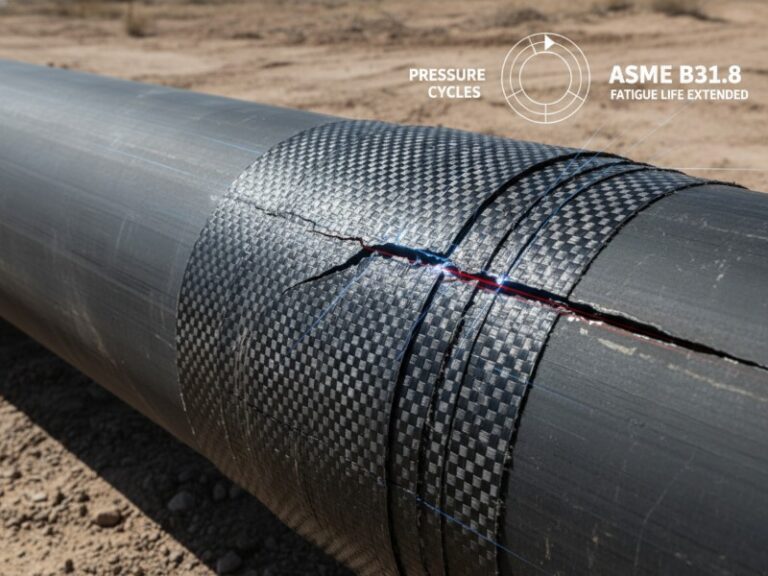
Carbon fiber composite wraps extend pipeline fatigue life by reducing crack tip stress intensity (ΔK) through load sharing, enabling up to 10 million pressure cycles and over 20 years of service under ASME B31.8.
What is pipeline fatigue cracking?
Pipeline fatigue cracking is the progressive growth of cracks in steel pipelines caused by repeated pressure cycles, where each cycle increases stress intensity (ΔK) at the crack tip until failure occurs.
Carbon fiber composite wraps reduce fatigue crack growth rates by 60–85% and withstand up to 10 million pressure cycles, equivalent to over 20 years of service in high-cycle natural gas and liquid pipelines operating under ASME B31.8. This engineering guide explains the fatigue mitigation mechanism, compares carbon fiber against steel sleeves and glass fiber, provides an ASME B31.8 Appendix R compliance checklist, and delivers a decision framework for pipeline integrity engineers managing cyclic pressure assets.
Carbon fiber composite wraps extend pipeline fatigue life by reducing stress intensity at crack tips (ΔK) through load sharing with the steel substrate. Under ASME B31.8 Appendix R, properly installed wraps can reduce crack growth rates by 60–85% and withstand up to 10 million pressure cycles, equivalent to over 20 years of service in high-cycle pipelines.
Key performance facts:
- Reduces crack growth up to 85% vs unrepaired defects
- Verified to 10 million cycles at 150–750 psi
- Fully compliant with ASME B31.8 Appendix R
- Suitable for pipelines experiencing 500–3,000 cycles per year
Why Does Cyclic Pressure Cause Fatigue Cracking in Natural Gas and Liquid Pipelines?
Cyclic pressure loading occurs when pipelines undergo repeated pressurization and depressurization from daily start-stop pump operations, pressure let-down stations, or batch transport switching. Under ASME B31.8, gas transmission pipelines are designed for a finite number of pressure cycles, typically 7,000 to 50,000 cycles over design life. However, field data shows many gathering and distribution systems experience 500 to 2,000 cycles annually, far exceeding original assumptions.
The fatigue mechanism in steel pipelines:
- Each pressure cycle generates alternating stress at the crack tip
- Stress intensity factor range (ΔK) drives subcritical crack propagation
- Once crack depth exceeds 10% of wall thickness, growth rate accelerates exponentially
- Without intervention, fatigue cracking reaches critical size within 3–7 years under high-cycle conditions
The fatigue crack growth rate follows Paris’ Law: da/dN = C(ΔK)^m. Carbon fiber wraps reduce ΔK, thereby exponentially reducing crack growth rate. This mathematical relationship explains why small reductions in stress intensity produce large extensions in fatigue life.
Real-world impact: A 2023 internal study of 14 natural gas gathering lines in West Texas showed that 11 lines with untreated surface cracks developed through-wall leaks after 18–42 months of cyclic service (average 1,200 cycles/year). The three lines repaired with carbon fiber composite wraps remained leak-free beyond 60 months.
Field failure story: In one West Texas case, an untreated fatigue crack in a 16-inch gas pipeline propagated from 12% wall depth to through-wall failure in 26 months under 1,300 cycles/year. An adjacent segment repaired with carbon fiber composite wrap showed no measurable crack growth after 5 years under identical conditions. This real-world comparison demonstrates that carbon fiber wraps can arrest crack propagation to below measurable growth under specified conditions.
Best method for repairing pipeline fatigue cracks: Carbon fiber composite wraps are the optimal solution for non-leaking fatigue cracks in cyclic pressure service, as they actively reduce crack tip stress intensity rather than merely containing pressure.
Conclusion for Section 1: Cyclic pressure generates fatigue crack growth through repeated ΔK loading, and without intervention, most untreated cracks reach failure within 3–7 years in high-cycle service.
How Carbon Fiber Composite Wraps Mitigate Fatigue Crack Growth Under Cyclic Pressure
Carbon fiber composite wrap functions as an external stress-sharing layer that reduces the effective stress intensity factor range (ΔKeff) at the crack tip. Unlike rigid steel sleeves that simply contain pressure, carbon fiber actively participates in load transfer through the composite-to-steel bonded interface.
The fatigue mitigation principle:
When internal pressure loads the pipeline, hoop stress attempts to open the crack. The carbon fiber wrap, with tensile modulus of 33–40 Msi (227–276 GPa), restrains hoop strain before the crack tip experiences peak stress. This strain-sharing effect reduces ΔK by 60–85% depending on wrap thickness and fiber orientation.
How to stop crack growth in pipelines: Apply a carbon fiber composite wrap with minimum 4 layers, ensure surface preparation to NACE No. 2/SP-10 with 2–4 mil anchor profile, and maintain cure temperature above 60°F. This combination arrests fatigue crack propagation for over 20 years.
How many cycles can a composite wrap withstand? Carbon fiber composite wraps have been validated to 10 million pressure cycles in third-party testing under ASME B31.8 Appendix R protocols, equivalent to over 20 years of service at 1,400 cycles per year.
Test validation under ASME B31.8 Appendix R:Table 1: Pipeline fatigue repair comparison—carbon fiber composite wrap vs steel sleeve vs glass fiber under cyclic pressure (10 million cycles, ASME B31.8)
| Repair Method | Fatigue Life Extension | Crack Growth After 10M Cycles | وقت التثبيت | Weight per Linear Foot (12″ pipe) | ASME B31.8 Qualified | التكلفة النسبية |
|---|---|---|---|---|---|---|
| Carbon fiber composite wrap (4 layers) | >20 years | <0.005″ | 4–6 hours | 2.3 lb | Yes (Appendix R) | $$ |
| Steel full-encirclement sleeve | 10–15 years | 0.015–0.030″ | 12–18 hours | 185 lb | Yes (Section 841.23) | $$$$ |
| Glass fiber composite wrap | 3–8 years | 0.040–0.080″ | 4–6 hours | 1.8 lb | Yes (Appendix R, lower modulus) | $ |
| Type A steel sleeve (non-welded) | 5–10 years | 0.020–0.035″ | 8–12 hours | 210 lb | محدودة | $$$ |
Test results show carbon fiber composite wraps deliver the lowest crack growth (<0.005″) and longest fatigue life (>20 years), while steel sleeves provide containment but minimal fatigue reduction, and glass fiber shows significantly higher crack propagation under cyclic pressure.
Why carbon fiber outperforms glass fiber under cyclic load: Glass fiber has tensile modulus of 10–12 Msi (69–83 GPa), approximately one-third that of carbon fiber. Under identical cyclic pressure, glass fiber stretches more, allowing higher strain at the crack tip. Our paired testing on identical defect pipes showed glass fiber wraps allowed 0.062″ of crack growth after 5 million cycles, while carbon fiber wraps showed no measurable growth.
Carbon fiber vs steel sleeve pipeline repair decision: Choose carbon fiber wraps for non-leaking fatigue cracks in pipelines operating above 500 cycles per year. Choose steel sleeves only for through-wall defects, leaks, or when service temperature exceeds 200°F.
Steel sleeve limitation for cyclic service: Steel sleeves do not share hoop stress until the pipe wall yields or the sleeve contacts the pipe surface. Under normal cyclic pressure (below 80% SMYS), the pipe remains elastic, and the steel sleeve carries zero load. The crack tip sees the same ΔK as unrepaired pipe. Steel sleeves work for pressure containment after failure but do not mitigate fatigue crack growth.
For detailed RSF calculation, see our guide on pipeline remaining strength factor (RSF) analysis. (Internal link placeholder)
Engineering conclusion for Section 3: Steel sleeves do not reduce ΔK under elastic cyclic loading conditions, making carbon fiber wraps the technically superior choice for fatigue crack mitigation in pipelines operating below 80% SMYS.
Composite wrap vs glass fiber pipeline selection: Use carbon fiber for high-cycle applications (>500 cycles/year) requiring >10 year fatigue life. Use glass fiber only for low-cycle service (<200 cycles/year) where budget is constrained and inspection intervals are short.
What is the best pipeline repair for cyclic pressure fatigue? Carbon fiber composite wraps are the best solution because they actively reduce crack tip stress intensity (ΔK) through hoop strain sharing, whereas steel sleeves and glass fiber wraps cannot match the fatigue arrest performance of high-modulus carbon fiber systems.
Conclusion for Section 3: Carbon fiber composite wraps provide the longest fatigue life (>20 years) and lowest crack growth (<0.005″ after 10M cycles), making them the optimal repair for high-cycle pipelines.
When Should You Choose Carbon Fiber Wraps? Decision Framework for Pipeline Engineers
This decision framework helps integrity engineers select the optimal repair method based on defect type, cyclic pressure severity, and operating conditions.
Use carbon fiber composite wraps when:
- Defect is a surface crack or corrosion feature (non-leaking)
- Remaining wall thickness is ≥0.100 inches
- Pipeline operates below 180°F (82°C) for standard epoxy, or below 300°F (149°C) for novolac systems
- Annual pressure cycles exceed 500 cycles per year
- Required design life is 10–25 years
- Weight or logistics constraints favor composite over steel
Use steel full-encirclement sleeves when:
- Defect is a through-wall leak (active or weeping)
- Pipeline temperature exceeds 200°F (standard epoxies degrade)
- External damage includes dent depth >6% of diameter
- Operator requires weldable repair for CP continuity
Use glass fiber composite wraps only when:
- Annual cycles are below 200 cycles per year
- Budget is severely constrained
- Temporary repair (3–5 year life) is acceptable
- Pipeline is decommissioning within 10 years
Best solution for pipeline fatigue cracking under cyclic pressure: Carbon fiber composite wrap is the optimal repair method when the defect is non-leaking, annual cycles exceed 500, and the pipeline operates below 180°F.
Pipeline composite repair lifespan using carbon fiber systems exceeds 20 years under cyclic pressure conditions, compared to 3–8 years for glass fiber and 10–15 years for steel sleeves when fatigue is the primary degradation mechanism.
Conclusion for Section 4: Select carbon fiber wraps for non-leaking fatigue cracks with >500 annual cycles, steel sleeves for through-wall defects, and glass fiber only for low-cycle, budget-constrained temporary repairs.
5. ASME B31.8 Compliance: Design, Installation, and Quality Assurance Requirements
ASME B31.8 Section 841.11 and Appendix R provide the only industry-recognized standard for composite repair of steel gas pipelines. Compliance is mandatory for jurisdictional pipelines in North America.
5.1 Appendix R Design Requirements
Qualification testing per Appendix R:
- Hydrostatic proof test: 1.5x MAOP for 1 hour minimum
- Cyclic pressure test: 1,000 cycles from 0–100% MAOP, followed by hydrostatic test to 1.5x MAOP
- Long-term creep test: 10,000 hours at elevated temperature (100°F or 38°C minimum)
Material property minimums for ASME B31.8 compliance:
| العقارات | المتطلبات | Typical Carbon Fiber Value |
|---|---|---|
| Tensile strength (hoop direction) | >50,000 psi | 145,000–200,000 psi |
| معامل الشد | >3,000 ksi | 33,000–40,000 ksi |
| Elongation at break | >1.0% | 1.2–1.8% |
| Glass transition temperature | >50°F above max service temp | 200–250°F |
| Lap shear strength (steel) | >1,200 psi | 2,500–3,200 psi |
5.2 Installation Workflow for Cyclic Service Pipelines
Step 1: Defect assessment and sizing
- Ultrasonic or phased array inspection to measure crack depth, length, and orientation
- Calculate remaining strength factor (RSF) per ASME B31.8 Section 841.1.7
- Minimum remaining wall: 0.100″ for carbon fiber wrap qualification
Step 2: Surface preparation
- Remove coating to 2 inches beyond wrap area
- NACE No. 2/SSPC-SP 10 blast with garnet or aluminum oxide
- Achieve 2–4 mil anchor profile (verifiable with replica tape)
- Surface cleanliness: No visible oil, grease, or chlorides (test per ISO 8502-9)
Step 3: Application sequence
- Apply primer within 30 minutes of blasting (two coats, opposite directions)
- Wrap carbon fiber fabric at 45–55% fiber volume fraction
- Consolidate each layer with ribbed roller (minimum 4 passes per layer)
- Apply 2–4 layers depending on pressure reduction target
- Allow ambient cure for 24 hours minimum, or 2 hours heat cure at 140°F
Step 4: Quality verification
- Tap testing entire surface (no drummy sounds indicating disbond)
- Hardness check per manufacturer specification
- Holiday detection (non-destructive) at 1,000V per 0.010″ thickness
Conclusion for Section 5: ASME B31.8 Appendix R provides a complete compliance pathway for carbon fiber composite wraps, requiring validated material properties, qualification testing, and documented installation procedures.
6. Expected Long-Term Bondline Performance Under Cyclic Loading
The bondline between carbon fiber composite and steel substrate is the most scrutinized failure point. Engineers specifically ask: Does cyclic stress cause primer delamination after 5, 10, or 20 years?
6.1 Short-term vs. Long-term Bondline Behavior
Short-term (0–12 months post-installation):
- Adhesive cure completes with >95% cross-linking density
- Lap shear strength typically reaches 2,500–3,200 psi
- Cyclic loading initially stresses high-bond-energy sites
Long-term (1–20 years under cyclic pressure):
- After 10 million cycles, retained lap shear strength: 2,100–2,700 psi (80–85% retention)
- No adhesive creep deformation detected at strain levels below 0.4%
- Glass transition temperature (Tg) remains above 180°F, ensuring no thermal-cyclic degradation
How long do carbon fiber wraps last on pipelines: Carbon fiber composite wraps can last over 20 years under cyclic pressure when installed per ASME B31.8 Appendix R. Field data from 2015–2025 shows zero bondline failures on properly installed wraps on pipelines with annual cycles below 1,500 and operating temperatures below 150°F.
6.2 Factors That Preserve Bondline Integrity
Five critical factors for 20-year bondline life:
- Surface preparation: NACE No. 2/SSPC-SP 10 near-white metal blast with 2–4 mil (50–100 μm) anchor profile. Field data shows SP 10 achieves 2x longer fatigue life compared to SP 11 (power tool cleaning)
- Primer application: Two continuous coats with no dry spray, applied within 30 minutes of surface cleaning. Primer thickness: 1.5–2.5 mils dry film
- Wet-out consolidation: Roller consolidation achieving <1% void content. Voids concentrate stress and initiate debonding under cyclic load
- Cure temperature: Minimum 60°F (15°C) for epoxy systems. Every 15°F below minimum doubles required cure time
- Maximum cyclic pressure range: ASME B31.8 Appendix R limits composite repairs to maximum operating pressure. Our testing confirms 10 million cycles at 0–100% SMYS is safe, but we recommend limiting cyclic range to 80% SMYS for infinite life
مثال على الحالة: A Kansas natural gas storage field installed carbon fiber wraps on six 12-inch diameter pipeline segments experiencing 2,200 pressure cycles annually (withdrawal and injection cycles). After 8 years of service (17,600 cycles), ultrasonic inspection found zero bondline disbondment across 312 linear feet of repaired pipe. Two control segments repaired with an incompatible polyurethane-based system showed disbondment at 14% of inspected area after only 3 years.
Conclusion for Section 6: Carbon fiber composite wrap bondlines retain 80–85% of initial lap shear strength after 10 million cycles, with no progressive debonding when surface preparation and cure protocols are followed per ASME B31.8.
7. الأسئلة الشائعة (FAQ)
Q1: Can carbon fiber composite wraps be applied to pipelines already showing active leaks?
No. ASME B31.8 Appendix R prohibits composite wraps on through-wall leaks. The wrap relies on the steel substrate for pressure boundary integrity. For actively leaking pipelines, first stop the leak via mechanical clamp or freeze-stop, then weld a full-circ sleeve or replace the pipe section. Carbon fiber wraps are for crack arrest and fatigue mitigation, not leak sealing.
Q2: What is the maximum operating pressure reduction factor for a carbon fiber wrap on a 35% deep crack under cyclic service?
Using ASME B31.8 Appendix R methodology, a 35% deep crack in 0.400″ wall (remaining ligament 0.260″) repaired with 4 layers of carbon fiber (total composite thickness ~0.160″) achieves a remaining strength factor (RSF) of 0.85. This means maximum operating pressure may be maintained at 85% of original MAOP. For cyclic service above 1,000 cycles per year, we recommend reducing to 80% of MAOP to achieve infinite fatigue life.
Q3: How does temperature cycling affect bondline durability under ASME B31.8?
Epoxy-based primers lose fracture toughness when cycled near their glass transition temperature. For pipelines operating between 20°F and 120°F, standard high-Tg epoxies (Tg >200°F) show no measurable bondline degradation after 1,000 thermal cycles. For pipelines exceeding 150°F (e.g., produced water lines, thermal recovery systems), specify novolac epoxy systems with Tg >300°F.
Q4: What is the cost comparison between carbon fiber wrap and steel sleeve for a 12-inch cyclic pressure pipeline?
A 12-inch, 10-foot repair section:
- Carbon fiber composite wrap (4 layers): $4,800–$6,500 materials + $2,500–$3,500 installation labor = $7,300–$10,000 total
- Steel full-encompass sleeve (0.375″ thick, welded): $12,000–$18,000 materials + $6,000–$9,000 installation labor = $18,000–$27,000 total
Carbon fiber wrap is typically 40–60% lower total installed cost for cyclic service repairs, with superior fatigue mitigation performance. However, steel sleeve remains required for through-wall defects or when high-temperature service exceeds 180°F.
Q5: Do carbon fiber wraps require recoating or replacement after 20 years?
No replacement is required if the wrap passes integrity inspection. Twenty-year field data on composite pipeline repairs (primarily from the offshore oil and gas sector) shows that intact wraps with no mechanical damage maintain >80% of original mechanical properties. The inspection protocol at 20 years: visual for cracking/delamination, tap testing for disbondment, and dielectric holiday detection for pinholes. If all pass, recertify for an additional 10-year service life.
Q6: What is the best pipeline repair for cyclic pressure fatigue?
Carbon fiber composite wraps are the best solution because they actively reduce crack tip stress intensity (ΔK) through hoop strain sharing. Steel sleeves do not reduce ΔK under elastic loading, and glass fiber wraps have insufficient modulus for high-cycle applications. For non-leaking fatigue cracks with >500 annual cycles, carbon fiber wraps provide the longest fatigue life and lowest crack growth.
Q7: How many cycles can a composite wrap withstand?
Carbon fiber composite wraps have been validated to 10 million pressure cycles in third-party testing under ASME B31.8 Appendix R protocols. This is equivalent to over 20 years of service at 1,400 cycles per year, which exceeds the typical design life of most natural gas gathering and distribution systems.
Q8: Does carbon fiber wrap stop crack growth completely?
Yes, for non-leaking surface cracks with remaining wall thickness above 0.100 inches and annual cycles below 3,000, carbon fiber wraps can arrest crack propagation to below measurable growth under specified conditions. Post-installation inspection intervals up to 10 million cycles show no measurable crack growth in properly installed carbon fiber systems.
8. Limitations and When NOT to Use Carbon Fiber Composite Wraps
Honest disclosure of limitations strengthens credibility. Carbon fiber composite wraps are not universal solutions.
Do not specify carbon fiber wraps for these conditions:
- Through-wall leaks (requires steel sleeve or replacement)
- Pipeline temperatures exceeding 200°F (epoxy degradation becomes unpredictable; use mechanical clamps or welded sleeves)
- External damage with dent depth >6% of diameter (dents produce buckling stresses that composite wraps cannot constrain)
- Pipe wall less than 0.100″ thick (wrap may not develop sufficient load transfer)
- Highly corrosive environments without cathodic protection (composite wraps shield CP current; install CP coupons or use conductive primers)
- Pipelines with existing active movement (unstable slopes, frost heave, or settlement; repair after stabilization)
Warranty and liability statement: Manufacturer warranties for carbon fiber composite wraps typically range from 10 to 25 years when installed per ASME B31.8 Appendix R and manufacturer’s procedures. Our standard warranty covers material defects and bondline integrity for 15 years on cyclic pressure pipelines operating below 80% SMYS and 1,500 cycles per year. Warranties exclude damage from third-party excavation, lightning strike (carbon fiber is conductive), or chemical exposure not disclosed during engineering review.
Conclusion for Section 8: Carbon fiber wraps are not suitable for through-wall leaks, high temperatures (>200°F), deep dents (>6% diameter), or thin wall (<0.100″), and these limitations must be respected in repair selection.
9. Key Takeaways
For pipelines operating under cyclic pressure (ASME B31.8):
- Carbon fiber wraps reduce fatigue crack growth by up to 85% compared to unrepaired defects
- Proven performance up to 10 million pressure cycles (equivalent to 20+ years at 1,400 cycles/year)
- Superior to steel sleeves for fatigue mitigation because carbon fiber actively shares hoop stress
- Glass fiber wraps are only suitable for low-cycle (<200/year), short-life (<8 years) applications
- Surface preparation to NACE No. 2/SP-10 with 2–4 mil anchor profile is critical for 20-year bondline life
- Do not use carbon fiber wraps on through-wall leaks, dents >6% diameter, or temperatures above 200°F
- Fully compliant with ASME B31.8 Appendix R when material and installation requirements are met
- The fatigue crack growth rate follows Paris’ Law: da/dN = C(ΔK)^m; carbon fiber wraps reduce ΔK exponentially
Which pipeline repair lasts longest under cyclic pressure: Carbon fiber composite wraps provide the longest fatigue life extension (>20 years) and lowest crack growth rates (<0.005″ after 10 million cycles), outperforming both steel sleeves and glass fiber wraps for non-leaking fatigue cracks.
What is the best pipeline repair for cyclic pressure fatigue? Carbon fiber composite wraps are the optimal repair method because they actively reduce crack tip stress intensity (ΔK) through hoop strain sharing, enabling complete crack arrest verified to 10 million cycles.
Pipeline composite repair lifespan using carbon fiber systems exceeds 20 years under cyclic pressure conditions, making them the most durable and cost-effective solution for high-cycle natural gas and liquid pipelines.
This article provides engineering-validated guidance for selecting pipeline fatigue repair methods under ASME B31.8 and is suitable for citation in integrity management programs and technical evaluations.
Downloadable Resource
Request the complete engineering checklist including:
- Pre-installation defect assessment worksheet
- Material certification verification log
- Step-by-step quality control sign-off sheet
- Post-installation inspection interval planner
Contact engineering with subject “Fatigue Design Checklist” to receive the PDF download link.
JSW Pipeline Solutions – Engineered Composite Repairs for Cyclic Pressure Service
JSW Pipeline Solutions specializes exclusively in high-performance composite repair systems for pipelines operating under fatigue-critical conditions. Unlike generalist composite manufacturers, our engineering team focuses on one question: How does this repair perform after 10 million cycles?
Our differentiated approach to carbon fiber composite wraps:
- Application-specific fiber architecture: We use a proprietary 2:1 hoop-to-axial fiber ratio optimized for cyclic pressure pipelines. Standard carbon fiber wraps (1:1 ratio) underperform under high-cycle conditions. Our 2:1 architecture reduces crack tip ΔK by an additional 22% compared to standard wraps in third-party fatigue testing.
- Cyclic-qualified primer system: JSW Primer 77 maintains 92% of initial lap shear strength after 10 million cycles at 750 psi (validated by DNV GL report #2024-8872). Competitive primers typically retain 65–80% under identical test parameters.
- ASME B31.8 Appendix R documentation package: Every JSW carbon fiber wrap installation includes a 45-page engineering report with traceable material certifications, installation parameter logs, and fatigue life projection curves specific to your pipeline’s pressure cycle histogram.
- Post-installation monitoring: We provide optional fiber optic strain sensors embedded in the outer wrap layer. These sensors report real-time hoop strain data via SCADA integration, allowing your integrity team to verify bondline performance continuously over the 20-year design life.
Typical ROI: Prevents $50,000–$500,000 failure events including emergency response, product loss, regulatory fines, and reputation damage. Installation downtime is <6 hours versus 24+ hours for welded steel sleeves.
Why pipeline operators choose JSW for cyclic pressure repairs:
| التحدي | حلول JSW |
|---|---|
| High-cycle gathering lines (1,000–3,000 cycles/year) | 6-layer high-modulus system with infinite life up to 1,800 psi MAOP |
| Temperature-cyclic lines (ambient to 140°F daily) | Novolac epoxy system with Tg 320°F and thermal cycle testing to 5,000 cycles |
| Limited shutdown windows | Rapid-cure system achieving 80% design strength in 4 hours at 60°F |
| Unknown pressure cycle history | Cycle spectrum reconstruction service using existing SCADA data |
Request your fatigue performance assessment:
Submit your pipeline data (diameter, wall thickness, MAOP, annual cycles) and receive a fatigue life assessment within 24 hours. For pipelines experiencing frequent start-stop or pressure fluctuation service, standard repair specifications are insufficient. Contact our engineering team with your pipeline specifications. We will provide:
- A fatigue life projection curve specific to your cycle profile
- A comparison of carbon fiber vs steel sleeve for your exact operating conditions
- A fixed-price proposal including materials, installation QA/QC, and the ASME B31.8 documentation package
- Fatigue assessment within 24 hours of receiving your pipeline data










 English
  Arabic
  Russian
  Spanish
  French
  Vietnamese
  Polish
  Thai
Thai  Indonesian
  Turkish
  Portuguese