
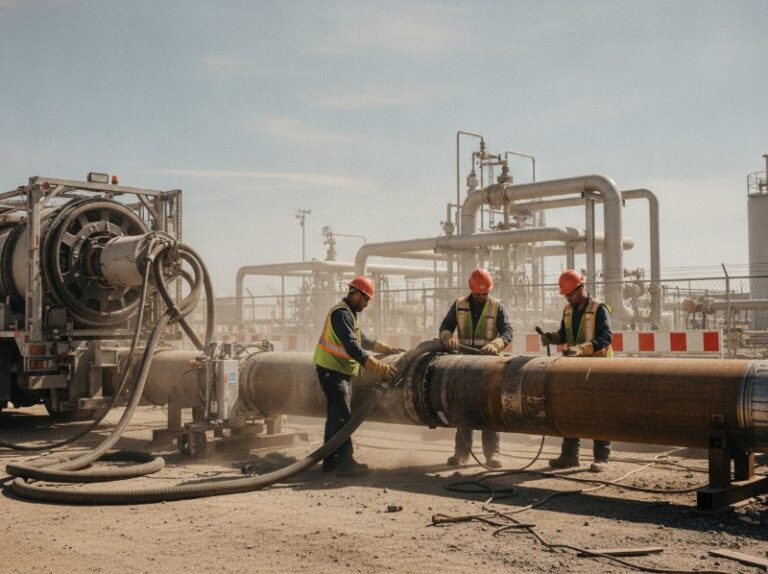
Pipeline rehabilitation is a trenchless method used to restore aging pipelines using technologies such as CIPP or sliplining. It reduces costs by 50–75%, extends pipeline lifespan by over 50 years, and minimizes excavation, environmental impact, and service disruption compared to traditional replacement.
The primary methods include structural liners that create a “pipe within a pipe,” slip-lining with new pipes, and spray-on coatings. This guide explores the quantifiable advantages—from massive cost savings to significant environmental benefits—and breaks down which approach works best for different scenarios. Whether you are a municipal engineer, asset manager, or industrial facility operator, understanding pipeline rehabilitation benefits is essential for making informed infrastructure decisions.
ما هي إعادة تأهيل خطوط الأنابيب؟
Pipeline rehabilitation refers to a set of trenchless technologies used to restore the structural integrity and hydraulic capacity of aging pipelines without the need for full-scale excavation. Unlike traditional open-cut replacement, which involves digging up and removing the entire pipe, rehabilitation works with the existing pipe as a host structure.
Key takeaway: Rehabilitation creates a “pipe within a pipe” using methods such as Cured-in-Place Pipe (CIPP), sliplining, or spray-applied coatings. These techniques address corrosion, leaks, and structural degradation while preserving the surrounding environment.
Why it matters: The American Society of Civil Engineers (ASCE) gave U.S. water infrastructure a C- grade in its 2025 report card, with a $452 billion funding shortfall. Rehabilitation offers a practical, cost-effective path to extend asset life without breaking municipal budgets.
Pipeline Rehabilitation vs Replacement (Cost, ROI Comparison)
In most cases, pipeline rehabilitation is the preferred solution for aging but structurally sound pipelines due to its lower cost, faster installation, and reduced disruption. However, full replacement becomes necessary when pipelines are collapsed, severely deformed, or require capacity upgrades.
A dedicated comparison between rehabilitation and open-cut replacement helps clarify the pipeline rehabilitation benefits in financial terms.
| عامل المقارنة | Pipeline Rehabilitation (CIPP/Sliplining) | استبدال القطع المفتوح |
|---|---|---|
| Direct Construction Cost | 50–75% less than replacement | Baseline (100%) |
| Surface Restoration | Minimal (access pits only) | Extensive (roads, landscaping, utilities) |
| Project Duration | من أيام إلى أسابيع | Weeks to months |
| Traffic Disruption | 78% reduction in delays | High (lane closures, detours) |
| الأثر البيئي | Minimal (no large-scale excavation) | High (soil displacement, habitat damage) |
| Permitting Complexity | Lower (classified as maintenance) | Higher (requires full construction permits) |
| Total Lifecycle Cost (NPV) | 48.2% savings over 50 years | Baseline (100%) |
Bottom line: A machine-learning-based study for water main rehabilitation found that when environmental and social costs were factored in, open-cut methods became approximately 300% more expensive than rehabilitation.
Key Benefits of Pipeline Rehabilitation
Understanding the pipeline rehabilitation benefits requires examining multiple dimensions: financial, operational, environmental, and social.
1. Substantial Cost Savings
Rehabilitation typically costs 50–75% less than full-scale pipe replacement. A lifecycle cost analysis of sewer rehabilitation found that CIPP offered 48.2% cost savings compared to open-cut methods over a 50-year period.
- Direct cost reduction: Lower material and labor requirements than excavation
- Indirect cost avoidance: Minimal surface restoration reduces ancillary expenses
- Permitting savings: Rehabilitation is often classified as maintenance, avoiding complex permitting processes
- ROI: For every dollar invested in pipeline rehabilitation, municipalities save an estimated $3–5 in future emergency repairs and replacement costs
- Trenchless pipe repair cost: Typically ranges from $50 to $150 per foot, compared to $150 to $400 per foot for open-cut replacement
Get a Custom Pipeline Rehabilitation Solution
Contact our engineering team for a project assessment, cost estimate, and method selection tailored to your pipeline condition.
2. Extended Pipeline Lifespan
A properly rehabilitated pipeline can have its lifespan extended by 50 years or more, delaying the need for complete replacement.
- Structural strength: Recent full-scale tests on corroded reinforced concrete pipes rehabilitated with CIPP showed that the lining improved cracking load by 11–30% and ultimate load by 2–44%
- Corrosion resistance: CIPP liners are highly resistant to chemical and biological attack, eliminating the corrosion that plagues metal and concrete pipes
- Smooth flow: The smooth interior surface reduces friction loss and prevents mineral buildup, maintaining hydraulic capacity over the long term
- Proven performance: FFRPP systems have been internationally proven for over 25 years and come with warranties up to 5 years
3. Minimal Community Disruption
Open-cut replacement often means weeks or months of road closures, noise, and business interruptions. Trenchless technologies dramatically reduce this impact.
- Faster project completion: Rehabilitation projects often take days instead of weeks
- Minimal traffic impact: CIPP and sliplining require only small access pits, reducing traffic detours by 78%
- Reduced business losses: Studies show rehabilitation reduces business disruptions by 70% in commercial areas
- No utility shutdowns: Gas or water service can often remain active during installation
Case Study: Municipal Sewer Rehabilitation Project
A mid-sized city in the Midwest rehabilitated 5 miles of aging 24-inch sanitary sewer using CIPP lining. The project cost 65% less than open-cut replacement, was completed in 3 weeks (vs. 4 months), and required no road closures beyond local access points. The rehabilitated pipe is expected to serve the community for another 50 years. Soil conditions were primarily clay, and the flow type was gravity.
Environmental Benefits of Trenchless Technology
Pipeline rehabilitation benefits extend beyond economics to significant environmental advantages. Underground pipeline repair without digging represents a paradigm shift in sustainable infrastructure management.
Waste Reduction and Carbon Footprint
- Waste reduction: CIPP reduces excavated material by 95% (60 m³ vs. 1,200 m³ per kilometer of pipe)
- Lower carbon footprint: UV-CIPP technology significantly reduces carbon emissions during the curing process compared to traditional thermal curing
- Contamination prevention: Rehabilitation reduces contamination risks by up to 82% compared to excavation
Water Conservation and Quality
- Reduced infiltration: Sealing leaks prevents groundwater infiltration into sanitary systems, reducing the load on wastewater treatment plants
- Leak prevention: The EPA estimates that treating inflow and infiltration costs $2 to $5 per thousand gallons—unnecessary expenses that rehabilitation eliminates
- Improved water quality: Eliminating leaks prevents soil and groundwater contamination from pipeline contents
Pipeline Lifespan and Performance
Structural Performance Data
| Performance Metric | Rehabilitation (CIPP/FFRPP) | استبدال القطع المفتوح |
|---|---|---|
| Design Life Extension | 50+ years | Full replacement (same as new) |
| Leak Reduction | High (seamless liner) | Depends on installation quality |
| مقاومة التآكل | Excellent (inert materials) | Varies by pipe material |
| Hydraulic Efficiency | Improved (smooth inner surface) | Standard (new pipe) |
| Structural Enhancement | 11–44% load increase | Full structural capacity |
| Seismic Resistance | Enhanced (flexible liner absorbs movement) | Varies by design |
Key insight: The smooth interior surface of CIPP liners prevents calcium carbonate and other mineral deposits, maintaining the pipe’s original flow capacity and often improving it. This is particularly valuable for gravity sewers where flow velocity is critical.
Types of Pipeline Rehabilitation Methods (CIPP, Sliplining, SIPP)
Different situations call for different approaches. Here is a breakdown of the most common trenchless technologies:
الأنابيب المُعالجة في الموقع (CIPP)
A resin-impregnated liner is inserted, inflated, and cured (using hot water, steam, or UV light) to form a rigid shell inside the host pipe.
- Best for: Gravity sewers and pressure mains with minimal bends
- Capacity: Can handle class IV structural loads
- نطاق القطر: 4 inches to 120 inches
- CIPP lining cost per foot: Varies by diameter and condition, typically 50–70% less than replacement
Sliplining and Modified Sliplining
A new pipe (often HDPE or FFRPP) is inserted into the existing pipe and grouted in place.
- Best for: Long, straight runs
- Capacity: FFRPP systems can be pulled 2,000 feet or more between access pits, sometimes up to 8,000 feet
- الميزة: FFRPP can navigate bends better than CIPP
الأنابيب المصبوبة بالرش في الموقع (SIPP)
A spray-applied coating forms a protective layer on the pipe’s interior surface.
- Best for: Small-diameter pipes or localized repairs
- الميزة: Rapid application with minimal equipment
تكسير الأنابيب
A bursting head fractures the old pipe while pulling a new pipe into place.
- Note: This is technically replacement rather than rehabilitation
- Best for: Severely damaged pipes where rehabilitation is not feasible
كيفية اختيار الطريقة المناسبة لإصلاح خطوط الأنابيب
Selecting the appropriate rehabilitation method requires a systematic approach:
Step 1: Inspect the Pipeline
Conduct a comprehensive CCTV inspection to assess the pipe’s condition, identify defects, and document the existing geometry. This provides the baseline data for decision-making.
Step 2: Assess Structural Condition
Evaluate the pipe’s remaining structural capacity. Determine whether the pipe is structurally sound enough to support a liner, or if full replacement is required.
Step 3: Select the Appropriate Method
Based on the assessment, choose between CIPP, sliplining, SIPP, or pipe bursting. Consider factors such as pipe diameter, length, bends, and accessibility.
Step 4: Conduct Cost Analysis
Compare the total lifecycle costs of rehabilitation vs. replacement. Factor in direct construction costs, indirect costs (traffic disruption, business losses), and long-term maintenance savings.
Need Help Selecting the Right Method?
Our engineering team can conduct a site assessment and provide method recommendations based on your specific pipeline condition, budget, and project timeline.
When to Choose Rehabilitation vs Replacement
Decision-making for pipeline rehabilitation benefits depends on the condition and configuration of the existing pipe.
Indications for Rehabilitation
- Pipe is structurally intact but has leaks or minor cracks
- Corrosion is present but has not caused collapse
- Hydraulic capacity is adequate
- Access points exist for liner insertion
- Surface disruption must be minimized
Indications for Replacement (Open-Cut or Pipe Bursting)
- Pipe has fully collapsed or is severely deformed
- Significant diameter changes or sharp bends exist
- Pipe material is incompatible with available liners
- Hydraulic capacity needs to be increased
- Entire system is being reconfigured
Guidance: If you are unsure which method applies, consult with a pipeline rehabilitation specialist who can conduct a thorough CCTV inspection and structural assessment.
Limitations of Pipeline Rehabilitation
While pipeline rehabilitation benefits are substantial, the approach has limitations that must be considered.
القيود الفنية
- Not suitable for pipes with significant bends or diameter changes (CIPP can struggle with sharp turns)
- Material and installation costs can still be high for complex projects, though lower than replacement
- Risk of annular seepage: Changing the equilibrium of a pipe by adding an internal lining can create pathways for seepage along the outside of the pipe, requiring careful grouting
- Not a solution for fully collapsed sections
Safety and Compliance
- Styrene emissions: Traditional CIPP materials release styrene during curing. UV-CIPP technology addresses this with clean lining materials
- Regulatory compliance: Always verify that the rehabilitation method meets local codes and standards
- Standards compliance: All rehabilitation designs should comply with ASTM, AWWA, or local regulatory standards depending on the application
Fact Check: CIPP installations typically follow ASTM F1216 standards for structural lining design. Always ensure your contractor is certified and uses materials compliant with applicable standards.
Future Trends in Pipeline Rehabilitation
Significant investment and research are driving innovation in trenchless rehabilitation:
Technology Advances
- Machine learning: The City of Kitchener, Ontario, uses Decision Tree machine learning models to predict water main breaks with 97% accuracy, enabling proactive rehabilitation
- UV-CIPP: Clean lining materials that eliminate styrene emissions, making it viable for drinking water systems
- National standards: Ohio University researchers are developing equations to determine minimum CIPP liner thickness, which could become a national AASHTO standard
Federal Funding and Policy
- Bipartisan Infrastructure Law: Established the NGDISM grant program, providing nearly $600 million for natural gas pipeline rehabilitation and replacement
- EPA programs: Multiple funding sources are available for municipal sewer and water system rehabilitation
- Investment trend: The pipeline rehabilitation market is expected to grow at 6-8% annually through 2030
Frequently Asked Questions About Pipeline Rehabilitation
Q: What is trenchless pipeline rehabilitation?
A: A set of methods to repair or replace pipes with minimal excavation, including CIPP, sliplining, and pipe bursting. These techniques restore pipeline function without digging up roads or landscaping.
Q: Is pipeline rehabilitation cheaper than replacement?
A: Yes. Rehabilitation typically costs 50–75% less than full open-cut replacement. Lifecycle cost analyses show that CIPP offers over 48% cost savings compared to traditional methods.
Q: How long does a rehabilitated pipeline last?
A: Properly rehabilitated pipelines can have their lifespan extended by 50 years or more. CIPP liners are corrosion-resistant and structurally robust, with proven performance for decades.
Q: What types of pipes can be rehabilitated?
A: Rehabilitation works on a wide range of materials, including cast iron, steel, concrete, and PVC, for applications such as water mains, sewer lines, gas pipelines, and force mains.
Q: What is CIPP lining cost per foot?
A: CIPP lining costs vary by diameter and condition but typically range from $50 to $150 per foot, compared to $150 to $400 per foot for open-cut replacement.
Q: Can drinking water pipelines be rehabilitated?
A: Yes, but specialized materials are required. UV-CIPP with low-styrene or styrene-free resins is increasingly used for potable water applications.
Key Takeaways for Engineers and Asset Managers
- Pipeline rehabilitation reduces costs by up to 75% compared to open-cut replacement
- CIPP lining extends pipeline life by over 50 years with proper design and installation
- Trenchless methods reduce traffic disruption by up to 78% with fewer community impacts
- Rehabilitation is suitable for structurally sound pipelines with leaks or corrosion
- Professional assessment is required to determine the optimal method
- ASTM and AWWA standards ensure quality and durability
About JSW – Your Partner in Pipeline Rehabilitation
With over 25 years of global experience and a 50-year design life on our liners, JSW delivers engineered pipeline rehabilitation solutions that offer significant cost savings (up to 75% vs. replacement) and minimal community disruption.
JSW Core Advantages
- Proven technology: Our FFRPP and CIPP systems have been internationally proven for over 25 years
- Warranty protection: Up to 5-year warranty on our rehabilitation systems
- Comprehensive solutions: Applicable to water, gas, and industrial pipelines
- Technical expertise: Full engineering support from assessment to installation
- Standards compliance: All systems meet or exceed ASTM and AWWA standards
Get a Custom Pipeline Rehabilitation Solution
Contact our engineering team for a project assessment, cost estimate, and method selection tailored to your pipeline condition.





 English
  Arabic
  Russian
  Spanish
  French
  Vietnamese
  Polish
  Thai
Thai  Indonesian
  Turkish
  Portuguese