
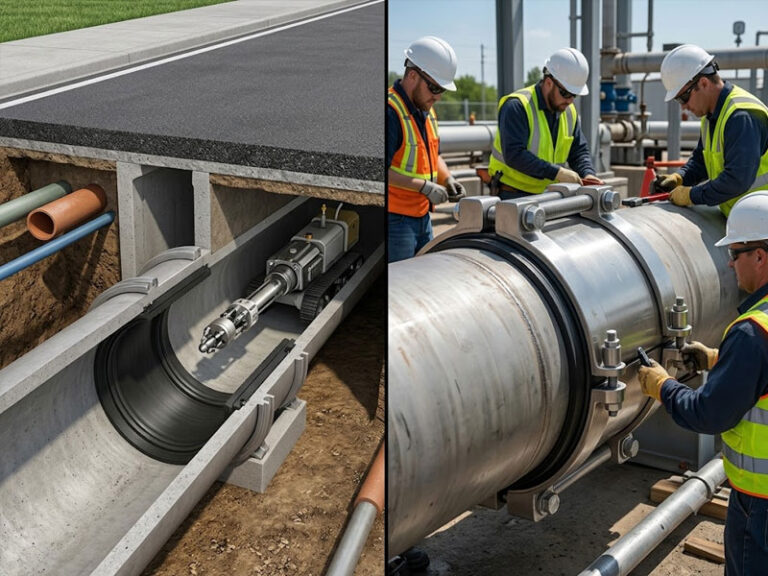
Internal vs External Pipe Sealing Systems
Internal pipe sealing systems are installed inside the pipeline and are mainly used for إعادة تأهيل الخنادق بدون خنادق, underground leak repair, and sewer or water main rehabilitation. External pipe sealing systems are installed around the outside of the pipe and are preferred for new construction, hydrostatic testing, and exposed pipeline repairs.
For buried pipelines where excavation is expensive, internal seals are usually the more cost-effective solution. For accessible pipelines, external seals generally provide faster installation and easier maintenance. The final choice depends on access, pressure requirements, pipe condition, and total project cost.
Internal vs External Pipe Sealing Systems: Key Differences
| العامل | Internal Pipe Sealing | External Pipe Sealing |
|---|---|---|
| Installation Location | Inside pipe bore | Outside pipe surface |
| Main Purpose | Rehabilitation and leak repair | New construction and exposed repair |
| Excavation Requirement | Usually avoided | Often required |
| أفضل تطبيق | Buried pipelines | Accessible pipelines |
| Installation Method | Expansion from inside | External clamping/compression |
| Main Advantage | Minimal surface disruption | Fast installation |
| Main Limitation | Requires specialized equipment | Requires external access |
| Cost Advantage | Lower lifecycle cost underground | Lower installation cost above ground |
How to Choose Between Internal and External Pipe Sealing Systems
Selecting the right pipe sealing system requires evaluating four critical factors: pipeline accessibility, operating pressure, pipe condition, and lifecycle cost. This guide compares internal and external sealing technologies, helping engineers determine the most suitable solution for rehabilitation, construction, and repair applications.
What Is an Internal Pipe Sealing System?
Internal pipe sealing systems are devices and methods designed to create a seal from inside the pipe bore. These systems are deployed through the pipe interior and expanded or activated to form a seal against the inner wall of the pipe.
Primary applications include:
- Sealing leaking pipe joints in underground pipelines without excavation
- Sealing pipe ends during hydrostatic testing
- Installing replacement pipes within existing service pipes
- Sealing connections between pipe sections from the inside
Internal sealing devices typically consist of a seal body with elastomeric sealing elements that are radially expanded against the pipe’s inner surface. The expansion mechanism may use mechanical expanders, inflatable bladders, or tension rings that force the seal into compression against the pipe wall.
Engineering Insight: Why Internal Seals Are Preferred for Underground Repair
In underground pipeline rehabilitation projects, the sealing method is usually selected based on total installed cost rather than equipment price alone. Although internal sealing equipment requires specialized tooling, avoiding excavation, traffic control, and surface restoration often reduces total project cost significantly compared with traditional open-cut methods. Actual savings depend on project conditions, including excavation depth, restoration requirements, and site accessibility. This cost advantage makes internal sealing the preferred choice for buried infrastructure projects where surface disruption must be minimized.
What Is an External Pipe Sealing System?
External pipe sealing systems are installed on the outside surface of the pipe. These systems use clamps, compression rings, or wraparound sleeves that frictionally engage the pipe’s exterior to create a seal.
Primary applications include:
- Sealing open pipe ends for pressurization and testing
- Jointing or capping pipe ends in gas and water distribution
- Firestopping pipe penetrations through walls and floors
- Sealing connections between pipes with varying diameters
External sealing devices often employ clamping mechanisms with wedge-like members that provide uniform radial compression of an elastomeric seal around the pipe circumference. This design allows them to accommodate variations in pipe diameter caused by manufacturing tolerances, corrosion, or age.
Types of Internal Pipe Seals
Internal Sleeve Seals
Internal sleeve seals are cylindrical devices that create a seal by expanding against the inner wall of the pipe across a leak point or joint. These seals are positioned using pull-through tools with joint locators and then expanded using tension rings that force the sealing elements against the pipe wall on both sides of the leak. Internal sleeve seals are widely used for rehabilitating leaking joints in water mains and sewer pipelines.
Mechanical Expansion Seals
Mechanical expansion seals use a mechanically operated expander mechanism to force elastomeric sealing elements outward against the pipe’s inner surface. These seals are designed for applications requiring precise control over expansion pressure and are commonly used in hydrostatic testing and pipe end sealing operations. Certain engineered internal sealing systems are available for high-pressure applications; pressure ratings vary significantly by design, pipe material, and manufacturer.
Inflatable Pipe Plugs
Inflatable pipe plugs are temporary internal sealing devices that are inserted into the pipe and inflated to create a seal. These are frequently used for isolation testing, blocking flow during repairs, and temporary pipe end sealing. Inflatable plugs are available in various sizes and pressure ratings to suit different pipeline applications.
Internal Pipe Couplings
Internal pipe couplings connect two pipe sections from the inside, creating a continuous internal seal. These are often used in trenchless rehabilitation projects where access is limited and excavation is not feasible.
Internal Joint Seals
Internal joint seals are specifically designed to seal the annular gap at pipe joints. These seals are positioned directly over the joint and expanded to create a continuous seal that prevents infiltration and exfiltration. They are particularly effective for sewer rehabilitation and water main repair projects.
Types of External Pipe Seals
Pipe Repair Clamps
Pipe repair clamps are external devices that wrap around the pipe exterior at a leak point and are tightened to create a seal. These clamps are used for emergency repairs and can be installed quickly without specialized equipment. Pipe repair clamps are available for various pipe materials and sizes.
External Pipe Sleeves
External pipe sleeves are tubular devices that are installed over the outside of the pipe to seal leaks or reinforce damaged sections. These sleeves are commonly used for permanent repairs on above-ground pipelines and accessible buried pipelines.
Wraparound Pipe Seals
Wraparound pipe seals are flexible sealing bands that are wrapped around the pipe exterior and secured with mechanical fasteners. These seals are used for sealing joints and leaks in pipes where other repair methods are impractical.
Mechanical Pipe Couplings
Mechanical pipe couplings connect two pipe sections externally using clamping mechanisms and elastomeric sealing elements. These couplings are widely used in new construction, repair, and maintenance applications where external access is available.
Pipe End Caps
Pipe end caps are external sealing devices that are placed over the open end of a pipe to prevent flow and maintain pressure. These are commonly used during hydrostatic testing, pipeline commissioning, and temporary isolation operations.
Flange Sealing Systems
Flange sealing systems are external seals used to maintain the integrity of flanged connections. These systems include gaskets, seal rings, and clamping devices that ensure leak-free operation at flanged joints.
Technical Comparison
Installation Method Comparison
Internal Seal Installation:
- The sealing device is inserted into the pipe through an access point
- The device is positioned at the target location (joint, leak point, or end)
- The seal is expanded radially against the pipe’s inner wall
- Sealing elements compress against the pipe surface to create a fluid-tight seal
Internal seals for pipe joints can be installed using pull-through tools with joint locators, seal expanders, and seal magazine-loaders that carry multiple sealing devices and feed them one at a time. For pipeline rehabilitation, internal sleeve seals are positioned using locating means that engage the inner surface during movement, minimizing contact with the sealing elements until final expansion.
External Seal Installation:
- The external clamp or sealing device is positioned over the pipe end or joint
- The sealing element is placed against the outer pipe surface
- Clamping rings or compression bands are tightened
- Wedge-like members or compression mechanisms apply uniform radial pressure
External seals for open pipe ends typically involve positioning a clamp over the pipe exterior at a location spaced from the open end, covering the open end with a sealing plate, and connecting the sealing plate to the clamp. For jointing applications, an elastomeric sleeve is placed within a tubular body, and clamping rings are tightened around resilient collars using bolts and wedge-like members to ensure uniform compression.
Pressure Performance
| Performance Factor | Internal Seals | External Seals |
|---|---|---|
| Pressure Direction | Works with internal pressure (outward) | Resists internal pressure (inward) |
| Pressure Capability | Depends on seal design, expansion mechanism, and pipe condition | Depends on clamp design, sealing material, and installation method |
| Hydrostatic Testing Suitability | Good for sealed sections | Excellent for pipe ends |
| High-Pressure Applications | Available with engineered systems | Available with reinforced systems |
| Pressure Cycling Resistance | جيد | Good to Excellent |
| Leak Rate Under Pressure | Minimal when properly installed | Minimal when properly installed |
Key pressure considerations:
- For internal seals, internal pressure works with the seal, pushing it outward against the pipe wall, which is a mechanical advantage
- External seals must resist pressure that works against the sealing direction
- For concrete pipe joints, some seals use non-extendable members to absorb outward radial forces and reduce stress on the pipe socket
Advantages and Limitations
Internal Pipe Sealing Advantages
- No excavation required, making it suitable for underground pipelines
- Lower surface restoration costs compared with external methods
- Suitable for trenchless rehabilitation projects
- Minimal disruption to traffic and surroundings
- Can be installed through existing access points
- Effective for sealing leaks at joints and pipe ends
Internal Pipe Sealing Limitations
- Requires access to the pipe interior
- More specialized installation equipment is needed
- Limited diameter adjustment range
- May not be suitable for severely damaged pipes
- Installation time may be longer than external methods
- Not always feasible for large-diameter pipes without specialized equipment
External Pipe Sealing Advantages
- Faster installation compared with internal methods
- Wider diameter tolerance (can accommodate significant variation)
- Lower equipment costs
- Simpler installation with standard tools
- Suitable for emergency repairs
- Can be used on both new and existing pipelines
External Pipe Sealing Limitations
- Requires access to the pipe exterior
- May require excavation and site preparation
- Greater site disruption during installation
- Not suitable for buried pipelines where excavation is prohibited
- May not be as effective for certain leak types
- Surface restoration costs may be significant
Cost Comparison
| عنصر التكلفة | Internal Sealing | External Sealing |
|---|---|---|
| Equipment Costs | High (specialized tools) | Low (standard clamping tools) |
| Labor Costs | Medium (trained operators) | Low to Medium |
| Excavation Costs | None | Often Required |
| Surface Restoration | None | عالية |
| Material Costs | متوسط | متوسط |
| Project Preparation | متوسط | منخفضة |
| Total Project Cost (Buried Pipeline) | Often Lower | Higher (excavation + restoration) |
| Total Project Cost (Exposed Pipeline) | Higher (specialized equipment) | Lower (simple installation) |
Cost Insight from Field Experience
Field data from municipal rehabilitation projects indicates that internal sealing can significantly reduce total project costs compared with excavation-based external repairs when applied to buried pipelines. This cost advantage is driven by the elimination of trenching, traffic control, and surface restoration. However, for above-ground or new construction projects where excavation is already completed, external sealing typically offers lower installed costs due to simpler equipment and faster installation.
Selection Guide
START: Evaluate the project
Is the pipeline buried?
 |
 Yes
 |
Is excavation acceptable?
 |
No → INTERNAL PIPE SEAL (trenchless preferred)
 |
Yes → Compare total lifecycle cost
 |
 ↓
Is the pipeline exposed or accessible?
 |
 Yes
 |
Is the application new construction?
 |
Yes → EXTERNAL PIPE SEAL (cost-effective, easy installation)
 |
No → Evaluate repair urgency and access
 |
 ↓
Is rapid installation required?
 |
Yes → EXTERNAL PIPE SEAL (faster installation)
 |
No → Evaluate based on pipe condition and diameter tolerance
Quick Decision Table
| Project Condition | النظام الموصى به | Primary Reason |
|---|---|---|
| Underground leaking pipe | Internal seal | Eliminates excavation and surface restoration |
| Sewer rehabilitation | Internal seal | Trenchless installation through manholes |
| Water main repair | Internal seal | Minimizes service disruption and traffic impact |
| New pipeline installation | External seal | Direct access available during construction |
| Hydrostatic pressure testing | External seal | Simple installation and removal on exposed pipe ends |
| Emergency repair | External clamp | Fast installation without specialized equipment |
| إصلاح الأنابيب دون حفر | Internal seal | Specifically designed for trenchless methods |
| Large diameter variation | External seal | Accommodates wider tolerances |
Applications by Industry
Municipal Water Pipelines
Internal sealing systems are widely used for water main repair without excavation. External sealing systems are used during new water pipeline construction, hydrostatic testing, and accessible repair locations. Common applications include sealing leaking joints in drinking water distribution mains and rehabilitating aging water infrastructure. Internal joint seals and sleeve seals are commonly specified for water pipe sealing projects where trenchless methods are preferred.
Sewer and Drainage Systems
Sewer joint sealing is frequently accomplished using internal sealing systems that can be installed through manholes without excavation. These systems are effective for gravity pipeline rehabilitation where the pipe is partially or completely buried. External seals are used for new sewer construction and for repairs where the pipe is accessible. Sewer pipe sealing typically uses elastomeric materials that resist corrosion and abrasion from wastewater constituents.
أنابيب النفط والغاز
Pipeline integrity repair in the oil and gas sector uses both internal and external sealing systems. Internal seals are used for transmission pipeline sealing where excavation is not feasible. External repair clamps and sleeves are commonly used for pipeline leak repair where access is available. High-pressure applications require seals that meet industry standards for pressure retention and material compatibility with hydrocarbons.
أنابيب العمليات الصناعية
Industrial process piping often requires chemical pipeline sealing using specialized sealing materials that resist corrosion, high temperatures, and aggressive chemicals. Both internal and external seals are used depending on access conditions and the specific process requirements. Process piping repair often uses external clamps and couplings for quick maintenance, while internal seals are specified where internal access is available.
Fire Protection Systems
Fire protection systems require firestop pipe penetration seals that maintain fire resistance ratings in walls and floors. External sealing systems are standard for firestopping applications, where seals must maintain their integrity under fire conditions. These seals are installed externally around pipes passing through fire-rated building elements and must meet strict fire resistance classifications.
Materials and Compatibility
| المواد | Properties | التطبيقات النموذجية | Service Life |
|---|---|---|---|
| EPDM Vulcanized Rubber | Excellent resilience, strength, resistance to abrasion, wastewater resistance | Non-pressure underground drainage and sewage systems | 25–50 Years |
| Nitrile Rubber (NBR) | Oil and fuel resistance, good mechanical properties | External pipe jointing devices for gas and water applications | 15–30 Years |
| Rubber with Non-extendable Bands | Embedded metal bands absorb outward radial forces | Concrete pipe joints, prevents stress transmission to socket | 25–50 Years |
| SBR (Styrene-Butadiene Rubber) | Good abrasion resistance, cost-effective | General pipe sealing applications | 15–30 Years |
Important material considerations:
- The material must meet relevant international standards (ASTM F477, ISO 4633, EN 1366-3, etc.)
- For firestopping applications, materials must have specified fire resistance ratings (A2-s1, d0, melting point ≥1000°C)
- Seal material must be compatible with the fluid being conveyed (gas, water, aggressive fluids)
- Temperature ratings must match operating conditions
- UV resistance is required for above-ground applications
Common Failure Modes
| Cause of Failure | Description | استراتيجية الوقاية |
|---|---|---|
| Improper Installation | Seal not positioned correctly or expanded insufficiently | Follow manufacturer procedures; use trained installers |
| Incorrect Material Selection | Material incompatible with fluid or environment | Verify chemical compatibility; consult material data sheets |
| Excessive Pressure | Operating pressure exceeds seal rating | Ensure pressure rating matches system requirements |
| Chemical Attack | Fluid or soil chemistry degrades elastomer | Select chemically resistant materials (e.g., NBR for oils) |
| Pipe Movement | Thermal expansion or settlement causes displacement | Use seals that accommodate movement; install expansion joints |
| Thermal Expansion | Temperature changes cause pipe growth/contraction | Select seals with appropriate expansion accommodation |
| Corrosion | Pipe wall deterioration compromises seal support | Inspect and prepare pipe surface; consider internal seals in corroded pipes |
| Abrasion | Solids in fluid wear seal surface | Use abrasion-resistant materials; consider protective liners |
Standards and Compliance
ASTM Standards
| Standard | Description |
|---|---|
| ASTM F477 | Standard Specification for Elastomeric Seals (Gaskets) for Joining Plastic Pipe |
| ASTM C923 | Standard Specification for Resilient Connectors Between Reinforced Concrete Manhole Structures and Pipes |
| ASTM D3212 | Standard Specification for Joints for Drain and Sewer Plastic Pipes Using Flexible Elastomeric Seals |
ISO and EN Standards
| Standard | Description |
|---|---|
| ISO 4633 | Rubber seals—Joint rings for water supply, drainage, and sewerage pipelines |
| EN 681 | Elastomeric seals—Material requirements for pipe joint seals |
| EN 1366-3 | Fire resistance tests for service installations—Penetration seals |
| EN 13501-2 | Fire classification of construction products—Classification using data from fire resistance tests |
AWWA Standards
AWWA (American Water Works Association) standards apply to pipe sealing systems used in water supply and wastewater applications. Sealing materials and systems must comply with these standards to ensure potable water safety and system longevity.
Compliance considerations:
- All sealing materials must be compatible with the fluid being conveyed
- Fire penetration seals must be tested and classified according to fire resistance standards
- Material certifications should be obtained from reputable testing laboratories
- Installation should follow manufacturer specifications and industry best practices
Real Project Examples
Municipal Sewer Rehabilitation Project
A city sewer pipeline located beneath a major roadway experienced groundwater infiltration at multiple joints. Because excavation would disrupt traffic and require extensive surface restoration, internal sleeve seals were installed through existing manholes. The project was completed in 14 days with no surface disruption, eliminating the need for street closures and minimizing public inconvenience. Total project costs were significantly lower than the estimated excavation-based alternative.
Hydrostatic Testing of a Transmission Pipeline
During commissioning of a new steel transmission pipeline, external end-cap sealing systems were used to isolate and pressurize test sections. The external configuration simplified installation and removal while maintaining test integrity. Each test section was pressurized to 1.5 times the design pressure, and the external seals maintained integrity throughout the 24-hour test period, confirming the pipeline’s pressure retention capability.
Water Main Repair in a Sensitive Area
A leaking joint in a 24-inch water main located adjacent to a historic building required immediate repair. Internal mechanical expansion seals were installed through a single access pit, avoiding excavation near the building’s foundation. The repair was completed within 8 hours, significantly faster than the excavation method which would have required structural shoring and detailed planning.
Industrial Process Piping Chemical Leak
A chemical processing plant experienced a leak at a flange connection carrying aggressive solvents. External flange sealing systems with chemically resistant NBR gaskets were installed around the flange, creating a temporary seal while the plant scheduled a planned shutdown. The external seal prevented environmental release and allowed continued operation until the permanent repair could be implemented.
الأسئلة الشائعة
Q: What is the difference between internal and external pipe sealing?
A: Internal pipe sealing is installed from inside the pipe bore and is suitable for trenchless rehabilitation and buried pipelines. External pipe sealing is installed around the outside of the pipe and is used for new construction, testing, and accessible repairs.
Q: Which pipe sealing system is best for underground pipelines?
A: Internal sealing systems are generally the best choice for underground pipelines because they eliminate excavation, minimize surface disruption, and are specifically designed for trenchless rehabilitation through existing access points.
Q: Which pipe sealing system is best for trenchless rehabilitation?
A: Internal pipe sealing systems are generally preferred for trenchless rehabilitation because they can be installed through existing access points without excavation. Internal sleeve seals and mechanical expansion seals are commonly used in these applications.
Q: Can internal pipe seals repair leaks without excavation?
A: Yes, internal sleeve seals and mechanical expansion seals are specifically designed to repair leaking pipe joints without excavation. They can be installed through access points and expanded against the pipe’s inner wall to create a permanent seal.
Q: Are external pipe seals better for new construction?
A: Yes, external sealing systems are generally preferred for new construction because the pipe exterior is accessible during installation, and external seals can be installed quickly with standard tools, reducing overall project costs.
Q: How long do pipe sealing systems last?
A: The service life depends on the material and application. High-quality EPDM internal seals can last 25–50 years in typical water and wastewater applications. External repair clamps typically last 10–30 years depending on operating conditions and maintenance.
Q: What factors affect pipe seal service life?
A: Pipe seal service life depends on elastomer material, temperature, chemical exposure, pressure cycling, installation quality, and pipeline condition. Regular inspection and maintenance can extend service life.
Q: What materials are used for pipe seals?
A: Common materials include EPDM (for water and wastewater), Nitrile rubber/NBR (for oil and fuel applications), SBR (general applications), and specialized elastomers with embedded non-extendable bands for concrete pipe joints.
Q: Can internal seals withstand high pressure?
A: Certain engineered internal sealing systems are available for high-pressure applications; pressure ratings vary significantly by design, pipe material, and manufacturer. Some designs are suitable for transmission pipeline pressures.
Q: How do you select a pipe sealing system?
A: Selection is based on accessibility (internal vs external access), pressure requirements, pipe condition, installation cost, and applicable industry standards. Use the decision matrix and flowchart in this guide to evaluate your specific project conditions.
Q: Can external pipe seals be used underwater?
A: Yes, external seals can be installed underwater for subsea pipeline applications, provided the installation method allows for underwater work. Specialized external clamps and sleeves are available for offshore and subsea pipeline sealing.
Q: What is the difference between a repair clamp and a sealing sleeve?
A: A repair clamp is an external device that wraps around the pipe exterior at a leak point for emergency repairs. A sealing sleeve is a cylindrical device (internal or external) that covers a longer section of pipe or joint, providing a more comprehensive seal for permanent rehabilitation.
Technical Review
Reviewed by: Pipeline Rehabilitation Engineering Department
Expertise Areas:
- Trenchless pipeline rehabilitation
- Internal pipe sealing systems
- External pipe repair and sealing
- Underground infrastructure maintenance
- Pipeline integrity assessment
- Sealing material selection and compatibility
Standards Referenced:
- ASTM F477, C923, D3212
- ISO 4633
- EN 681, EN 1366-3, EN 13501-2
- AWWA Standards
نبذة عن شركة JSW لحلول خطوط الأنابيب
JSW supplies internal and external pipe sealing solutions for municipal, industrial, and pipeline rehabilitation applications. Our product range includes internal sleeve seals, mechanical expansion seals, pipe repair clamps, and external coupling systems designed to meet ASTM, ISO, AWWA, and EN requirements.
With extensive experience in trenchless rehabilitation and pipeline maintenance, JSW offers engineering support, installation guidance, and technical assistance to ensure your pipeline sealing project is successful. Our sealing systems are manufactured to rigorous quality standards and are specified by engineers for their reliability and performance in demanding applications.
Contact our technical team for expert guidance on selecting the right pipe sealing system for your specific application. We provide project evaluations and customized solutions tailored to your pipeline specifications and operating conditions.










 English
  Arabic
  Russian
  Spanish
  French
  Vietnamese
  Polish
  Thai
Thai  Indonesian
  Turkish
  Portuguese