
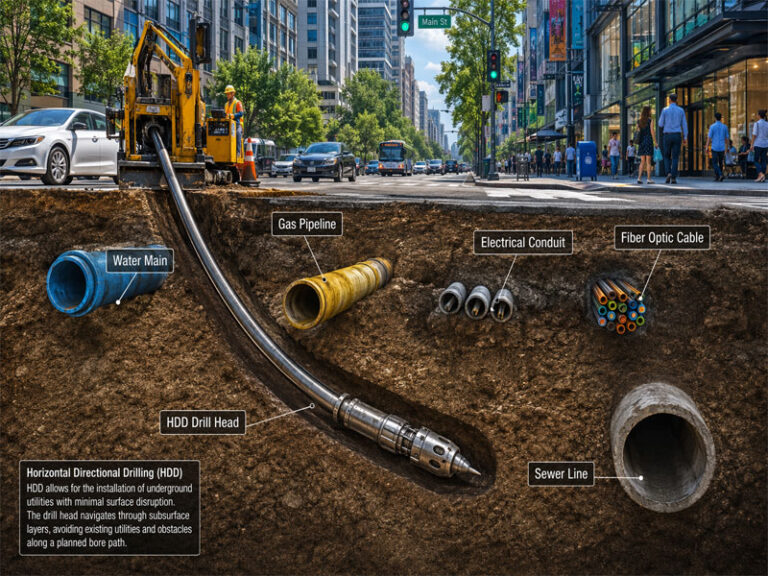
HDD in Urban Areas at a Glance
- Installs pipes without open trench excavation
- Typical depth: 3–20 meters
- Typical length: 100–1,500 meters
- Steering accuracy: ±1–5 centimeters
- Main applications: water pipelines, sewer force mains, gas pipelines, fiber optic conduits, power cable ducts
- Typical project duration: 1 day to 3 months
- Typical cost: $20–$300+ per foot
How Does Horizontal Directional Drilling Work in Urban Areas?
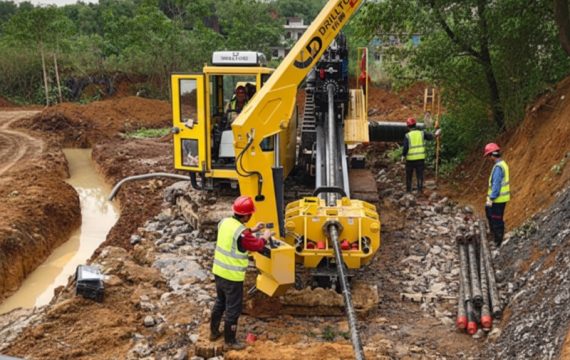
Horizontal directional drilling (HDD) installs underground pipes and cables beneath roads, buildings, and existing utilities without open trench excavation. The process includes:
- Utility locating and site investigation
- Pilot hole drilling with electronic guidance
- Borehole reaming
- Pipe pullback
- Grouting and restoration
Using electronic guidance systems, HDD can achieve centimeter-level accuracy while minimizing traffic disruption and surface damage in densely populated cities. This guide covers the entire HDD process, equipment selection, cost factors, project timelines, and real-world applications to help infrastructure professionals plan and execute successful urban projects.
1. What Is Horizontal Directional Drilling and Why Is It Critical for Cities?
الحفر الأفقي الموجه is a steerable, surface-launched التكنولوجيا التي لا تتطلب حفر خنادق used to install underground utilities with minimal surface excavation. In high-density urban areas—where roads, existing utilities, and buildings compete for limited space—HDD provides the only practical method for installing or replacing water mains, gas pipelines, fiber optic networks, and sewer force mains without shutting down the city.
Why HDD is indispensable in dense urban settings:
- Surface preservation: Roads, sidewalks, and business entrances remain operational throughout construction.
- Precision navigation: Advanced steering systems allow the drill head to weave between existing utilities, foundations, and other obstacles with centimeter-level accuracy.
- Extended reach: HDD can install pipes over distances exceeding 1,500 meters in a single drive, reducing the need for multiple work sites across a city.
2. How Does the Urban HDD Process Work Step by Step?
The HDD process follows a systematic sequence. In high-density areas, each step demands heightened precision to avoid existing infrastructure and maintain public safety.
2.1 Site Preparation and Subsurface Investigation
Before any drilling begins, the construction area undergoes a rigorous investigation. Contractors use ground-penetrating radar (GPR) and other utility locating tools to map existing underground structures. This “CT scan” approach identifies gas lines, water mains, power cables, and telecommunications ducts that could interfere with the bore path.
Key pre-construction activities:
- Utility clearance: Obtain records from local authorities and perform physical locating.
- Traffic management planning: Design temporary diversions for pedestrians and vehicles around the small entry and exit pits.
- Drilling fluid system setup: Position mud recycling tanks in a compact footprint to handle drilling fluids responsibly.
2.2 Pilot Hole Drilling with Electronic Guidance
The first phase involves drilling a small-diameter pilot hole along a predetermined path. The drill head contains a transmitter (sonde) that sends continuous data to a surface receiver. The operator uses this information to steer the drill head, adjusting its orientation to maintain the correct trajectory.
Critical control parameters:
- Inclination: The vertical angle of the drill head.
- Azimuth: The horizontal direction.
- Tool face orientation: The rotational position of the steering tool.
2.3 Multi-Stage Reaming
Once the pilot hole reaches the exit point, it is too small for the final utility pipe. Reaming enlarges the hole to a diameter suitable for the product pipe. This is done in multiple stages, with each reamer pass increasing the hole size by 10–15 cm in diameter.
Reaming strategy for urban stability:
- Gradual enlargement: Multiple passes prevent over-stressing the surrounding soil, reducing the risk of surface settlement.
- Mud management: Drilling fluid is pumped during reaming to stabilize the borehole walls and transport cuttings back to the surface.
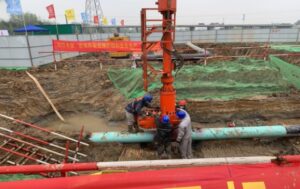
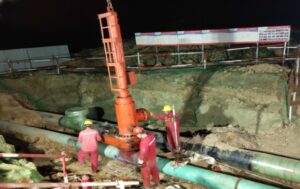
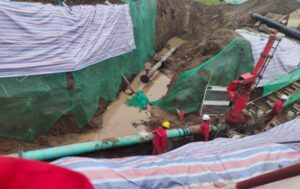
2.4 Pipe Pullback
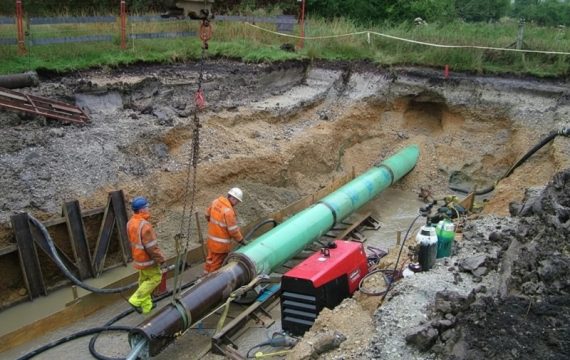
With the borehole prepared, the utility pipe—pre-assembled above ground—is pulled into the hole using a reamer attached to the drill string. The pipe enters from the exit side and is pulled back toward the drill rig.
<figure> <img src="”/images/hdd-pipe-pullback-sequence.jpg”" alt="”HDD" pipe pullback sequence showing assembled being pulled into reamed hole through exit pit”> <figcaption>Figure 2: During pipe pullback, the pre-assembled pipe is drawn into the enlarged borehole, with the drill rig providing controlled tension.</figcaption> </figure>
Pullback considerations:
- Tension monitoring: Pullback forces are continuously monitored to prevent pipe damage.
- Fluid circulation: Drilling fluid is circulated throughout the pullback to reduce friction and prevent the borehole from collapsing.
2.5 Grouting and Surface Restoration
After the pipe is in place, the annular space between the pipe and the borehole wall is filled with a cementitious grout. This step prevents future surface settlement and provides long-term support for the pipe.
The entry and exit pits are then backfilled and restored to their original condition, completing the project with minimal trace of the underground work.
3. What Are the Most Common Urban HDD Applications?
HDD serves a wide range of utility installation needs in city environments. Understanding the specific application helps determine the appropriate equipment, pipe material, and bore profile.
| التطبيق | Typical Pipe Material | Diameter Range | Common Depth |
|---|---|---|---|
| Fiber optic network expansion | HDPE conduit | 50–110 mm | 2–5 m |
| Water transmission pipelines | HDPE, Ductile Iron | 150–600 mm | 4–15 m |
| Sewer force mains | HDPE | 100–400 mm | 5–12 m |
| خطوط أنابيب الغاز الطبيعي | HDPE, Steel | 100–300 mm | 3–10 m |
| District cooling systems | HDPE, Steel | 200–800 mm | 5–15 m |
| Power cable conduits | PVC, HDPE | 100–200 mm | 2–6 m |
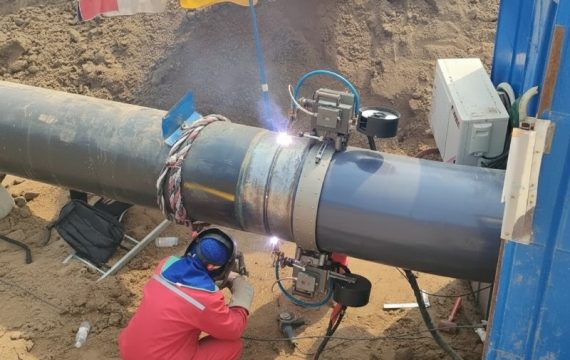
Each application presents unique requirements. For instance, HDD for water main installation demands strict quality control on fusion joints to ensure long-term leak-free performance, while HDD for fiber optic installation prioritizes borehole stability and minimal vibration to protect the delicate cables.
4. Urban HDD Performance Metrics and Technical Data
Data-driven planning is essential for successful urban HDD projects. The following metrics represent industry-standard benchmarks derived from field experience across thousands of municipal installations.
| Metric | Typical Value / Range |
|---|---|
| Steering Accuracy | ±1–5 cm |
| Utility Avoidance Clearance | 300–1,000 mm |
| Bore Depth | 3–20 m |
| طول التجويف | 100–1,500 m |
| HDPE Pullback Length (Continuous) | Up to 3,000 m |
| Traffic Disruption (vs. Open-Cut) | <10% |
| Surface Restoration Area Reduction | 80–95% less than open-cut |
| Borehole Stability Radius | Typically 15–30 × bore diameter |
5. What Are the Key Technical Challenges in Urban HDD?
While HDD offers clear advantages, urban environments introduce specific risks that must be addressed through careful planning and execution.
5.1 Complex Geology and Mixed Soil Conditions
Cities often sit on heterogeneous soil layers—clay, sand, gravel, and weathered rock may all exist within a single bore length. Each layer requires different drilling parameters.
التحدّي: Abrupt transitions from soft clay to hard rock can cause deviation in the bore path and damage to drill bits.
الحل: Site investigations using geophysical methods and test borings inform a layered drilling strategy. Operators adjust torque, rotation speed, and mud flow rates based on real-time feedback from the drilling rig.
5.2 Existing Utility Congestion
Urban underground space is a complex jigsaw of aging and modern utilities. The risk of striking a gas main or power cable is non-trivial.
Mitigation measures:
- Potholing: Vacuum excavation at critical points to expose and verify utility positions.
- Conservative trajectories: Designing the bore path with greater clearance from known utilities, even if this requires a longer route.
- High-accuracy locating systems: Using both ground-based and downhole sensors to ensure the pilot hole stays on course.
5.3 Environmental and Social Constraints
Construction in dense areas often operates under tight noise, vibration, and dust restrictions. The equipment must be positioned within a limited footprint, and drilling fluid disposal must meet environmental standards.
Practical solutions:
- Noise reduction: Enclosing generators and using electric drill rigs where feasible.
- Mud recycling systems: These systems, capable of filtering to 20 microns, reduce the volume of contaminated waste, lowering disposal costs and environmental risk.
- Working hours: Scheduling intensive operations during off-peak hours to minimize disruption.
6. HDD vs. Open-Cut Excavation and Microtunneling
Choosing the right construction method is a critical project decision. The following comparisons highlight the key trade-offs.
HDD vs. Open-Cut Excavation
| العامل | محرك الأقراص الصلبة | التعدين المكشوف |
|---|---|---|
| التأثير على حركة المرور | منخفض جدًا | High (lane closures, detours) |
| Road Restoration | Minimal (small pits only) | Extensive (full pavement replacement) |
| الأثر البيئي | منخفضة | High (dust, noise, runoff) |
| Utility Relocation | Rare | Frequent |
| Construction Speed (Urban) | Moderate to Fast | معتدل |
| Surface Footprint | Small (entry/exit pits) | Large (continuous trench) |
| Business Disruption | الحد الأدنى | Significant |
| Permitting Complexity | معتدل | متوسط إلى مرتفع |
HDD vs. Microtunneling
| العامل | محرك الأقراص الصلبة | النفق الدقيق |
|---|---|---|
| Steering Flexibility | عالية | متوسط |
| Curved Alignment | ممتاز | Limited (preferred straight) |
| Typical Cost (per meter) | أقل | أعلى |
| Diameter Capability | Medium–Large (up to 1,200 mm+) | Large (>800 mm) |
| Surface Equipment Footprint | معتدل | Large (thrust pit required) |
| Operator Skill Requirement | عالية | Very High |
| Suitable for Soft Ground | نعم | نعم |
| Suitable for Hard Rock | Yes (with specialized tooling) | نعم |
7. How Much Does Urban HDD Cost?
HDD installation costs vary significantly based on pipe diameter, geology, urban congestion, depth, and project length. The cost per linear foot generally decreases for larger volume projects.
| قطر الأنبوب | Typical Cost (USD per foot) | Typical Cost (USD per meter) |
|---|---|---|
| 50–150 mm (small diameter) | $20–$80 | $65–$260 |
| 150–300 mm (medium diameter) | $50–$150 | $160–$490 |
| 300–600 mm (large diameter) | $100–$300 | $330–$980 |
| 600 mm+ (extra-large, project-specific) | Project-specific | Project-specific |
Additional cost considerations:
- Geology: Rock drilling can increase costs by 50–100% compared to soft soil.
- Urban congestion: Dense utility corridors require more elaborate locating and steering, adding 10–30% to labor costs.
- Permitting and traffic control: In cities, these soft costs can add 15–25% to the total project budget.
- Drilling fluid management: Stringent environmental regulations may increase disposal costs.
It is important to note that while the unit cost of HDD may be higher than open-cut, the total project cost is frequently lower when accounting for restoration, traffic management, and business disruption avoidance.
8. How Long Does an Urban HDD Project Take?
Project duration depends on bore length, diameter, ground conditions, and the complexity of the urban environment.
| نوع المشروع | Typical Bore Length | المدة |
|---|---|---|
| Utility crossing (e.g., under a road) | 50–100 m | 1–3 أيام |
| Small urban installation | 100–300 m | 3–7 days |
| Medium municipal project | 300–800 m | 1–3 weeks |
| Large infrastructure crossing | 800–1,500 m+ | 1–3 months |
Key factors affecting timeline:
- Site preparation: Utility locating and traffic planning often take as long as the drilling itself.
- Permitting: Local approvals can add 2–8 weeks to the schedule.
- Ground conditions: Unexpected rock or obstructions can extend the bore time by 20–50%.
- Weather: Heavy rain may pause operations, especially in areas with strict environmental controls on drilling fluid runoff.
9. Representative Urban HDD Project Example
The following example is representative of a typical municipal HDD project and is provided for illustrative purposes. Actual project outcomes may vary based on site-specific conditions.
Scenario: Water main installation beneath a six-lane urban highway with average daily traffic of 45,000 vehicles.
Project Parameters:
- Bore Length: 420 meters
- Pipe: 450 mm HDPE water main
- Installation Depth: 8 meters below surface
- Geology: Mixed clay and weathered sandstone
- Existing Utilities: Power cables, gas main, and fiber optic lines within 3 meters of the bore path
Execution Approach:
- A multi-day GPR survey confirmed utility positions.
- A single pilot bore was installed, followed by 3 reaming passes (150 mm → 350 mm → 450 mm → 550 mm).
- A closed-loop mud recycling system minimized waste disposal.
- Operations were contained within a 10-meter-wide working corridor.
Observed Outcomes:
- Zero lane closures throughout the construction period.
- Total project cost was approximately 35% lower than the estimated open-cut alternative.
- No utility conflicts or service interruptions occurred.
- Surface restoration was limited to two 8m x 4m pits, completed within 2 days.
10. Advantages and Disadvantages of HDD in Urban Areas
Understanding the trade-offs is essential for project decision-making. HDD is not always the right choice, and a balanced view supports better engineering judgments.
| المزايا | العيوب |
|---|---|
| Minimal traffic disruption and road closures | Higher initial equipment mobilization costs |
| Reduced pavement restoration and landscaping costs | Complex utility coordination and permitting |
| Lower environmental impact and carbon footprint | Risk of drilling fluid returns at the surface |
| Ability to cross beneath rivers, railways, and buildings | Requires highly experienced operators and engineers |
| Improved worker safety versus open-cut excavation | Not suitable for extremely shallow or unstable ground |
| Can navigate curved and complex alignments | Longer planning and design phase required |
11. Frequently Asked Questions About Urban HDD
Can HDD be used under busy roads?
Yes. HDD is widely used to install utilities beneath highways, arterial roads, and intersections without disrupting traffic. The entry and exit pits are typically placed on shoulders or sidewalks, leaving travel lanes unaffected.
How accurate is HDD in urban areas?
Modern HDD guidance systems typically maintain accuracy within 1–3% of bore depth and often achieve centimeter-level positioning. With experienced operators, steering accuracy of ±1–5 cm is achievable.
What is the maximum HDD distance in cities?
Most urban HDD installations range from 100 to 1,500 meters. Specialized rigs can exceed 3,000 meters, though such distances are rare in dense urban settings due to space constraints.
Is HDD more expensive than open-cut excavation?
The drilling operation itself is often more expensive on a per-meter basis. However, total project costs are frequently lower because HDD eliminates pavement restoration, traffic control, and business disruption costs.
What pipe materials can be installed with HDD?
HDPE is the most common material due to its flexibility and corrosion resistance. Steel and ductile iron pipes are also installed using HDD for high-pressure applications.
Does HDD damage roads?
No. HDD is specifically designed to preserve road surfaces. Only small entry and exit pits are required, and the road structure remains intact throughout the installation.
What is the typical HDD depth under roads?
Most HDD road crossings are installed 3–10 meters below the road surface, depending on utility congestion and geotechnical conditions.
Can HDD be used in rock?
Yes. HDD is effective in sandstone, limestone, shale, and other rock formations using specialized rock bits and mud motors.
What is the largest pipe installed by HDD?
Modern HDD systems can install steel and HDPE pipelines exceeding 1,200 mm (48 inches) in diameter.
How safe is HDD near existing utilities?
When supported by utility locating, GPR surveys, potholing, and electronic guidance systems, HDD is considered one of the safest trenchless construction methods.
Is HDD environmentally friendly?
Compared to open-cut excavation, HDD significantly reduces surface disturbance, dust, noise, and carbon emissions. Closed-loop mud recycling systems further reduce environmental impact.
What happens if the drill hits an unforeseen obstacle?
The steering system provides real-time feedback, allowing the operator to slow down and change direction if necessary. For solid obstructions, the drill can be steered around them or, in some cases, retrieved and redirected.
Can HDD be used for sewer installations?
Yes. HDD is commonly used for sewer force mains and gravity sewer lines, although gravity lines require exceptionally precise grade control.
12. Key Takeaways: HDD in High-Density Urban Areas
- HDD installs underground utilities without continuous trench excavation, preserving surface infrastructure.
- The process consists of four main phases: pilot drilling, reaming, pipe pullback, and grouting.
- Electronic guidance systems allow for centimeter-level accuracy, enabling navigation beneath roads, buildings, and existing utilities.
- Typical urban installations range from 3 to 20 meters deep and 100 to 1,500 meters long.
- HDD serves multiple applications, including water mains, gas pipelines, fiber optics, and sewer force mains.
- While equipment costs are higher, total project costs are often lower than open-cut due to reduced restoration and traffic management expenses.
- Project timelines range from 1 day for simple crossings to 3 months for complex infrastructure projects.
- Successful urban HDD requires thorough site investigation, experienced operators, and robust drilling fluid management.
References and Technical Standards
The following industry standards and guidelines inform the practices described in this article:
- NASTT (North American Society for Trenchless Technology) – HDD Good Practices Guidelines
- ISTT (International Society for Trenchless Technology) – Trenchless Technology Guidelines
- ASTM F1962 – Standard Guide for Use of Maxi-Horizontal Directional Drilling for Placement of Polyethylene Pipe
- ASTM F1804 – Standard Practice for Determining Allowable Tensile Load for Polyethylene Pipe During Installation
- ASCE (American Society of Civil Engineers) – Utility Engineering and Surveying Manual
About JSW Drilling Services
JSW stands at the forefront of trenchless technology, delivering industry-leading horizontal directional drilling services for the most challenging urban environments. With over 15 years of specialized experience, JSW has completed more than 200 infrastructure projects across Asia-Pacific, ranging from fiber optic network expansions to large-diameter water transmission mains.
Our capabilities include:
- A versatile fleet of drilling rigs capable of bores from 50 mm to 1,200 mm in diameter
- Proprietary mud recycling systems that reduce environmental impact by up to 70%
- In-house geotechnical engineering and utility locating teams
- Turnkey project delivery from feasibility assessment through final commissioning
Our commitment to excellence:
JSW integrates advanced guidance systems with proven operational protocols to deliver projects on time and within budget. Our safety record—zero lost-time incidents in the past 5 years—reflects our rigorous training and quality control standards. We hold ISO 9001 and ISO 14001 certifications, and all our projects are backed by a 12-month workmanship warranty.
What sets JSW apart is our consultative approach. We work alongside clients from the earliest planning stages, offering feasibility studies, alternative method comparisons, and risk assessments to ensure the chosen solution truly fits the project’s needs. Our deep experience in congested urban settings means we anticipate challenges before they arise, providing clients with confidence and certainty.
Ready to explore HDD for your next infrastructure project? Contact JSW for a free feasibility consultation and project assessment. Our team is ready to help you build smarter, faster, and more sustainably.










 English
  Arabic
  Russian
  Spanish
  French
  Vietnamese
  Polish
  Thai
Thai  Indonesian
  Turkish
  Portuguese