
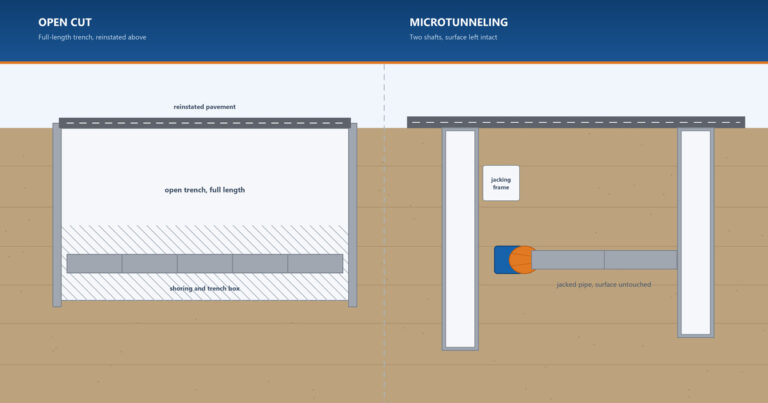
Short answer: in the microtunneling vs open cut decision, open cut is usually the lower bid on short, shallow, stable-ground runs, but microtunneling becomes the lower whole-life cost once a crossing runs deeper than 20 ft (6 m), sits under live roads or utilities, or runs through contaminated or water-bearing ground.
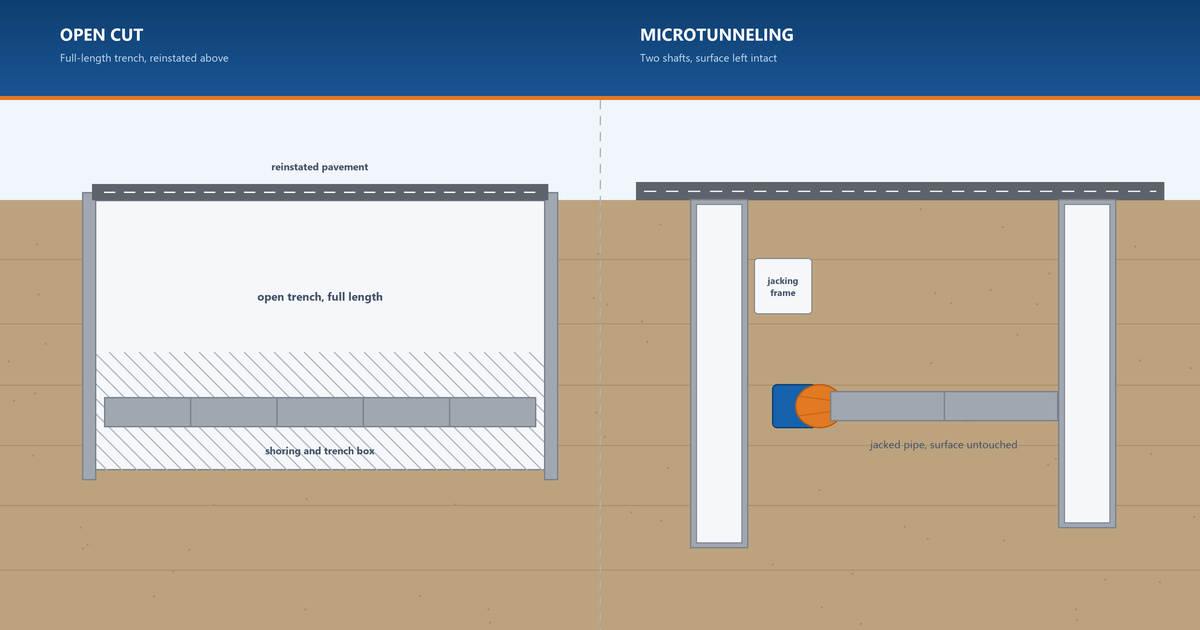
This guide compares the two methods on the three criteria that decide most of these projects: direct cost, project programme and surface impact. Each section gives the published ranges, the reason behind them, and the depth at which the ranking changes.
Is Microtunneling Always More Expensive Than Open-Cut?
No. Microtunneling carries the higher rate per unit length, because it includes a tunnel machine, engineered shafts and a jacking system. But that rate is weighed against an open cut excavation bill that grows with depth, groundwater and what sits above the route.
The useful question is not which method is cheaper, but cheaper over what depth. Four conditions tilt the total toward microtunneling:
- Depth. Deeper than 20 ft (6 m), the ground support and water control needed to keep a trench safe climb steeply.
- Ground and water. Running sand, a high water table and contaminated soil add export, replacement and risk.
- Surface value. Under a live carriageway or a shop frontage, the cost of disruption can exceed the construction premium.
- Utility density. Every buried service in the path is a relocation or protection bill.
Where none of those apply, open cut is the cheaper choice.
Bottom line: open cut wins the bid on shallow, dry, open-ground runs; microtunneling wins the total cost once depth, groundwater or surface value enters the calculation.
Direct Cost: What Each Method Actually Bills For
In this comparison, direct cost is the part a contractor prices line by line. For open cut excavation it is excavating, ground support, water control, pipe laying, backfill and surface restoration along the whole length. For microtunneling it is the two shafts, the machine, the pipe and spoil handling.
The two bills are structured differently. Open cut is linear: cost tracks the length of trench. Microtunneling is front-loaded: most of the cost sits in the shafts, so the unit rate falls as the drive gets longer. Pipe preparation sits on the equipment side, covered by pipe cutting machines.
| Cost line | Open cut | النفق الدقيق |
|---|---|---|
| إعداد الموقع | Working strip both sides, full length | Two shaft sites; one hosts the machine and spoil |
| Ground support | Trench support along the full length | Shaft lining and ground treatment |
| Water control | Pumping along the trench for its open life | Slurry or earth pressure balance face support |
| Pipe installation | Lay and joint in the open trench | Jack the pipe behind the machine |
| Backfill | Imported or selected fill plus compaction | Only the shafts are backfilled |
| Surface restoration | Full-length reinstatement, often to a highway specification | Shaft reinstatement only |
| Indicative municipal rate | Lower on short, shallow runs | About USD 150-500+ per linear foot |
Indicative municipal ranges run about USD 150-500+ per linear foot for microtunneling – a drive-only rate, excluding shafts, slurry handling, disposal and reinstatement. Those are planning-level figures: shoring, dewatering, diameter, depth, ground and the disposal route move them by multiples, so no published rate replaces a project-specific price.
For the wider side-by-side, see trenchless technology vs open cut.
The Crossover Depth: When Microtunneling Becomes Cheaper
The crossover: on urban crossings deeper than 20 ft (6 m) with a constrained surface, microtunneling is typically the lower whole-life cost; on shallow crossings in open ground, open cut is cheaper, arriving earlier in dense or sensitive corridors.
Open cut cost is a function of depth twice over: ground support must resist more earth pressure, and dewatering must lift water from deeper. Both are multiplied by the full length of the works. Microtunneling replaces that with two shafts, and a shaft is priced per shaft, not per metre of alignment.
Deep open cuts also trigger requirements that shallow ones do not:
- Engineered support. Beyond a certain depth a trench box is no longer enough, and a designed system is required.
- Continuous water control. Deeper trenches meet more groundwater, so pumps run for the whole open period.
- Traffic management. A deep, wide excavation usually means a lane closure for months.
- Disposal. Deeper excavation generates more spoil, and contaminated spoil must be tested, hauled and replaced.
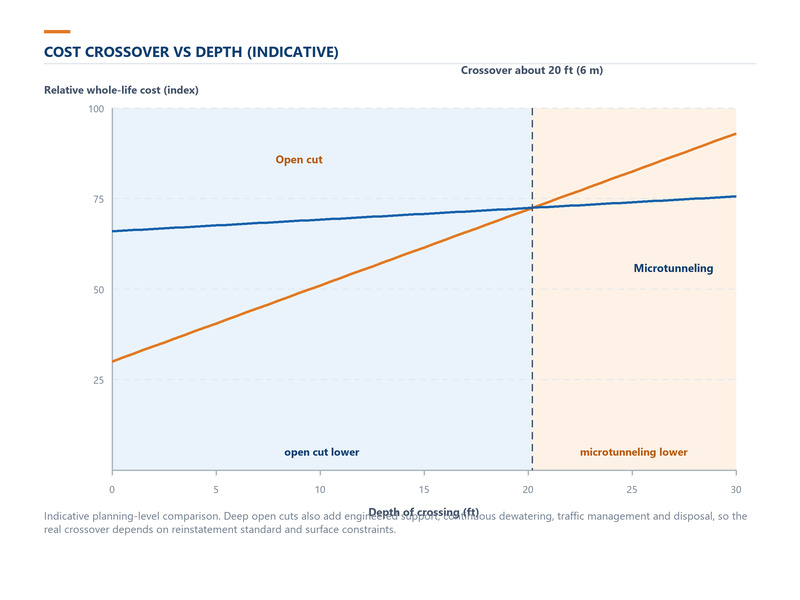
Bottom line: treat 20 ft (6 m) as the planning threshold where microtunneling typically becomes the cheaper method in a microtunneling vs open cut comparison – not a fixed rule, but a reliable starting point for a budget comparison.
This section carries the full threshold economics; screening pages quote it, not redefine it.
What Pushes Open-Cut Costs Up: Support, Water, Disposal and Restoration
Four cost drivers separate a cheap open cut from an expensive one, and all four scale with depth and urban density.
- Ground support. Trench support is priced by area, and deep or unstable ground needs more of it; in running sand it can become the largest line.
- Water control. Pumping, settling and discharge permitting add cost and environmental obligations.
- Disposal and replacement. Contaminated spoil must be tested, transported to a licensed facility and replaced with fill.
- Surface restoration. Reinstatement to a highway standard is billed per square metre over the whole alignment.
Two further items sit beside those: utility relocation, the temporary works that keep adjacent structures stable, and keeping a live main running through a tie-in with hot tapping and plugging services. On projects we have executed, utility conflicts and unmapped services have turned an open cut estimate into a redesign.
Programme and Schedule: Who Finishes First, and Why?
The two methods carry schedule risk in different places. Open cut advances linearly: each length must be excavated, piped, backfilled and reinstated before the next opens, so the project programme tracks the slowest section, not the average.
Microtunneling works shaft to shaft, so several drives can run in parallel and the surface between shafts stays closed.
| Programme factor | Open cut | النفق الدقيق |
|---|---|---|
| Work sequence | Linear, one section at a time | Shaft to shaft; drives can overlap |
| Surface occupation | Whole alignment, full duration | Shafts only; other areas released early |
| Weather sensitivity | High: the trench floods and collapses | Low: the face is supported and enclosed |
| Utility risk to schedule | High: every conflict stops the section | Low: the drive passes beneath the services |
| Surface restoration | After every section | Only at the shafts |
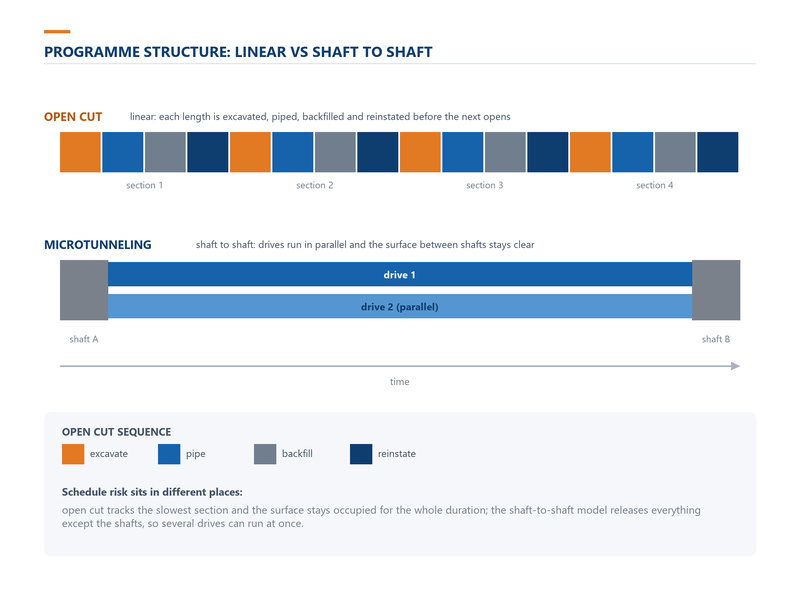
Open cut wins on schedule only on short, simple, dry runs, where a single trench beats mobilising a machine and building shafts. Where shoring and dewatering scale with the open length and traffic disruption runs for months, the shaft-to-shaft model wins on time.
Bottom line: open cut is faster only on short, simple, unconstrained alignments; on long, deep or busy corridors the shaft-to-shaft model wins on time.
Surface Impact and the Indirect Costs Owners Underestimate
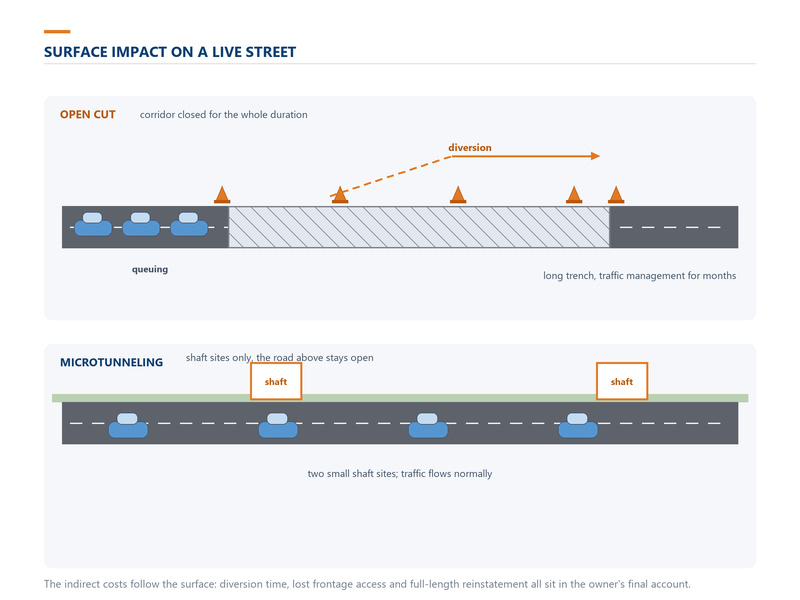
Open cut closes the surface along the whole alignment for the whole duration, and traffic disruption follows for everyone above it.
On urban trunk sewers deeper than 20 ft (6 m) with full highway-standard reinstatement, the open-cut bill can run to roughly three times the cost of a comparable microtunneling drive.
The indirect costs that follow are rarely in the tender, but they are real:
- Traffic disruption. Diversions, queuing and a reduced speed limit raise travel time and emissions for every road user, for as long as the corridor stays open.
- Business accessibility. Shops and services lose passing trade when frontage is fenced, and some never recover the customers who reroute.
- Lost economic activity. Some appraisal guidance counts lost trade during construction as a public cost.
- Public safety exposure. A long open trench keeps the public beside a deep excavation for months, lengthening the period of risk.
- Carbon footprint. Excavation, haulage, imported fill and full-length reinstatement carry embodied carbon a shaft-only solution avoids.
Traffic disruption and the social costs around it are why several transport authorities now screen deep urban crossings for a trenchless option. The environmental case is examined further in our guide to environmental impact assessment for trenchless construction.
Surface impact converts directly into indirect cost: diversion time, lost access and reinstatement all appear in the owner’s final account.
Two Projects That Switched From Open-Cut to Trenchless
Two widely reported municipal projects show how the crossover works: both began as open cut excavation schemes and were re-scoped once surface and ground costs were quantified.
- Las Vegas, a 2,700 lf, 60 in. sewer. The route ran through an operating resort corridor where a full open cut was impractical. The scheme was re-engineered as three microtunneling drives, which kept the frontage and the roadway open.
- San Diego, a 3,700 lf, 21 ft deep sewer. The open route passed through unstable and contaminated ground that would have needed extensive water control, ground support and soil export. The project moved to pilot tube microtunneling to cut the excavation, the exposed contaminated volume and the disruption.
Both are published public projects, not JSW work, and the reporting does not disclose the final contract value. Three conditions – over 20 ft (6 m) cover, live traffic above and no full closure – not the length, drove the shaft-based trenchless option.
For the cost and accuracy side of a neighbouring comparison, see microtunneling vs jack and bore: cost and accuracy, and for the wider family of trenchless options, start from what trenchless technologies are.
How Does Microtunneling vs Open-Cut Compare Side by Side?
The table below condenses the microtunneling vs open cut comparison into the criteria a cost or method study normally covers.
| المعيار | Open cut | النفق الدقيق |
|---|---|---|
| Typical lower-cost depth | Shallower than 20 ft (6 m) | Deeper than 20 ft (6 m) |
| Unit cost basis | Per length of trench | Per shaft plus per drive length |
| Site footprint | Whole alignment plus working strips | About 11,000 sq ft at the shafts |
| Shoring demand | Full-length, rising with depth | Shaft support only |
| Dewatering demand | Pumping for the life of the trench | Face support from the machine |
| Surface restoration | Full length, highway standard | Shaft reinstatement only |
| Contaminated soil | Export and replace along the alignment | Limited to the shaft and bore arisings |
| Programme model | Linear, no overlap | Parallel drives possible |
| Best fit | Shallow, dry, open ground | Deep, constrained, wet or contaminated ground |
Which Five Rules Decide Between Microtunneling and Open-Cut?
Apply these in order; the first rule that gives a clear answer usually settles the method.
- Measure the depth first. Against the crossover above: price microtunneling deeper than 20 ft (6 m) and open cut excavation shallower than that.
- Check the water and the soil. If the trench would need dewatering or the ground will not stand, price that support and pumping on the open-cut side before choosing.
- Count what is buried in the corridor. Dense, poorly recorded utilities make open cut unpredictable and favour a method that passes beneath them – and they raise the shoring and protection bill either way.
- Value the surface. If the route is a live road, a rail line or a shop frontage, put a number on the disruption before comparing construction cost.
- Test the schedule. If the programme cannot tolerate a linear, weather-sensitive excavation, the shaft-to-shaft model wins on time even before cost.
A comparison should end with a written recommendation that names the depth threshold – not a preference. In trenchless construction the crossover depth is still the first number to check.
Not sure whether the crossover applies to your project? Send your alignment and geotechnical data for a free method review, and our engineers will tell you which method the numbers support.
الأسئلة الشائعة
Our 180 m sewer is 4 m deep in open ground beside a school – is open cut really the cheaper option?
At 4 m in open ground, open cut is usually the lower bid; the higher microtunneling rate only pays off once depth, groundwater or surface value rises. Even so, open cut adds shoring, water control, disposal and reinstatement, so weigh the closure duration and site access too.
We have a 600 m trunk sewer at 9 m under a market street with tram tracks – microtunneling vs open cut?
At 9 m under live traffic, microtunneling is usually the lower whole-life cost, and the crossover above explains why: open cut would need heavy ground support, continuous water control and full-length reinstatement along the whole corridor.
How much surface does a microtunneling site need?
A drive needs a launch shaft and a reception shaft, so the working footprint is typically around 11,000 sq ft across the launch and reception shaft sites combined, excluding a separate slurry handling area. Open cut occupies the whole alignment plus a working strip on both sides for the full duration of the work.
If we open cut 400 m of contaminated ground, what does the disposal share of the bill look like?
Disposal usually becomes one of the largest open-cut line items: contaminated soil is tested, transported to a licensed facility and replaced with imported fill, so the more trench you open, the more volume is handled. Shorter drives disturb far less.
Does microtunneling take longer than open cut?
Not necessarily. Open cut advances linearly – each section must be excavated, backfilled and reinstated before the next – while microtunneling works shaft to shaft and can run parallel operations. On long, deep or constrained alignments the project programme usually favours microtunneling.
What are the hidden costs of open cut?
Indirect costs are typically listed as traffic diversion, lost business access, safety exposure and a larger carbon footprint; quantifying them is project-specific and not part of a headline rate.
My 300 m sewer runs 7 m deep under a retail street through contaminated soil – should I open cut or microtunnel?
At that depth under a retail street, microtunneling is usually the practical choice, and contaminated ground strengthens the case. Open cut would expose and must export contaminated soil along the whole trench; a microtunneling drive disturbs only the shaft footprint and the bore, so the volume of contaminated material handled and replaced is far smaller.
Getting a Real Cost Comparison
Owners scoring bids should weight the surface cost and the programme; designers should check the tolerance and settlement limits; contractors should price the shaft count and the disposal route.
A reliable microtunneling vs open cut comparison needs five inputs: the geotechnical investigation, the utility locates, the length and depth, the pipe diameter and material, and the acceptable surface occupation.
Ask every bidder to state the crossing depth at which their own rate stops being the cheaper one.
For the drive, see microtunneling construction services; for the surrounding delivery scope, see pipeline construction services and the long-term view in pipeline maintenance services. The machine-side comparison sits in microtunneling services. All of it is planned against one project programme and delivered as a single trenchless construction offer.
Two priced options on one alignment, with the assumption that would flip the recommendation written down, is how we hand over a comparison.
Contact our engineering team with your alignment data for a cost and programme comparison.
Final Verdict: Which Method Fits Your Project?
Open cut and microtunneling are not ranked absolutely; they are ranked against a specific depth, ground and surface. Choose open cut excavation for shallow, dry, open ground. Choose microtunneling when the crossing is deep, the ground is wet or unstable, or the surface must keep working – the traffic disruption of a long open trench is a cost the owner keeps paying.
Where the maths is still close, the deciding inputs are the geotechnical report and a bidder-priced alternative – and the crossover depth is the first number to check in any microtunneling vs open cut comparison.
Get a second opinion at no cost. Our engineering team will price both methods on your alignment and tell you which one we would build.
Related: microtunneling vs HDD and when to use microtunneling.
Sources
Each axis of this comparison is backed by a published source: the crossover depth by ASCE/CI 36-15, the direct-cost and programme questions by issuing-body guidance, and the surface-impact case by NASTT good practice.
- ASCE/CI 36-15, Standard Construction Guidelines for Microtunneling – supports the crossover-depth section.
- ASTM – the issuing body for pipeline and trenchless installation standards; supports the direct-cost section.
- NASTT Good Practices Guidelines (Microtunneling and Open-Cut Construction) – supports the surface-impact section.
- ASCE – the issuing body for pipeline construction and project delivery guidance; supports the programme section.





































 English
  Arabic
  Russian
  Spanish
  French
  Vietnamese
  Polish
  Thai
Thai  Indonesian
  Turkish
  Portuguese