
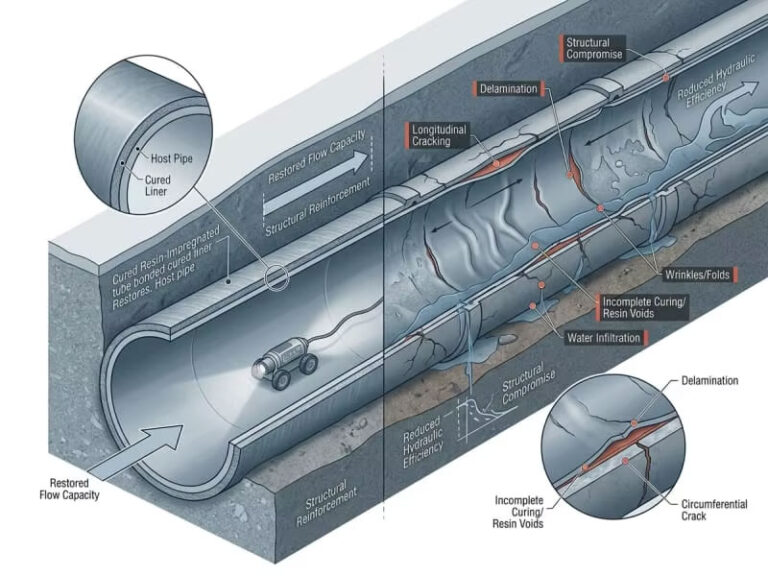
1. What Are the Most Common CIPP Liner Failure Modes?
The most common CIPP liner failure modes include:
- Structural cracking and collapse
- Delamination and bonding failure
- Wrinkles and deformation
- التصلب غير الكامل
- Resin defects and material failure
- Pinhole leakage and seam defects
- Diameter reduction and flow restriction
- Lateral reinstatement failures
- Chemical degradation
- Long-term aging failure
These failures are mainly caused by poor design, inadequate surface preparation, improper curing, installation errors, and unsuitable material selection. These CIPP defects and trenchless rehabilitation failures generally fall into five main categories: structural failures, installation-related defects, hydraulic failures, long-term material degradation, and connection reinstatement failures. Understanding these failure mechanisms is essential for utility owners, engineers, and contractors to make informed decisions about system design, installation practices, and maintenance strategies.
Common Trenchless Pipe Lining Failure Modes Overview
| وضع الفشل | Main Causes | Warning Signs | استراتيجية الوقاية |
|---|---|---|---|
| Cracking & Collapse | Insufficient thickness, excessive loads | Leaks, visible deformation, CCTV cracks | Accurate structural design per ASTM F1216 |
| Delamination & Bonding Failure | Poor surface prep, incompatible resin | Water tracking behind liner, annular space | Thorough cleaning, proper resin selection |
| Wrinkles & Folds | Improper inversion pressure, resin voids | Reduced flow capacity, CCTV obstructions | Controlled inflation, uniform resin saturation |
| Incomplete Cure | Wrong temperature, insufficient time | Soft liner, tacky surface, low strength | Continuous cure monitoring, data logging |
| Over Cure | Excessive temperature, too long cure | Resin scorching, brittleness, cracking | Accurate temperature control |
| Pinhole Leakage | Resin film dissolution, manufacturing defects | Infiltration, positive dye test | Quality materials, proper impregnation |
| Seam Failure | Poor joint sealing, incompatible seam adhesive | Leakage along longitudinal seam | Proper seaming techniques, compatible adhesives |
| تقليل القطر | Excessive liner thickness, incomplete expansion | Reduced flow, increased pumping cost | Design for hydraulic capacity, QC checks |
| Chemical Degradation | Aggressive wastewater, industrial discharge | Surface softening, material loss | Chemical-resistant resin system selection |
| Connection Failure | Robotic cutting error, misalignment | Backups at laterals, local blockages | Precision robotic reinstatement, verification |
2. Structural CIPP Liner Failure: Cracking and Collapse
Structural failures affect the liner’s ability to carry external loads from soil, groundwater, and surface traffic. These failures typically manifest as cracks, ovality (deformation into an “egg shape”), or complete collapse.
The primary mechanisms include:
- Under-designed thickness for the specific loading conditions
- Inadequate resin saturation during impregnation
- Excessive external loads not accounted for in initial design calculations
- Improper inflation pressure during installation
Full-scale three-edge bearing tests on reinforced concrete pipes rehabilitated with CIPP liners demonstrate that a 12mm structural liner increased cracking and ultimate loads by 10–26%, while a 5mm semi-structural liner actually decreased ultimate load by up to 17% due to circumferential stiffness mismatch. This finding highlights the critical importance of proper thickness selection.
3. CIPP Delamination and Bonding Failure
Delamination occurs when the liner separates from the host pipe’s inner surface, creating an annular gap. This failure mode is particularly problematic because it:
- Allows water to track between the liner and host pipe
- Reintroduces infiltration and exfiltration pathways
- Eliminates composite strength benefits in bonded systems
- Creates voids susceptible to future collapse or biological growth
Data from a comprehensive monitoring program revealed that 41% of mainline liners exhibited pinhole leaks at post-rehabilitation inspection, increasing to 52% at warranty inspection (18–24 months post-installation). These findings demonstrate that defects often worsen over time rather than self-sealing, contradicting some industry assertions.
4. CIPP Lifts, Sags, and Deformation
Lifts (upward deformation in the invert) and sags (downward deformation at the crown) represent a specific structural failure mode occurring when:
- Full cure is not achieved in an area during the curing process
- Hydraulic water pressure (groundwater infiltration) between liner and host pipe exceeds installation cure pressure
- Condensate becomes trapped in low spots during steam curing
These deformations can occur in both gravity and pressure applications, compromising flow capacity and structural integrity.
5. Hydraulic Performance Problems: Wrinkles and Blockages
A liner may be structurally sound but hydraulically compromised. Wrinkles and folds typically occur at bends, diameter transitions, and changes in slope. While sometimes considered cosmetic, these defects can:
- Trap debris and grease, leading to chronic blockages
- Reduce flow capacity significantly
- Create turbulence that accelerates wear
Excessive diameter reduction occurs when:
- The liner is too thick for the application
- Incomplete expansion during installation
- Improper resin distribution creates localized thickness variations
The challenge is particularly acute in smaller-diameter laterals and building drains, where access constraints increase the complexity of achieving uniform coverage.
6. CIPP Installation Defects and Curing Problems
Inadequate Surface Preparation
Proper cleaning and surface preparation is the foundation of successful lining. Common deficiencies include:
- Insufficient jetting or mechanical cleaning
- Failure to remove scale, roots, grease, and tuberculation
- Lack of post-cleaning verification
Poor surface preparation directly leads to adhesion failures, annular spaces, and premature delamination.
Improper Curing Practices
Under-curing occurs when resin does not achieve full polymerization, resulting in:
- Soft, tacky, or weak liners
- Reduced chemical resistance
- Compromised long-term structural performance
Common causes include incorrect temperature or time profiles, uneven heating, and resin systems mismatched to field conditions.
Overheating during curing can cause excessive shrinkage, internal stress, cracking, and resin scorching, equally compromising liner integrity.
Resin and Material Quality Issues
The quality of materials directly impacts failure rates:
- Substandard resins with lower-grade fibers or inconsistent wall thickness
- Improper storage (temperature exposure, expiration, contamination)
- Incompatible resin-host pipe combinations
Industry data shows that failure rates are significantly higher when materials are not matched to specific service conditions, particularly for aggressive chemical or thermal environments.
7. Long-Term Aging and Chemical Degradation
Even properly installed liners face long-term degradation from:
- Chemical attack: Industrial wastewater, restaurant grease, cleaning agents, and hydrogen sulfide can degrade resins
- Thermal cycling: Repeated expansion and contraction from temperature variations
- Abrasion and erosion: Solids in flow gradually wear away surfaces
The choice of resin system must account for these factors, particularly in aggressive industrial or combined sewer environments.
Leakage and Infiltration
A major concern, particularly for inflow and infiltration (I&I) reduction projects, is the development of leakage over time. Studies tracking liner performance over 2–3 years found:
- Pinhole leaks in mainline liners increased from 41% to 52% at warranty inspection
- Seam defects increased from 0.3% to 24% over the same period
These findings challenge the assumption that liners provide a permanent seal and highlight the importance of long-term monitoring.
8. Lateral Connection Reinstatement Failures
When reinstating lateral connections, robotic cutting presents specific risks:
- Over-cutting: Damaging the new liner or host pipe
- Under-cutting: Incomplete opening restricting flow
- Misalignment: Lateral openings partially covered
Poorly reinstated connections can lead to backups in individual units or branches, even when the main line liner appears intact.
9. How to Inspect and Diagnose Failed CIPP Liners
Comprehensive inspection is essential for diagnosing failure and planning remediation. Methods include:
- CCTV inspection: Visual confirmation of cracks, delamination, and blockages
- Laser profiling: Precise measurement of deformation and diameter loss
- Thickness measurement: Ultrasonic testing to verify liner thickness
- Leakage testing: Dye testing or smoke testing to identify infiltration points
- Coupon testing: Laboratory evaluation of cure extent and resin properties
10. CIPP Liner Failure Prevention and Quality Assurance
Engineering and Design Phase
Proper prevention begins with thorough evaluation:
- Comprehensive CCTV inspection of the entire pipe segment
- Accurate condition assessment identifying root causes of deterioration
- Proper load calculations accounting for soil, groundwater, and traffic loads
- Material selection matched to specific chemical and thermal conditions
Installation Quality Control
Effective quality assurance includes:
- Independent post-rehabilitation inspection (minimum 120 days after installation)
- Warranty inspections at 18–24 months to identify delayed defects
- Third-party inspection rather than contractor self-certification
- Documentation of all installation parameters
Material Verification
- Batch tracking of all resins and liners
- Storage monitoring to ensure proper conditions
- Testing of cure samples to verify achieved strength
11. CIPP Liner Failure Repair Options and Cost Guide
When failures occur, repair options include:
- Point repairs: Isolated sections can be relined using short liner segments
- Spot coating: Epoxy application to address localized damage
- Full relining: Complete replacement of the failed liner
- Open-cut replacement: For severe failures where relining is not feasible
CIPP Liner Failure Repair Cost Guide
| Failure Severity | Typical Cost Range | الحل الموصى به |
|---|---|---|
| Minor defects (small pinholes, local spots) | $500 – $5,000 | Spot repair coating or epoxy application |
| Medium failures (localized delamination, isolated cracks) | $5,000 – $50,000 | Sectional liner repair or short relining |
| Major structural failure (severe cracking, collapse, extensive delamination) | $50,000+ | Full relining or open-cut pipe replacement |
Actual costs depend on pipe diameter, access conditions, length of damage, and severity of the failure. Contact a trenchless rehabilitation specialist for a site-specific assessment.
Failure vs. Repair Decision Matrix
| Failure Condition | الحل الموصى به | Justification |
|---|---|---|
| Small pinholes | Spot repair coating | Low cost, minimal disruption |
| Localized delamination | Sectional liner repair | Restores structural bond, cost-effective |
| Severe cracking | Full relining | Requires complete structural reinforcement |
| Collapsed host pipe | Open-cut replacement | No pipe structure remains to support a liner |
| Poor hydraulic capacity | Flow improvement evaluation | May require larger pipe, not just lining |
12. Frequently Asked Questions About CIPP Liner Failures
Q: What is the most common cause of CIPP liner failure?
A: Poor installation quality, including inadequate cleaning, improper curing, and incorrect design thickness, are among the leading causes of CIPP liner failure.
Q: Why do CIPP liners fail?
A: CIPP liners fail primarily due to design errors (incorrect thickness), installation defects (poor surface prep, improper curing), material issues (incompatible resin), and external factors (chemical attack, excessive loads).
Q: Can a failed CIPP liner be repaired?
A: Yes. Depending on the extent and type of failure, repair options include spot coating, point repairs, full relining, or in severe cases, open-cut replacement.
Q: How do you inspect a CIPP liner after installation?
A: Comprehensive post-installation inspection includes CCTV inspection, laser profiling, thickness measurement (ultrasonic testing), and leakage testing.
Q: Why do CIPP liners wrinkle?
A: Wrinkles typically occur due to improper inversion pressure, resin voids, or during steam curing when condensate becomes trapped in low spots.
Q: What causes CIPP liner delamination?
A: Delamination is primarily caused by inadequate surface preparation (leaving debris or scale on the host pipe wall) or incompatibility between the resin and the host pipe material.
Q: How long does a failed pipe liner last?
A: A failed liner may last only a few years after failure signs appear, depending on the severity of the defect and service conditions.
Q: Can epoxy coating repair a damaged pipe liner?
A: Epoxy coating can be applied as a spot repair for localized damage but is not typically a solution for widespread structural failure.
Q: What testing is required after CIPP installation?
A: Industry best practice requires post-installation CCTV inspection, thickness measurement, and leakage testing (dye or smoke) to verify liner integrity.
Q: Are some pipe materials unsuitable for CIPP lining?
A: Yes. Orangeburg pipes and severely deteriorated structures may be unsuitable for lining. Compatibility depends on host pipe condition and structural stability.
Q: How does groundwater pressure affect CIPP liners?
A: High groundwater pressure can cause lifts and sags if the liner is not properly cured or if there is water tracking behind the liner.
Q: What is the expected service life of a properly installed CIPP liner?
A: When properly designed and installed, CIPP liners are expected to last 50–100 years, depending on operating conditions and maintenance.
Q: What is the biggest disadvantage of CIPP lining?
A: The biggest challenges are installation sensitivity, curing control requirements, and dependence on proper design and quality control.
Q: How do you know if a CIPP liner has failed?
A: CCTV inspection is the primary method for identifying cracks, delamination, wrinkles, and other defects. Other signs include sewer backups, infiltration, and reduced flow.
Q: Can CIPP liner failure cause sewer backups?
A: Yes. Wrinkles, delamination, and connection failures can trap debris and cause blockages, leading to sewer backups.
Q: How much does it cost to repair a failed CIPP liner?
A: Repair costs range from $500–$5,000 for minor spot repairs to $50,000+ for major structural failures requiring full relining or replacement.
Q: What is the difference between structural and semi-structural CIPP liners?
A: Structural liners are designed to carry external loads independently, while semi-structural liners rely on the host pipe for structural support.
Q: How can I prevent CIPP liner failure?
A: Prevention requires thorough design, proper surface preparation, strict quality control during installation, and independent post-installation inspection.
Q: What is resin starvation in CIPP liners?
A: Resin starvation refers to areas where insufficient resin is present, creating dry spots or voids that weaken the liner and allow leaks.
Q: Does CIPP lining reduce pipe diameter?
A: Yes, CIPP lining reduces the internal diameter by the thickness of the liner, which must be accounted for in hydraulic design.
Expert Engineering Insight
Most liner failures occur not because of the lining technology itself, but because of improper design assumptions, insufficient preparation, or inadequate quality control during installation. The most cost-effective failure prevention strategy is investing in comprehensive pre-installation evaluation and independent quality assurance throughout the process.
About JSW Trenchless Rehabilitation Solutions
JSW provides trenchless pipeline rehabilitation solutions including CIPP lining, epoxy pipe coating, and UV-cured liner systems. Our engineering approach focuses on proper material selection, installation quality control, and long-term pipeline performance. We provide complete project support from initial condition assessment through post-installation verification, delivering trenchless solutions that stand the test of time. Contact JSW for a comprehensive assessment of your pipeline infrastructure and customized rehabilitation strategies.








 English
  Arabic
  Russian
  Spanish
  French
  Vietnamese
  Polish
  Thai
Thai  Indonesian
  Turkish
  Portuguese