
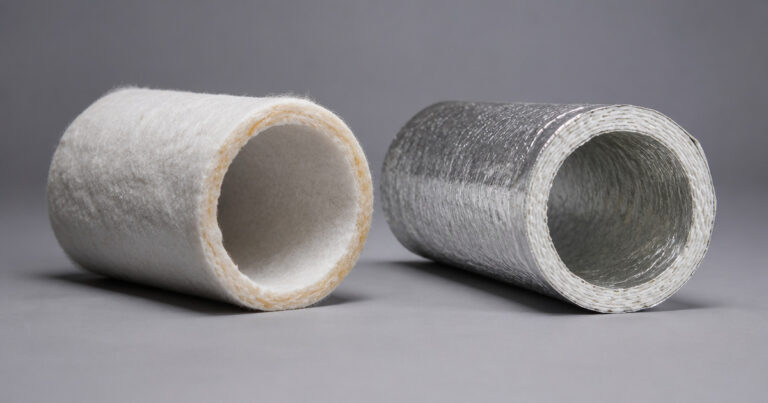
Choosing between a felt vs fiberglass CIPP liner is really a conversation about the carrier, not the finished pipe. A cured-in-place pipe (CIPP) is built from two parts: the tube that arrives at site, and the thermoset resin that is forced into it during wet-out. The tube holds the resin while it cures, and the cured tube-and-resin composite becomes the structural pipe. Short answer: polyester felt is the usual carrier for hot-water and steam cure on circular, egg-shaped and irregular gravity sewers, while a glass-fiber reinforced tube is the usual carrier for UV or LED cure and for any line where structural demand or internal pressure is higher.
That is why the tube you select is a design decision rather than a procurement detail, and why this guide compares both carriers across cure method, resin uptake, thickness, behavior in bends, storage, cost and lead time.
The tube carries the resin; the cured composite carries the load
The load-carrying element of a cured-in-place pipe (CIPP) is the cured wall, not the tube: what resists groundwater, soil and traffic load is resin that has filled the tube and hardened into a composite, while the dry tube has almost no structural value on its own. ASTM F1216 (current revision F1216-24a), the standard practice for rehabilitating pipelines and conduits by the inversion and curing of a resin-impregnated tube, governs that cured wall rather than the dry fabric, and it covers design for both partially deteriorated and fully deteriorated host pipes.
The tube’s job is to hold resin until cure and then to transfer load into the composite, and that job sets four selection questions: how much resin the carrier holds, how evenly the resin fills it, how well the tube follows the host shape, and how much cured strength per millimeter the composite delivers. In our bid reviews, tube selection is treated as a procurement line item far more often than as a design input, and that habit costs a small-diameter lateral contractor and a large-diameter trunk-sewer owner in different ways. Treating the felt vs fiberglass CIPP liner choice as a design input, rather than a procurement line item, is what prevents those problems on site.
What needle-punched felt does in a liner
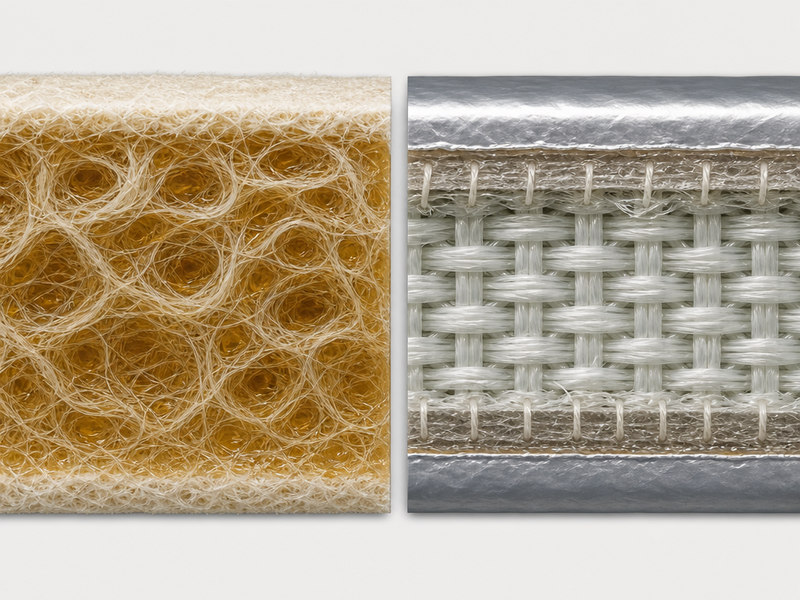
Polyester felt, the needle-punched non-woven polyester mat also called a felt tube or a felt liner, is the classic carrier. Its fibers are needled into a mat with open, connected voids, so it takes up resin the way a sponge does and holds it in those voids until the resin gels. A polyester felt tube is soft and, for the same nominal wall, thicker than a glass-fiber tube, which helps it press against an irregular host wall. Needle-punched felt is the usual carrier for hot-water and steam cure, and it is common on gravity sewers and on egg-shaped or otherwise non-circular hosts.
The rule that governs felt is void volume. The published performance-specification language on CIPP impregnation is direct: the quantity of resin must be sufficient to fill all of the felt voids. Under-filling leaves dry spots and a soft cured wall, while over-filling wastes resin and can create wrinkles. A felt CIPP tube is therefore judged mainly by its resin absorption and its void volume, not by a single tensile number.
What a glass-fiber tube does differently
A glass-fiber reinforced tube replaces much of the felt with stitched or woven glass reinforcement. The glass strands carry tensile and flexural load, so a fiberglass tube can reach a higher tensile and flexural capacity for each millimeter of wall than needle-punched felt can. That is the main reason a fiberglass tube is preferred where structural demand is higher, or where the line is a pressure main that must resist internal pressure as well as external load.
The glass carrier is also the usual tube for UV and LED cure. These tubes arrive wet out from the factory with an inner and outer foil material that keeps the resin in place and lets the light train cure the wall evenly. Pre-liner rule: a UV or LED tube supplied with both its inner and outer foil already provides its own protective membrane, so it needs no separate pre-liner. A felt or steam-cured tube normally needs a pre-liner or an exterior coating, the NASSCO CIPP Installation Performance Specification Guideline (2023) states.
The trade-off is stiffness: a fiberglass tube stretches less, so it is less forgiving in a tight bend and less able to flatten into a non-circular profile.
Felt vs fiberglass CIPP liner: a property-by-property comparison
The table below sets the two carriers side by side on the points that decide a fiberglass pipe lining or a felt lining specification. Read it as a starting point, because site conditions, host condition and the cure method available decide which column wins on any given job.
| العقارات | Needle-punched felt tube | Glass-fiber reinforced tube |
|---|---|---|
| Carrier structure | Needled mat with open, connected voids | Stitched or woven glass reinforcement |
| Resin absorption | High: resin fills the felt voids | Targeted by glass content; the glass, not resin volume, carries the load |
| Tensile and flexural capacity per millimeter of wall | Lower per millimeter; reaches the design wall with more thickness | Higher per millimeter; reaches the same design wall with less thickness |
| Typical cure pairing | Hot water or steam | UV or LED, arriving with inner and outer foil |
| Wall thickness for the same nominal liner | Thicker and more compressible | Thinner and stiffer |
| Bends and non-circular hosts | Conforms and stretches well | Holds its own geometry; intended for straight, circular runs |
| Pre-liner requirement | Pre-liner or exterior coating often used | Foil can replace the separate pre-liner for UV tubes |
| Surface finish after cure | Flexible wall, smooth bore | Rigid wall, very smooth bore |
| Typical applications | Gravity sewers, egg-shaped hosts, laterals | Pressure mains and high-structural-demand UV jobs |
In our lining crews’ logs, the clearest difference between the two carriers shows up during wet-out. Felt takes resin slowly and holds it, while a glass-fiber tube reaches its resin target quickly and then has to be handled on a short window before the initiator begins to work. Neither behavior is a fault; each one simply sets a different rhythm for the crew and a different requirement for site storage.
Which tube pairs with which cure method
Cure method and tube are normally chosen together, because the resin and the tube are supplied as a matched system. Hot water and steam are the traditional pairing with felt, while UV and LED cure are paired with a glass-fiber tube that arrives with foil. A matched UV curing system uses a different initiator package from a steam or water tube, which is why the felt vs fiberglass CIPP liner question usually follows the cure method rather than leading it.
| Host geometry and demand | Cure method | Tube | لماذا |
|---|---|---|---|
| Circular gravity sewer, moderate load | Hot water or steam | Felt | Holds resin for a long wet-out at the lowest material cost |
| Egg-shaped or irregular gravity sewer | Hot water or steam | Felt | Soft mat stretches into a non-circular profile |
| Circular line, higher structural demand | UV light | Glass-fiber reinforced tube | More tensile and flexural capacity per millimeter of wall, confirmed by three-point bending to the ASTM F1216 route |
| Pressure main or industrial line | UV light or hot water | Glass-fiber reinforced tube | Greater hoop and flexural capacity, the property a pressure main must show under internal pressure |
| Short small-diameter lateral | Steam or ambient | Felt | Light equipment and quick small-bore installation |
| Large-diameter trunk sewer | Hot water or steam | Felt, or glass where specified | Conformance and cost matter most at large diameter |

UV curing is the fastest of the field methods. One equipment maker describes a UV light train curing at about one minute per meter of liner, while steam and hot water typically take about one to four hours and ambient cure takes longest. Speed, however, is not the same as suitability, because the method still has to match the tube, the resin and the access available at the site. A UV cured pipe lining is the usual route where the program is tight, and a UV CIPP lining is specified as a matched tube, resin and light-train package.
Thickness, stretch and behavior in bends and non-circular hosts
For the same nominal wall, a felt tube is thicker and more compressible, so it can stretch and fold into an egg-shaped or slightly deformed host and still sit against the wall. That is why the felt vs fiberglass CIPP liner decision often turns on host geometry rather than on strength: an irregular or non-circular host usually points to felt.
A fiberglass tube is thinner for the same cured strength and stretches less. On a long, straight, circular run that is an advantage, because less stretch means more predictable installed thickness. In a tight bend or a sharply oval host it becomes a constraint, because the stitched glass will not distort as far before it wrinkles or bridges. Where a line is both structural and irregular, engineers sometimes resolve the conflict by segmenting the job or by accepting a thicker felt wall with a higher resin content.
On the CCTV inspection records we review after lining, the smoothest bores tend to appear where the tube matched the host profile, not where the strongest tube was used. A stiff tube forced into a shape it does not want to hold can leave a wrinkle or a bridge that reduces the bore and catches debris.
Resin uptake, void volume and wet-out control
The resin capacity of a felt tube is set by its void volume, the open space between fibers that the resin has to fill. A dense felt holds less resin per millimeter and a looser, needled felt holds more, and the wet-out target is set per tube from that void volume rather than by one figure for all felt. For a glass-fiber tube, resin absorption is lower because the glass reinforcement is not built to soak up resin the way a needled mat is; the tube’s strength comes from the glass, not from the volume of resin it carries.
Our wet-out records show the two carriers failing in opposite ways. A felt tube that is wet out too quickly can show dry patches that a cure log alone will not catch, and a glass-fiber tube that sits too long before cure can begin to set inside the tube. Both risks are controlled by following the manufacturer’s wet-out and cure instructions and by recording resin type, quantity and cure details on the wet-out and cure logs that a CIPP specification requires. The NASSCO guideline (2023) treats wet-out and installation as skilled work, expecting the crew to hold three years of documented experience in pipe of similar size and configuration.
Handling and storage: inhibited resin and refrigeration
A wet-out tube is a chemical product with a clock attached. The resin is inhibited so that it does not set during transport and installation, and the inhibitor buys a working window rather than unlimited time. Felt tubes are often wet out on site shortly before installation, which keeps the window short and the logistics simple. Glass-fiber UV tubes are typically wet out at the factory and shipped with the foil in place, so they need controlled storage, in practice refrigeration, to hold the resin until the light train cures it.
Our field teams record storage temperature and the time each tube spends out of refrigeration, because a glass-fiber tube stored warm can begin to cure before it ever reaches the pipe. The felt vs fiberglass CIPP liner choice is clearest on storage: felt is kept clean and dry as a roll before wet-out, while a glass-fiber tube is a refrigerated, time-limited product from the moment it leaves the factory.
Cost, lead time and where tube choice cannot help
For a municipal owner renewing an egg-shaped Victorian sewer, tube cost and lead time decide as much as strength does; for an industrial operator on a pressure main, the same tube competes on hoop capacity and refrigerated logistics. Felt is a low-cost, widely produced material, so a felt tube is usually the cheaper option and is often available on a short lead time. A glass-fiber tube carries the added cost of the glass reinforcement and of factory wet-out, foil and refrigerated logistics, and its lead time is longer because it is built and shipped as a matched UV system rather than wet out on site.
Cost, though, is not the whole equation. A tube that is cheaper per meter but needs a pre-liner, or that narrows the cure methods you can use, can cost more once access, bypass pumping and program time are counted. Published US trade ranges for CIPP lining as a whole are wide, and diameter, host condition, depth, access, groundwater, bypass needs and reinstatement drive the number far more than the tube name does, so any figure should be read as a published range rather than a quotation.
Applicability comes before selection. Tube choice can only help where the host pipe still holds its basic shape and its structural continuity; where the section is collapsed, severely deformed or missing, lining is the wrong tool and open-cut replacement is the option. Two things are then checked rather than assumed: gradient, because the liner reproduces the existing line and level, so a sagging or back-graded sewer stays sagging whatever carrier is selected; and flow capacity, because the finished bore is smaller by roughly the wall thickness plus any annular gap the design assumes.
Frequently asked questions about felt and fiberglass liners
Is a felt or fiberglass CIPP liner stronger?
A glass-fiber reinforced tube is stronger for the same wall thickness. The woven or stitched glass carries more tensile and flexural load per millimeter than needle-punched felt, so where structural demand is high a glass-fiber tube is the usual choice; it is the cured tube-and-resin composite, not the dry tube, that carries that load. Felt can still be designed to carry the same load by using a thicker wall.
Which tube is paired with UV light?
UV curing normally uses a glass-fiber reinforced tube. These tubes arrive wet out from the factory with an inner and outer foil that lets the light train cure the wall evenly, and the foil means a separate pre-liner is not required. A tube intended for UV light also uses a different initiator package from a steam or water tube.
Can a CIPP tube be used in an egg-shaped sewer?
Yes, and an egg-shaped host usually points to a felt tube. Needle-punched polyester felt is softer and stretches further, so it conforms to a non-circular profile better than a stiff glass-fiber tube. A glass-fiber tube can serve some non-circular hosts, but it is less forgiving in a sharp change of section.
How much resin does a felt liner absorb?
Enough to fill all of the felt voids. The void volume of the felt sets the resin target, and the quantity of resin must be sufficient to fill all of the felt voids. A looser, needled felt holds more resin and a denser felt holds less, and the wet-out log records the resin quantity actually used.
Do CIPP tubes need refrigeration?
Glass-fiber UV tubes usually do, while felt tubes usually do not. A factory wet-out glass-fiber tube is shipped with foil in place and must be kept cool to hold the resin until cure. Felt is typically wet out on site just before installation, so refrigeration is usually not part of the felt route.
Is a glass-fiber tube always better?
No, the choice depends on site conditions. A glass-fiber tube offers more strength per millimeter and pairs with UV cure, but felt is lower in cost, easier to store and better at conforming to irregular and non-circular hosts. Neither carrier is universally better.
النقاط الرئيسية
- The tube is the carrier of the resin; the cured tube-plus-resin composite is the structural pipe, so the felt vs fiberglass CIPP liner choice is a design decision.
- Needle-punched felt holds resin in its voids, is thicker and more compressible for the same wall, and normally pairs with hot-water or steam cure.
- A glass-fiber reinforced tube carries more tensile and flexural load per millimeter, and normally pairs with UV or LED cure using a tube that arrives with inner and outer foil.
- Match the tube to the host geometry first: irregular and non-circular hosts favor felt, while higher structural demand and pressure mains favor glass.
- Felt is usually cheaper and easier to store, while a glass-fiber UV tube is a refrigerated, time-limited product with a longer lead time.
- Tube choice cannot correct lost gradient or rescue a collapsed or missing section, so host condition is always checked before selection.
How JSW Supports Liner Selection and Installation
JSW is a pipeline engineering and construction company that executes trenchless rehabilitation with its own crews and equipment. Our scope covers pipe restoration solutions, inserted hose lining, pipeline repair services و trenchless technologies, matched to the carrier, resin and cure method each job needs. We select the tube after a CCTV condition survey and a design check, not before.
Our process is auditable end to end: CCTV before and after, wet-out and cure logs for every liner, and samples and test records retained for the owner. We quote with the site risks stated, so bypass pumping, access and reinstatement are visible instead of discovered later.
- Integrated delivery: one team for survey, cleaning, tube selection, wet-out, installation, cure and service reinstatement.
- Auditable process data: CCTV records, wet-out and cure logs, and material test documentation on file.
- Risk-explicit pricing: bypass, access and reinstatement identified before the bid, not after award.
- Safety and compliance: styrene and odor controls, and certified crews, applied as a standard part of the site plan.
Not sure whether your line needs a felt or glass-fiber tube? Send your pipe size, material and the latest CCTV survey for a free technical review. Our engineers respond with a scoped recommendation and a budget range.





































 English
  Arabic
  Russian
  Spanish
  French
  Vietnamese
  Polish
  Thai
Thai  Indonesian
  Turkish
  Portuguese