
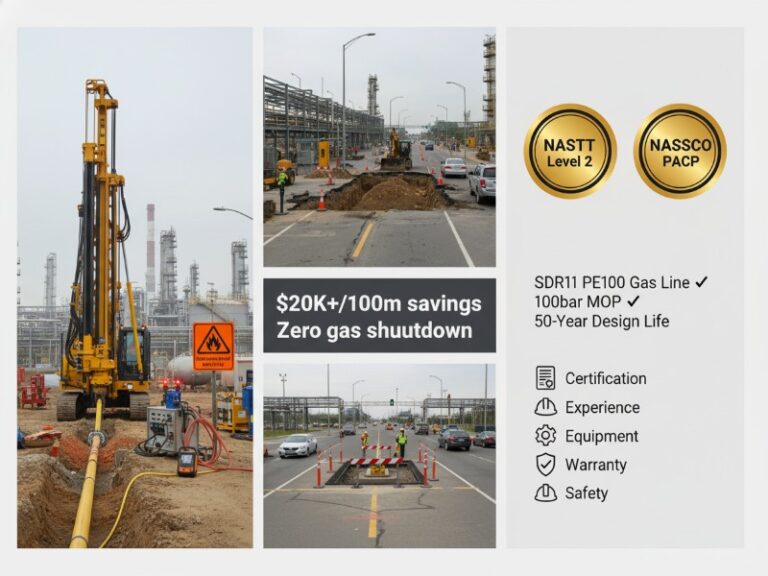
Trenchless contractor selection requires verifying 5 critical factors: NASTT/NASSCO certifications, project-specific experience (CIPP vs pipe bursting), documented quality control, 50-year warranty terms, and OSHA safety records (EMR below 1.0). This checklist prevents 30-50% cost overruns from poor contractor performance and ensures your pipe rehabilitation project stays on schedule.
Selecting the right trenchless contractor determines whether your cured-in-place pipe (CIPP) lining lasts 50 years or fails within five. Unlike traditional excavation where mistakes are visible, trenchless installation errors hide underground—wrinkled liners, incompletely cured resin, or missed lateral connections only surface years later. This guide covers certification verification, pipe material matching, cost comparison matrices, contract safeguards, and red flag identification.
1. Which Certifications Prove Trenchless Expertise? (NASTT vs NASSCO)
Two organizations set the global standards for trenchless contractor qualifications. Understanding their distinct focuses helps you ask the right verification questions.
NASTT Certification Focus
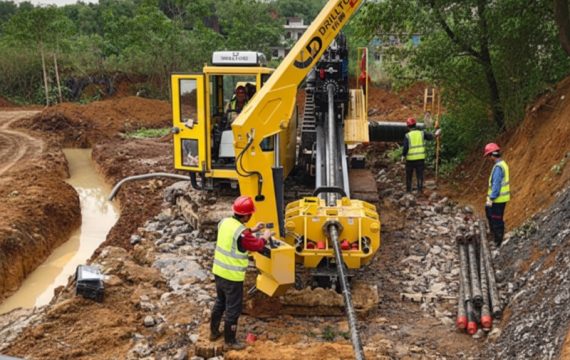
The North American Society for Trenchless Technology (NASTT) offers certification programs covering installation methods including horizontal directional drilling (HDD), pipe jacking, and microtunneling. NASTT Level 2 certification is required for contractors performing CIPP lining on municipal projects. Level 1 certification indicates basic competency but insufficient for complex installations.
NASSCO PACP Certification Focus
The National Association of Sewer Service Companies (NASSCO) Pipeline Assessment Certification Program (PACP) certifies inspection quality using standardized defect coding. A NASSCO PACP certified contractor follows consistent protocols for identifying cracks, joints, offsets, roots, and corrosion levels. This certification matters because inconsistent inspection data leads to incorrect method selection. The NASSCO Bypass Specialist Defect Identification (BSDI) certification is increasingly required for quality assurance, with recertification mandatory every three years.
Contractor Capability Matrix
| Certification | تبطين CIPP | تكسير الأنابيب | محرك الأقراص الصلبة | Epoxy Coating |
|---|---|---|---|---|
| NASTT Level 2 | مطلوب | مطلوب | مطلوب | موصى به |
| NASSCO PACP | مطلوب | اختياري | اختياري | مطلوب |
| Minimum Projects (3 yrs) | 10+ | 15+ | 20+ | 8+ |
| Typical Warranty | 50 years | 50 years | 25 years | 25 years |
| EMR Requirement | Below 1.0 | Below 0.9 | Below 0.8 | Below 1.0 |
EMR = Experience Modification Rate, an OSHA safety metric where lower numbers indicate better safety records.
Verification Steps
Ask the contractor for their NASTT certificate number and NASSCO PACP card. Verify active status with each organization directly. For municipal projects, check participation in third-party prequalification programs like the Water Environment Federation (WEF) Qualified Products List. Contractors who invest in ongoing crew training in epoxy systems and CIPP lining demonstrate commitment to quality installation.
2. How Do You Verify Pipe Material Experience?
Trenchless methods are highly material-specific. A contractor experienced with 8-inch PVC municipal sewers may lack expertise for 4-inch cast iron building drains. You need experience verification matching your exact pipe material, diameter, and condition.
Pipe Material Experience Requirements
| Pipe Material | الطريقة الموصى بها | Contractor Experience Needed | Typical Challenges |
|---|---|---|---|
| Clay Tile | تبطين CIPP | 20+ installations | Root intrusion, joint gaps, egg-shaped deformation |
| Cast Iron | Epoxy Coating + CIPP | 15+ installations | Corrosion pitting, tuberculation, graphitization |
| PVC | تكسير الأنابيب | 10+ upsizing jobs | Ovality correction, fusion joint separation |
| Orangeburg (bituminized fiber) | Full-Length CIPP | 25+ historic pipe jobs | Complete collapse risk, water absorption damage |
| Concrete | Pipe Bursting + CIPP | 12+ installations | Reinforcement interference, aggregate exposure |
| HDPE | Pipe Bursting only | 20+ friction weld jobs | Fusion joint integrity, bend radius limits |
Key Questions to Ask
Request examples of past projects on your specific material. Ask about their experience with your diameter range (under 4 inches, 4-8 inches, 8-12 inches, or over 12 inches). Request references for similar applications—occupied buildings, busy commercial streets, railroad crossings, or sensitive environmental areas near wetlands.
Assessing Their Diagnostic Process
Before any repair, a qualified contractor performs a CCTV inspection using NASSCO PACP coding. Expect a written report with defect classification, GPS-located positions, and severity ratings from 1 to 5. This documentation identifies cracks, roots, offsets, corrosion, infiltration points, and remaining wall thickness. The inspection data determines whether CIPP lining, epoxy coating, pipe bursting, or spot repair is appropriate. Contractors who skip or rush this diagnostic step often deliver mismatched solutions that fail within five years.
3. CIPP vs Pipe Bursting: Which Contractor Specialization Matches Your Project?
Two dominant trenchless methods serve different pipe conditions. Understanding which method your project requires helps you select a contractor with relevant specialization rather than a generalist.
CIPP Lining Applications
Cured-in-place pipe (CIPP) lining inserts a resin-saturated felt or fiberglass tube into the existing pipe, then cures it with hot water, steam, or UV light. This method works for pipes with structural cracks, root intrusion, corrosion, and joint separation, provided the host pipe maintains its shape. CIPP requires the existing pipe to be clean and free of obstructions. Maximum diameter for standard CIPP is typically 36 inches, though larger diameters require specialized equipment.
Pipe Bursting Applications
Pipe bursting fractures the existing pipe outward while pulling a new HDPE pipe into place. This method works for collapsed pipes, severely deformed pipes, or projects requiring diameter upsizing (replacing 4-inch with 6-inch). Pipe bursting requires sufficient soil cover (typically 3 feet minimum) and cannot be used under buildings, roadways with shallow cover, or pipes with nearby utilities.
Method Selection Matrix
| حالة الأنابيب | الطريقة الموصى بها | Contractor Experience Needed | Success Rate |
|---|---|---|---|
| Longitudinal cracks only | تبطين CIPP | 10+ liners | 98% |
| Root intrusion moderate | تبطين CIPP | 15+ liners | 95% |
| Joint separation under 1 inch | تبطين CIPP | 12+ liners | 94% |
| Collapse under 30% diameter | CIPP Lining (after cleaning) | 20+ liners | 88% |
| Collapse over 30% diameter | تكسير الأنابيب | 15+ bursts | 96% |
| Pipe deformation (ovaling) | تكسير الأنابيب | 10+ bursts | 92% |
| Upsizing required (add 1-2 inches) | تكسير الأنابيب | 20+ bursts | 97% |
| Severe corrosion with holes | تبطين CIPP | 25+ liners | 91% |
4. What 7 Contract Elements Prevent Cost Overruns?
A professional contract protects both parties. It must clearly define scope, materials, warranties, and contingency plans for unexpected ground conditions.
Essential Contract Elements
The written estimate must specify the exact length of pipe being repaired in linear feet, measured from access point to termination point. The trenchless method (CIPP, epoxy coating, pipe bursting, or combination) must be named, not described generically as trenchless repair. The liner material type (felt, fiberglass, polyester) and resin type (polyester, vinyl ester, epoxy) must be identified by manufacturer and product number. The curing method (hot water, steam, UV light, ambient) and target cure temperature must be stated.
Access point locations and surface restoration responsibility must be assigned to a specific party. The contract must also state which party bears the risk for unforeseen ground conditions—rock, groundwater, contaminated soil, or abandoned utilities—with per-hour rates for delay and equipment standby.
Warranty Requirements
Demand clear warranty terms in writing. Quality trenchless systems are designed for a 50-year service life for CIPP and HDPE liners. Pro-rata warranties of 25-35 years indicate lower-quality resin systems or inexperienced installers. The warranty should cover both materials and workmanship, with no exclusions for normal wear. Ask whether the warranty transfers to future property owners. Understand what voids the warranty—specific cleaning chemicals (drain openers with sulfuric acid), hydrojetting above 4,000 PSI, or future modifications without contractor approval. Reputable contractors provide post-installation CCTV footage as proof of quality and store a copy with warranty documentation.
5. 5 Red Flags That Signal Low-Quality Bids
Choosing the lowest bid often leads to higher long-term costs. Trenchless installation requires precision; mistakes in cleaning, liner insertion, or curing cause wrinkles, incompletely cured resin (soft spots), misaligned laterals, or delamination within three to seven years.
Red Flag List
- Only one method recommended without explaining alternatives. A competent contractor presents options including CIPP, pipe bursting, epoxy coating, and traditional dig, with pros and cons for each.
- No CCTV inspection offered or footage withheld. Refusing to share pre-installation and post-installation video indicates something to hide. Reputable contractors provide both.
- Extremely low bid (more than 25% below average). This may indicate insufficient insurance (general liability below $2 million), lack of proper equipment (renting gear unfamiliar to crew), no warranty coverage, or unlicensed operation.
- Vague material specifications like premium resin or industrial grade liner without manufacturer names. Quality contractors specify exact products from established manufacturers.
- Pressured timeline demands requiring deposit before providing written inspection results. Professional contractors wait for diagnostic data before quoting.
Total Project Cost Comparison (100 Linear Feet, 8-Inch Sewer)
| عامل التكلفة | Traditional Dig | تبطين CIPP | تكسير الأنابيب | Savings vs Dig |
|---|---|---|---|---|
| Mobilization | $2,500 | $4,000 | $4,500 | -$1,500 to -$2,000 |
| Pipe Installation | $8,000 | $12,000 | $10,000 | -$2,000 to -$4,000 |
| Surface Restoration | $15,000 | $1,500 | $2,000 | +$13,000 to +$13,500 |
| Business Interruption (per day) | $5,000 | $500 | $750 | +$4,250 to +$4,500 |
| Permits & Traffic Control | $3,000 | $1,500 | $1,500 | +$1,500 |
| Contingency (15% of install) | $1,575 | $2,475 | $2,175 | -$600 to -$900 |
| TOTAL (3-day project) | $45,575 | $23,975 | $24,925 | +$20,650 to +$21,600 (47-48%) |
*CIPP saves approximately $20,650-$21,600 per 100 linear feet compared to traditional dig-and-replace after accounting for restoration and interruption costs.*
FAQ: Trenchless Contractor Selection
Q: What’s the difference between NASTT and NASSCO certification?
A: NASTT certifies installation methods including HDD, pipe jacking, and CIPP lining. NASSCO PACP certifies inspection quality using standardized defect coding for CCTV assessment. Both are required for comprehensive contractor verification.
Q: How do I know if a contractor can handle collapsed pipe?
A: Require pre-installation flow testing plus CCTV inspection. Collapse exceeding 30% of diameter typically requires spot excavation and pipe replacement before CIPP lining can proceed. Pipe bursting may work for complete collapses.
Q: What warranty terms are industry standard?
A: 50-year material plus workmanship for CIPP and HDPE liners represents industry best practice. Pro-rata warranties of 25-35 years indicate lower-quality resin systems and should be negotiated upward.
Q: Can any plumber perform trenchless pipe repair?
A: No. Trenchless repair requires specialized training in resin chemistry calculation, inversion or pull-in-place equipment setup, and curing temperature monitoring. Choose contractors with documented NASTT Level 2 or NASSCO certifications.
Q: How long does trenchless pipe lining installation take?
A: A typical 100-foot residential sewer line requires 1-2 days including cleaning, CCTV inspection, liner insertion, curing, and final inspection. Commercial projects with multiple laterals may require 3-5 days.
Q: Is trenchless repair more expensive than traditional digging?
A: Upfront cost per foot is similar (typically $80-$150 per foot for both methods). Total project cost is 30-50% lower for trenchless because restoration costs are eliminated or minimized.
Q: What if my pipe has completely collapsed?
A: Severe collapses over 50% of diameter may prevent liner insertion or bursting. In these cases, spot excavation to replace 5-10 feet of collapsed section may be necessary before lining the remaining lengths. A qualified contractor will identify this during pre-bid CCTV inspection.
Q: How do I verify a contractor’s safety record?
A: Request their OSHA 300 log for the past 3 years and their Experience Modification Rate (EMR) certificate. EMR below 1.0 indicates below-average incident rates. EMR below 0.8 indicates excellent safety performance.
Q: What causes CIPP liner failure?
A: The three most common failure modes are incomplete curing (soft spots from insufficient temperature or duration), delamination (poor bonding to host pipe from inadequate cleaning), and wrinkle formation (improper liner insertion causing flow restriction points).
Q: Can CIPP lining be used under buildings?
A: Yes. CIPP requires only small access pits at each end, making it ideal for pipes running under slab foundations, finished basements, or building structures where excavation would require interior demolition.
Q: How do I check if a contractor is properly insured?
A: Request a certificate of insurance showing general liability minimum $2 million aggregate, worker’s compensation, and auto liability. Call the insurance agent listed to verify active coverage without lapse.
Q: What should post-installation inspection show?
A: Final CCTV footage should show a smooth, continuous liner with no visible wrinkles, gaps, or resin pooling. All lateral connections should be reopened (visible as circular openings). The liner should be uniform in color without light or dark spots indicating thickness variation.










 English
  Arabic
  Russian
  Spanish
  French
  Vietnamese
  Polish
  Thai
Thai  Indonesian
  Turkish
  Portuguese