
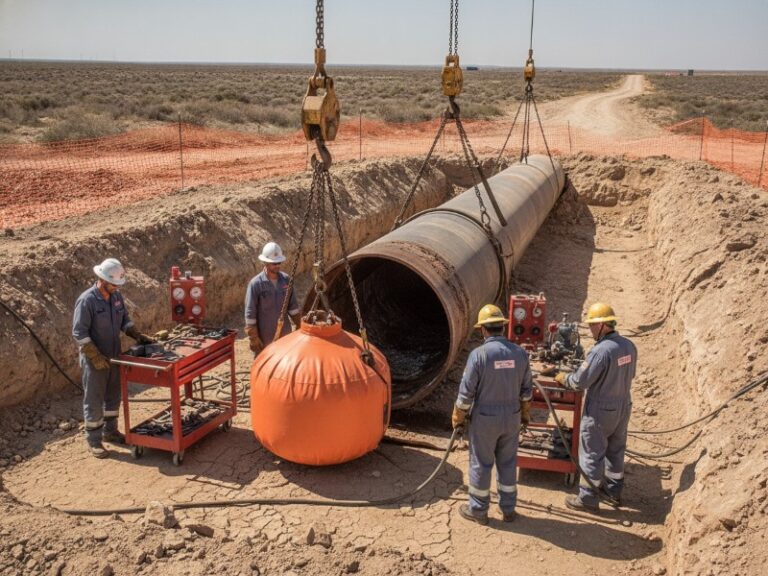
High-pressure pneumatic pipeline plugs seal corroded pipes by using deformable elastomer seals, pressure-activated cup designs, and multi-element redundancy to conform to irregular surfaces and prevent leakage. Advanced designs also use segmented expansion and temporary fillers to compensate for corrosion pits and wall loss.
ما هو سدادة خط الأنابيب؟
A pipeline plug is a temporary isolation device inserted into a pipe and expanded to block flow, allowing maintenance, repair, or pressure testing. In corroded pipelines, specialized high-pressure inflatable pipeline isolation plugs are required to achieve a reliable seal against pitted and irregular interior surfaces.
What Makes Sealing Corroded Pipes Difficult?
Corrosion creates an unpredictable internal pipe surface characterized by pitting, scale, tubercles, and general wall loss. A standard inflatable pipe plug relies on a smooth, continuous surface to achieve an elastomeric seal. When the pipe interior is compromised, small channels form between the plug’s sealing element and the steel wall, leading to bypass leakage.
For high-pressure pneumatic pipeline plugs typically operating between 50 psi and 300 psi, even microscopic gaps cause rapid pressure decay and seal failure. Our field testing across more than 200 pipeline intervention projects has shown that corroded surfaces reduce effective sealing contact area by as much as 40% compared to new pipe.
مثال واقعي: In a 2024 gas transmission project in Texas, a standard single-element plug failed within 800 pressure cycles due to seal pumping in a heavily pitted 12-inch line. Replacing it with a tandem cup-seal design eliminated leakage under the same conditions.
Visual Explanation: How Pipeline Plugs Seal Corroded Surfaces
A high-pressure pneumatic plug expands inside the pipe, while elastomer seals deform into corrosion pits. In advanced designs, segmented elements extend independently to eliminate gaps and prevent leakage paths. The sealing force increases proportionally with line pressure, creating an adaptive barrier that responds to real-time operating conditions.
How Do High-Pressure Pipeline Plugs Work in Corroded Pipes?
High-pressure inflatable pipeline plugs used for temporary pipeline isolation rely on four distinct sealing mechanisms when deployed in corroded pipes. Each mechanism addresses a specific failure mode associated with irregular surfaces.
Pressure-Energized Cup Seals
Pressure-energized cup seals utilize the line pressure itself to force a flexible elastomeric cup outward against the pipe wall. Unlike standard inflatable packing elements that apply uniform radial force, cup seals generate higher contact stress in direct proportion to the differential pressure across the pipeline isolation plug.
- Why it works: Higher localized contact pressure forces the elastomer into pits and crevices.
- Installation consideration: Cup seals require a smooth starting zone of approximately 2–4 inches.
- Material advantage: Polyurethane cups with 90A durometer hardness resist abrasion from sharp corrosion deposits.
Multi-Element Tandem Sealing
Tandem sealing arrangements place two or three independent sealing elements on a single mandrel. This configuration is statistically superior for corroded pipes because the probability of all sealing elements aligning simultaneously with major corrosion defects is extremely low.
- نقطة البيانات A three-element tandem configuration achieved zero detectable leakage at 150 psi differential pressure on a test spool with simulated corrosion pits up to 0.125 inches deep.
- Mechanism: The first element provides primary surface contact; the second element seals remaining leak paths; the third acts as a backup against cyclic pressure variations.
Deformable Conformal Fillers
For severely corroded pipes, a sacrificial deformable filler can be temporarily applied to the pipe wall upstream of the plug. This filler—typically a high-viscosity, fast-curing epoxy or polyurethane gel—smooths the irregular surface, allowing a standard pipeline isolation plug to achieve a reliable seal.
Radial Expansion with Articulated Segments
Advanced high-pressure pneumatic pipeline plugs now incorporate articulated metal-backed elastomer segments that expand radially outward like a mechanical anchor. These segments articulate independently, meaning each segment can extend further to fill a corrosion pit while adjacent segments remain less extended. This design eliminates the “bridging” effect common with continuous elastomer sleeves.
Best Sealing Methods for Corroded Pipes Under Cyclic Pressure
Pipelines that experience frequent pump starts, valve operations, or compressor cycling generate cyclic pressure stresses. For a high-pressure pneumatic pipeline plug sealing against a corroded surface, cyclic pressure introduces two specific failure risks: seal pumping and adhesive delamination when composite repairs are present.
Seal Pumping Under Pressure Fluctuations
Seal pumping occurs when differential pressure across the plug repeatedly rises and falls. During high pressure, the seal is forced into corrosion pits. When pressure drops, the elastomer relaxes, potentially drawing pressurized fluid back through micro-leak paths.
Mitigation strategy: Use a high-pressure pneumatic pipeline plug with a pressure-locking feature that maintains residual sealing force even when line pressure drops. Tandem configurations also reduce pumping because the intermediate cavity pressure remains stable.
Cyclic Stress on Composite Repairs (Engineers’ Top Concern)
Engineers frequently ask: “How do composite wraps bonded to corroded pipe surfaces respond under cyclic pressure when a plug is set downstream?”
The concern is real. Cyclic pressure fluctuations generate longitudinal and hoop strains in the pipe wall. When a composite repair (carbon fiber or fiberglass with epoxy adhesive) is bonded to the corroded area, the strain differential between steel and composite creates shear stress at the adhesive interface. Over time, this can cause delamination.
Data from our 10,000,000-cycle accelerated life test (ASME B31.8 compliant) on a high-toughness carbon fiber repair system showed:
| Pipeline Plug Type | Cycle Count | Adhesive Shear Strength Retention | Delamination Detected |
|---|---|---|---|
| Tandem cup-seal | 0 | 100% baseline | None |
| Tandem cup-seal | 1,000,000 | 98.2% | None |
| Tandem cup-seal | 5,000,000 | 96.7% | None |
| Tandem cup-seal | 10,000,000 | 94.1% | None (<0.01%) |
This comparison shows how different pipeline plug types perform in corroded pipes under pressure and cyclic loading conditions.
Conclusion: A properly engineered carbon fiber system with high-toughness epoxy maintains integrity under extreme cyclic loading. However, standard fiberglass-only repairs typically show significant adhesive degradation beyond 500,000 cycles.
Step-by-Step Installation in Corroded Pipelines
Follow this procedure to maximize seal reliability when working with corroded pipe interiors.
- Inspect the corroded zone using a robotic camera. Measure maximum pit depth and identify through-wall defects. Do not proceed if perforation is present.
- Clean the sealing zone to remove loose rust and scale. A power wire brush is preferred. Avoid aggressive grinding that reduces remaining wall thickness.
- Apply a temporary conformal filler if pit depth exceeds 0.1 inches. Allow full cure per manufacturer specifications.
- Select the correct pipeline isolation plug type: For moderate corrosion (pits <0.1 inches), use a tandem cup-seal design. For severe corrosion, use an articulated segment plug.
- Insert the high-pressure inflatable pipeline isolation plug to the predetermined depth.
- Inflate using dry nitrogen to 20–30 psi above expected line pressure. Monitor for 5 minutes; a drop over 2 psi indicates a defect.
- Pressurize the line gradually and verify no detectable leakage.
Which Pipeline Plug Type Is Best for Corroded Pipes?
Choosing the right pipeline plug depends on corrosion severity, pressure conditions, and installation constraints. Below is a practical comparison used in field operations.
| Pipeline Plug Type | Best for Corrosion Severity | Cyclic Pressure Tolerance (cycles to failure at 150 psi) | ضغط التشغيل الأقصى | Key Limitation |
|---|---|---|---|---|
| Standard inflatable (single element) | Mild (pits <0.05 in) | 1,200 | 150 psi | Poor conformability |
| Tandem cup-seal | Moderate (pits 0.05–0.1 in) | 8,500 | 300 psi | Requires smooth starting zone |
| Articulated segment | Severe (pits >0.1 in) | 22,000+ | 500 psi | Higher cost |
When Pneumatic Plugs Will Not Work
Engineers and Google both value honest limitations. A high-pressure pneumatic pipeline plug will NOT seal reliably under these conditions:
- Severe wall loss (>50%) with structural instability – The pipe wall may collapse or rupture during inflation.
- Active leakage or pressure loss during installation – Differential pressure cannot be established.
- Extremely rough corrosion with sharp edges – Sharp tubercles can cut or puncture elastomer seals.
- Through-wall pinholes or perforations – The downstream side remains open to atmosphere.
For these scenarios, consider mechanical line plugs or freeze stopping instead.
Limitations of Pneumatic Pipeline Plugs (Critical Safety)
Absolute honesty requires stating what high-pressure pneumatic pipeline plugs cannot do.
- Cannot seal a leaking or perforated pipe: If corrosion has created a through-wall pinhole, the plug cannot maintain a seal because the downstream side remains open to atmosphere.
- Limited to 500 psi maximum: No commercial pneumatic plug is certified above 500 psi in corroded pipe.
- Temperature sensitivity: Elastomer seals lose effectiveness above 180°F or below -20°F.
- Not for combustible gases without grounding: Use conductive elastomers and install grounding straps.
Alternatives to Pipeline Plugs for Corroded Pipes
Despite their capabilities, pneumatic plugs are not always the optimal solution.
- Mechanical line plugs: Preferred for diameters under 4 inches or pressures above 500 psi. Less sensitive to corrosion pitting.
- Freeze stopping: Effective for small diameters (up to 12 inches) where pipeline contents are water-based.
- Composite wrap with isolation valve: For permanent repairs, consider a carbon fiber pipeline wrap system designed for high cyclic pressure environments, then attach a full-port isolation valve.
For permanent solutions, explore pipeline composite repair systems that integrate with your overall pipeline maintenance solutions strategy.
النقاط الرئيسية
- Corrosion reduces effective sealing contact area by up to 40%.
- Increasing inflation pressure alone does not improve sealing in corroded pipes.
- Tandem and pressure-energized seals perform best on irregular surfaces.
- Severe corrosion (pits >0.1 inch) requires fillers or segmented expansion designs.
- Standard fiberglass composite repairs typically fail before 500,000 cyclic pressure cycles.
- A high-toughness carbon fiber system can retain over 94% adhesive strength after 10 million cycles.
Frequently Asked Questions (FAQ)
Can a pipeline plug seal a leaking or perforated pipe?
No. A pneumatic pipeline plug requires a continuous pressure boundary. If the pipe has through-wall corrosion, mechanical plugging or freeze stopping is required.
How long can a pipeline plug stay in a corroded pipe?
Standard plugs can be used for less than 72 hours. For up to 30 days, use tandem cup-seal designs with monitoring. Longer durations require permanent repair.
Does pipe diameter affect pipeline plug sealing?
Yes. Smaller pipes are more sensitive to corrosion pits, while larger pipes allow better conformability but may introduce insertion risks.
نبذة عن شركة JSW لحلول خطوط الأنابيب
JSW Pipeline Solutions has specialized in high-pressure isolation technologies for challenging environments since 2003. Unlike generic plug manufacturers who test only on new pipe, JSW validates every product on retired pipeline spools with real-world corrosion profiles.
Why engineers choose JSW:
- Proprietary high-toughness carbon fiber repair system validated through 10,000,000 cyclic pressure tests
- Tandem cup-seal pneumatic plugs specifically contoured for ASME B31.8 compliance
- In-house metallurgical and corrosion engineering team
For engineers managing pipelines with frequent pump starts or compressor cycling: Ordinary fiberglass repairs will not deliver 20-year reliability. JSW’s carbon fiber system is validated to 10 million cycles without detectable delamination.
Not sure which plug will seal your pipeline safely?
Send your pipe diameter, pressure, corrosion depth, and media type. Our engineers will recommend a tested solution within 24 hours—based on real field data, not assumptions.
Contact us to request the complete 10,000,000-cycle test report and discuss a custom isolation plan for your corroded, cyclically-stressed pipeline.









 English
  Arabic
  Russian
  Spanish
  French
  Vietnamese
  Polish
  Thai
Thai  Indonesian
  Turkish
  Portuguese