
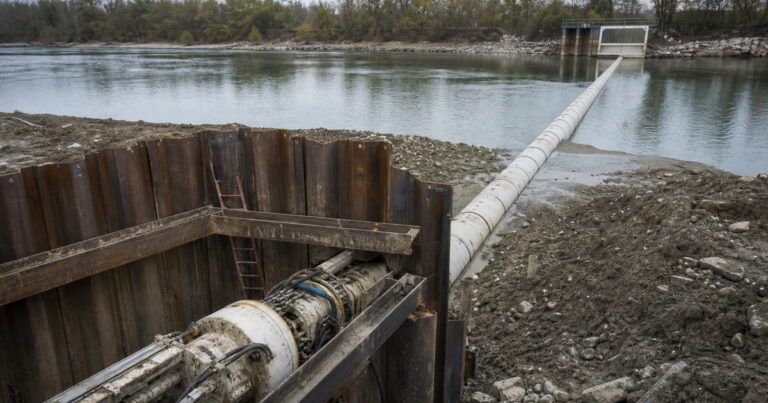
Microtunneling for water mains places a pressure pipeline and its terminal structures beneath a river, lake or estuary without dewatering the ground or building a cofferdam in the water. The method works because a microtunneling machine (MTBM) holds a hydrostatic counterbalance even when it is stopped, so the face stays supported under a riverbed. This guide covers that mechanism, the pressure pipe involved, subaqueous break-in and machine recovery, burial depth for scour and buoyancy, the in-water permit chain and the risks worth pricing.
Why does microtunneling for water mains suit water crossings better than open-face methods?
Open-face methods assume the ground at the face will stand long enough to be worked and that water can be kept out by pumping. Under a river, both assumptions fail together. A microtunneling machine supports the face with a pressurized medium and balances the hydrostatic pressure against it, which is why microtunneling for water mains is chosen where an open shield would flood.
The balance holds whether the machine is cutting or at a standstill. Drives stop for cutterhead changes and maintenance, so a face that holds only while the pumps run is not supported, and on river crossings the machine is kept closed and pressurized from launch to break-in.
Machine type follows the ground, and that selection is the first thing a bid review tests.
- Slurry shield: high groundwater pressure, sands and gravels.
- EPB shield: cohesive soils with low water content.
- Face support: held during cutting and during stops.
- Annular grouting: fills the overcut so the ground carries the load.
How does a pressure pipe behave inside a jacked lining?
A water transmission main is a pressure system, so its profile need not fall continuously the way a gravity sewer must. That freedom helps across a river, where the alignment dives under the bed and climbs to a connection on the far bank. Pressure class, thrust restraint and air control replace grade as the governing geometry.
For microtunneling for water mains, the jacked tunnel and the pressure carrier are usually two distinct items. The tunnel provides a straight, stable envelope; the carrier inside it is specified and tested on its own terms, so keeping that split explicit in the contract avoids a common dispute about which party owns a leak.
Which pipe materials and pressure classes apply?
Steel pipe to AWWA C200 is widely used for large-diameter, high-pressure transmission and for jacking casing, because it tolerates internal pressure and jacking loads. Reinforced concrete pressure pipe to AWWA C300 and C301 is an alternative for large mains. AWWA C900, C905 and C906 cover PVC and PE4710 HDPE, while ductile iron is governed by AWWA C150 and C151. The jacked tunnel itself is normally reinforced concrete jacking pipe to ASTM C76 or EN 1916.
Why does alignment still matter in a pressure main?
Alignment matters less than in a gravity sewer, but it still matters. Local high points collect air, air pockets raise head loss and amplify surge, and cover governs whether the carrier can be inserted. In our bid reviews, a main is lost not on straight runs but at the tie-in, the connection to an intake or outfall, and the turn in the profile.
How do you build intakes and outfalls below the water table?
Most intake structures sit below water, either beneath a riverbed or below the water surface itself. That condition defeats an open-face machine, because the face is connected to a large body of water at a real head. A closed and pressurized machine is therefore the default tool, which is why microtunneling for water mains appears so often at these terminal structures.
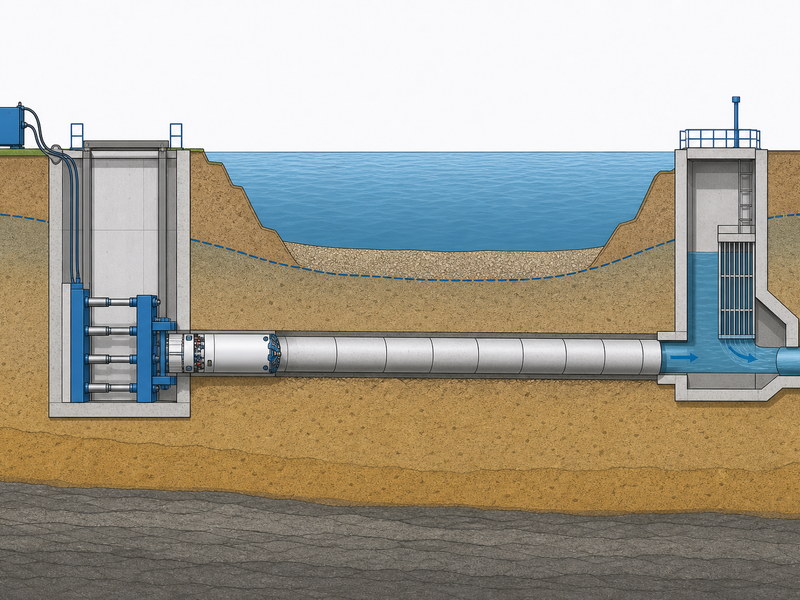
How does hydrostatic counterbalance replace dewatering?
The machine holds a support pressure at the face matched to the local hydrostatic pressure, so groundwater does not flow toward the face and carry ground with it. Because that pressure comes from the machine, it is available while stopped as well as while cutting, so no wellpoint system and no cofferdam is required. Slurry pressure is matched to permeability, a filter cake limits seepage, and the annular gap is grouted promptly.
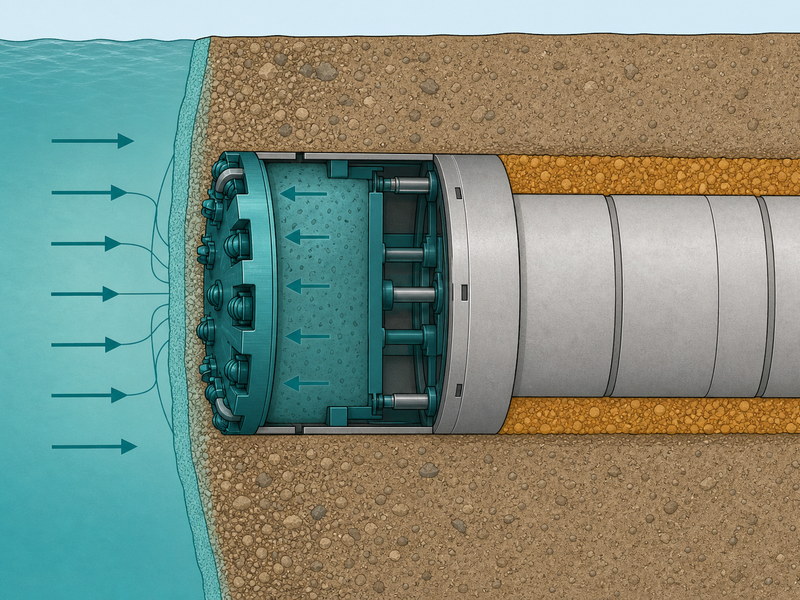
What happens at break-in when a microtunneling machine arrives under water at the receiving shaft?
Break-in is the highest-risk moment of a submerged drive. The machine and pipe string carry the full friction load, face support must be removed in a controlled way, and inflow must be managed without washing ground into the opening. The machine is normally recovered into a prepared reception with a guide frame and a seal. On a large-diameter machine the man-access door is more than 60 in. wide, and that dimension decides whether a cutter change can be done from inside.
What detail decides whether an outfall diffuser works?
A diffuser is the terminal section of an outfall, where flow is released through a series of ports so that it mixes with the receiving water and loses velocity. The diffuser and its ports are spaced and sized to distribute flow, and on a microtunneling for water mains drive the structure is oriented to discharge into the mixing zone the permit allows. It also has to survive internal and external pressure, buoyancy when empty and scour, so anchoring, ballast and protection are designed with it.
Public projects show how much of this work is terminal detail rather than long tunnel. A California project near Tracy involved roughly 18,000 lf of 42 in. outfall, including a 680 lf microtunneling section beneath Paradise Cut, with a new diffuser built at Old River about 800 ft west of the existing one. The relocation, not the tunnel length, met the discharge requirement.
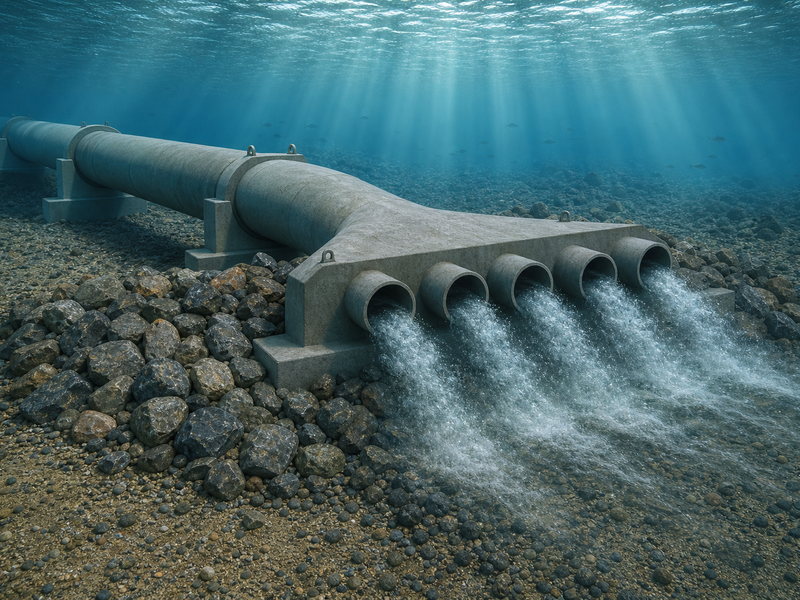
Cover, scour and buoyancy: how deep does the pipeline need to be?
For microtunneling for water mains beneath a riverbed, cover is the outcome of three checks. The pipeline must sit below the design scour depth, resist uplift when empty, and be deep enough that anchors and protection can be placed.
- Scour: set cover below the design scour depth for the flood event the owner adopts.
- Buoyancy: check the empty pipe against uplift and add ballast or anchors.
- Protection: riprap, rock or mattresses where the bed is mobile and cover is thin.
These checks pull in different directions: deeper cover increases the depth of the shafts, while shallow cover risks exposure. Scour normally governs an outfall in a mobile bed, while buoyancy tends to govern a large empty water transmission main under a high water table, so the controlling case should be stated rather than generalised.
On the water transmission main crossings we have priced, the three checks above rarely agree: the scour depth that satisfies the bed is usually deeper than the cover the river authority will permit, and the design basis has to say which one governs.
Which permits gate an in-water microtunneling crossing?
In-water work carries a layered approval chain, and the construction method does not remove it. The chain comes down to a short list that the owner and the contractor both have to clear.
- USACE Section 404 of the Clean Water Act: governs discharge of dredged or fill material into waters of the United States.
- State water quality certification: normally required alongside the federal permit.
- NEPA review: applies where a federal permit, federal funding or federal land puts the crossing inside a federal action.
- State fish and wildlife alteration agreement: often needed where the crossing disturbs a state-regulated stream, wetland or shellfish bed.
- Navigable waters approval: may add conditions on the channel.
- Drinking water source protection: applies where an intake draws from a protected supply.
The practical consequence for microtunneling for water mains is that the environmental work window, not the construction method, usually sets the calendar, so a drive that could be executed in three months may be confined to a narrow in-water season. Because the tunnel is built from the banks, the area of in-water disturbance is also far smaller than open-cut placement of an outfall.
How do a transmission main and an outfall differ in requirements?
Both are pressure water systems, but they are designed to different governing cases. Table 1 sets the two side by side, and it is the comparison we use when a specification treats them as one scope.
| المعيار | Transmission main | Outfall structure |
|---|---|---|
| Primary function | Convey water under pressure | Release flow into receiving water |
| Governing hydraulic case | Peak demand, surge and friction head | Port velocity, mixing and dilution |
| Profile freedom | May rise and fall; air control at crests | Fixed by bed, mixing zone and cover |
| Typical carrier | Steel to AWWA C200, concrete pressure pipe | Steel or concrete pressure pipe |
| Controlling external case | Ground and water pressure in tunnel | Scour, buoyancy and impact at the bed |
| Terminal structure | Connection to existing main or intake | Multi-port outlet with anchors |
| Permit emphasis | Crossing and waterbody works | Discharge, mixing zone and habitat |
| Acceptance test | Hydrostatic pressure test | Pressure test plus survey of the outlet |
How far can a water main drive go at each diameter?
Drive length and diameter move together, and river crossings sit at the long end of the range because shafts are expensive and are pushed to the banks. Table 2 gives indicative drive lengths by internal diameter, based on the Pipe Jacking Association figures most bid teams use.
| Internal diameter (m) | Indicative drive length (m) | تعليق |
|---|---|---|
| 0.9 | 200 | Short crossings; interjack rarely needed |
| 1.2 | 450 | Lubrication strategy begins to matter |
| 1.5 | 700 | Common large transmission range |
| 1.8 | 900 | Long river crossings |
| 2.4 | 2,000 | Very long drives with risk analysis |
Drive length is capped by jacking force, and jacking force in turn depends on friction, lubrication and how many intermediate jacking stations are installed. Skin friction on the pipe string usually runs at 0.5 to 2.5 t/m² of external circumferential area; lubrication can bring that down to about 0.1 t/m². On drives longer than about 300 m, or where curvature is significant, these stations are the main tool for relieving jacking force.
Long drives are also a North American trend. Published industry figures put the North American single-drive record at 475 m in 1989 and 930 m in 2008, and note that drives over 1,000 m have become common, which is what makes single drives between bank shafts realistic rather than exceptional.
Public crossings make the same point at scale. Minneapolis has seven major water mains crossing the Mississippi, some suspended on bridges and some laid in trenches in the riverbed, which shows how many separate solutions one river can demand. A 54 in. transmission main crossing the American River was driven as a single 1,410 ft, 54 in. drive from a main shaft of 28 ft diameter and 79 ft depth, a concrete caisson, to a receiving shaft of 20 ft inside diameter and 74 ft depth excavated by auger. Neither crossing is a JSW project; both appear here because the records are public, and each is sized to keep the work out of the channel.
What goes wrong on a submerged or near-shore drive?
The risks on a submerged drive are a short list, but each has a large consequence because recovery under water is difficult. Naming them in the bid is cheaper than meeting them in the field.
What happens if the drive loses face pressure under a river?
- Face instability: pressure not matched to permeability; control by slurry pressure and prompt grouting.
- Break-in inflow: uncontrolled water at receipt; control by a prepared reception and seal.
- Buoyancy of the empty main: uplift during installation; control by ballast and staged flooding.
- Scour at the outfall: bed movement exposing the pipeline; control by deeper cover and rock.
- Permit window: in-water season closes mid-drive; control by sequencing and early break-in.
- Jacking force: friction underestimated; control by lubrication and intermediate stations.
On microtunneling for water mains drives near the shore, we have found that the schedule risk sits almost entirely in the window and the break-in, not in the tunnelling itself.
Frequently asked questions (FAQ)
Can microtunneling for water mains avoid dewatering and cofferdams?
Yes, in most subaqueous settings, because a microtunneling machine holds a hydrostatic counterbalance at the face while it is running and while it is stopped. That balance replaces the need to draw the water table down or to build a cofferdam out into the water. Open-face machines in the same ground would flood, which is why intake and outfall work favours closed, pressurized machines.
Which machine type suits a river crossing?
Slurry machines are the usual choice for high groundwater pressure and granular soils, where the slurry pressure is matched to the permeability of the ground and a filter cake forms against it. Earth pressure balance machines suit cohesive soils with low water content. A mismatch between the machine and the ground is a technical risk, not a preference.
What pipe standards apply to a jacked water transmission main?
Steel pipe to AWWA C200 and reinforced concrete pressure pipe to AWWA C300 and C301 are common carriers, while AWWA C900, C905 and C906 cover PVC and HDPE and AWWA C150 and C151 cover ductile iron. The jacked tunnel itself normally uses reinforced concrete jacking pipe to ASTM C76 or EN 1916. The tunnel and the pressure carrier are separate procurement items.
How deep does an outfall pipeline need to be buried?
Deep enough that scour, buoyancy and anchor design all pass, which is a site-specific calculation rather than a fixed number. Cover is checked against the design scour depth, and the empty pipe is checked against uplift, because a buoyant empty outfall is a hydraulic problem before it is a structural one. Rock, riprap and mattress protection are the usual remedies where scour governs.
What permits are needed for in-water work?
A USACE Section 404 permit, a state water quality certification, NEPA review and a state fish and wildlife alteration agreement are commonly part of the chain. Navigable waters approvals and drinking water source protection requirements may also apply. The environmental work window is usually the binding schedule constraint, not the construction method.
How long can a subaqueous microtunneling drive be?
The published envelope opens at roughly 200 m for a 0.9 m bore and closes at 2,000 m for 2.4 m, with drives beyond 1 km already routine. Drive length is governed by jacking force and friction, with friction typically 0.5 to 2.5 t/m² and as low as 0.1 t/m² with lubrication. Beyond 1 km, published guidance recommends a project-specific risk assessment before the drive is committed.
Key takeaways
- Because a closed, pressurized machine holds a hydrostatic counterbalance while running and while stopped, microtunneling for water mains needs no dewatering and no in-channel cofferdam.
- Slurry machines match high groundwater pressure in granular ground; EPB machines suit cohesive ground with low water content.
- Break-in and machine recovery, not the tunnel itself, carry the highest risk on a submerged drive.
- Cover is set by scour, buoyancy and protection, and the controlling case should be stated rather than generalised.
- The in-water permit chain runs through USACE Section 404, state water quality certification, NEPA and a fish and wildlife alteration agreement, and its window drives the schedule.
- The reach that matters is set by jacking force and lubrication, not by the diameter table alone, so the envelope in Table 2 is a planning input rather than a promise.
How JSW supports water transmission, intake and outfall projects
JSW is a pipeline engineering and construction company that executes trenchless water crossings with its own crews and equipment. Our scope covers microtunneling construction, trenchless technologies, خدمات تركيب خطوط الأنابيب و pipeline repair services, together with pipeline inspection for tie-ins and acceptance. For microtunneling for water mains, intakes and outfalls, our range covers DN300 to DN1500 (12 to 60 in.), with single drives up to 600 m, laser guidance around ±25 mm and installation depths of about 2 to 25 m.
We plan the water-facing details, not only the bore. That means agreeing the break-in method and the recovery plan with the owner before launch, defining cover against the governing scour and buoyancy cases, and aligning the drive calendar with the environmental work window so that permit conditions and construction sequence match.
- Integrated delivery: microtunneling, pipe installation and inspection under one scope.
- Auditable process data: guidance, slurry pressure and grout records available for review.
- Risk-explicit pricing: face stability, break-in and permit-window risks named in the bid.
- Safety and compliance: ISO 9001:2015, ISO 14001:2015 and ISO 45001:2018 certified systems.
Crossing a river or building an intake or outfall? Send your alignment, target diameter and water-body conditions for a free technical review. Our engineers respond with a scoped recommendation and a budget range.





































 English
  Arabic
  Russian
  Spanish
  French
  Vietnamese
  Polish
  Thai
Thai  Indonesian
  Turkish
  Portuguese