
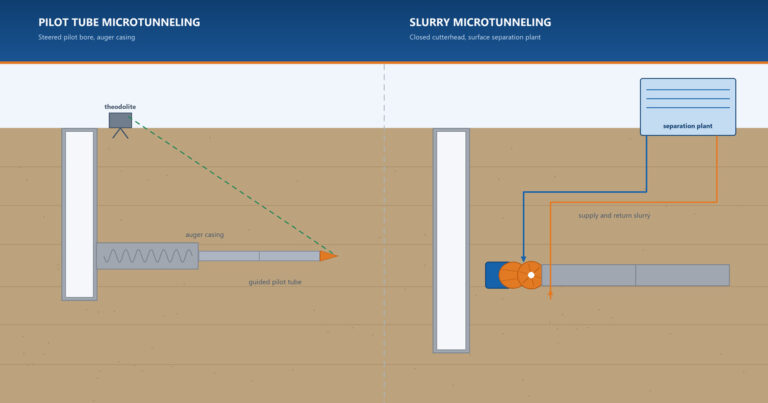
Short answer: the pilot tube system suits small-diameter gravity sewer drives in firm, displaceable ground where a tight grade matters, while the slurry system suits larger-diameter, below-water-table drives in unstable ground that need continuous face support and a surface separation plant.
Pilot tube microtunneling is a guided boring system built around a steered pilot tube and a displacement cutterhead. Its counterpart, the slurry system, holds the tunnel face with pressurised slurry and a surface plant. Both meet the microtunneling criteria in ASCE/CI 36-15, yet they are chosen for different drives. This guide compares the two families on face support, ground suitability, line and grade, diameter and drive length, spoil removal and site footprint, so the choice is made on geology and tolerance rather than on machine availability.
Which Microtunneling Family Are You Choosing Between?
Under the umbrella of microtunneling there are two distinct families, and the family decides the whole method statement. The pilot tube family advances a small guided bore first, then follows it with a casing and a product pipe. The slurry family excavates the full diameter in a single pass behind a pressurised, closed face.
Both families are remote-controlled and both hold a tight line and grade, but they manage the face in different ways. That difference – displacement versus pressure balance – sets the ground each can enter and the equipment each must mobilise.
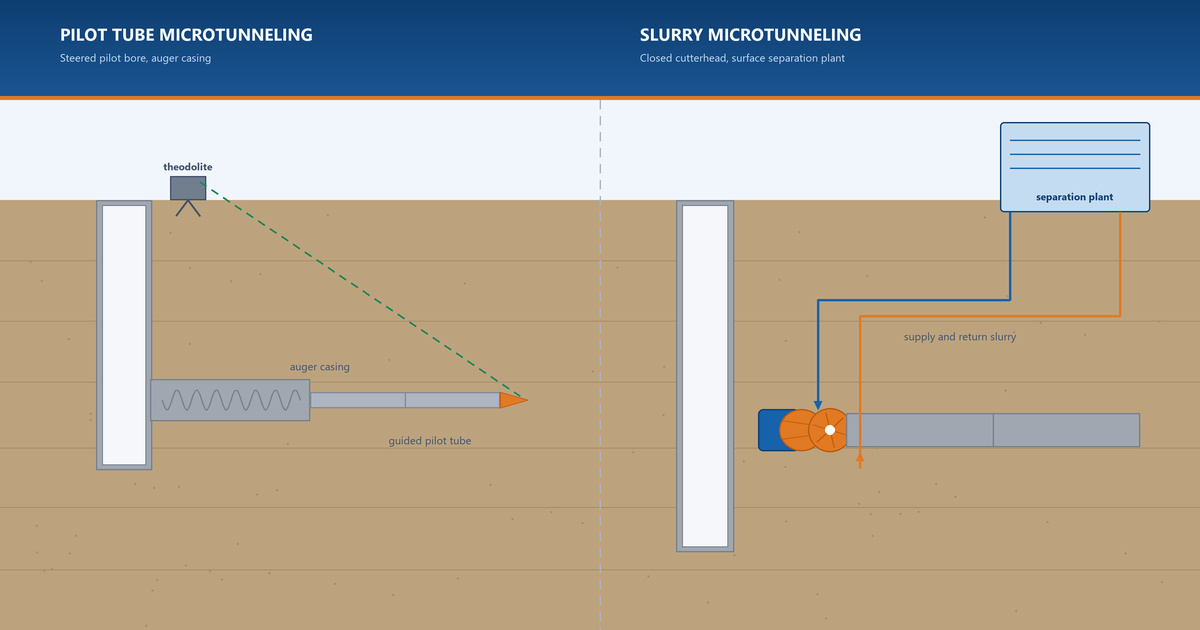
- Pilot tube (guided boring): a theodolite-guided pilot tube sets the line; an auger casing follows; the product pipe is jacked behind it.
- Slurry: a closed cutterhead excavates the full bore while slurry pressure supports the face and carries cuttings to a surface plant.
- Auger microtunneling: a closed family that draws its support from the soil plug held in the auger flights rather than from a pressurised slurry.
For a wider view of how these families sit alongside other trenchless options, see microtunnel vs. HDD vs. direct pipe.
What Makes a Machine Microtunneling? The ASCE/CI 36-15 Three-Criteria Test
Treat the test as a filter, not a subject. Under ASCE/CI 36-15 a machine counts as microtunneling when it jacks the pipe with a remotely controlled machine, holds the line and grade within a stated tolerance, and provides continuous face support.
The pilot tube microtunneling family meets that test through its pre-set pilot bore and the cutterhead that follows, and the slurry family meets it through a pressurised closed face. Both families compared on this page pass that filter, so the choice turns on ground and tolerance rather than on the definition itself. The tolerances and jacking rules that follow from the test are set out in microtunneling vs pipe jacking. Rule: where any one of the three is absent, the drive is specified and priced as traditional pipe jacking rather than microtunneling.
How Pilot Tube Microtunneling Works, Step by Step
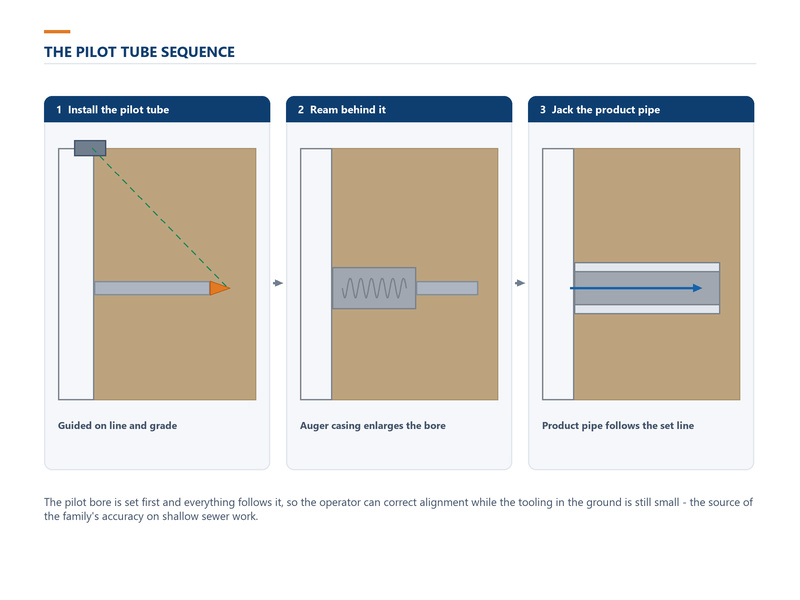
Pilot tube microtunneling breaks a drive into three stages, which is why it can hold a gravity sewer grade so tightly.
- Install the pilot tube. A small guided boring head, steered by a theodolite and target, is jacked on line and grade through the full drive.
- Ream behind it. An auger casing follows the pilot tube, enlarging the bore to the casing diameter; spoil removal is by auger flights.
- Jack the product pipe. The product pipe is pushed into the cased bore behind the auger casing, with the pilot tube fixing the final line.
Because the small pilot bore is set first and everything follows it, the operator can correct alignment while the tooling in the ground is still small. That is the source of the family’s accuracy and of its suitability for shallow sewer work.
How Slurry Microtunneling Works
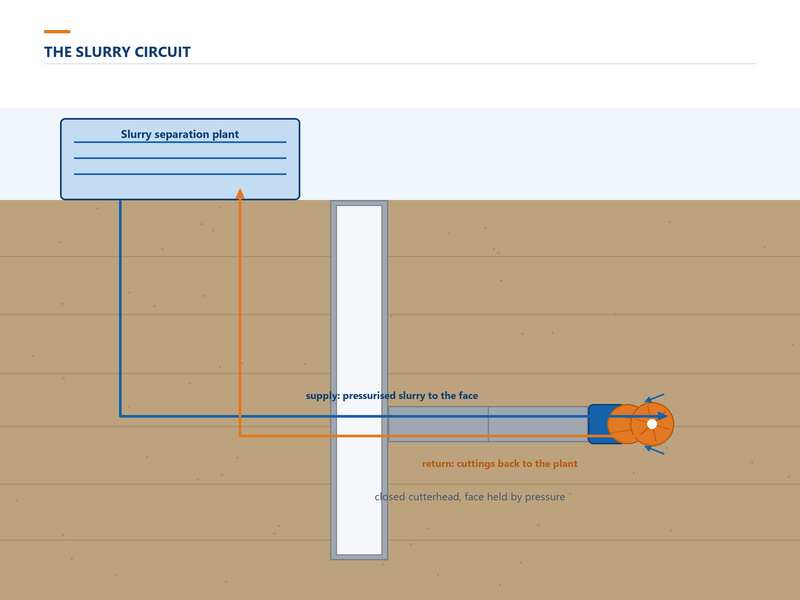
Slurry microtunneling excavates the full face in one pass. A closed cutterhead cuts the ground while a bentonite slurry is pumped to the face, where it provides face support and lifts the cuttings back to the surface.
At the surface, a slurry separation plant cleans the return slurry so it can be recirculated. The plant, not the machine, is often what shapes the site layout and the daily cycle.
- A closed, pressurised face that holds unstable and water-bearing ground
- The pipe jacked behind the machine as the face advances
- A continuous slurry circuit feeding the plant, with spoil removal by settlement and separation
Which Microtunneling System Suits Which Ground?
Ground conditions, not preference, choose the family. Each system fails in a different soil, and a geotechnical report is what separates a design from a guess.
| Ground condition | Pilot tube | Slurry |
|---|---|---|
| Firm clay and silt (displaceable) | Preferred: displacement is efficient | Suitable, but the plant adds cost |
| Loose sand above the water table | Suitable with a casing | Suitable with pressure control |
| Loose, running or water-bearing sand | Limited: displacement is unsafe at the face | Preferred: continuous support holds the face |
| Soft rock and weathered rock | Limited by the pilot tube cutterhead | Suitable with a rock cutterhead |
| Mixed ground with cobbles | Difficult: guidance and displacement suffer | Difficult: tool wear and intervention rise |
The pattern is consistent: the pilot tube family is most effective in firm, displaceable ground above the water table, where a small guided bore can be jacked without disturbing the face. The slurry family is strongest where the ground cannot support itself, because its closed face supports the ground continuously.
A third family, auger microtunneling, sits between them: it draws its support from the soil plug in the auger flights rather than from a pressurised slurry, which suits some firm cohesive soils but limits it in coarse or water-bearing ground.
For how this choice shifts against another method, see microtunneling vs HDD: the key differences.
Applicability: the pilot tube family applies in firm, displaceable ground above the water table. Where loose running sand sits below the water table, specify a closed-face slurry machine.
In our drives, that is the single condition that most often moves a drive from one family to the other.
Bottom line: firm, displaceable ground favours the pilot tube family; unstable or water-bearing ground favours the slurry family.
Which System Holds Grade Better?
For most gravity sewer drives the two systems are close, but pilot tube microtunneling is normally the tighter of the two, because its guided pilot bore is set with a theodolite before any full-diameter tooling enters the ground.
For the pilot tube family, the published figure is about ±1 in. (25 mm) on design grade and about ±3 in. (75 mm) on design line, and here grade and line are separate figures. The slurry system holds a comparable line, but its grade follows machine attitude rather than a pre-set pilot tube, so the achievable grade tolerance is usually stated a little wider. Actual capability depends on geology and equipment configuration.
That grade difference matters on a gravity sewer, where a few centimetres of fall decide whether a line flows. It matters less on a pressure line, where a small deviation changes nothing about hydraulic performance.
Bottom line: where a sewer grade must be held tightly, the pilot tube system is the safer of the two to specify.
Diameter and Drive-Length Envelope: Where Each System Stops
The pilot tube system is a small-diameter, short-drive method. Product pipe typically runs to about 48 in., and a single drive is usually limited to 400 ft (about 120 m) before guidance reach and jacking force become the constraints. Working shafts are commonly 8-16 ft across, which keeps the surface footprint small.
Slurry microtunneling covers a wider envelope. A closed-face machine, slurry or earth pressure balance, covers the industry-typical microtunneling band – roughly 12-120 in. (300-3,000 mm) – and within that band the slurry family takes the large-diameter end; with intermediate jacking stations, it can also extend a drive well beyond the pilot tube range. Its shafts are usually larger and deeper, because the machine, the jacking equipment and the separation plant all have to be supported at the surface.
| المعلمة | Pilot tube | Slurry |
|---|---|---|
| Product pipe diameter | Up to about 48 in. | Up to about 3,000 mm (120 in.) |
| Typical single drive | Up to about 400 ft (120 m) | Longer, using intermediate jacking stations |
| Working shaft size | About 8-16 ft | Larger, sized to machine and plant |
The pilot tube envelope is small and shallow; the slurry envelope is larger and can run further between shafts.
These are industry-typical ranges for standard equipment; the practical envelope is set by the machine, the ground and the shaft dimensions on your project. For drive-length limits across methods, see HDD maximum length and diameter.
Where Does Each System’s Money Go?
The pilot tube system is usually the lower-cost option on short, small-diameter drives, because it needs less plant, a smaller crew and smaller shafts. Spoil arrives as auger cuttings, simpler to handle than a slurry stream. Auger microtunneling behaves similarly, since its spoil also leaves as auger cuttings.
The slurry family carries extra fixed cost: a slurry separation plant, a larger site, and the labour to run and clean the circuit. Spoil removal becomes a managed process rather than a simple spoil pile, and disposal of the separated solids has to be planned. By contrast, auger microtunneling needs no plant and is the lowest-cost family where the ground is firm and dry.
On projects we have executed, the pilot tube system holds the budget on a short sewer drive, while the slurry system wins once the drive runs below the water table, passes roughly 120 m, or needs a diameter the pilot tube envelope cannot reach.
Bottom line: pilot tube wins the bid on short, small, dry drives; slurry earns its premium where ground or length forces a closed face.
How Do Pilot Tube and Slurry Systems Compare Side by Side?
The table below gathers the criteria a method statement normally covers, so the rows can be pasted straight into your selection report.
| المعيار | Pilot tube | Slurry |
|---|---|---|
| Groundwater handling | Prefers dry ground; minimal dewatering | Manages inflow; no dewatering |
| Typical diameter | Small, up to about 48 in. | Up to about 3,000 mm (120 in.) |
| Grade tolerance (design slope) | About ±1 in. (25 mm) | 10-25 mm on a controlled drive |
| Line tolerance (horizontal) | About ±3 in. (75 mm) | Widens to 25-50 mm in mixed ground or on long drives |
| Drive length | Up to about 400 ft (120 m) | Longer, with intermediate jacking stations |
| Site footprint | Small shafts, auger spoil | Larger site with a slurry separation plant |
| Deciding factor on site | Tight grade; shallow shafts | Face stability; long or large drives |

Not sure which microtunneling system fits your drive? Send your alignment data and geotechnical report for a free method review, and our engineers will tell you which family to bid.
الأسئلة الشائعة
Is the pilot tube system a form of guided boring?
Yes. The pilot tube system is a guided boring method: a theodolite-steered pilot tube sets the line and grade first, and an auger casing plus the product pipe follow it. That small-diameter guidance is why it holds a sewer grade so tightly.
Our sewer runs 12 m deep in loose sand below the water table – which system suits that?
Yes, and that is one of its strengths. The closed face uses slurry pressure for continuous face support, so loose or water-bearing ground that would displace or collapse in front of a pilot tube head stays stable during the drive.
Our sewer must hold a tight grade through firm clay – which family holds it better?
Published ranges put the pilot tube system at about plus or minus 1 in. (25 mm) on design grade and about plus or minus 3 in. (75 mm) on design line. The slurry system holds a comparable line but usually states a slightly wider grade tolerance, because grade follows machine attitude rather than a pre-set pilot tube. Actual capability depends on geology and equipment configuration.
Why does the slurry system need a separation plant?
The slurry that supports the face and carries cuttings has to be cleaned before it can be recirculated. A slurry separation plant splits the returned mix into reusable slurry and separated solids, and those solids become the spoil removal stream the site has to manage and dispose of.
We need a 250 mm gravity sewer 180 m long through firm clay – does pilot tube microtunneling cover it?
Yes, that drive sits well inside the pilot tube envelope. Product pipe in pilot tube microtunneling typically runs to about 48 in. (1,200 mm), and a single drive is usually limited to about 400 ft (around 120 m), so a 250 mm sewer over 180 m is a comfortable fit.
Our drive needs to cross a long, deep alignment – how far can each family run?
A pilot tube drive is typically limited to about 400 ft (around 120 m), set by guidance reach and jacking force. The slurry system can extend well beyond that by adding intermediate jacking stations, so longer, deeper drives usually favour the slurry family.
Our drive is 400 m long and passes below the water table – which system should we budget for?
Budget for the slurry system. A pilot tube drive is typically limited to about 400 ft (around 120 m), set by guidance reach and jacking force, so 400 m is well beyond it, and ground below the water table is where the pilot tube family is least suitable. The slurry system extends well beyond that range with intermediate jacking stations, so it is the practical basis for a budget at that length and depth.
Does pilot tube microtunneling need a slurry separation plant?
No. The pilot tube family lifts spoil as auger cuttings, so it needs no surface plant; the slurry family does, because slurry pressure supports its closed face and the return has to be cleaned before it is recirculated.
Choosing a System for Your Drive
Where you sit changes the first question. If you are a contractor, check machine availability and shaft size first; if you are the owner, weigh programme certainty and the separation plant’s site impact.
A reliable decision between the two families needs four inputs: the geotechnical report, the required line and grade, the pipe diameter, and the drive length between shafts. With those four in hand, whether the drive suits pilot tube, slurry or auger microtunneling is usually obvious.
Then ask for two priced options on the same alignment – the recommended system and the alternative – and ask each bidder to state which ground condition would move the drive from one family to the other. That question exposes more than the bottom line does.
The delivery behind jacked drives sits under microtunneling construction services; for a ground-driven comparison against another method, see microtunneling vs jack and bore: cost and accuracy. Both sit inside a wider delivery chain described in what trenchless technologies are, with long-term performance covered under pipeline maintenance services.
We match the machine family to the ground and the shaft budget first, and only then talk about price.
Final Verdict: Which Family Fits Your Drive?
Neither family is better in the abstract. Choose pilot tube microtunneling when the drive is short and small, the ground is firm and displaceable, the water table is deep or absent, and a tight sewer grade must be held. Choose the slurry system when the ground is unstable or water-bearing, the diameter is large, or the drive is long and deep enough to justify a separation plant.
Where the answer is still unclear after those checks, the geotechnical report followed by a bidder-priced alternative on the same alignment settles the question, in that order. The choice is not about which machine is available; it is about which machine the ground will accept.
Get a second opinion at no cost. Tell us the ground conditions and the drive length, and our team will size the system that fits.
Related: when to use microtunneling and microtunneling vs pipe jacking.
Sources
The accuracy, diameter and drive-length ranges in this guide follow these published industry standards and guidance documents:
- ASCE/CI 36-15, Standard Construction Guidelines for Microtunneling.
- Herrenknecht, machine-type and face-support guidance for microtunneling, pipe jacking and guided boring drives.
- NASTT Good Practices Guidelines (Microtunneling and Guided Boring).





































 English
  Arabic
  Russian
  Spanish
  French
  Vietnamese
  Polish
  Thai
Thai  Indonesian
  Turkish
  Portuguese