
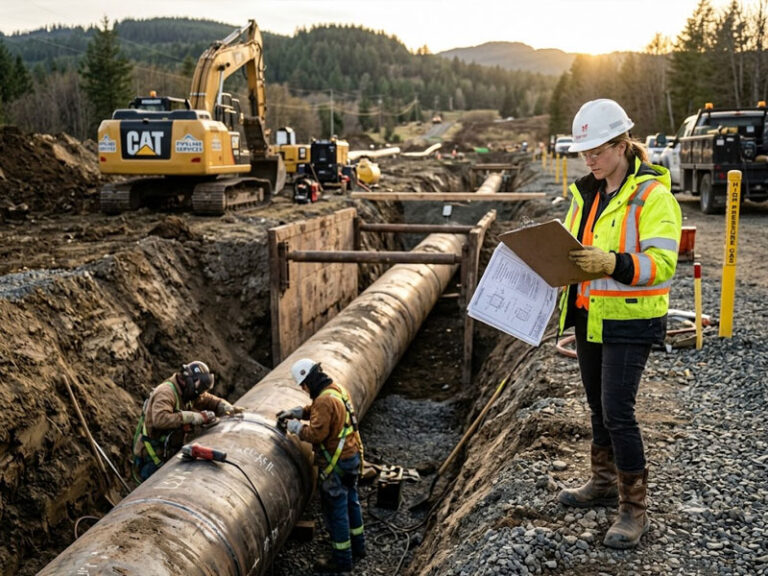
What Is a Pipeline Repair Permit?
A pipeline repair permit is an authorization issued by a federal, state, or local authority allowing maintenance, excavation, replacement, or rehabilitation work on an existing pipeline system. Permit requirements vary based on pipeline type, repair scope, environmental impact, and location. Most pipeline repair projects require excavation permits, right-of-way permissions, environmental approvals, utility coordination clearances, and inspection authorizations. Additional federal, state, or local permits may be required depending on pipeline classification and repair scope.
Pipeline Repair Permit Requirements at a Glance
| المتطلبات | Typical Need | When Applicable |
|---|---|---|
| Excavation Permit | Almost Always | All work involving ground disturbance |
| Right-of-Way Permit | Common | Work on public property or utility easements |
| Environmental Permit | Location Dependent | Near water bodies, wetlands, or protected habitats |
| State Notification | Transmission Pipelines | Regulated transmission and distribution systems |
| Federal Coordination | Major Repairs | Integrity management repairs, federal land |
| Inspection Authorization | Major Repairs | Welding, pipe replacement over 100 meters |
| Confined Space Permit | When Applicable | Entry into valve pits, pipe sections, or vaults |
| Utility Locate Clearance | Always Required | Before any excavation in all 50 states |
Pipeline Repair Permitting Statistics
Understanding the scale and scope of pipeline repair permitting helps operators plan effectively. Here are key statistics that highlight the importance of proper permitting:
- More than 70% of pipeline repair projects require excavation permits, making this the most common permit type across all pipeline classifications
- Environmental permits are required for approximately 20-40% of transmission pipeline repairs, depending on the location and proximity to sensitive areas
- Utility locate requests are mandatory before excavation in all 50 U.S. states, with operators required to call 811 at least 48-72 hours before digging
- Major transmission pipeline repairs often involve permits from 3-10 separate agencies, including federal, state, and local authorities
- Approximately 60% of pipeline repair delays are related to permit processing, making early permit application critical for project timelines
- Emergency pipeline repairs requiring expedited permits account for roughly 15-25% of all repair work, with most jurisdictions having special provisions for emergency situations
1. What Determines the Permits Needed for Pipeline Repair?
The permits required for pipeline repair work depend on three primary factors: pipeline classification, repair location, and repair method. Understanding these variables is the first step in determining your specific permitting pathway.
Pipeline Classification
Different pipeline types face different regulatory requirements:
| نوع خط الأنابيب | Typical Permit Complexity | Primary Regulator |
|---|---|---|
| Natural Gas Transmission | عالية | PHMSA, State PUC |
| Natural Gas Distribution | متوسط | State PUC, Local |
| Crude Oil Pipeline | عالية | PHMSA, EPA, State |
| Water Pipeline | متوسط | State, Local |
| Industrial Process Pipeline | متوسط | OSHA, State, Local |
| Sewer Force Main | متوسط | EPA, State, Local |
Repair Location Factors
Depending upon where the pipeline is situated, the operator may have to obtain permits, notify property owners, prepare a dig plan, and let contracts to outside firms as necessary. The majority of pipe is underground, so excavation permits are almost always required before any repair work can commence.
Repair Scope and Method
- Major repairs: Replacing over 100 meters of pipe, welding new sections, or changing operating parameters trigger additional inspection requirements
- Routine maintenance: Minor repairs, coating touch-ups, and valve lubrication may have reduced permitting requirements
- Emergency repairs: Expedited permitting procedures are often available for safety-critical situations
2. Federal Pipeline Repair Regulations and Coordination
Federal involvement in pipeline repair permitting primarily focuses on environmental coordination and safety compliance rather than issuing a single “pipeline repair permit.” The Pipeline Safety Act establishes an Interagency Committee to coordinate environmental reviews and streamline the permitting process for pipeline repairs. For more detailed information, refer to our pipeline safety compliance checklist.
The Interagency Committee on Pipeline Repair Permitting
This committee consists of representatives from multiple federal agencies, including:
- Department of Transportation
- Environmental Protection Agency
- U.S. Fish and Wildlife Service
- Bureau of Land Management
- Federal Energy Regulatory Commission
The committee evaluates federal permitting requirements for access, excavation, and restoration activities in connection with pipeline repairs. For repairs that employ industry best practices and result in no more than minimal adverse environmental effects, discretionary administrative reviews may be minimized or eliminated.
When Federal Pipeline Repair Permits Are Required
- Pipeline Integrity Management repairs: Operators must provide notice to the Secretary of Transportation and receive concurrence before proceeding. Our pipeline integrity management requirements guide provides additional details on this process
- Environmental reviews: Projects requiring federal authorization undergo coordinated review through the Interagency Committee process
- Water crossing permits: Repairs affecting navigable waterways may require Army Corps of Engineers authorization
- Federal land repairs: Repairs on federal lands require specific authorizations from the managing agency
For pipelines regulated under the Integrity Management rule, operators must follow the administrative process established under 49 U.S.C. § 60133. This process allows operators to proceed with repairs after providing proper notice, with the Secretary having 7 days to disapprove the proposed repair approach.
3. State Pipeline Repair Permits
States typically require permits for pipeline repairs that affect public safety, environmental resources, or transportation infrastructure. The specific requirements vary significantly by state and pipeline type.
State Pipeline Safety Permits
Many states have pipeline safety programs that parallel federal pipeline repair regulations. For pressure pipelines (long-distance transmission, public utility, and industrial pipelines), states may require:
- Notification of repair work: Advance notice to the state pipeline safety authority
- Inspection requirements: State inspectors may need to witness certain repair procedures
- Documentation: Recording and reporting repair methods and results
State Environmental Permits
- Water quality permits: For repairs near streams, wetlands, or water bodies
- Air quality permits: For repairs involving large welding operations or venting
- Stormwater permits: For excavation and dewatering activities
Pipeline Repair Permit Requirements by State
| State | Primary Authority | Typical Requirements |
|---|---|---|
| Texas | Railroad Commission of Texas | State notification, excavation permits, ROW approval |
| California | California State Fire Marshal | Environmental review, local permits, safety documentation |
| Pennsylvania | PUC Pipeline Safety Division | State inspection, local excavation permits, erosion control |
| Louisiana | Department of Natural Resources | Coastal zone permits, water quality, local excavation |
| Ohio | Public Utilities Commission | State notification, local ROW permits, inspection scheduling |
| New York | Department of Public Service | State notification, environmental review, local permits |
| Colorado | Public Utilities Commission | State notification, ROW permits, environmental compliance |
| Oklahoma | Corporation Commission | State notification, excavation permits, inspection scheduling |
4. Local Excavation and Right-of-Way Permits
Local permits are often the most numerous and time-sensitive requirements for pipeline repair projects. Municipalities and counties typically require permits for any work that impacts public rights-of-way or underground utilities.
Excavation Permits for Pipeline Work
Before digging to access a pipeline, operators typically must obtain:
- Street opening or excavation permits: Required for work in public roads and sidewalks
- Right-of-way permits: For work within utility easements
- Traffic control permits: For projects affecting traffic flow
Local permit applications generally require:
- Design documents stamped by a qualified engineer
- Construction plans and schedules
- Traffic control and safety plans
- Restoration and cleanup commitments
Pipeline Right-of-Way Permit
When repair work requires staging equipment or materials on public property or easements, temporary occupancy permits are typically required. These specify:
- The area to be occupied
- Duration of occupancy
- Restoration requirements
Utility Locate Clearance
Before excavation begins, operators must also obtain utility locate clearances through the “Call Before You Dig” system (811 in the United States). This ensures all underground utilities are marked and prevents accidental damage during pipeline repair work. Excavation permits and utility coordination are critical first steps for any pipeline rehabilitation project planning.
Temporary Occupancy and Utility Coordination Clearances
Local jurisdictions often charge fees for pipeline repair permits. For example:
| Type of Permit | Typical Fee Range |
|---|---|
| Residential plumbing repair | $200 – $300 |
| Commercial plumbing repair | $600 – $2,700+ (based on project scale) |
| Gas piping repair | $200 – $300 |
| Underground storage tank piping repair | $75+ per location |
Fees are often based on project scope and square footage, with commercial projects generally incurring higher fees.
5. Environmental Permits for Pipeline Repairs
Pipeline repairs in environmentally sensitive areas require additional environmental permits and approvals. These permits are designed to protect natural resources and ensure that repair work does not cause significant environmental harm. For more information, see our pipeline environmental compliance guide.
Common Environmental Permit Requirements
- Water quality certifications: Required for repairs affecting wetlands, streams, or other water bodies
- Stormwater permits: For excavation, dewatering, and erosion control
- Air quality permits: For welding, venting, or other air emissions
- Endangered species consultations: For repairs in habitats of protected species
When Environmental Permits Are Required
Pipeline repair environmental permits are typically required when:
- The repair is within 100 feet of a water body
- The repair involves more than 1 acre of ground disturbance
- The repair is in a floodplain or wetland area
- The repair affects a designated critical habitat
Wetland and Waterway Crossings
Repairs involving wetland crossings or work in or near waterways require additional permits. These wetland crossing permit requirements often include:
- Section 404 Clean Water Act permits (Army Corps of Engineers)
- Section 401 Water Quality Certifications (State)
- Coastal Zone Management consistency determinations
6. Confined Space and Safety Permit Requirements
Pipeline repair frequently involves entering confined spaces such as valve pits, pump stations, or pipe sections. OSHA requires employers to implement a permit-required confined space program for spaces that have:
- Hazardous atmospheres (toxic gases, oxygen deficiency, flammable vapors)
- Engulfment hazards
- Internal configurations that could trap workers
- Other serious safety hazards
Permit-Required Confined Space Program Components
A typical permit-required confined space program includes:
- Written entry procedures
- Hazard evaluations
- Rescue plans
- Worker training
- Designated entry supervisors
Trenching and Excavation Permits
Beyond general excavation permits, deep trenching for pipeline access requires specific safety documentation and potentially separate permits. This includes:
- Soil classification and shoring plans
- Competent person designation
- Emergency response procedures
- Daily inspection logs
Are confined space permits needed for pipeline repair?
Yes, if the repair involves entering a space that meets OSHA’s definition of a permit-required confined space. However, if an effective policy prohibits workers from entering pipelines and alternative access methods are used, the confined space standard may not apply. Trenching and excavation regulations (29 CFR 1926.650-652) typically apply instead.
7. Pipeline Repair Inspection Requirements
For significant pipeline repairs—defined as repairs involving welding to replace pipe sections or components—additional inspection and oversight requirements apply. Our pipeline welding inspection standards and pipeline pressure testing requirements guides provide detailed technical information.
Pipeline Major Repair Inspection Process
Major repairs on regulated pipelines typically require:
- Notice to the inspection authority: Typically 72 hours or more before commencing work
- Inspector presence: For welding and critical operations
- Testing oversight: Witnessing of pressure tests
- Documentation review: Examination of welding procedures and operator qualifications
Required Documentation for Pipeline Repair Inspections
- Welding procedure specifications
- Welder performance qualifications
- Material test reports
- Non-destructive examination results
- Pressure test records
- Repair completion reports
8. Pipeline Repair Permit Costs
Understanding pipeline repair permit costs helps with project budgeting and planning. Costs vary significantly based on repair type, location, and regulatory requirements.
Pipeline Repair Permit Cost Breakdown
| Permit Type | Typical Cost Range | Factors Affecting Cost |
|---|---|---|
| Small utility repair permit | $200 – $1,000 | Local fees, inspection costs |
| Road crossing repair permit | $1,000 – $10,000 | Traffic control, restoration bonds |
| Transmission pipeline repair permit | $5,000 – $50,000+ | Federal coordination, environmental review |
| Environmental review permit | $2,000 – $100,000+ | Project scale, agency fees |
| ROW occupancy permit | $100 – $5,000 | Duration, area occupied |
| Confined space entry permit | $0 – $500 | Training, equipment certification |
| State pipeline safety notification | $0 – $2,000 | State fee schedule |
| Federal coordination fees | $500 – $10,000 | Agency review costs |
How much do pipeline repair permits cost for transmission lines?
Transmission pipeline repair permits typically range from $5,000 to $50,000 or more, depending on the complexity of the project, the number of jurisdictions involved, and whether environmental impact reviews are required.
9. How Long Does It Take to Obtain Pipeline Repair Permits?
Pipeline repair permit processing times vary widely based on permit type, jurisdiction, and project complexity. Planning ahead is essential to avoid project delays.
Pipeline Repair Permit Processing Times
| Permit Type | Typical Processing Time | Expedited Options |
|---|---|---|
| Excavation Permit | 1 – 7 days | Same-day (emergency) |
| ROW Permit | 1 – 4 weeks | None |
| Environmental Review | 2 – 12 weeks | Expedited for emergency |
| Federal Coordination | 1 – 8 weeks | Emergency provisions |
| State Pipeline Safety Notification | 1 – 7 days | None |
| Utility Locate Clearance | 2 – 5 business days | Emergency locate available |
| Confined Space Permit | 0 – 3 days | None |
How long does it take to obtain a pipeline repair permit for emergency repairs?
Emergency pipeline repairs can begin with verbal authorization in some jurisdictions, with formal permit applications submitted concurrently. Processing times are typically 1-24 hours for emergency approvals.
10. Pipeline Repair Permit Process (Step-by-Step)
Following a structured pipeline repair permit process helps ensure all requirements are met and reduces the risk of project delays or compliance violations.
Step-by-Step Pipeline Repair Permit Process
Step 1: Identify the repair scope and location
Determine whether the repair is classified as routine maintenance or major repair. Repairs involving welding, pipe replacement over 100 meters, or changes to operating parameters typically trigger more permitting requirements.
Step 2: Confirm pipeline classification
Identify whether the pipeline is a transmission line, distribution main, or service line. This determines which federal, state, and local regulations apply.
Step 3: Determine jurisdiction
Identify all federal, state, and local authorities with jurisdiction over the repair location. Multiple jurisdictions may have overlapping requirements.
Step 4: Apply for excavation permits
Submit excavation permit applications to the local municipality or county. Include construction plans, traffic control plans, and safety documentation.
Step 5: Obtain environmental approvals
If the repair affects wetlands, water bodies, or protected habitats, submit environmental permit applications to the appropriate agencies.
Step 6: Secure right-of-way access
Obtain ROW permits or access agreements for work on public property or utility easements.
Step 7: Submit safety documentation
Provide required safety documentation, including confined space entry plans, trenching and shoring plans, and emergency response procedures.
Step 8: Schedule inspections
Coordinate required inspections with the appropriate authorities. Some repairs require inspections at multiple stages, not just upon completion.
Step 9: Complete repair work
Perform the pipeline repair work in accordance with approved plans and permit conditions.
Step 10: Submit close-out reports
After the repair is complete, submit required close-out reports and documentation to all relevant authorities.
11. Pipeline Repair Permit Checklist
Use this pipeline repair permit checklist to ensure all necessary permits and approvals are obtained before work begins.
Pipeline Repair Permit Quick Answer
Most pipeline repair projects require:
- ✓ Excavation permits
- ✓ Right-of-way permits
- ✓ Utility locate clearances
- ✓ Environmental approvals
- ✓ Safety documentation
- ✓ Inspection authorization
Permit requirements increase for transmission pipelines, repairs on federal land, environmentally sensitive areas, and projects involving major pipe replacement.
Complete Pipeline Repair Permit Checklist
- ✓ Confirm pipeline classification (transmission, distribution, service)
- ✓ Identify all federal, state, and local jurisdictions
- ✓ Obtain excavation permits
- ✓ Secure right-of-way authorization
- ✓ Complete environmental reviews
- ✓ Submit safety documentation (confined space, trenching)
- ✓ Schedule required inspections
- ✓ Maintain complete permit records
- ✓ Coordinate utility locates (Call Before You Dig)
- ✓ Confirm compliance with all permit conditions
- ✓ Prepare emergency response procedures
- ✓ Notify property owners (if required)
- ✓ Submit restoration and cleanup plans
- ✓ Schedule post-repair inspections
12. Common Pipeline Repair Permit Mistakes
Avoiding common permit mistakes can save time, money, and regulatory headaches. Based on field experience, these are the most frequent issues encountered during pipeline repair permitting:
Top Permit Mistakes to Avoid
- Starting excavation before utility locates: All 50 states require contacting 811 before excavation. Failure to do so can result in fines and liability for utility damage
- Failing to obtain ROW access permits: Working on public property or easements without proper ROW permits can lead to stop-work orders and penalties
- Ignoring environmental review triggers: Many repairs near water bodies or sensitive areas require environmental permits that operators may overlook
- Not scheduling required inspections: Major repairs require inspection oversight. Missing required inspections can require rework or costly retro-inspections
- Assuming emergency repairs exempt all permits: While emergency work can begin immediately, operators must still submit permit applications concurrently
- Incomplete permit documentation: Missing drawings, plans, or safety documentation delays permit processing
- Not accounting for permit processing time: Failure to build in buffer time for permit review can delay project start dates
- Overlooking state-specific requirements: States have varying requirements that operators working across multiple states must track
13. Real-World Example: Permits Required for a Natural Gas Transmission Pipeline Repair
The following example illustrates the typical permits required for a natural gas transmission pipeline repair project. This real-world scenario demonstrates the scope of permitting needed for a moderate-scale repair.
Example Project Description
- المشروع: Natural gas transmission pipeline repair
- خط الأنابيب: 24-inch diameter natural gas transmission line
- الموقع: County roadway crossing in Pennsylvania
- Repair Method: Replace 50 feet of damaged pipe section
- Repair Scope: Excavation, pipe removal and replacement, welding, pressure testing, backfill, and restoration
Required Permits and Authorizations
| Permit Type | Issuing Authority | Processing Time |
|---|---|---|
| County excavation permit | County Public Works Department | 5-10 business days |
| Traffic control permit | County Transportation Department | 3-7 business days |
| Utility locate clearance | PA One Call System | 2-5 business days |
| State pipeline safety notification | PA PUC Pipeline Safety Division | 3-7 business days |
| Environmental erosion control approval | County Conservation District | 1-4 weeks |
| Pressure test inspection authorization | PHMSA / PA PUC | 72 hours notice |
Lessons Learned
- The project required approvals from 6 separate authorities
- Total permitting time was approximately 4 weeks from application to approval
- Early communication with the county conservation district identified the erosion control requirement before work began
- Emergency provisions allowed work to begin while permits were being finalized
14. Pipeline Repair vs. Pipeline Construction Permits
Understanding the difference between pipeline repair permits and pipeline construction permits helps ensure proper application.
Key Differences
| أسبكت | Repair Permit | Construction Permit |
|---|---|---|
| الغرض | Maintain existing pipeline | Build new pipeline |
| Scope | Limited to specific repair area | Full route construction |
| Environmental Review | Reduced if minimal impact | Comprehensive |
| Public Notice | Usually not required | Often required |
| Application Complexity | معتدل | عالية |
| Processing Time | 1-12 weeks | 6-24 months |
| Federal Coordination | محدودة | Extensive |
What is the difference between a pipeline repair permit and a pipeline construction permit?
A pipeline repair permit authorizes maintenance or replacement work on an existing pipeline system, typically with reduced environmental review and processing time. A pipeline construction permit authorizes new pipeline installation and requires comprehensive environmental review, public notice, and significantly longer processing times.
15. Frequently Asked Questions About Pipeline Repair Permits
Q: Who issues pipeline repair permits?
A: Pipeline repair permits are issued by multiple authorities: local municipalities issue excavation and ROW permits, state pipeline safety authorities issue safety permits, and federal agencies coordinate environmental reviews. The specific issuer depends on the pipeline location and repair scope.
Q: Do pipeline repairs require permits?
A: Most pipeline repairs require some form of permit, notification, or authorization. Routine maintenance not involving excavation may not require formal permits, but any work affecting public right-of-way, underground utilities, or safety systems typically does require permits.
Q: Can emergency pipeline repairs begin without permits?
A: In most jurisdictions, emergency pipeline repairs can begin immediately when there is an imminent safety risk. However, operators must notify relevant authorities as soon as possible and submit permit applications concurrently. Verbal authorization is often sufficient for emergency work.
Q: Do pipeline repair contractors need separate permits?
A: While the pipeline operator is ultimately responsible for obtaining all required permits, contractors may need additional licensing or registration permits to perform pipeline repair work in certain jurisdictions. Contractors should verify their qualifications and any additional permit requirements before beginning work.
Q: What permits are required for pipeline repairs on private land?
A: Pipeline repairs on private land typically still require excavation permits if the land is within a regulated jurisdiction, environmental permits for certain activities, and may require landowner access agreements. However, ROW permits are generally not required on private property.
Q: How much do pipeline repair permits cost?
A: Pipeline repair permit costs range from $200 to $50,000+ depending on the project type, location, and regulatory requirements. Small utility repairs typically cost $200-$1,000, while transmission pipeline repairs can cost $5,000-$50,000 or more.
Q: How long does it take to obtain a pipeline repair permit?
A: Processing times range from 1-7 days for simple excavation permits to 2-12 weeks for projects requiring environmental reviews. Emergency repair permits can be obtained within 24 hours in most jurisdictions.
Q: Can pipeline repair work begin while permits are pending?
A: In most cases, no. Work should not begin until all required permits are obtained. However, the federal integrity management rule allows interim operational alternatives while permits are being processed, provided the operator is pursuing permits in good faith. Emergency repairs are an exception.
Q: What permits are needed for pipeline repair on federal land?
A: Pipeline repairs on federal land require specific authorizations from the managing federal agency (e.g., Bureau of Land Management, U.S. Forest Service), in addition to standard federal, state, and local requirements. These permits often include environmental reviews and public notice requirements.
Q: Do temporary pipeline repairs require permits?
A: Temporary repairs generally require the same permits as permanent repairs if they involve excavation, ROW access, or safety-critical work. However, temporary repairs may have reduced documentation requirements and faster approval processes.
Q: Which agency regulates pipeline repair permits?
A: Pipeline repair permits are regulated by multiple agencies: PHMSA at the federal level, state pipeline safety authorities at the state level, and local municipalities for excavation and ROW permits. No single agency regulates all aspects of pipeline repair permitting.
Q: Do pipeline repair permits expire?
A: Yes, most pipeline repair permits have expiration dates. If the repair work is not completed within the specified timeframe, permit extensions may be required. Extensions typically require additional fees and may trigger updated reviews or inspections.
Pipeline Repair Compliance Review
This article was reviewed by pipeline integrity engineers, construction managers, and regulatory compliance specialists with experience in oil and gas transmission pipeline maintenance projects. The information provided reflects current regulatory requirements and industry best practices as of the publication date.
This guide provides general information about pipeline repair permitting requirements. The specific permits needed for any project depend on the unique circumstances of the repair, including location, pipeline type, and scope of work. Always consult with relevant permitting authorities before commencing work.
JSW Pipeline Solutions: Your Pipeline Repair Partner
JSW Pipeline Solutions is a leading provider of pipeline construction, maintenance, and repair services. Our expertise spans the full spectrum of pipeline operations, from emergency leak repair to comprehensive integrity management programs.
Our Capabilities:
- Hot Tap and Line Stop Services: JSW performs safe, efficient pipeline interventions without service interruption using industry-leading equipment and procedures
- Pipeline Welding and Repair: Our certified welders and engineers deliver high-quality repairs meeting all applicable codes and standards
- Non-Destructive Testing (NDT): Comprehensive inspection services to verify repair quality and ensure long-term integrity
- Permit Coordination: Our project management team handles permit applications and coordination for all repair projects, reducing compliance burden on pipeline operators
- Pipeline Rehabilitation: From coating repair to complete section replacement, we offer comprehensive rehabilitation services
لماذا تختار JSW؟
- Safety-First Culture: All projects comply with applicable safety standards and regulations
- Industry Experience: Decades of pipeline project experience across diverse environments
- Full-Service Capability: From consultation and planning to execution and post-repair inspection
- Regulatory Compliance: Our procedures align with applicable regulatory requirements
- Permit Assistance: We help navigate complex permitting requirements across multiple jurisdictions
Get Started
Need assistance with pipeline repair planning, permitting, or execution? Contact JSW Pipeline Solutions today to discuss your project requirements.












 English
  Arabic
  Russian
  Spanish
  French
  Vietnamese
  Polish
  Thai
Thai  Indonesian
  Turkish
  Portuguese