
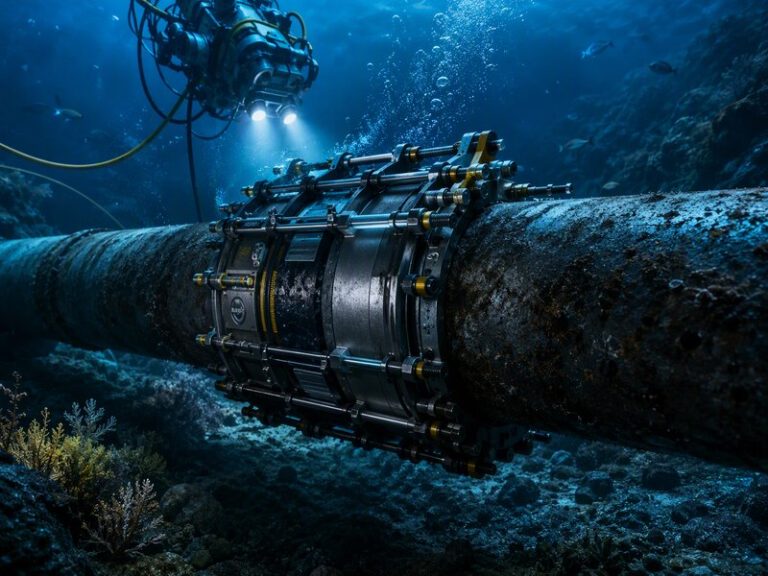
What is the Correct Sizing for a Subsea Pipeline Repair Clamp in High-Pressure Environments?
Sizing a subsea pipeline repair clamp for deepwater (>1,000m / 3,280 ft) requires calculating the specific pressure differential between internal fluids and external hydrostatic head. In deepwater environments exceeding 1,000 meters, this sizing process is primarily dictated by the external hydrostatic pressure and the pressure differential between the internal fluid and the surrounding sea. Unlike shallow-water clamps, heavy-duty structural clamps must be engineered to resist collapse when depressurized while providing full axial restraint. According to 2026 industry field data, the “gold standard” involves a minimum safety factor of 1.5 against external collapse using the Von Mises stress criteria, ensuring structural continuity in the most unforgiving depths.
Defining the Design Basis: Environmental and Operational Loads
The design of a subsea repair clamp begins with a rigorous definition of the “Design Basis.” Unlike surface-level repairs, subsea components are subjected to a multi-axial load regime that changes throughout the pipeline’s 25-year lifecycle.
1. How to Calculate Pressure Differential for Subsea Clamps at 2,000m Depth?
In shallow water, internal pipeline pressure is the primary driver of wall thickness. However, at depths of 2,000m (6,562 ft), the external hydrostatic pressure reaches approximately 200 bar (2,900 psi).
- Design Rule: The Subsea Clamp body must be sized to withstand full external hydrostatic head without the support of internal pressure (e.g., during pipeline maintenance or shutdown).
- FEA Advantage: Advanced Finite Element Analysis (FEA) is used to simulate these pressure fluctuations, identifying potential stress concentrations at the seal interfaces. Advanced modeling allows engineers to calculate the exact pressure differential, ensuring the Subsea Clamp body remains within the elastic limit.
2. Full-Load Structural Duties and Load Capacity
A “Heavy-Duty Structural” clamp is a load-bearing component, not just a leak patch. The Structural Repair Clamp design is engineered to take over the full structural duties of the pipeline, including:
- Axial Tension: Preventing pipeline separation in cases of full circumferential cracks.
- Bending Moments: Sustaining the pipeline’s suspended weight and managing seabed span movements.
- Thermal Constraints: Withstanding stresses induced by high-temperature fluids (up to 150°C) flowing through the line.
Technical Standards and Compliance Framework
Engineering a repair solution that satisfies global insurance and regulatory bodies requires strict adherence to international standards.
- DNV-RP-F113 (Pipeline Subsea Repair): The primary framework for qualifying mechanical connectors and repair clamps, ensuring they meet the highest safety classes.
- API 6H: Provides requirements for the sizing and materials of high-pressure connectors.
- API 17D: Offers guidance on ROV (Remotely Operated Vehicle) interfaces and subsea installation tolerances.
- NACE MR0175/ISO 15156: Ensuring material compatibility in “sour service” (H2S) environments to prevent sulfide stress cracking.
Advanced Sizing Methodology for Deepwater Clamps
The Sizing methodology for subsea clamps is a precision-driven process that balances structural mass with ROV maneuverability.
Wall Thickness and Diameter Calculation
We apply the “thick-wall” cylinder theory to ensure the clamp body resists external hydrostatic collapse. This involves evaluating the Von Mises Stress—a value used to determine if a material will yield or fracture under complex loading.
- Tolerance Requirement: The internal diameter must accommodate the pipeline’s nominal outer diameter (OD) plus a 5% tolerance for ovality and coating residuals.
- Quantitative Benchmarking: In a recent 12-inch pipeline repair at 1,500m (4,921 ft) depth, utilizing Super Duplex (ASTM A182 F53) allowed for a 20% reduction in wall thickness. This design optimized total clamp weight from 4.2 tons down to 3.3 tons (calculated per ISO 13628-7 standards for riser components), significantly easing ROV handling and reducing mobilization costs.
Length and Grip Coverage
To provide “Full Axial Restraint,” the internal “grips” or “slips” must engage a sufficient surface area. The clamp length must extend at least 2.5 times the pipeline diameter beyond the damaged zone to ensure stable load transfer through the clamp body without damaging the host pipe.
Core Design Elements of Structural Repair Clamps
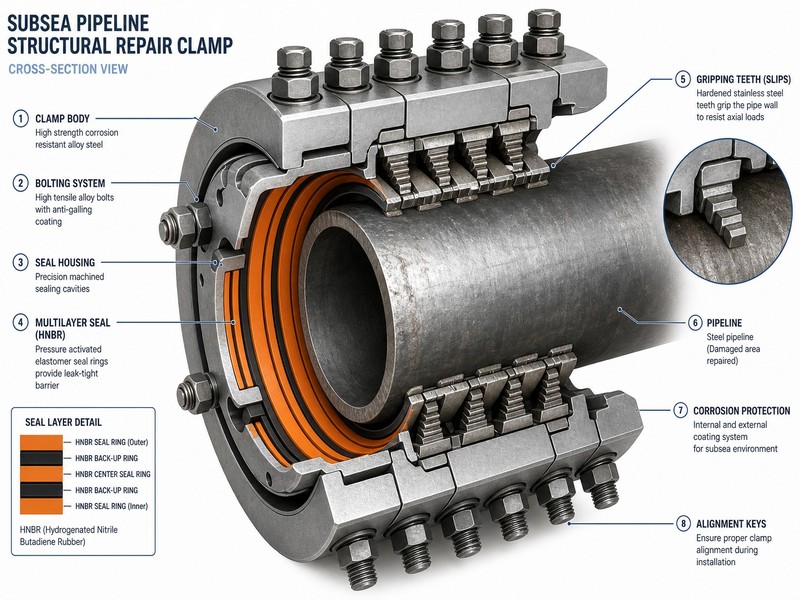
A high-performance structural clamp integrates several key systems to ensure a permanent, leak-proof repair.
1. Sealing Mechanism Comparison (Technical Data)
| الميزة | Soft Elastomer Seals (HNBR/Viton) | Metal-to-Metal Seals |
|---|---|---|
| تصنيف الضغط | Up to 10,000 psi | Up to 15,000+ psi |
| Temp. Resistance | Moderate (up to 180°C) | High (up to 300°C+) |
| Surface Tolerance | High (conforms to scoring) | Low (requires polished surface) |
| Longevity | 20-25 Years | 40+ Years |
| Activation Force | Low to Medium | Very High |
2. Structural Integrity: The Full-Load Philosophy
Heavy-duty clamps feature internal grips that “bite” into the pipeline surface. The Subsea Clamp Structural Grip mechanism ensures that even if the pipeline were to sever completely, the clamp maintains the structural circuit, preventing catastrophic fluid release.
3. Material Selection and Corrosion Protection
To survive 25+ years on the seabed, material selection is paramount:
- ASTM A182 F51 / F53: For exceptional strength and corrosion resistance.
- Inconel 625 Cladding: Applied to seal areas to prevent localized pitting and crevice corrosion.
- Sacrificial Anodes: Integrated to provide cathodic protection in saline environments.
Installation Constraints: Fronting the Operational Boundaries
Successful installation in high-pressure environments depends on specific design accommodations for ROVs.
Scenario A: For Project Managers in Active Leak Response If you are managing an active subsea leak, focus on the Seal Surface Tolerance (see Sealing Mechanism Comparison table). A soft elastomer seal is your fastest deployment option to bypass pipe ovality issues and achieve rapid pressure containment.
- Applicability Range: This heavy-duty design is exclusively optimized for ROV-deployed mechanisms in deepwater. Diver-assisted installation is limited to depths shallower than 50 meters (164 ft) due to decompression and hyperbaric constraints.
- ROV Deployment Features: The clamp features ROV-friendly handles and visual indicators. The integration of hydraulic hot stabs allows the ROV to power the clamp’s activation cylinders directly from the vehicle’s hydraulic system.
- What is the ROV Installation Tolerance for Deepwater Clamps? The design allows for a ±5-degree angular misalignment during the landing and locking sequence, ensuring a successful connection even on uneven seabed terrain.
- Hyperbaric Testing: Every JSW clamp includes a dedicated Annulus Seal Test Port, allowing for subsea pressure verification before full system re-pressurization.
Not Recommended Scenarios: Defining the Operational Boundaries
While structural clamps are highly versatile, certain conditions may require alternative intervention methods:
- Severe Localized Corrosion: If the host pipe wall thickness is reduced by more than 80%, a structural clamp may not have sufficient “meat” to grip. In these cases, a full spool piece replacement is recommended.
- Unstable Seabed Conditions: If the repair zone is subject to significant mudflows or seismic activity, additional external stabilization (such as rock dumping or concrete mattresses) must be deployed alongside the clamp.
Economic Impact & Procurement Strategy: Structural Clamps vs. Spool Replacement
For offshore operators, the Cost-Benefit Analysis of Subsea Repair Clamps vs. full pipeline section replacement is a critical decision.
- Lead Time Efficiency: A pre-engineered structural clamp can be deployed in days, whereas a spool replacement involves complex cutting, metrology, and hyperbaric welding that can take weeks.
- Total Cost of Ownership (TCO): While the initial CAPEX of a heavy-duty clamp is significant, the reduction in deferred production (downtime) often results in a ROI within the first 48 hours of restored flow.
- Advice for Procurement Teams: We recommend maintaining a strategic inventory of Emergency Pipeline Repair System (EPRS) kits. Pre-sizing clamps for your specific asset depths and diameters ensures you are not waiting on a 6-month manufacturing lead time during an active leak.
FAQ: Common Challenges in Subsea Clamp Design
Q1: Can a structural clamp be used on a pipeline with high ovality?
Yes, but the Subsea Clamp sizing methodology must switch to a “compliant grip” design that accounts for the specific ovality measurement, ensuring uniform seal compression across the elliptical profile.
Q2: What is the risk of Hydrogen-Induced Stress Cracking (HISC)?
For Super Duplex clamps, HISC is a significant risk due to the cathodic protection systems used subsea. We mitigate this by applying localized Inconel 625 cladding and carefully controlling the cathodic protection potential per DNV standards.
Q3: What is the typical lead time for an Emergency Pipeline Repair System (EPRS)?
Standard pre-engineered designs can be delivered in 8-12 weeks, while custom ultra-deepwater solutions may take 16-24 weeks. Strategic stocking of long-lead items (like Super Duplex forgings) is recommended to reduce this window.
Q4: Is FEA mandatory for all deepwater repairs?
For depths exceeding 500m, Finite Element Analysis (FEA) is essential to validate the combined effects of external hydrostatic pressure and operational bending loads. It ensures the design meets the safety factors required by DNV-RP-F113.
The Era of Intelligent Subsea Repair
As subsea exploration reaches ultra-deep waters, the Subsea Pipeline Repair Clamp is evolving into an “intelligent” asset. By integrating real-time strain sensors and fiber-optic seal monitoring, we ensure that your pipeline integrity is visible from the surface. Mastering these sizing and design challenges is the only way to safeguard global energy infrastructure.










 English
  Arabic
  Russian
  Spanish
  French
  Vietnamese
  Polish
  Thai
Thai  Indonesian
  Turkish
  Portuguese