
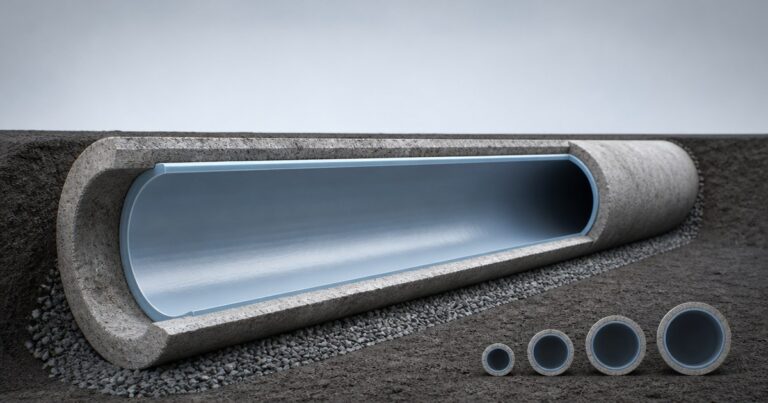
Cured in place pipe lining is a trenchless rehabilitation method. The acronym CIPP stands for cured-in-place pipe, and the same method is written CIPP lining, cure-in-place pipe, CIPP pipe lining or CIPP renewal across the industry. This guide answers what is CIPP lining and what is a CIPP, then sets out the CIPP diameter range, the host conditions the liner design assumes and when lining is the wrong choice. A flexible, resin-impregnated tube is installed inside an existing pipeline and cured in place, so the tube and the resin harden into a new structural pipe wall within the old one. It applies to gravity sewers, pressure mains and industrial pipelines that still hold their basic shape.
What Is Cured in Place Pipe Lining?
A cured-in-place pipe (CIPP) is a resin-impregnated tube that is inserted into a host pipe, pressed against its wall and then cured so the resin cross-links into a rigid composite. The resin and the cure method matter, but what physically defines the method is the sequence: the tube is delivered, positioned and cured inside the pipe, so the finished pipe is created in place rather than manufactured elsewhere and pushed in as a complete product. Remove any one of those steps and it becomes a different technique. Put simply, what is CIPP? It is the cured liner, and the lining is the process that creates it inside the host pipe.
The tube is the carrier of the resin; the cured composite is what carries the load. That is why tube selection, resin volume and wall thickness behave as engineering decisions rather than purchasing details, and why a tube must arrive fully saturated to the specified resin quantity.
The two installation routes are inversion, where the tube is turned inside out and pushed forward by fluid or air pressure, and pull-in and inflate, covered by the companion practice ASTM F1743. Both end in the same place: a felt or glass-fiber carrier pressed against the host wall and held there while the resin sets.
In our lining crews’ logs, the variables that decide success are boring but consistent: resin quantity, cure temperature and cure time. Get those three right and the liner behaves as the design assumed; get any one wrong and the defect shows up later, not on the day.
Which Host Conditions Does the Liner Design Assume?
The governing standard, ASTM F1216 (current revision F1216-24a), sets the design rules for one of two host conditions that the owner specifies. In the partially deteriorated condition, the existing pipe is assumed to retain some structural capacity, and the liner is designed mainly to resist internal pressure and to stop infiltration and exfiltration. In the fully deteriorated condition, the liner is designed to carry external loads on its own, and the wall thickness rises accordingly.
The wall thickness that follows comes from a design calculation: Appendix X1 of the governing standard holds the design equations, Appendix X2 the chemical-resistance requirements, and where the owner requires it the design is stamped by a professional engineer. The same standard is the reason a specification can state a number for thickness rather than a rule of thumb.
NASTT’s technical knowledge base presents two industry-accepted design routes, ASTM F1216 and ASCE Manual of Practice 145, and frames the choice between them as a decision rather than one being correct. A typical US municipal specification names the inversion route, the pull-in route in ASTM F1743 and ASTM D5813 together in one document.
What Is the CIPP Diameter Range, and Why Do Published Ranges Differ?
The CIPP diameter range is 2 in. to 108 in., the scope written into the governing standard. ASTM F1216 covers the reconstruction of pipelines and conduits in that range, about 50 mm to 2,750 mm, by installing such a tube. That scope is the anchor, and it is why a careful specification quotes a range rather than a single figure.
Field practice concentrates on a narrower band than the standard’s scope. In practice most wet-out, inversion and cure equipment fleets are sized for roughly 6 in. to 96 in., and that is where most municipal work sits. Large-diameter trunk sewers run above that band, and each one is engineered case by case.
Can a 48-inch trunk sewer be lined under a live road?
A 48-inch trunk sewer sits inside the lining envelope, so the diameter is workable; on a live road the work is planned around access and traffic control. On large-diameter CIPP work of 72 in. to 96 in., published accounts note that excavation is still often needed just to gain access for the lining works. In our bid reviews we treat “trenchless” as a statement about the majority of the run, not a promise that no ground is ever opened. Table 1 sets out those bands.
| Diameter band | Typical host pipe | Typical cure method | Practical limit |
|---|---|---|---|
| 2 in. to 6 in. (about 50 to 150 mm) | Building laterals and small collector branches | Ambient, steam or UV | Small robotic cutters and access limit service reinstatement |
| 6 in. to 24 in. (about 150 to 600 mm) | Municipal gravity sewers and laterals | Hot water, steam or UV | The mainstream band; most wet-out and cure equipment is sized for it |
| 24 in. to 48 in. (about 600 to 1,200 mm) | Trunk sewers and large collectors | Hot water or steam, UV where equipment fits | Liner handling and bypass pumping dominate the site plan |
| 48 in. to 96 in. (about 1,200 to 2,400 mm) | Large trunk sewers and culverts | Hot water or steam in sections | Crew size, cure-water volume and access openings drive cost |
| Above 96 in. | Very large trunk sewers and conduits | Project-specific, often segmented | Field practice thins out; access excavation is often still required |

Three different ranges explain the confusion. The standard’s scope is one, the practical equipment envelope is another, and the host pipe itself sets a third. A range on a marketing page usually describes the equipment envelope; a range in a specification usually describes the standard. Both are true at once, so the usable answer is to state which range you mean.
Which Liner Families and Curing Methods Are Used?
CIPP is defined by the combination of a tube carrier, a resin family and a cure method. The tube is the carrier, the resin is the matrix and the cure method is how the matrix is converted into a solid. Change any one and the product changes, even when the finished pipe looks the same from the outside.
The Latin American Society for Trenchless Technology (LAMSTT), in its trenchless technologies guideline, names four saturating resin systems for CIPP: polyester, vinyl ester, epoxy and silicate. Each suits a different service condition, and the choice turns on effluent chemistry, temperature, host condition and the cure method available.
Two tube carriers dominate. Needle-punched polyester felt is absorbent and holds resin in its voids, and it is the usual carrier for hot-water and steam cure. Glass-fiber reinforced tube offers higher tensile and flexural capacity per millimeter and is the usual carrier for UV cure, where the tube arrives with inner and outer foil.
| Tube carrier | Resin family | Typical cure pairing | Typical use |
|---|---|---|---|
| Needle-punched polyester felt | Polyester | Hot water or steam | Gravity sewers, irregular and egg-shaped hosts |
| Needle-punched polyester felt | Vinyl ester | Hot water or steam | Aggressive effluent and industrial lines |
| Glass-fiber reinforced tube | Polyester or vinyl ester | UV light | Higher structural demand and pressure mains |
| Glass-fiber reinforced tube | Epoxy | UV or hot water with longer cycles | Potable-water contact with the proper certification |
| Felt or glass fiber | Silicate | Ambient or a short heat cycle | Small-diameter and point repair, lower-odor route |
Four curing methods are used in the field: hot water, steam, UV light and ambient cure. They differ in speed and in what they demand on site, and each one sets the resin.
| Curing method | Typical duration | Strengths | Considerations |
|---|---|---|---|
| Hot water | About 1 to 4 hours | Even cure on thick felt liners and large diameters | Releases styrene into the cure water, which must be handled |
| البخار | About 1 to 4 hours | Faster than water on many liners and less cure water to manage | Temperature control matters across long liner lengths |
| UV light | About 1 minute per meter of liner | Fast, and reduces odor emission in published accounts | Needs a UV-matched tube, resin and initiator package |
| Ambient | Longest of the four | No heat or light equipment required | Slowest; suited to small, short or point repairs |
Site management usually drives the choice of cure method on a CIPP installation project. Published NASSCO styrene guidance recommends a 15-foot perimeter around emission points and exhaust stacks sited at least 6 feet above ground during installation, and hot-water curing releases styrene into the cure water, so cure-water handling belongs in the site plan rather than at the end of the job. UV curing needs a tube, resin and initiator package supplied as a matched system.
What Cured in Place Pipe Lining Is Not
CIPP is one form of trenchless pipe lining, and it is not a coating, not pipe bursting, not slip lining and not fold-and-form. The table below separates it from the techniques that solve different problems.
| CIPP is | CIPP is not |
|---|---|
| A structural liner that becomes a new pipe wall inside the host | A surface coating or sealant that adds no load capacity |
| A trenchless method that limits excavation to access points | A no-excavation guarantee; large pipes may still need access pits |
| A pipe-within-a-pipe that follows the existing line and level | A grade correction; it cannot lift a sagging or back-graded sewer |
| A renewal designed to carry load under a defined design condition | Pipe bursting, slip lining or fold-and-form, which are separate methods |
| A lining that reduces the bore by its wall thickness and annular gap | A method that returns the original full bore |
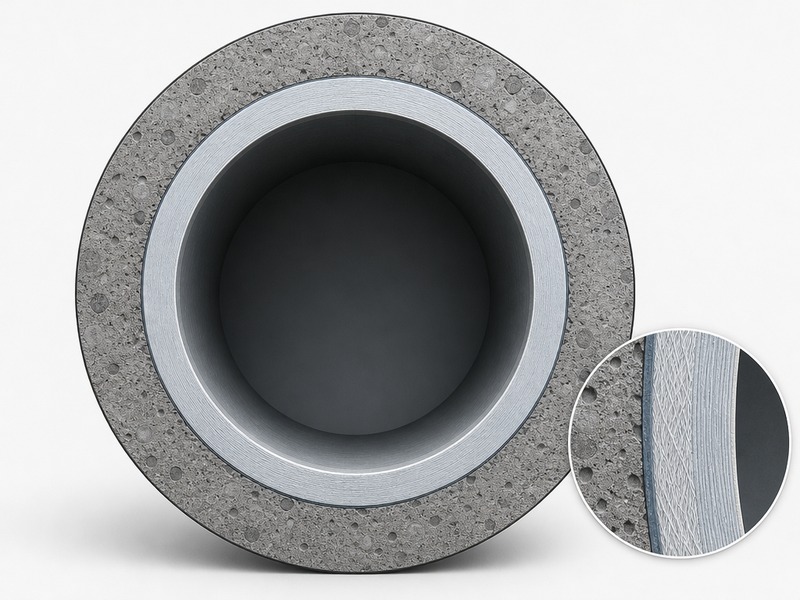
Two applicability limits matter most. First, CIPP reproduces the existing line and level, so it fits a sewer whose grade already draws the design flow; a sagging or back-graded line stays sagging. Second, it delivers a reduced bore: the liner reduces the internal diameter of the host pipe by roughly the liner wall thickness, plus any annular gap the design assumes, so flow capacity must be checked rather than assumed. On a pipe already near capacity, that difference decides whether lining is viable at all.
How Long Does CIPP Last, and How Is Quality Verified?
The customary design horizon for CIPP is 50 years. A published water-industry standard draft works through liner thickness against a 50-year service life, and the San Francisco Public Utilities Commission’s public fact sheet describes CIPP as long-lasting with a 50-year design life, citing lower cost and reduced community impact as the drivers. Those are design targets, not a guarantee, because life depends on the host, the effluent and the installation quality.
Quality is verified per liner, not per project. Contractors submit wet-out and cure logs for each liner recording resin type and cure details, and the quantity of resin must be sufficient to fill all of the felt voids. The NASSCO CIPP Installation Performance Specification Guideline from 2023 expects key personnel to hold documented experience, and it cites three years of cumulative experience installing CIPP in pipe of similar size, length and configuration. The same guideline requires a pre-liner tube except where pulled-in tubes carry an exterior coating, or where UV or LED wet-out tubes contain an inner and outer foil.
On the CCTV surveys our pipeline inspection service reviews after lining, the pass or fail usually comes down to wrinkles, wall-thickness samples and service reconnections rather than the headline cure method. The IKT institute describes a minimum testing scope centered on a three-point bending test for modulus of elasticity and bending stress, alongside other listed tests. For most municipal work, a CIPP lining is accepted on the strength of those records plus post-installation CCTV.
First-hand experience matters here because the process is unforgiving at the margins. A liner that cures a few degrees cold, or that is pulled through a host with a sharp offset, can look acceptable on the day and still miss the design wall thickness. The records are what make that visible before the pipe goes back into service.
When Is CIPP the Wrong Choice?
Cured in place pipe lining is the wrong choice when the host pipe cannot support it or when the owner needs something the method cannot deliver. Naming those cases up front saves owners from a lining that fails its purpose even though it was installed correctly.
Applicable host condition: CIPP fits a host pipe that still holds its basic shape and structural continuity. Where the pipe is collapsed, severely deformed or missing, open-cut replacement is the method to scope instead. Where the line has to be lifted back to a design grade or restored to its full original bore, trenchless pipe lining is the wrong choice even though it is technically feasible.
On building-side scopes, check the reported plumbing-code language, which also places limits on using CIPP where the existing piping is compromised. Odor and styrene emission during installation are real, managed issues rather than marketing problems, and they belong in the site plan alongside bypass pumping.
In our bid reviews, the projects that should not be lined are usually visible before pricing: a confirmed collapse or a grade defect on the survey. Our field teams record those defects as a reason to scope a different method rather than to force a liner into a pipe that cannot hold it. That single decision is often worth more than any saving on the liner itself.
Cured in Place Pipe Lining: Frequently Asked Questions
Is CIPP a coating or a structural liner?
It is a structural liner, not a coating. A coating follows the inside surface and adds little or no load capacity, while a CIPP lining is designed as a new pipe wall that carries load under a defined design condition. That is why the wall thickness is computed rather than chosen by feel.
What diameter pipe can be lined with CIPP?
From 2 in. to 108 in. under the governing standard, with field practice concentrated on about 6 in. to 96 in. The low end covers laterals and small branches, and the high end covers large trunk sewers where access still often needs excavation.
Does CIPP reduce the inside diameter of the pipe?
Yes, by roughly the liner wall thickness plus any annular gap the design assumes. The loss is usually small on a gravity sewer but is not zero, so flow capacity should be checked rather than assumed, especially on lines already near capacity.
How long does a CIPP liner last?
The customary design horizon is 50 years. A published water-industry standard draft designs thickness against a 50-year service life, and a public utility fact sheet describes CIPP with a 50-year design life, citing lower cost and reduced community impact.
Can CIPP fix a collapsed or sagging pipe?
No. Lining needs a host that still holds its basic shape. A collapsed, severely deformed or missing section is not a lining candidate, and a sagging or back-graded sewer stays sagging because the liner follows the existing line and level.
Which curing method is used on most municipal sewers?
Hot water and steam are the traditional workhorses, and UV light is increasingly common. Typical published descriptions put steam and hot water at about one to four hours and UV curing at about one minute per meter, with ambient cure taking longest. The right choice depends on liner type, diameter and access.
النقاط الرئيسية
- Definition: cured in place pipe lining turns a resin-impregnated tube into a new structural pipe wall inside the existing pipe.
- النطاق: the governing standard is written for 2 in. to 108 in., while field practice concentrates on about 6 in. to 96 in. and larger trunk sewers need more access work.
- Design: partially and fully deteriorated host conditions drive the wall thickness, and the owner specifies which condition applies.
- Cure methods: hot water and steam suit thick felt liners and large diameters, while UV suits glass-fiber tubes where speed matters.
- Limits: trenchless pipe lining does not correct grade and does not restore the full bore, so flow capacity must be checked rather than assumed.
- When it is wrong: a collapsed, deformed or missing host, or a line that needs grade correction, is a job for replacement, not lining.
How JSW Supports Cured in Place Pipe Lining Projects
JSW is a pipeline engineering and construction company that executes trenchless rehabilitation with its own crews and equipment. Our scope covers pipe restoration solutions, inserted hose lining, pipeline repair services, trenchless technologies and pipeline inspection services. We work on oil and gas, water and infrastructure pipelines, and we publish our certifications and a factory showcase.
For lining projects, we keep the process auditable end to end: CCTV before and after, wet-out and cure logs for every liner, and samples with test records. Thickness designs and material recommendations are reviewed by professional engineers before bid, and our pricing states the bypass and access assumptions instead of burying them.
- Integrated delivery: inspection, design, lining and service reinstatement handled by one team rather than handed between subcontractors.
- Auditable process data: a per-liner cure log recording resin type, cure temperature and cure time, plus test records where specified.
- Risk-explicit pricing: bypass pumping, access, groundwater and reinstatement are stated up front so the number is comparable.
- Compliance and safety: styrene and odor control, cure-water handling and confined-space procedure are planned, not improvised.
Not sure whether your pipe is a lining candidate? Send your pipe size, material and the latest CCTV survey for a free technical review. Our engineers respond with a scoped recommendation and a budget range.





































 English
  Arabic
  Russian
  Spanish
  French
  Vietnamese
  Polish
  Thai
Thai  Indonesian
  Turkish
  Portuguese