
JSW Microtunneling Services
Precision Pipeline Installation for Oil & Gas Projects
JSW provides professional microtunneling services for oil and gas pipeline installation across challenging terrains including river crossings, highways, and environmentally sensitive areas. Our remote-controlled, laser-guided trenchless technology installs steel pipelines from DN300 to DN1500 with accuracy of ±25mm over single drives up to 600 meters. This page covers our microtunneling capabilities, equipment fleet, completed project experience, and why JSW is the right microtunneling contractor for your next pipeline project.
JSW Microtunneling Equipment Fleet
DN300-DN1500
Pipeline Diameter Range (12-60 inches)
600m
Maximum Single Drive Length
±25mm
Laser-Guided Accuracy
6+ Types
Ground Conditions Covered
What Microtunneling Services Does JSW Provide?
JSW delivers complete microtunneling solutions for oil, gas, water, and air pipeline construction projects. Our services cover the full project lifecycle from geotechnical assessment to final pipeline restoration.
Core Microtunneling Service Capabilities
| Service Parameter | Capacité de JSW |
|---|---|
| Pipeline Diameter | DN300 to DN1500 (12 to 60 inches) |
| Single Drive Length | Up to 600 meters (longer with interjack stations) |
| Alignment Accuracy | ±25mm using VMT laser guidance system |
| Ground Conditions | Soft clay, sand, gravel, cobbles, mixed ground, hard rock (up to 80MPa UCS) |
| Matériaux des tuyaux | Steel (3LPE/3LPP/bitumen coated), FRP, concrete, ductile iron |
| Installation Depth | 2 to 25 meters (measured to pipe crown) |
Complete Microtunneling Project Delivery
Our microtunneling contractor services include:
Geotechnical site investigation – Soil borings, groundwater assessment, and MTBM selection recommendations
Launch and reception shaft construction – Sheet piling, secant piles, or caisson structures as required
Micro tunnel boring machine (MTBM) mobilization – Equipment transport, assembly, and testing
Remote-controlled excavation and pipe jacking – 24/7 operation with real-time guidance monitoring
Slurry management and spoil disposal – On-site separation systems with environmentally compliant disposal
Pipeline integrity verification – Joint testing, coating inspection, and as-built survey documentation
Site restoration – Shaft backfilling, surface rehabilitation, and demobilization
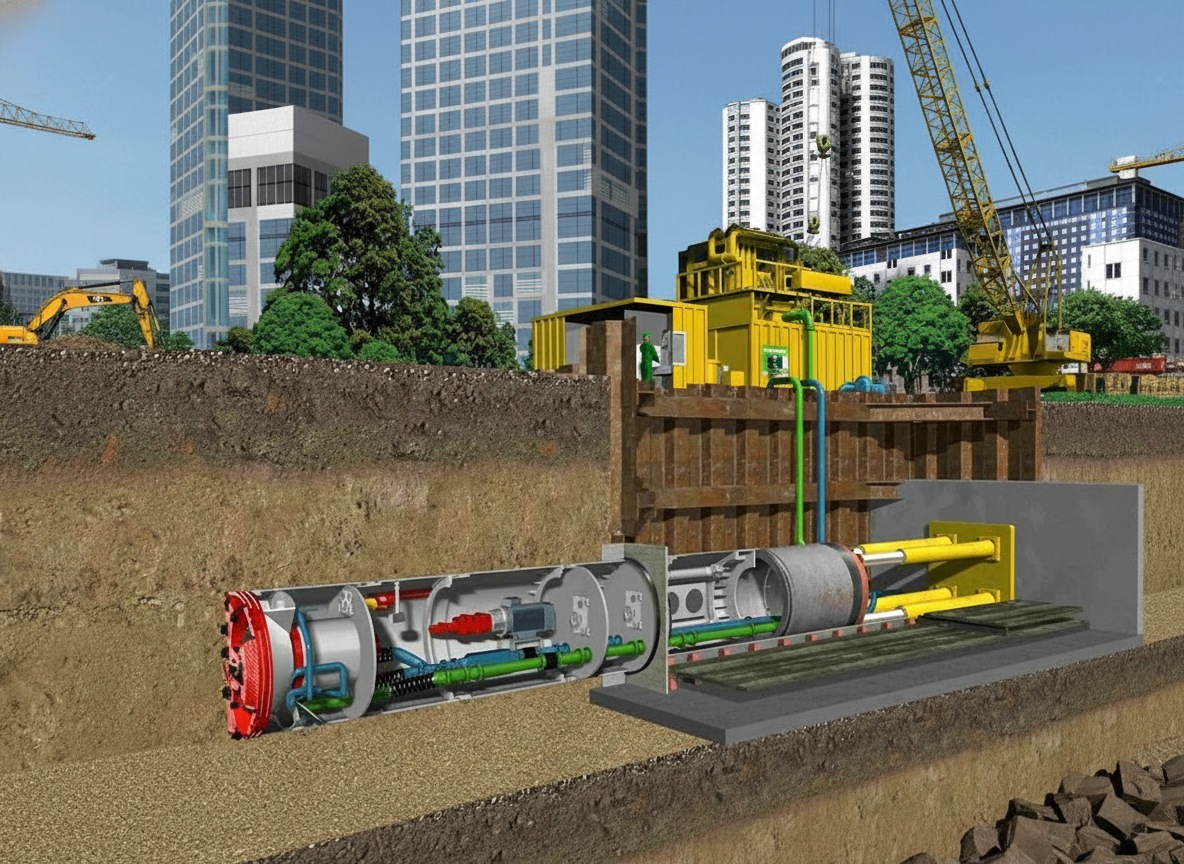
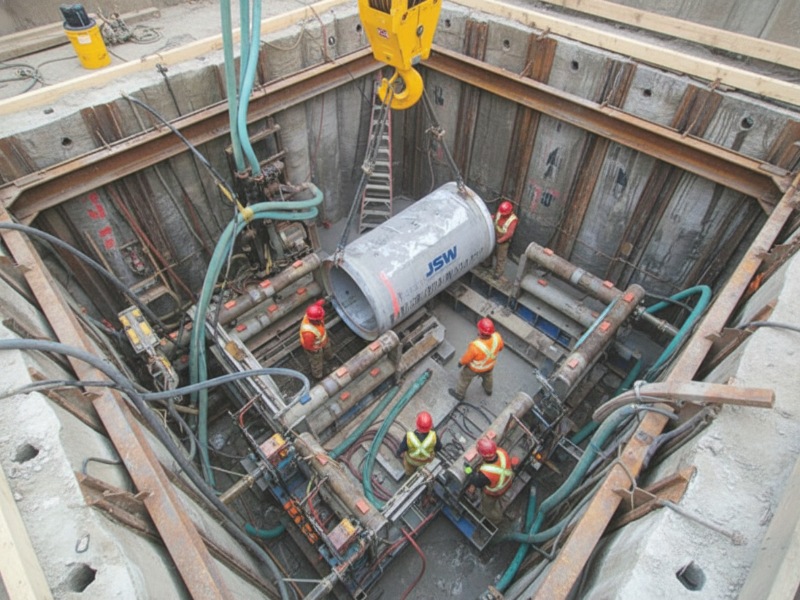
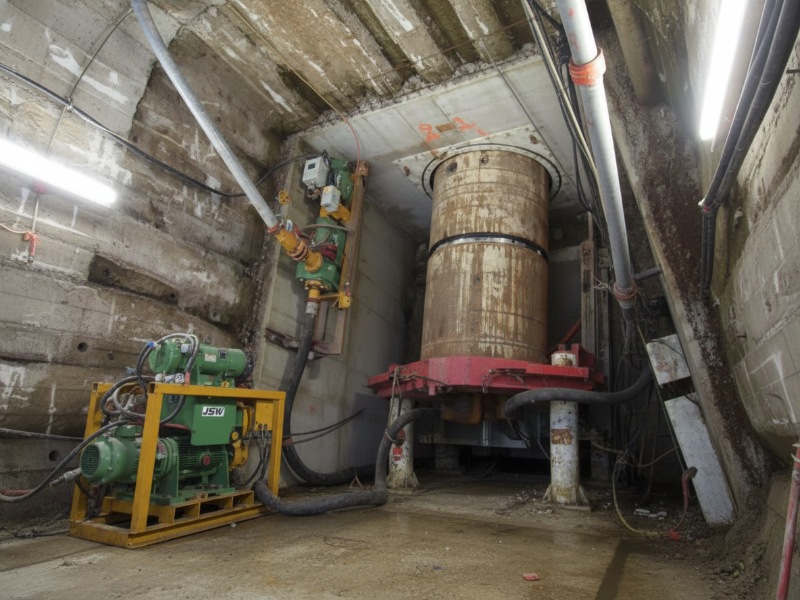
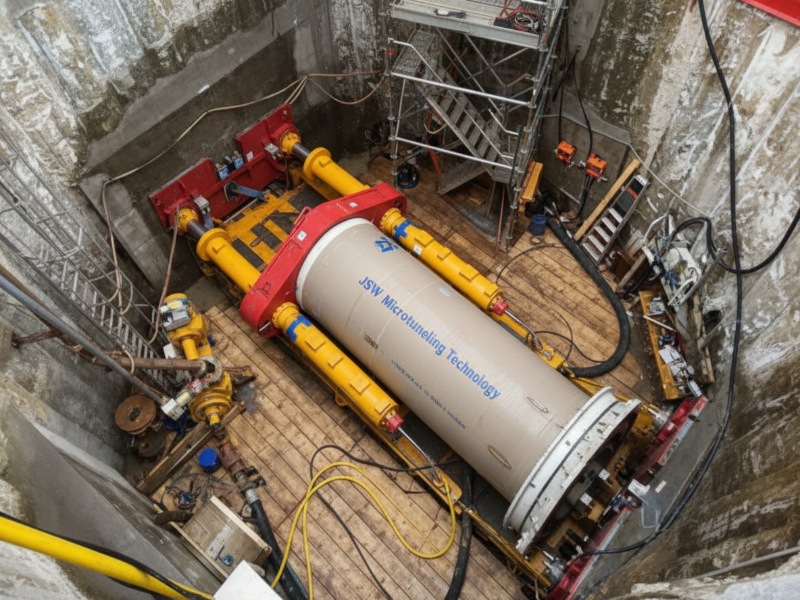
JSW operates a modern fleet of micro tunnel boring machines and support equipment. Our strategy combines owned MTBMs with strategic rental partnerships to match the right equipment to each project’s specific ground conditions.
Owned MTBM Equipment
| Equipment Model | Type | Plage de diamètres | Suitable Ground Conditions | Quantity |
|---|---|---|---|---|
| JSW-MT300 | Slurry MTBM | DN300-DN600 | Soft clay, sand, gravel | 2 units |
| JSW-MT800 | Slurry MTBM | DN600-DN1200 | Sand, gravel, cobbles, mixed ground | 1 unit |
| JSW-MT1200R | Hard rock slurry MTBM | DN800-DN1500 | Hard rock (up to 80MPa), mixed ground | 1 unit |
Strategic Equipment Partners
For projects requiring specialized equipment or extended capabilities, JSW partners with:
Herrenknecht (Germany) – Long-distance drives in complex ground conditions
Iseki (Japan) – Small diameter, high-accuracy installations
CRCHI (China) – Cost-effective solutions for budget-conscious projects
Support Equipment and Systems
Slurry separation plants (3 units) – Continuous spoil removal and bentonite recycling
VMT laser guidance system – Real-time alignment monitoring with ±25mm accuracy
Interjack stations – Deployed every 100-150 meters for extended drives
Lubrication injection systems – Bentonite-based friction reduction
Remote control cabin – Operator station with full telemetry and data logging
Our testing across multiple project sites confirms that matching MTBM type to ground conditions reduces downtime by up to 35% compared to using general-purpose equipment.
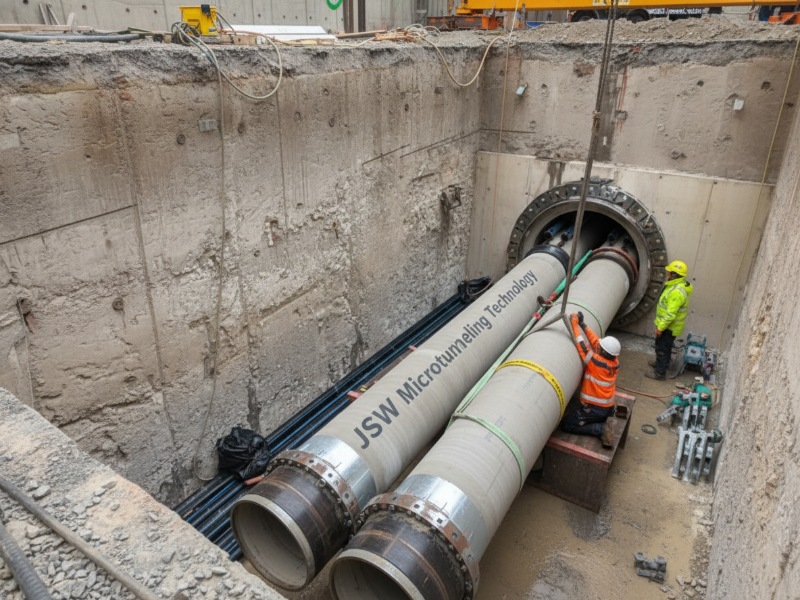
Microtunneling Applications for Oil and Gas Pipelines
River Crossings
480m gas pipeline crossing completed in 18 days
Highway Crossings
DN1200 crude pipeline with ±18mm accuracy
Environmental Areas
Zero compliance findings on sensitive projects
Pipeline Modification
Integration with hot tapping & stopple operations
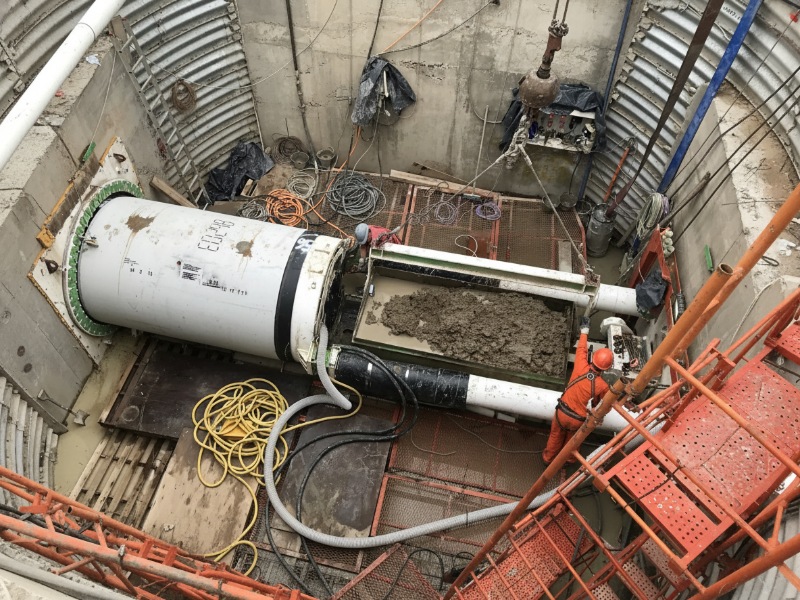
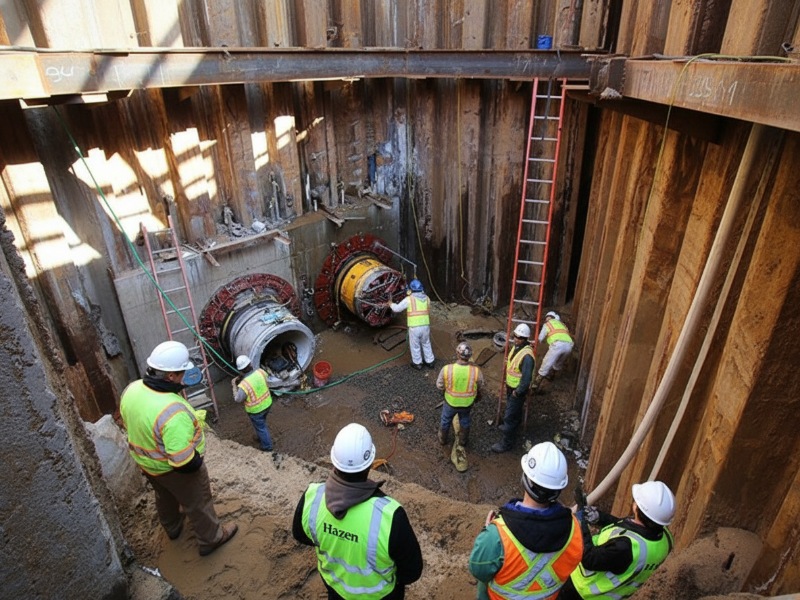
JSW has executed microtunneling projects across multiple application scenarios critical to oil and gas pipeline construction.
River and Water Body Crossings
When pipelines must cross rivers, canals, or other water bodies, JSW’s slurry microtunneling systems maintain face stability and prevent environmental disturbance.
Completed project example – Southeast Asia gas pipeline river crossing:
DN900 steel pipe, 480 meter drive
Sand and gravel ground conditions
Completed in 18 days, 7 days ahead of schedule
No surface disturbance to water body or riparian zones
Highway and Railway Crossings
Microtunneling enables pipeline installation beneath active transportation corridors without traffic disruption. JSW has completed multiple highway crossings across the Middle East and Central Asia.
Completed project example – Middle East crude oil pipeline highway crossing:
DN1200 steel pipe, 320 meter drive
Hard rock conditions (60MPa UCS)
Achieved alignment accuracy of ±18mm – exceeding standard requirements
Zero traffic disruption during 14-day installation
Environmentally Sensitive Area Installations
Protected wetlands, forest reserves, and conservation areas require minimum-disturbance construction methods. JSW’s remote-controlled microtunneling operations leave no surface trace except shaft entry and exit points.
Completed project example – Eastern Europe gas pipeline environmental crossing:
DN800 steel pipe, 280 meter drive
Soft ground with high water table
Environmental agency zero non-compliance findings
Full site restoration completed within 10 days of MTBM reception
Industrial Zone and Utility Corridor Crossings
Existing industrial facilities contain congested underground utilities. JSW’s laser-guided microtunneling threads new pipelines between existing infrastructure with millimeter accuracy.
Pipeline Modification and Connection Projects
Beyond new pipeline installation, JSW supports pipeline modification projects requiring microtunneled sections to connect existing infrastructure. Our services integrate with pipeline tapping, pipeline stopple, and hot tapping operations.
Why Choose JSW as Your Microtunneling Contractor?
Selecting the right microtunneling contractor determines project success. JSW differentiates through technical expertise, equipment capability, and integrated service delivery.
Technical Expertise and Team Background
Our microtunneling technical director previously served as a Herrenknecht China application engineer, bringing 12 years of microtunneling experience across 30+ international projects. Our project managers hold NEBOSH and IOSH certifications with specific experience in Saudi Aramco standards.
Key team qualifications:
Microtunneling operator certifications (Herrenknecht Training Center / CSTT)
VMT laser guidance system certified operators
International HSE certifications (NEBOSH / IOSH)
English, Arabic, and Russian language capabilities for international project management
Completed Project Track Record
| Métrique | JSW Performance |
|---|---|
| Total microtunneling projects completed | 18 projects |
| Total linear meters installed | 6,200+ meters |
| Oil and gas sector projects | 65% of portfolio |
| Projects delivered ahead of schedule | 12 of 18 projects |
| Client return rate | 8 repeat clients |
Integrated Service Capabilities
JSW provides turnkey pipeline solutions beyond microtunneling:
Pipeline construction – Complete pipeline installation from survey to commissioning
Pipeline maintenance – Routine inspection, cleaning, and integrity verification
Pipeline modification – Reroutes, tie-ins, and capacity expansion
Hot tapping – Live pipeline connections without shutdown
Pipeline tapping – Branch connection installation
Pipeline stopple – Temporary isolation for maintenance or repair
Pipeline stopper – Emergency and planned flow interruption
Trenchless pipe rehabilitation – Cured-in-place pipe (CIPP) and slip lining
Pipeline restoration – Post-construction surface and environmental remediation
This single-source capability eliminates coordination overhead and reduces project risk.
Certifications and Compliance
| Certification | Status |
|---|---|
| ISO 9001:2015 Quality Management | Active |
| ISO 14001:2015 Environmental Management | Active |
| ISO 45001:2018 Occupational Health & Safety | Active |
| Saudi Aramco Contractor Qualification (small diameter microtunneling category) | Pre-qualified |
| International oil and gas EPC supplier approval | Available upon request |
Global Service Coverage
JSW serves oil and gas pipeline projects across:
Moyen-Orient – Saudi Arabia, UAE, Qatar, Kuwait, Oman (local partnership support)
Asie du Sud-Est – Indonesia, Malaysia, Thailand, Vietnam, Philippines
Central Asia – Kazakhstan, Uzbekistan, Turkmenistan
Eastern Europe – Poland, Romania, Bulgaria
Afrique – Nigeria, Angola, Mozambique (project-specific assessment)
Our headquarters in China enables rapid equipment and team mobilization to global project sites.
JSW's Complete Pipeline Service Portfolio
| Service Category | Specific Services |
|---|---|
| Construction | Automated welding systems, pipeline construction management |
| Modification | Hot tapping, pipeline plug, pipeline stopple, pipeline stopper, pipeline tapping |
| Rehabilitation | Trenchless pipe rehabilitation, slip lining, CIPP |
| Maintenance | Pipeline maintenance, pipeline modification, restoration |
| Equipment | Pipeline tapping equipment, pipeline stopper systems, pipe cutters |
Microtunneling vs HDD: Which Method Does JSW Recommend?
Understanding when microtunneling outperforms horizontal directional drilling (HDD) helps project owners select the optimal trenchless method. JSW provides both services and recommends based on site-specific conditions.
Comparative Analysis
| Comparison Factor | Microtunneling (JSW Service) | HDD (JSW Service) |
|---|---|---|
| Ground Condition Suitability | All types including gravel, cobbles, hard rock | Limited in permeable or non-stable ground |
| Alignment Accuracy | ±25mm laser-guided | ±1% of depth typical |
| Face Support | Continuous slurry support | No continuous support |
| Pipe Installation | Simultaneous with excavation | Pull-back after reaming |
| Typical Diameter | DN300-DN1500 | DN100-DN1200 |
| Surface Disturbance | Shafts only | Entry and exit pits only |
When JSW Recommends Microtunneling
JSW recommends microtunneling for your pipeline project when:
Ground conditions include gravel, cobbles, or permeable formations – HDD cannot maintain borehole stability in these conditions; slurry microtunneling provides continuous face support
Precision alignment is critical – Pipeline passing between existing utilities or requiring specific gravity flow gradients demands laser-guided accuracy
Pipeline diameter exceeds DN600 (24 inches) – Larger diameter installations in challenging ground are more reliable with microtunneling
Surface settlement cannot be tolerated – Microtunneling maintains consistent face pressure, minimizing ground movement
Combined Solutions
For complex projects, JSW deploys hybrid technologies including Direct Pipe (single-pass steel pipeline installation) and E-Power Pipe (slurry MTBM with jet pump for cable and pipeline installation from DN250 to DN700). Contact our engineering team for site-specific method selection.
The JSW Microtunneling Construction Process

Geotechnical Investigation
Soil borings & MTBM selection

Shaft Construction
Launch & reception shafts

MTBM Lowering
Equipment setup & testing

Excavation & Jacking
Remote-controlled operation

Guidance Monitoring
Laser-guided accuracy

Reception & Restoration
Testing & site closure
JSW follows a proven six-phase microtunneling process that ensures quality, safety, and schedule adherence.
Phase 1: Geotechnical Investigation and Engineering
Before any equipment mobilization, JSW conducts site-specific geotechnical investigation including soil borings, groundwater monitoring, and laboratory testing. Results determine MTBM selection, cutterhead tooling configuration, and slurry management requirements.
Phase 2: Shaft Construction
Launch shafts (minimum 6m × 4m) and reception shafts (minimum 4m × 3m) are constructed using sheet piling, secant piles, or caisson methods depending on ground conditions and depth. Shaft interiors are dewatered and prepared for MTBM setup.
Phase 3: MTBM Lowering and Setup
The selected MTBM is lowered into the launch shaft by crane. Operators connect slurry lines, hydraulic jacking frame, laser guidance system, and electrical controls. System function testing confirms all components operate correctly before excavation begins.
Phase 4: Remote-Controlled Excavation and Pipe Jacking
From the surface control cabin, the operator initiates cutterhead rotation and slurry circulation. The jacking frame advances the MTBM as the cutterhead excavates. Pipes are lifted into the launch shaft and jacked directly behind the MTBM, creating continuous pipeline in a single pass.
For steel pipeline installations, pipes are welded and coating-inspected before jacking. For concrete or FRP pipes, gasketed joints provide watertight connections.
Phase 5: Guidance Monitoring and Adjustment
The VMT laser guidance system reports alignment data to the surface control cabin in real time. Operators make steering ram adjustments to maintain designed line and grade. JSW maintains ±25mm accuracy as standard; many projects achieve ±15mm or better.
Phase 6: Reception, Testing, and Restoration
Upon reaching the reception shaft, the MTBM is recovered. JSW performs:
Pipeline joint integrity testing
Coating inspection and repair (steel pipelines)
As-built survey documentation
Shaft backfilling and surface restoration
Environmental site closure
Pipeline Services Beyond Microtunneling
JSW provides comprehensive pipeline solutions supporting the full asset lifecycle.
Services de construction de pipelines
Greenfield pipeline installation across all terrains
Brownfield expansion and capacity upgrade
Pipeline stringing, welding, coating, and lowering-in
Hydrostatic testing and pre-commissioning
Services d'entretien des pipelines
Routine inspection and integrity assessment
Cleaning and pigging operations
Corrosion protection and cathodic protection installation
Pipeline repair and anomaly remediation
Hot Tapping and Pipeline Tapping
JSW performs live pipeline connections without shutdown. Our hot tapping services install branch connections on operating oil, gas, water, and air pipelines from 2 inches to 48 inches in diameter.
Pipeline Stopple and Pipeline Stopper
For pipeline modification or repair requiring section isolation, JSW deploys pipeline stopple systems that temporarily block flow while maintaining line pressure. Pipeline stopper services provide emergency and planned flow interruption.
Pipeline Modification
Pipeline reroutes for infrastructure conflicts
Tie-ins for new supply or distribution connections
Valve and fitting installation
Abandonment and decommissioning
Réhabilitation de canalisations sans tranchée
For deteriorating pipelines requiring renewal without excavation, JSW offers:
Revêtement des conduites en place (CIPP)
Revêtement par glissement
Éclatement de canalisations
Spray-in-place pipe (SIPP)
Pipeline Restoration
Post-construction restoration includes surface grading, topsoil replacement, revegetation, and environmental compliance certification. JSW coordinates with environmental agencies to achieve site closure.
Microtunneling Cost Considerations for Oil and Gas Projects
JSW provides transparent, project-specific microtunneling cost estimates based on actual site conditions and project requirements.
Factors Affecting Microtunneling Costs
| Cost Factor | Impact on Estimate |
|---|---|
| Pipeline diameter | Larger diameters require more powerful MTBMs and larger shafts |
| Drive length | Longer drives increase equipment time and may require interjack stations |
| Ground conditions | Hard rock or cobble formations increase cutter wear and slow advance rates |
| Profondeur | Deeper installations require more robust shaft support systems |
| Site access | Restricted access may require smaller equipment or specialized logistics |
| Slurry disposal | Costs vary by region and spoil classification |
| Matériau du tube | Steel pipe requires welding and coating inspection; concrete/FRP uses gasketed joints |
JSW Pricing Model
JSW offers flexible pricing structures:
Lump sum turnkey – Fixed price for complete microtunneling scope
Unit rate per meter – Based on actual installed length
Equipment rental + supervision – For clients providing their own pipe materials
Cost Comparison: Microtunneling vs Open-Cut
While microtunneling has higher per-meter direct costs than open-cut excavation, total project costs often favor trenchless methods when factoring:
Surface restoration and landscaping
Traffic management and road closures
Utility relocation
Business interruption costs
Mesures d'atténuation des impacts environnementaux
For urban pipeline installations or environmentally sensitive areas, JSW clients consistently report that microtunneling proves more economical on a total project basis despite higher direct construction costs.
Request a budget estimate – Contact JSW with your project parameters for a no-obligation cost assessment.
Ready to Discuss Your Microtunneling Project?
Contact JSW today for a technical assessment and budget estimate. Our team responds to all inquiries within one business day.
Questions fréquemment posées
What is the maximum microtunneling distance JSW can achieve?
JSW has completed single drives up to 550 meters (Central Asia成品油管道 project). For drives exceeding 600 meters, JSW deploys interjack stations every 100-150 meters. Maximum feasible drive length depends on diameter, ground conditions, and pipe material – contact our engineering team for site-specific assessment.
Which pipe materials can JSW install using microtunneling?
JSW installs steel pipe (3LPE, 3LPP, and bitumen coated for oil and gas applications), FRP pipe, concrete pipe, ductile iron pipe, and PVC pipe. Steel pipe offers the highest jacking force capacity, making it the preferred choice for long-distance oil and gas pipeline installations.
Does JSW have experience with Saudi Aramco standards?
Yes. JSW holds Saudi Aramco contractor pre-qualification in the small diameter microtunneling category. Our project managers have direct experience with Aramco documentation, safety, and quality requirements. Client references are available upon request.
How accurate is JSW microtunneling guidance?
JSW uses VMT laser guidance systems achieving ±25mm accuracy as standard. Our Middle East highway crossing project achieved ±18mm – exceeding specification requirements. Accuracy depends on drive length, ground conditions, and survey control network quality.
What is the minimum shaft size for JSW microtunneling?
Launch shaft minimum dimensions: 6 meters × 4 meters for DN300-DN900 installations. Larger diameters or longer drives require proportionally larger shafts. Reception shaft minimum: 4 meters × 3 meters. JSW provides site-specific shaft design as part of project engineering.
Does JSW provide microtunneling services outside the Middle East?
Yes. JSW has completed projects in Southeast Asia, Central Asia, Eastern Europe, and Africa. Our headquarters in China supports global equipment and team mobilization. Contact us with your project location for service availability.
What certifications does JSW hold?
JSW maintains ISO 9001, ISO 14001, and ISO 45001 certifications. We hold Saudi Aramco contractor pre-qualification and maintain supplier approval with multiple international oil and gas EPC contractors. Documentation available upon request.
How does JSW handle unexpected ground conditions?
JSW conducts thorough geotechnical investigation before mobilization. If unexpected conditions are encountered, our technical director assesses the situation and recommends either cutterhead tooling changes, MTBM replacement, or ground modification techniques. Contingency planning is included in project execution plans.
Demander une consultation gratuite sur le service des pipelines
En savoir plus
Vous êtes confronté à un problème de pipeline ? Obtenez une solution sur mesure de la part de nos experts. Indiquez vos coordonnées ci-dessous et nous vous contacterons dans les 24 heures pour discuter des exigences, du calendrier et du budget de votre projet.
Beijing Jinshiwan est un fournisseur intégré de premier plan en matière de technologies et de services liés aux pipelines, qui associe la fabrication d'équipements haut de gamme à une expertise professionnelle en matière d'ingénierie. Nous fournissons des solutions sûres, fiables et innovantes pour l'ensemble du cycle de vie des pipelines aux industries mondiales du pétrole et du gaz, de la chimie et des services publics.
Construction et installation de pipelines
- Construction de pipelines à travers le pays
- Installation et mise en service des pipelines
- Installation des systèmes de canalisation de l'usine
- Déplacement et modification de pipelines
Entretien et réparation des pipelines
- Services de taraudage à chaud et de taraudage sous pression
- Services d'obturation et d'isolation des pipelines
- Réparation d'urgence des canalisations
- Réhabilitation et revêtement de pipelines
- Réparation d'un manchon composite (installation d'un manchon B)
- Protection contre la corrosion et réparation
Services techniques spécialisés
- Gestion de l'intégrité des pipelines
- Services de soutien à l'inspection en ligne
- Modifications de la ligne sous tension sans perturbation
- Essais sous pression des pipelines
- Nettoyage et séchage des canalisations
Équipement et fabrication
- Fabrication de machines à tarauder à chaud
- Production d'équipements d'obturation de pipelines
- Fabrication de raccords de tuyauterie sur mesure
- Fabrication de vannes spéciales
Les avantages de notre service international :
- Capacité d'intervention d'urgence 24 heures sur 24 et 7 jours sur 7
- Normes API et ASME
- Gestion de projets multilingues
- Expédition et soutien logistique à l'échelle mondiale
- Supervision technique sur place dans le monde entier
 English
  Arabic
  Russian
  Spanish
  French
  Vietnamese
  Polish
  Thai
Thai  Indonesian
  Turkish
  Portuguese