
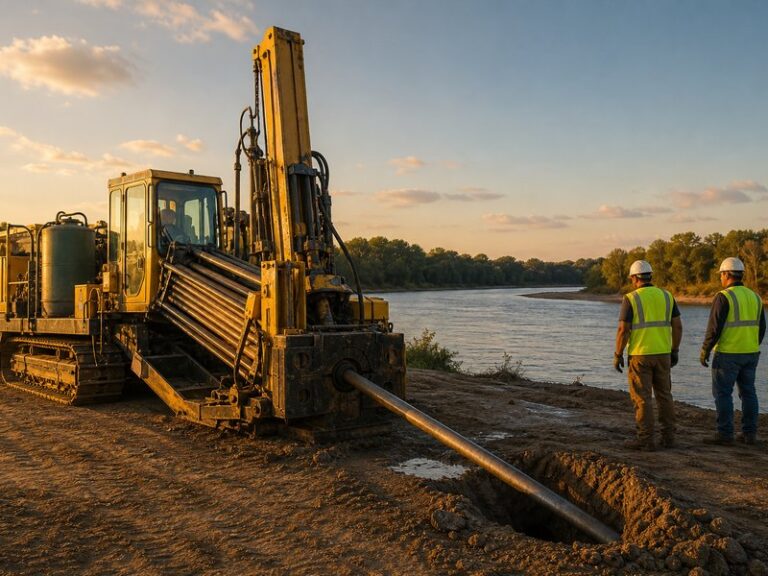
Horizontal directional drilling (HDD) is a steerable, trenchless method that installs pipelines, conduits and cables underground along a controlled arc without open-cut excavation. The process works in three stages: a small pilot hole is drilled along the design path, the bore is enlarged by reaming, and the product pipe is pulled back through the finished hole.
This guide explains how HDD works step by step, what equipment and drilling fluids it relies on, what HDD projects cost, and when it beats open trenching and other trenchless technology alternatives, so you can judge whether HDD fits your crossing.
Key takeaways:
- HDD is a steerable, trenchless method that installs pipes and cables beneath obstacles without open-cut trenching.
- Every HDD project runs the same three-stage sequence: pilot hole, reaming and pipe pullback.
- HDD is cost-effective when a trench would cross rivers, roads, railways or sensitive sites; for short, shallow open-ground runs, open cut is usually cheaper.
- Damage prevention (locate, pothole and maintain clearance) is the primary risk-control decision on every crossing.
- The global HDD market is projected to grow from about USD 9.2 billion (2025) toward USD 25 billion by 2034, roughly 11.7% CAGR.
What Is Horizontal Directional Drilling?
Horizontal directional drilling, also called directional boring, is a surface-launched trenchless technology for installing pipes, conduits and cables beneath roads, railways, rivers, shorelines and environmentally sensitive areas. A drill rig positioned at ground level guides a rotating drill string along a curved underground path from one surface point to another, so no continuous trench is needed and surface disruption is limited to small entry and exit pits.
The standard industry definition, published in the NASTT glossary, describes HDD as a process that creates a pilot bore along the design pathway, reams the pilot bore in one or more passes to a diameter suitable for the product pipe, and pulls the product pipe into the prepared bore as the final step. The method traces its lineage to directional drilling in the oil and gas industry, but HDD operates at shallow depths, on shorter distances and with much tighter steering control, so the two techniques serve different purposes.
Scale matters in terminology. “Directional boring” is generally reserved for mini and small rigs, small pipe diameters and crossings measured in hundreds of feet. The term HDD usually describes large, maxi-class rigs, large diameters and crossings measured in thousands of feet. In practice, crews use the two labels interchangeably, and the rig class, not the name, determines what a project can achieve.
| Rig Class | Typical Pullback | Typical Bore Length | Common Use |
|---|---|---|---|
| Mini HDD rig | Up to 100,000 lb | Up to a few hundred feet | Service connections, short road and driveway crossings, telecom and power conduits |
| Midi HDD rig | 100,000-250,000 lb | Up to about 1,000 ft | Municipal water, sewer and gas lines under roads and small rivers |
| Maxi HDD rig | More than 250,000 lb, up to about 1,320,000 lb | Thousands of feet | Major river, highway and rail crossings, large-diameter oil, gas and water pipelines |
For brand-level comparisons of rig manufacturers, see our HDD rig brands guide.
How Does Horizontal Directional Drilling Work?
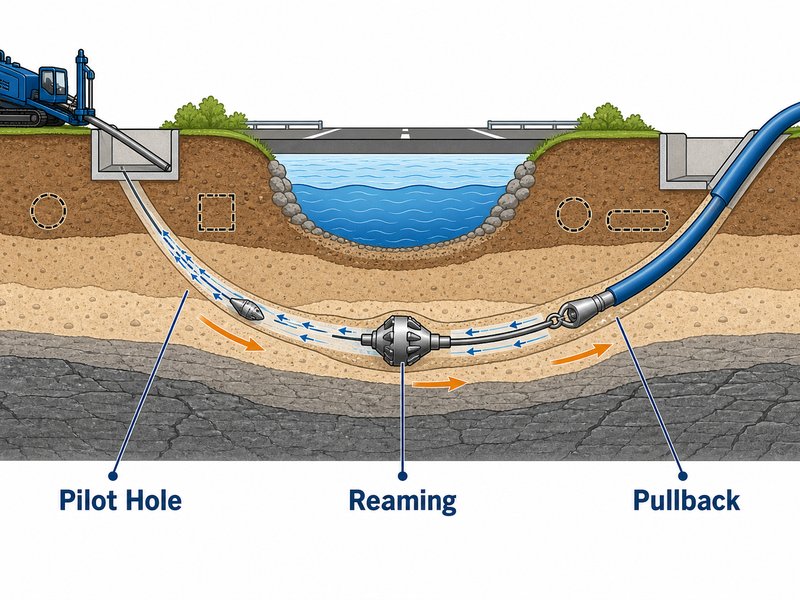
Every HDD project follows the same three-stage sequence: pilot hole, reaming and pullback. The stages are executed in one continuous operation, and the same drill rig, drill pipe and mud system remain in service from the first cut to the final pull.
Stage 1: Pilot Hole Drilling
A small-diameter pilot hole, typically a few inches across, is drilled from the entry point to the exit point along the engineered bore path. The drill head is steerable: a bent housing or mud motor offsets the bit face, so the operator can curve the bore upward, downward or sideways by rotating the drill string to orient the bend and then advancing without rotation.
Steering accuracy depends on the guidance system. A walkover locator reads a sonde transmitter (the downhole beacon the surface locator tracks) behind the bit and is standard for shallow bores. A magnetic wireline system transmits inclination and azimuth data through the drill pipe and holds accuracy to about two percent of depth over distances beyond 2,000 m. A gyro-based system navigates autonomously and is used for long, congested crossings where surface access for a locator is impossible.
Stage 2: Reaming
Once the pilot hole reaches the exit pit, a back reamer is attached and pulled back through the bore to enlarge it. Large bores may require several reaming passes with progressively larger cutters, and the final reamer diameter is commonly 1.3 to 1.5 times the outside diameter of the product pipe. Swab passes may follow to clean and condition the hole before installation.
Stage 3: Pipe Pullback
The product pipe string is assembled on the exit side and connected to the reamer with a swivel, which prevents the pipe from rotating. The rig then pulls the pipe back through the enlarged bore in one continuous pull. Steel strings are welded and coated before pullback, HDPE and other plastic pipes are fused or joined on site, and buoyancy is controlled so large-diameter pipe does not float or drag in the bore.
Pipe string fabrication is where the drilling spread meets the pipeline construction spread. In our projects, the pullback schedule is planned together with pipe string assembly, automatic welding, cold bending and the cutting and bevelling work on the entry spread, because a stalled pullback is far more expensive than a well-prepared pipe string.
What Equipment Does an HDD Project Use?
A complete horizontal directional drilling spread includes far more than the rig. The typical equipment set covers the drill rig itself, a mud mixing and recycling system, high-volume pumps, drill pipe and downhole tooling, an excavator to handle pipe, water tanks, containment and disposal units, and the guidance electronics.
- Drill rig with rated thrust, pullback and rotary torque matched to the bore design.
- Drilling fluid mixing unit and a reclaimer that removes cuttings and recycles the mud.
- Downhole tooling: steerable pilot bits, hole-openers, back reamers, swab tools and swivels.
- Guidance package: walkover locator, magnetic wireline system or gyro tooling.
- Support plant: excavators, water supply, generators, containment tanks and lighting.
In our field experience, matching HDD equipment to the ground model matters more than raw rig size. An underpowered rig causes stuck pipe; an oversized reamer creates an unstable hole. The right spread is the one sized to the geology, the pipe diameter and the pullback load, not the largest machine available.
Why Is Drilling Fluid Essential in HDD?
Drilling fluid (also called drilling mud), usually a mix of water, bentonite clay and polymers, is pumped continuously to the drill head throughout the bore. It stabilizes the hole so it does not collapse, carries drill cuttings to the surface, cools the cutting tool and lubricates the pipe during pullback.
The fluid is a construction material as much as a lubricant. It holds cuttings in suspension so they do not clog the bore, and a reclaimer recycles the fluid to cut water consumption and disposal volume. Fluid management also carries environmental risk: if pressure exceeds the ground’s capacity, drilling fluid can escape to the surface or into a water body in an event called a frac-out. Disciplined crews monitor return flow, contain pits, and have a frac-out response plan before drilling starts.
What Can Horizontal Directional Drilling Be Used For?
Horizontal directional drilling is used to install utility and pipeline infrastructure almost everywhere open-cut work is impractical. Telecom and power conduits, water lines, sewer force mains, gas distribution lines, oil and product pipelines, and environmental remediation casings are all routine HDD applications. The method crosses roadways, railways, runways, rivers, wetlands, shore approaches and congested urban corridors without interrupting traffic or surface activity.
The market context explains why HDD keeps growing. The global horizontal directional drilling market was valued at roughly USD 9.2 billion in 2025 and is projected to approach USD 25 billion by 2034, according to industry research published in 2025 and 2026. At a compound annual growth rate (CAGR) of about 11.7 percent, growth is driven mainly by utility renewal, renewable energy grid connections and pipeline replacement programs.
HDD vs. Open-Cut Trenching and Other Trenchless Methods
Choosing between HDD and an open trench, between HDD and Direct Pipe, or between HDD and another trenchless method, depends on depth, length, accuracy, ground conditions and surface constraints. Open-cut excavation is simple and inexpensive for short, shallow runs, but it disrupts traffic, requires dewatering in wet ground, and is often impossible under rivers and sensitive sites. HDD removes those barriers but adds equipment and engineering cost.
Kỹ thuật đào hầm vi mô and pipe jacking are alternatives for straight, precise alignments, particularly for gravity sewers where HDD’s curved profile is not acceptable. HDD remains the most flexible method when the alignment must curve, when the crossing is long and shallow, or when the product pipe must follow a specific corridor.
| Tiêu chí | HDD | Open-Cut Trenching | Kỹ thuật đào hầm vi mô |
|---|---|---|---|
| Surface disruption | Minimal; entry and exit pits only | Full-length trench, traffic and landscape impact | Minimal; launch and reception shafts |
| Alignment | Curved, steerable | Straight or any above-ground path | Straight, high precision |
| Depth range | Shallow to tens of metres | Practical to about 5-6 m | Deep, up to tens of metres |
| Typical pipe | Steel, HDPE, PVC, ductile iron, polypropylene | Any material | Concrete, steel, RCP, HDPE |
| Best use | Rivers, roads, rails, congested corridors, curved alignments | Short, shallow, low-cost runs with open space | Gravity sewers, deep straight crossings |
What Are the Advantages and Limitations of HDD?
HDD offers clear benefits, and it has equally clear limits. An honest assessment of both is the fastest way to decide whether HDD fits a project.
- Minimal surface disruption: no continuous trench, no traffic closures beyond the work areas.
- Crosses obstacles: rivers, railways, highways, runways and sensitive habitats without surface work.
- No dewatering: the bore is created below the water table without open pits.
- Depth flexibility: pipe can be installed at depths where open-cut work is not practical.
- Faster restoration: entry and exit areas are restored quickly compared with a full-length trench.
The limitations are equally real. HDD is not suitable in ground with large cobbles, boulders or coarse gravel, in heavily fractured or karstic rock, or where borehole stability cannot be maintained. Accuracy decreases with depth, so very deep crossings need wireline or gyro guidance at higher cost. Frac-out risk exists wherever drilling fluid is pumped, and a failed bore can strand pipe underground. For short, shallow, simple runs in open ground, open-cut excavation is usually faster and cheaper.
In our experience, the most common HDD failure is not the machine but the ground model. One project we reviewed planned a river crossing in what the geotechnical report called uniform sand; the first reaming pass hit a buried gravel lens, fluid returns stopped, and the rescue consumed the entire contingency. Ground truthing before drilling is not an extra step; it is the step.
How Much Does HDD Cost?
HDD cost is driven by site conditions and machine time, not by materials. Bore length, pipe diameter, geology, drilling fluid volumes and disposal, mobilization and restoration dominate the price, and each project is priced against its own bore plan.
As a rough benchmark, short utility service bores can be completed for a few thousand dollars, mid-size municipal crossings commonly range from tens of thousands to several hundred thousand dollars, and large maxi river or highway crossings typically reach millions. The single most reliable way to compare HDD cost is an itemized bid against a defined design, which separates genuine pricing from hidden scope.
| Cost Driver | Why It Matters |
|---|---|
| Bore length and depth | Longer and deeper bores add rig time, steering passes and pullback risk. |
| Pipe diameter and material | Larger diameters require more reaming passes and heavier pullback loads. |
| Soil and rock conditions | Rock multiplies bit wear, fluid demand and drilling time. |
| Drilling fluids and disposal | Fluid volume, recycling and disposal can reach a double-digit share of the bid. |
| Mobilization and logistics | Remote sites add transport, water supply and crew accommodation. |
| Restoration and permitting | Entry and exit restoration, environmental controls and crossing agreements add cost. |
How Safe Is HDD, and How Is Damage Prevented?
HDD is a controlled underground operation, and its main risk is not the drilling itself but the utilities already buried along the bore path. The Common Ground Alliance estimated in its 2026 economic impact report that damage to buried utilities costs the US economy about USD 83.2 billion every year, more than USD 227 million per day. Failures to pothole (hand-excavate small test holes to verify utility locations), maintain clearance and follow locate marks appear consistently among the top root causes. For HDD crews, damage prevention is the main risk-control decision on every crossing.
Damage prevention in HDD follows a standard sequence: one-call locates (the national utility locate hotline, 811 in the United States), verification of locate marks by potholing or vacuum excavation, positive clearance from existing utilities, and an engineered bore path that stays outside conflict zones. Environmental controls cover drilling fluid containment, frac-out response and restoration of entry and exit areas. The NASTT HDD Good Practices Guidelines, ASTM F1962 for polyethylene pipe installations and ASCE Manual of Practice 108 define the accepted engineering basis for HDD design and execution.
A Brief History of HDD
Horizontal directional drilling was pioneered in the early 1970s by Martin Cherrington, a California contractor widely credited as the father of HDD. In 1971 he completed the first documented HDD river crossing, installing a utility pipeline beneath the Pajaro River in northern California, and he later amassed 27 patents related to the method. The first frac-resistant river crossing followed in 1978, and the technique spread from gas distribution work into water, sewer, telecom, power and large-diameter pipeline crossings around the world.
Today’s maxi rigs can exert more than 1.3 million pounds of pullback force, and completed crossings beyond 2,000 m are routine. The technology has moved from a niche river-crossing tool to a standard construction method for utility and pipeline infrastructure.
HDD FAQ
What is the difference between HDD and directional boring?
The terms describe the same steerable trenchless method at different scales. Directional boring usually refers to mini-rig work on short, small-diameter bores, while HDD typically refers to larger rigs, larger diameters and longer crossings. Most industry professionals use the names interchangeably.
How deep can HDD go?
HDD installs pipe from about one metre below the surface for shallow utility work to tens of metres beneath major rivers and congested urban areas. Maximum practical depth depends on the rig class, the guidance system and the accuracy required; wireline and gyro systems are used where walkover locating is not possible.
How accurate is HDD?
Roughly two percent of depth for wireline guidance beyond 2,000 m, with walkover locating for shallow bores and gyro systems where surface access is impossible. Precision drops with depth, which is why long, congested crossings pay for wireline or gyro steering.
How long does an HDD crossing take?
From days for short utility bores to weeks for large river crossings, depending on length, geology and the number of reaming passes. The schedule is set by rig time, pipe string fabrication and site conditions, not by the machine alone.
How much does HDD cost per foot?
Unit cost varies with geology, depth, pipe diameter and mobilization distance. Short utility bores commonly run from tens of dollars per foot, while large river or highway crossings climb into the hundreds or thousands per foot. The only reliable benchmark is an itemized bid against your bore plan.
Is HDD cheaper than open trenching?
For short, shallow runs in open ground, open-cut excavation is usually cheaper. HDD becomes cost-effective when a trench would cross rivers, roads, railways or sensitive sites, require dewatering, or cause disruption costs that exceed the drilling cost. The breakeven point is site-specific and should be tested with an itemized bid.
What pipe materials can be installed with HDD?
Steel, HDPE, PVC, polypropylene and ductile iron are all installed by HDD, provided the pipe can withstand the pullback loads and bending radius of the bore. Steel strings are welded and coated before pullback; plastic pipes are fused or joined on site.
What happens if drilling fluid escapes during HDD?
An uncontrolled escape of drilling fluid to the surface or into a water body is called a frac-out. Disciplined crews monitor fluid returns, maintain containment, and have a response plan ready, because a frac-out can halt the bore and trigger environmental penalties. Prevention starts with the ground model and ends with careful pressure control.
How do I get an HDD cost estimate?
Submit your bore parameters, including pipe diameter, length and ground report, through the contact page, and the JSW engineering team will confirm scope and pricing.
How JSW Supports HDD Projects
JSW is a pipeline engineering and construction partner that supports owners, engineering firms and HDD contractors across the full lifecycle of HDD and trenchless work.
- Construction and rehabilitation: pipeline construction services, trenchless pipeline repair technology and pipeline maintenance services.
- HDD support processes: pipeline automatic welding technology, pipeline cold bending and pipeline hot tapping and plugging services.
- Equipment and tooling: pipeline hot tapping equipment, pipeline plugging pigs and pipeline cutting machines used to prepare pipe strings on the entry spread.
What distinguishes our support is integrated execution: bore planning that accounts for pipe string fabrication and welding, drilling fluid management that respects environmental limits, and restoration work that returns the site to a defensible condition. We publish our engineering basis, document as-builts and price contingencies explicitly. If you are planning a horizontal directional drilling crossing or evaluating the method for a pipeline project, contact the JSW engineering team with your bore parameters, and we will provide a technical review and an itemized proposal within five working days.





































 English
  Arabic
  Russian
  Spanish
  French
  Vietnamese
  Polish
  Thai
Thai  Indonesian
  Turkish
  Portuguese