
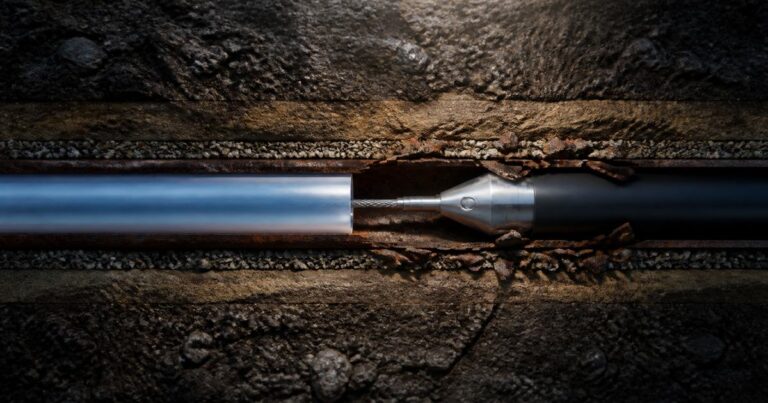
Answer: CIPP vs pipe bursting separates a repair from a replacement. Cured-in-place pipe (CIPP) cures a liner inside the host pipe; pipe bursting fractures the pipe and pulls a new HDPE pipe through the same path. Line a pipe that holds its shape and needs no extra capacity; replace it when the cross-section has failed or the bore must grow.
The CIPP vs pipe bursting question is usually framed as a price comparison, but it is a scope comparison: the two methods answer different questions. This article works through condition, diameter, ground and connections, and names the point at which each method drops out. For a wider introduction, see the guide to trenchless pipeline rehabilitation methods.
Is CIPP or Pipe Bursting the Right Fit for Your Pipe?
The CIPP or pipe bursting choice turns on one question: is the pipe still worth keeping?
When the existing pipe keeps enough integrity to carry a liner and the flow capacity is adequate, CIPP usually fits. When the pipe has lost its shape, is heavily deformed, or the network needs a larger bore, pipe bursting usually fits.
- CIPP fits a pipe that is cracked, corroded or leaking but still round enough to line.
- Pipe bursting fits a pipe that is collapsed or badly deformed, or where capacity must increase.
Bottom line: CIPP restores a pipe in place, while pipe bursting replaces it. Match the method to the pipe, not to a headline price.
Repair in Place or Replace the Pipe: What Is the Real Difference?
Repair in place means the original pipe stays in the ground and a new structural surface is formed inside it.
Replacement means the original pipe stops carrying load and a new pipe takes its place. That one distinction drives almost every downstream difference: soil movement, lateral tie-ins, and the diameter you end up with. In method terms, CIPP belongs to the repair family and pipe bursting to the replacement family.
How CIPP Forms a New Pipe Inside the Host Pipe
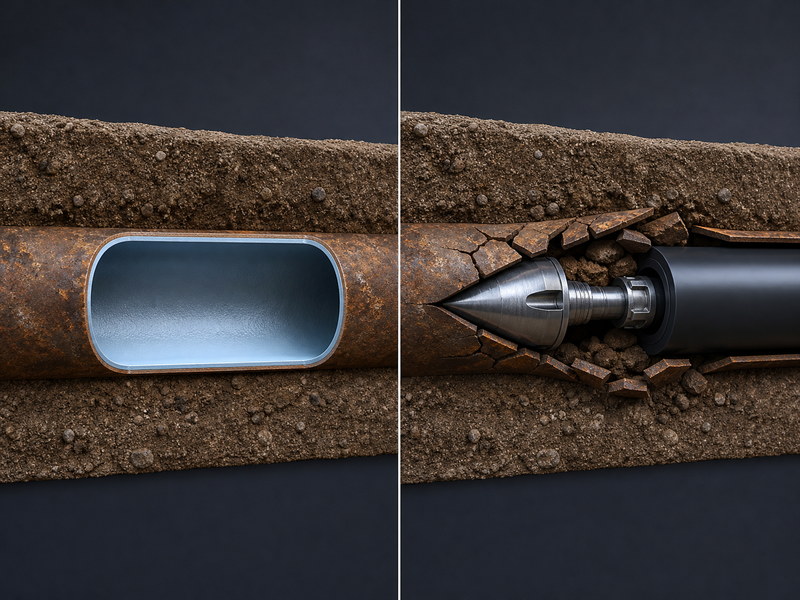
Cured-in-place pipe, or CIPP, starts as a flexible tube of felt or glass fibre saturated with a thermoset resin. The tube is inserted into the existing pipe, pressed against the wall, and cured in place, so the resin hardens into a new pipe that sits tightly against the original pipe.
On our lining jobs, the governing standard follows the installation route:
- ASTM F1216 covers the inversion method.
- ASTM F1743 covers pull-in-place installation.
- ASTM F2019 covers glass-reinforced liners installed by pull-in.
- ASTM F1871 covers folded-and-formed liners.
A liner can also be designed as structural under the ASTM F1216 approach, which is why lining can restore rather than replace a pipe.
Because CIPP builds its wall from the inside, it depends on the host pipe keeping enough shape to guide the tube and hold it during curing.
A CIPP liner also takes the shape of the line it is installed in, so a sag, usually called a belly, or a sharp offset, a step between pipe ends, survives curing.
Lining suits a pipe whose profile still matches the design line; a run that no longer does is a replacement question.
To see how this fits the wider workflow, read how trenchless pipe rehabilitation works.
How Pipe Bursting Replaces the Pipe
Pipe bursting pulls a conical bursting head through the old pipe.
The conical head fractures the pipe and pushes the fragments outward into the surrounding soil, while a new HDPE pipe, made of high-density polyethylene, is pulled in directly behind it.
The old pipe is not lined; it is replaced in the same corridor.
There are three common variants, separated by how the force is generated:
- Static bursting uses a pulling winch at the reception pit.
- Pneumatic bursting drives a percussive air tool at the bursting head.
- Hydraulic bursting expands the tool face with hydraulic force.
Because the head has to make room, the method depends on the ground accepting displaced fragments. It sits with trenchless technologies for pipe replacement rather than with pipe restoration.
Which Method Gives You the Diameter You Need?
Diameter is where the repair-versus-replace difference becomes concrete.
Because a CIPP liner sits inside the existing pipe, its wall thickness takes up a small part of the internal bore. As an industry-typical public range, that wall is measured in a few millimetres up to a few tens of millimetres, set by design for the pipe’s condition and loads.
Pipe bursting changes the bore in the other direction. It installs the same nominal size or increases it, and as an industry-typical public range it can raise capacity by roughly one to two nominal sizes, because the new HDPE pipe is pulled into the void left by the destroyed pipe.
- If the network only needs current capacity, CIPP’s thin wall is usually acceptable.
- Where the network needs more capacity, only a new pipe delivers it; a lining holds the bore it is installed in.
Both ranges depend on pipe condition, surrounding soil and site equipment. These are industry-typical public ranges, not design values.

Ground Conditions, Soil Displacement and Adjacent Utilities
Pipe bursting depends on the soil around the pipe. The bursting head splits the old pipe and presses the fragments outward into the ground, and that soil displacement is what the method depends on.
A gas main, a fibre duct or a shallow foundation close to the line is a reason to rule bursting out.
CIPP forms its wall inside the pipe and leaves the ground untouched. Its constraint sits on the pipe instead, which must stay sound enough to carry the liner during insertion and curing.
- Bursting applies where the soil can take fragments and no other service sits close.
- Bursting needs launch and reception pits, so surface access at both ends matters.
- CIPP needs manhole access and a pipe that can hold a liner.
In our relining work, the first job is not pricing but mapping: a survey that records the pipe’s shape, the nearby services and the ground. For projects that pair repair with asset work, we draw on pipe restoration solutions as well as replacement routes.
Bottom line: Ground and utilities decide feasibility. Soil displacement is the binding limit for bursting, and pipe integrity is the binding limit for lining.
Service Laterals: The Cost Most Comparisons Miss
Both methods disturb the points where smaller branches join the main pipe, but they do it differently. After CIPP is cured, a crew must reopen each service lateral connection through the new liner, because the cured tube covers the openings.
After pipe bursting, existing connections are often damaged by the passage of the bursting head and by ground movement, so they must be reconnected to the new pipe.
The number of connections along the run matters as much as the pipe length: a short length with many branches can carry more work than a long one with few.
On projects our crews have delivered, the service lateral reconnections, not the main line, were the item that moved the schedule. That is why we count connections at survey stage, before a method is chosen.
Bottom line: Count the connections first. Whichever method you pick, the branches are where the surprises live.
What Each Method Costs, and Why the Comparison Is Not Like for Like
The two methods spend money in different places, so a simple price per metre is misleading. CIPP concentrates cost in the liner material, the resin, the curing equipment and manhole-based access.
Pipe bursting spreads cost across the launch and reception pits, the pulling equipment, the new HDPE pipe, and the lateral reconnections.
The price comparison misleads because the two methods deliver different things: one restores the pipe you have, the other replaces it and may enlarge it. A cheap quote for a method that misses your diameter need is a different scope, not a cheaper option.
- Compare like for like: same length, same connection count, same end diameter.
- Include access works, traffic management and reinstatement on both sides.
- Include reopening every service lateral connection after curing or bursting.
For repair scopes our trenchless pipe rehabilitation crews handle the lining. Replacement scopes run through our trenchless pipeline repair team.
A Five-Check Selection Checklist
Five inputs settle the answer: a current closed-circuit television (CCTV) survey, internal diameter and material, the number of lateral connections, the soil and nearby utilities, and the space at both ends. Without them, a method review returns a range, not a recommendation.
Our reviews run these five checks in order, because any one of them can remove a method.
- Condition: the pipe must be round, continuous and on grade. A collapse, a sharp offset or a belly the liner cannot follow makes the run a replacement scope.
- Diameter: lining holds the existing bore and takes a little of it. Capacity growth is a new-pipe requirement.
- Ground: bursting needs ground that accepts fragments, with no utility or foundation close enough to be affected.
- Access: lining works manhole to manhole; bursting needs a launch pit and a reception pit.
- Connections: count every branch, because each one is a reopen after lining or a reconnect after bursting.
Bottom line: If the pipe fails the condition check, repair is off the table and the decision becomes a replacement one.
Working through a CIPP vs pipe bursting decision on a live network? JSW’s engineers review CCTV surveys and pipe records, then set out which method fits the condition, diameter and access limits.
CIPP vs Pipe Bursting: Decision Table
The first three rows decide feasibility; the last three decide cost and disruption.
| Yếu tố | CIPP lining | Pipe bursting |
|---|---|---|
| What it does | Forms a new pipe inside the existing host pipe | Fractures the old pipe and pulls in a new HDPE pipe |
| Pipe condition needed | Round, continuous, on grade, sound enough to carry the liner | Cracked, deformed or collapsed; the old pipe is destroyed |
| Diameter outcome | Slightly reduced by the liner wall | Same size or enlarged by one to two nominal sizes |
| Soil effect | No soil displacement | Fragments displaced by the bursting head |
| Service lateral | Reopened after curing | Reconnected after bursting |
| Access | Mainly through manholes | Launch and reception pits |

CIPP or Pipe Bursting: Questions Owners Ask Before Choosing
Does CIPP replace the pipe or line it?
CIPP lines the pipe. A resin-saturated tube is installed inside the existing pipe and cured, so the original pipe stays in place and a new inner wall is formed within it.
Can pipe bursting upsize a pipe that CIPP cannot?
Pipe bursting can hold the same nominal size or increase it, and as an industry-typical public range it can add roughly one to two nominal sizes, because a new pipe is pulled into the space the old one occupied.
Which method disturbs the surrounding soil more?
Pipe bursting causes soil movement, because it pushes old pipe fragments outward into the surrounding ground. CIPP does not displace soil, since it builds its wall within the pipe.
Do lateral connections need work after either method?
After CIPP curing, every service lateral connection is reopened from inside the new liner. After pipe bursting, the expansion of the bore disturbs them, so each is reconnected. Both methods leave every branch to be dealt with.
Is CIPP or pipe bursting cheaper?
Cost sits in different places, so the two totals measure different scopes. CIPP concentrates cost in the liner, resin and curing equipment, while pipe bursting spreads it across pits, pulling equipment, the new pipe and lateral reconnections.
My line runs beside a gas main: can pipe bursting still be used?
Pipe bursting applies where three conditions hold: other utilities and foundations sit clear of the line, the soil accepts displaced fragments, and the route has space for a launch and reception pit. Where any one fails, the decision returns to lining.
My pipe has partly collapsed: does the CIPP vs pipe bursting comparison still apply?
The comparison ends at a collapse. A liner needs a round, continuous host, so a collapsed or badly deformed run becomes a replacement scope and pipe bursting is the usual route. CIPP stays available where the rest of the run still qualifies as a host.
Matching the Method to Your Pipe
The CIPP vs pipe bursting choice comes down to what you are trying to achieve. If the pipe is sound enough to receive a liner and you want to keep the existing alignment, CIPP is the repair route.
If the pipe is beyond lining, if you need a larger bore, or if the old material must leave the corridor, pipe bursting is the replacement route.
Neither method is universally correct. For a practical CIPP vs pipe bursting decision, start with condition and diameter, confirm ground and access, then price a scope that matches what the method actually delivers.
For a specific line, JSW’s engineering team reviews the survey and records and sets out the fit.
Ready to decide between CIPP vs pipe bursting for a specific pipe? Send the survey and pipe details and our team will confirm which method fits and why.
Sources
- ASTM International, standards and technical committees for cured-in-place pipe and plastic pipe systems: astm.org
- NASTT, North American Society for Trenchless Technology, industry guidance: nastt.org
- WRc, water and environmental research and technical guidance: wrcgroup.com
- NASSCO, pipeline assessment and certification programs (PACP): nassco.org










 English
 Arabic
 Russian
 Spanish
 French
 Vietnamese
 Polish
 Thai
 Indonesian
 Turkish
 Portuguese