
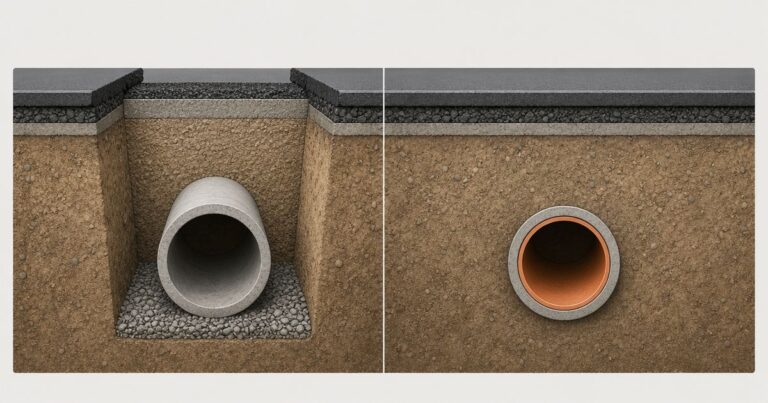
CIPP vs pipe replacement is decided by the host pipe, not the price: lining wins where the pipe keeps its shape and the surface cannot be opened, while open-cut work wins where the pipe has collapsed, lost grade or run out of capacity. Cured-in-place pipe (CIPP) renewal builds a structural liner inside the existing host, so the roadway, soil and surrounding services stay undisturbed. Traditional open-cut construction removes the old pipe and lays a new one at the original bore and grade. This guide compares the two methods on the axes owners actually weigh: structure, published cost ranges, environmental impact and service life.
What Is the Core Structural Difference Between CIPP and Open-Cut Replacement?
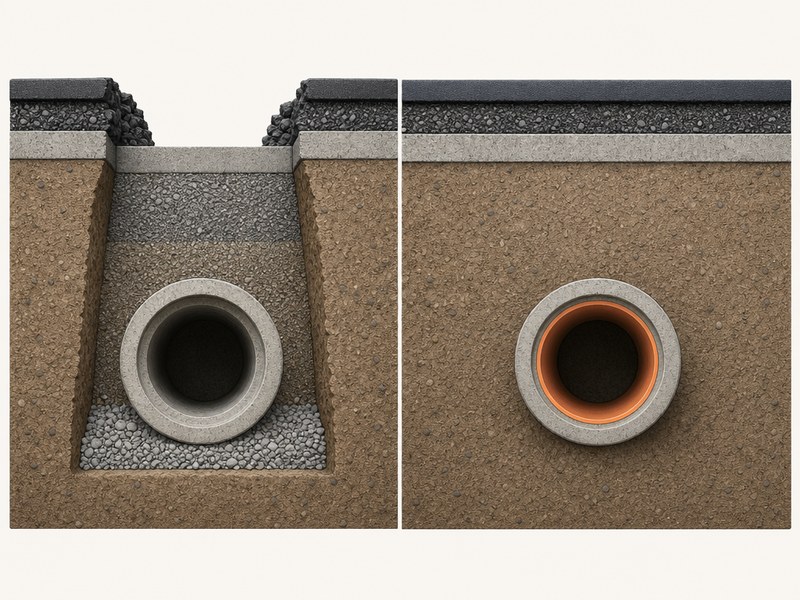
CIPP renewal is a pipe-within-a-pipe method; traditional open-cut replacement, also called dig-and-replace or open-trench replacement, is a pipe-swap method. In CIPP, a resin-impregnated tube is installed inside the host and cured in place, so the cured tube and resin together become a new structural pipe that carries load within the old one. Open-cut does the opposite: the old pipe is excavated, removed, and replaced with new pipe of the original diameter and grade.
The pipe-within-a-pipe versus pipe-swap difference decides what each method can fix. A CIPP liner depends on the host pipe retaining its basic shape and structural continuity; the liner spans and bridges defects, but it does not recreate a pipe that is no longer there. Open-cut does not care much about host condition, because the host is removed entirely.
The CIPP vs pipe replacement choice therefore starts with the host, not with the budget; a liner reproduces the existing line and level, and it reduces the internal diameter, so both limits trace back to the same pipe-within-a-pipe logic.
The diameter envelope narrows the comparison before cost is considered. ASTM F1216 is written for host pipes from 2 in. to 108 in. (about 50 mm to 2,750 mm), which is the documented envelope for the method. Field practice concentrates in a narrower band, and the very large end behaves differently.
The two methods also leave different assets in the ground. After lining, the original pipe is still in the ground and still carrying load alongside the liner, so future excavation near the line meets the same host as before. After open-cut, the corridor holds a new pipe and backfill. Owners who manage easements and third-party crossings tend to weigh this differently.
On the CCTV surveys we review, the decisive question is rarely the pipe material and almost always the host geometry: a line that still holds its circular or egg shape can usually be lined, while a collapsed or badly deformed run cannot.
How Is a CIPP Liner Designed? The Structural Liner Design Basis
The structural liner design for CIPP follows ASTM F1216, the standard practice for rehabilitating existing pipelines and conduits by the inversion and curing of a resin-impregnated tube. The standard covers two host assumptions: partially deteriorated and fully deteriorated. Which assumption applies is the owner’s call, and it changes the required wall thickness.
Design equations sit in Appendix X1 of ASTM F1216, and chemical-resistance requirements sit in Appendix X2. NASTT presents two industry-accepted design routes plus a decision framework for choosing between them: ASTM F1216 and ASCE Manual of Practice (MOP) 145. They are alternatives, not a right and a wrong answer, and the choice usually follows owner preference and local specification history.
US municipal practice commonly cites ASTM F1216, ASTM F1743 (the pull-in and inflate counterpart to the inversion route) and ASTM D5813 together in one CIPP specification. Where the owner requires it, the wall thickness design is stamped by a professional engineer before bid and the structural liner design reviewed against the chosen host assumption.
Quality control is tied to the same design. Resin impregnation, or wet-out, follows the manufacturer’s instructions, and the quantity of resin must be sufficient to fill all of the felt voids. Contractors submit wet-out and cure logs per liner, recording resin type and cure details. The NASSCO CIPP Installation Performance Specification Guideline (2023) expects three years of cumulative experience for the crews that carry out wet-out, installation, curing and service reconnections.
Cure method is a design variable as well as a scheduling one. The field methods are hot water, steam, UV light and ambient cure. UV light cures fastest, described by one equipment maker at about one minute per meter of liner, while steam and hot water typically take about one to four hours. Each method pairs with a matched tube and resin system.
An ASTM F1216 wall-thickness design does not settle the field question on its own. A liner can be correctly specified on paper and still underperform if the host was mis-coded during survey, if a lateral was cut and not resealed, or if the cure was not held long enough. That is why the acceptance package protects the owner over the liner’s working life.
A lining succeeds or fails on host verification and cure control, not on the design calculation. In our lining crews’ logs, the liners that pass inspection cleanly are the ones where tube selection matched the host and the resin fill was verified before cure, not after.
CIPP vs Pipe Replacement: Published Cost Ranges and Added Cost Lines
On headline numbers, CIPP vs pipe replacement is not an open-and-shut call. Published 2025 US trade ranges put CIPP lining at roughly USD 80–250 per linear foot and open-cut replacement at roughly USD 50–250 per linear foot at homeowner scale. The pipe replacement cost published for larger works rises to about USD 150–300 per linear foot once excavation, pipe and backfill are included. Lateral lining is usually quoted separately, at roughly USD 135–150 per linear foot. Table 1 lists the published ranges.
These are published ranges, not quotations. The spread in pipe replacement cost is driven by diameter, host condition, depth, access, groundwater, bypass needs and reinstatement far more than by the method name. A short, shallow, open site can favor excavation; a deep line under a busy surface rarely does.
| Scope | Published range (USD per linear foot) | What it typically includes |
|---|---|---|
| CIPP lining | 80–250 | Host preparation, liner, wet-out, cure, service reinstatement |
| Lateral lining | 135–150 | Lateral liner and connection to the main |
| Open-cut, homeowner scale | 50–250 | Local excavation, new pipe, backfill and surface repair |
| Open-cut, larger works (municipal or bidder scope) | 150–300 | Excavation, pipe, backfill and reinstatement at scale |
The comparison changes once the hidden cost lines are added to the base pipe work, because each method carries a different set. Table 2 separates the two lists.
| Phương pháp | Adds these cost lines | Often overlooked |
|---|---|---|
| CIPP renewal | Bypass pumping, CCTV survey, wet-out and cure logistics, liner transport | Bypass pumping volume and overnight cure windows |
| Open-cut excavation | Traffic control, pavement and reinstatement, utility conflicts, service interruption, spoil disposal | Reinstatement depth and buried-utility relocation |
The two cost lists differ in who controls the largest line items. Bypass pumping and CCTV are overheads a lining crew controls on a single site, whereas reinstatement, traffic control and spoil disposal on an urban line depend on third parties and permit windows that a contractor cannot compress. That is why two bids for the same pipe can diverge sharply. The trade-off also turns on who owns the surface: a homeowner weighs reinstatement, a municipal owner permit windows, a bidder allowance risk.
Depth moves cost in opposite directions for the two methods. A deeper line increases excavation, shoring and reinstatement cost on the open-cut side, and it increases bypass and access cost on the lining side. Neither method escapes depth; they simply move the cost to different trades, so a side-by-side estimate has to be built for the actual route.
In our bid reviews, the ranking often flips on an urban arterial and holds on a rural trunk line: reinstatement and traffic control can erase the lower headline open-cut rate, while a greenfield route with easy access keeps excavation competitive. Figure 1 shows the two cross-sections at the same burial depth.
How Do the Two Methods Compare on Environmental Impact?
In the CIPP vs pipe replacement comparison, environmental impact is where the two methods differ most clearly. A published comparative assessment of open-cut pipeline replacement and trenchless CIPP renewal for sanitary sewers found that CIPP renewal caused about 68% less environmental impact and about 75% less impact on human health, on average. The percentage is scoped to the study’s renewal case, not to every pipe size, depth or surface. The gap comes largely from the excavation, hauling and reinstatement that lining avoids rather than from the liner material itself.
The 68% and 75% figures cover sanitary sewer renewal only. The comparison still points to the practical drivers that owners notice directly: less spoil, fewer heavy machines on site, fewer truck movements and less disrupted surface above the line. On a residential street or a hospital campus, that difference is often the reason lining is chosen before cost is even modeled.
CIPP installation is not emission-free: styrene and odor during cure are real, managed issues rather than marketing problems. NASSCO’s styrene guidance recommends a 15-foot perimeter around emissions points and exhaust stacks a minimum of 6 feet above ground, and published industry commentary notes that UV curing is reported to reduce odor emission.
Preliminary 2024 measurements reported that non-styrene polyester resins did not exceed OSHA or EPA exposure limits in the cases measured, but that work is best read as preliminary rather than as a general clearance. These controls are part of the site plan, not an afterthought.
Do CIPP and Open-Cut Renewal Deliver the Same Service Life?
When correctly designed and installed, both methods reach 50-year-class horizons, so longevity is rarely the deciding axis on its own. A published water-industry CIPP standard draft works through liner thickness against a 50-year service life, which is the customary design horizon for the method. The San Francisco Public Utilities Commission’s public CIPP fact sheet likewise describes CIPP with a 50-year design life.
Our field teams record that the problems seen in practice trace back to wet-out, cure control or reinstatement far more often than to the resin family or the tube type. That is a useful reminder that a headline design figure assumes the process was done correctly, which is also why acceptance records matter as much as the specification.
For CIPP, the caveat is design and installation quality: a liner meets its service life only if the wall thickness matches the host assumption, the resin fills the felt voids, and the cure is logged with the material records. For open-cut, the caveat is jointing, bedding and backfill.
When Is CIPP the Wrong Answer? Explicit Boundaries
CIPP vs pipe replacement is not a contest with a fixed winner. Applicability: CIPP renewal fits where the host keeps its basic shape, enough diameter for the required flow, and its designed line and level. Where any of the following fails, open-cut replacement or another method carries the work:
- Collapsed or missing pipe. This condition belongs to open-cut work, because lining needs a host with shape and continuity.
- Lost grade. This condition belongs to open-cut work, because lining reproduces the existing line and level.
- Capacity already at the limit. This condition favors open-cut work, because the liner reduces internal diameter and spare capacity must be verified first.
- Very large access needs. This condition is shared: on very large pipes (72–96 in.), access excavation is still common, so trenchless is not the same as no excavation.
- Compromised existing piping under reported code language. This condition also belongs to open-cut work, under the reported code language discussed in the trade press.
Two methods often lumped into this discussion sit outside it. Pipe bursting is a separate route used where upsizing is wanted, and slip lining is a separate close-fit method; each has its own page. The point here is narrower: matching the method to the host condition, not ranking every alternative method.
Which Method Fits Which Condition? A Decision Table
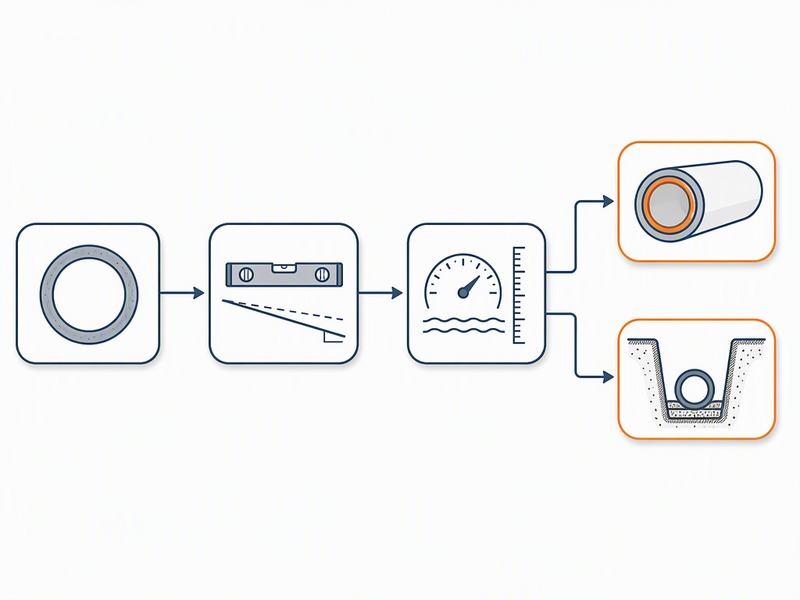
The CIPP vs pipe replacement screening step comes before any cost comparison, so Table 3 matches the host condition to the method. It is deliberately condition-first, because cost only becomes meaningful once the method is technically feasible.
| Condition | CIPP | Open-cut | Reason |
|---|---|---|---|
| Partially deteriorated, still round, good access | Preferred | Fallback | Lining bridges defects without disrupting the surface |
| Fully deteriorated but intact shape | Preferred | Fallback | Fully deteriorated design transfers load to the liner |
| Sagging or back-graded line | Không áp dụng | Preferred | Lining reproduces existing grade and cannot correct it |
| Collapsed or missing section | Không áp dụng | Preferred | Lining needs a host with shape and continuity |
| Line at hydraulic capacity limit | Conditional | Preferred | Liner reduces diameter, so capacity must be verified |
| Deep urban line under a busy surface | Preferred | Fallback | Traffic control and reinstatement drive open-cut cost up |
| Very large diameter, access still needs excavation | Conditional | Fallback | On 72–96 in. pipes, access excavation is still common |
Treat Table 3 as a screening tool, not as a liner design. Figure 2 summarizes that screening order. Final selection still depends on the CCTV inspection, the hydraulic check and the site access that the survey and drawings reveal, and on the owner’s tolerance for surface disruption during the works.
Two rows of Table 3 carry the most commercial risk: the check-first row and the very large diameter row. Lining a full pipe without a hydraulic check can turn a repair into a restriction, and on large pipes access excavation is common on both sides.
A municipal owner weighing a deep failing sewer is really asking six questions of the data:
- Pipe diameter, material and prior repairs.
- The latest CCTV survey and its defect coding.
- Flow and water-level records.
- Burial depth and surface type.
- Bypass and access conditions, including laterals.
- Wet-out and cure records, plus acceptance tests.
Missing any one, a comparison returns a range, not a firm recommendation.
Frequently Asked Questions: CIPP vs Pipe Replacement
Is CIPP cheaper than pipe replacement?
Not always; it depends on the site. Published US ranges overlap: CIPP lining is roughly USD 80 to 250 per linear foot and open-cut work is roughly USD 50 to 250 per linear foot at homeowner scale, rising to about USD 150 to 300 per linear foot on larger works. Diameter, depth, access and reinstatement usually decide the winner, not the method name alone.
CIPP vs pipe replacement: does the liner last as long as a new pipe?
Both reach 50-year-class horizons when correctly designed and installed. A published water-industry CIPP standard draft works against a 50-year design horizon, and the San Francisco Public Utilities Commission describes CIPP with a 50-year design life. Workmanship, not the method name, usually determines the outcome.
Can CIPP be used on a collapsed pipe?
No; CIPP applies only where the host keeps its basic shape and structural continuity. A collapsed section cannot be lined back into service, and where the pipe is collapsed, severely deformed or missing, open-cut work carries the job.
Does CIPP reduce pipe flow capacity?
Yes; the liner reduces the internal diameter. Capacity falls by roughly the liner wall thickness plus any annular gap the design assumes, so flow capacity must be checked rather than assumed. A line already at its hydraulic limit may not accept lining.
Is CIPP better for the environment than open-cut work?
On the published assessment, yes. A comparative assessment of sanitary sewer renewal found CIPP caused about 68% less environmental impact and about 75% less impact on human health than open-cut work. CIPP still carries managed styrene and odor emissions during cure.
Does CIPP work for all pipe diameters?
No; the practical envelope is bounded. ASTM F1216 is written for 2 in. to 108 in. (about 50 mm to 2,750 mm). On very large pipes (72 to 96 in.) excavation is still often needed just to gain access, so lining does not mean zero excavation.
My sewer runs under a concrete driveway: is lining still possible, or does the driveway have to come up?
Usually yes, and the driveway normally stays in place. Lining works from existing access points, so the surface above the line is not opened; what decides feasibility is the host condition, not the driveway.
Key Takeaways
- CIPP vs pipe replacement is a structural decision first: CIPP needs a host with basic shape and continuity, while open-cut delivers a new pipe at the original bore and grade.
- Published US cost ranges overlap, so site factors such as depth, access and reinstatement matter more than the method name.
- Both methods reach 50-year-class horizons when designed and installed correctly; workmanship is the deciding variable.
- Published environmental comparisons are scoped to the case studied, so read them as ranges rather than universal results.
- CIPP is the wrong answer for collapsed pipe, lost grade and lines already at hydraulic capacity; those are open-cut or alternate-method cases.
How JSW Supports CIPP and Open-Cut Decisions
JSW is a pipeline engineering and construction company that executes trenchless rehabilitation with its own crews and equipment. Our scope covers pipe restoration solutions, pipeline repair services and dịch vụ lắp đặt đường ống.
For a CIPP renewal decision, that means one team can survey condition, design the liner, execute the lining and reinstate the surface. Our process data is auditable: CCTV before and after, wet-out and cure logs, and samples and test records per liner.
- Integrated delivery: survey, design, lining and reinstatement under one scope.
- Auditable process data: CCTV records, wet-out and cure logs, and test documentation per liner.
- Risk-explicit pricing: bypass, access and reinstatement identified before bid, not after.
- In-house capability: inspection, lining, repair and installation crews with their own equipment.
Trying to decide between CIPP and an open-cut approach? Send your pipe size, material and the latest CCTV survey for a free technical review. Our engineers respond with a scoped recommendation and budget range.





































 English
  Arabic
  Russian
  Spanish
  French
  Vietnamese
  Polish
  Thai
Thai  Indonesian
  Turkish
  Portuguese