
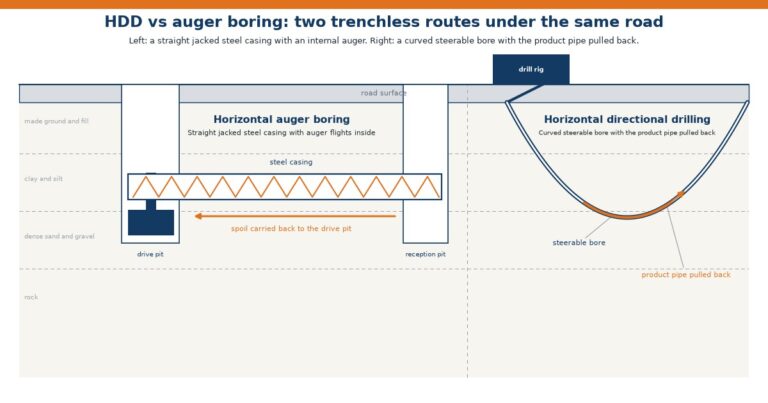
Short answer: in the HDD vs auger boring decision, auger boring wins where the ground is stable, dry and consistent, the crossing is short and straight, and the permit requires a steel casing. HDD (horizontal directional drilling) wins on long or curved crossings, where a high water table or coarse soil makes an open auger face risky, or where the pipe is the product line. Grain size, boulder content, water table and stand-up time decide more crossings than price or schedule do.
Terminology in this guide: HDD means horizontal directional drilling, not hard disk drive; auger boring, jack and bore and horizontal auger boring are the same method; water table means the groundwater level.
HDD and auger boring both install pipe without an open trench, and both are specified on the same class of work: utility and pipeline crossings beneath roads, railways, embankments and waterways. Four ground facts separate them, and they are run in this order: grain size and boulder content, water table and stand-up time, soil consistency and mixed face, and buried obstructions including contamination. This guide covers how each method works, those four tests, the specification and tolerance limits that rule a method out, the cost logic behind each bid, and an eight-step selection process you can run against a geotechnical report before you go to tender.
How HDD and Auger Boring Actually Work
Auger boring: one straight drive, one rigid steel casing
Auger boring, also called horizontal auger boring, horizontal earth boring or jack and bore, jacks a steel casing through the ground from a drive pit while a rotating helical auger inside the casing carries spoil back to the boring machine. The cutting head sits at the leading end of the auger string; the casing follows immediately behind and stays in the ground as the permanent sleeve.
The auger boring machine is track-mounted. A master track is set in the pit to the required line and grade before the first casing section goes in, and the machine thrusts against a backing plate or concrete backstop in the rear pit wall. That setup step is the whole project: once an unsteered auger bore starts, there is almost no ability to correct line or grade, so a small misalignment at the start becomes a large deviation at the reception pit. Steerable auger boring units now exist and allow minor corrections, but they add cost and complexity.
Auger boring drive and reception pits typically measure about 26 to 40 feet (8 to 12 m) long and 8 to 12 feet (2.4 to 3.7 m) wide, over-excavated and backfilled with crushed stone so the equipment has a stable base. The leading casing section is often banded with a steel strip around the upper three quarters of its outside diameter, which slightly over-excavates the hole and cuts skin friction on the sections behind it. Because the auger rotates inside the casing, the casing itself is steel; a carrier pipe is then pushed or winched inside on casing chocks. Casing and pipe sections are cut to length on site with pipe cutting machines before they are welded into the string.
HDD: one curved bore, drilled, reamed and pulled back
Horizontal directional drilling launches a steerable rig from the surface at a shallow entry angle, usually around 12 degrees. The pilot bore is steered down a sag curve to design depth, tracked along the alignment, then steered back up to the exit point. A bent sub or asymmetric drill head provides the steering; walk-over locating, wireline or gyroscopic systems track position and depth. On long crossings, two rigs can drill toward each other and intersect, which lowers downhole pressures and reduces the time to complete the crossing.
Once the pilot bore is through, the head is removed and a reamer is pulled back to enlarge the hole, normally to about 1.5 times the outside diameter of the product pipe. The reamer also mixes cuttings with drilling fluid to form a slurry that supports the bore walls until the pipe is in. The product string is then welded or fused into one length and pulled back in a single continuous operation. Steel and HDPE are the common product pipes; PVC and other flexible materials are also installed.
HDD rig capability scales sharply with thrust and pullback class. Mini rigs handle drive lengths under 600 feet (180 m) and pipes up to about 10 inches (250 mm). Full-size HDD rigs work pipe diameters from 12 to 60 inches (300 to 1,500 mm) over lengths beyond 2,000 feet (600 m). Rigs are usually classed by thrust and pullback capacity: mini below 50,000 pounds, mid-size 50,000 to 150,000 pounds, large 150,000 to 550,000 pounds, and maxi above 550,000 pounds. A maxi spread can occupy a pad of roughly 150 by 250 feet (46 by 76 m) and arrive on site in as many as ten trailers, which is why mobilization dominates the bid.

Why Ground Conditions Decide More Crossings Than Cost
The most cited conclusion in trenchless method selection comes from a U.S. Transportation Research Board synthesis on trenchless installation of conduits beneath roadways (NCHRP Synthesis 242, Transportation Research Board, 1997), whose questionnaire respondents represented 33 American states and six Canadian provinces. Its finding is blunt: no single method is suitable for all types of utility or all types of soil or site condition. Selection is site specific and highly dependent on subsurface conditions, which makes an adequate soils investigation and an accurate underground utility location programme the two most important inputs to the decision.
The TRB finding that no single method suits every soil holds because each method reaches a different physical limit in the ground. Auger boring has a hard ceiling set by grain size, because every particle has to travel back through the annular space between the auger flights and the casing wall. HDD has a soft ceiling set by bore stability, because the open hole is held only by the pressure of the drilling fluid between the reaming pass and pullback. Where the overburden is thin or permeable, that fluid can escape to the surface as an inadvertent return, commonly called a frac-out.
Because each method fails in different ground, the HDD vs auger boring decision belongs to the geologist and the design engineer before it belongs to the estimator.
Bottom line: the geotechnical report rules methods in or out before cost enters the conversation. Ground improvement can widen the envelope of either method, but it adds both cost and schedule, and it should be treated as a design decision rather than a fallback.
Four Ground-Condition Tests That Separate the Two Methods
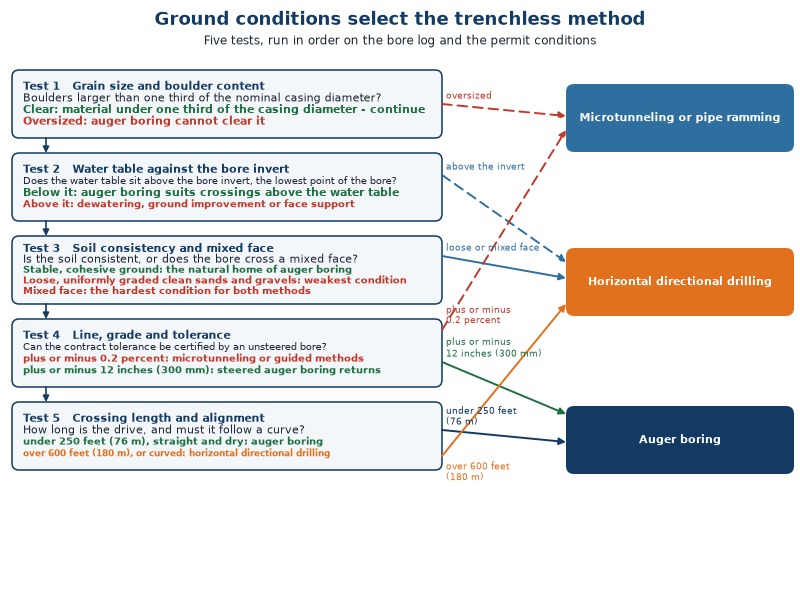
Each test below resolves one part of the HDD vs auger boring question for a particular alignment. Run them in order on the borehole log and the permit conditions; the first test that fails usually settles the method on its own.
Test 1: Will the ground pass boulders larger than one third of the casing diameter?
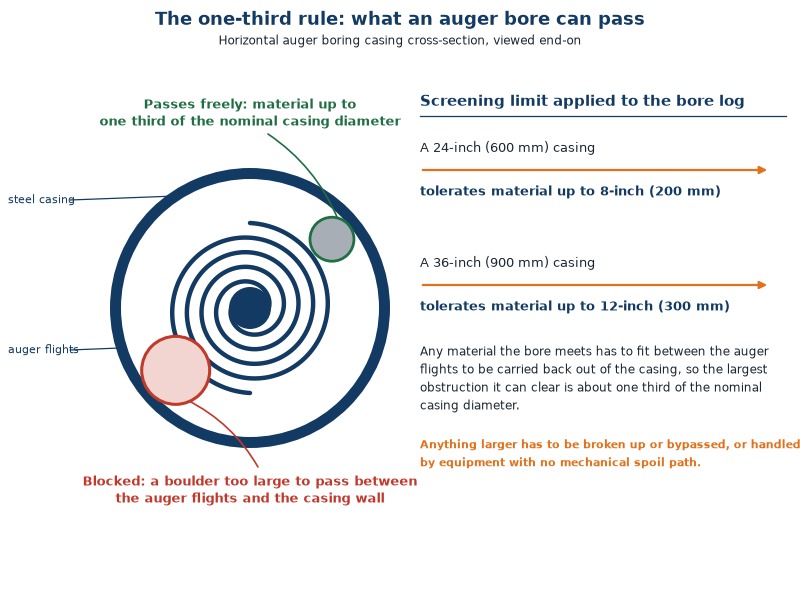
Auger boring works across a wide range of soils, but the largest boulder or obstruction it can clear is limited to roughly one third of the nominal casing diameter, because any material encountered must fit between the auger flights to be carried out. A 24-inch (600 mm) casing therefore tolerates about 8-inch (200 mm) material. Anything larger has to be broken up, bypassed or handled by equipment that does not depend on a mechanical spoil path.
HDD has no equivalent hard limit, because cuttings are cut and suspended in fluid rather than carried mechanically. Coarse gravel, cobbles and boulders still hurt: penetration rate drops, the pilot bore deflects, tooling wear rises, and steering corrections become harder. In blocky or very coarse ground, pipe ramming, which drives a casing with a percussive hammer and no mechanical spoil path, is often more successful than either.
Test 2: Is the water table above the bore invert, and will the face stand up?
The water table is the single most decisive test in most crossings, and the comparison to make is against the bore invert, the lowest point of the bore. Auger boring suits crossings above the water table; below it, the open unpressurised face requires dewatering or ground improvement in place before the drive starts, and in running sand or loose saturated granular soil the face can flow into the casing, causing ground loss ahead of the cutting head and settlement at the surface. It is for this reason that auger boring is rarely selected for waterbody crossings, where the water table would have to be drawn down and controlled for the duration of the drive.
HDD handles saturated ground far better because fluid pressure supports the bore, but the trade is a new failure mode. Inadvertent returns happen most often near the entry and exit points, where cover is thinnest, and in coarse or fractured ground where fluid finds an easy path out. Two design rules reduce the exposure: keep roughly one foot of cover for every inch of pipe diameter (about 300 mm of cover per 25 mm of diameter), and ream the hole to about 1.5 times the product outside diameter so that fluid can travel back through the annulus instead of being forced into the formation.
Test 3: Is the soil consistent, or does the bore cross a mixed face?
Stable, cohesive ground is the natural home of auger boring: stiff clays, clayey silts and dense uniform sands above the water table. Loose, uniformly graded clean sands and gravels are its weakest condition, because the open face has no mechanism to resist inflow.
HDD’s ideal ground is clays, silts and sands. Gravel and rock can be drilled with the right tooling, but speed and accuracy both fall away. Mixed face, where the bore crosses two materials of sharply different strength in the same cross-section, is the hardest condition for both methods and is the most common reason a bid changes after mobilization. High-plasticity clay adds its own problem for HDD: sticky cuttings can ball on the tools and reduce fluid return unless the mud programme is matched to the soil.
Test 4: What buried obstructions and contamination will the bore meet?
Older industrial corridors rarely present native soil. Fill, buried foundations, timber piles, abandoned tanks and contaminated ground all appear along the same alignment, and each changes the spoil and handling plan. Auger boring produces a dry or moist cuttings stream that is handled at the pit; HDD produces a fluid stream that must be contained, recycled through a separation plant and disposed of under the relevant waste rules.
Potholing or vacuum excavation at each bore crossing is the standard of care before either method is priced: records alone systematically under-report both the number and the depth of buried services, and an unmapped obstruction stops either method. Both methods are therefore designed against utility records that have been verified in the field.
| Ground condition | Auger boring | HDD |
|---|---|---|
| Stiff clay or clayey silt, above water table, short straight crossing | Best fit; fast and economical | Works, but mobilization is hard to amortize |
| Boulders larger than one third of casing diameter | Viable only after the material is broken up, bypassed or pre-treated; the mechanical spoil path sets the limit | Workable with rock tooling; slow |
| Running sand or high water table at bore level | Requires dewatering; inflow and settlement risk | Workable; bore supported by fluid pressure |
| Thin cover with coarse, permeable overburden | Less relevant; method already needs a dry face | Inadvertent return risk; needs fluid control |
| Mixed face or highly variable fill | Suits a straight, pre-set line in ground that holds a face; mixed face needs a steerable method | Possible but slow; microtunneling is safer |
| Solid rock | Cutting heads exist; tool wear is high | Standard with rock reamers |
| Contaminated ground | Dry spoil must be characterised and contained | Fluid and cuttings need full containment |
Basis: the four ground-condition tests above, applied to the bore log and the permit conditions. This table is a screening judgement for method viability, not a specification.
I have a geotechnical report showing cobbles and a high water table. Can I still auger bore?
Only if both are marginal: material under one third of the casing diameter, and a water table that can be drawn down before the drive. The two limits compound rather than cancel, because the mechanical spoil path sets the size limit and the open face sets the water limit. Have the report re-screened for the largest obstruction and the highest water level before either method is priced.
HDD vs Auger Boring: Head-to-Head Specifications
Once the ground has been characterised, the shortlist is usually settled by whether the crossing has to be straight, how long it can run, what diameter it must carry, and whether a casing is mandatory. The table below sets the two methods side by side on the parameters that decide tenders.
| Tham số | Auger boring (jack and bore) | HDD |
|---|---|---|
| Steering | None on a standard rig; steered and guided variants exist at extra cost | Continuously steerable throughout the drive |
| Alignment | One straight line and grade, fixed before the bore starts | Curved sag profile; entry and exit angles set by design |
| What is installed | Steel casing as the permanent sleeve, with a carrier pipe inside on chocks | Product pipe pulled directly into the bore; casing only if specified |
| Common diameter range | Most common 8 to 36 inches (200 to 900 mm); up to about 60 inches (1,500 mm) with large machines | Mini-HDD up to about 10 inches (250 mm); full-size HDD 12 to 60 inches (300 to 1,500 mm) |
| Typical drive length | About 175 to 225 feet (53 to 69 m) typical; beyond 500 feet (150 m) achievable on larger machines | From about 50 feet to 2,000 feet (15 to 600 m) and beyond; major crossings exceed 13,000 feet (4,000 m) |
| Line and grade tolerance | About plus or minus 1 percent of bore length; steered variants about plus or minus 0.1 percent vertically | About plus or minus 1 percent of bore length; mini-HDD typically within 6 to 12 inches (150 to 300 mm) |
| Surface footprint | Drive and reception pits, typically 26 to 40 feet by 8 to 12 feet (8 to 12 m by 2.4 to 3.7 m), plus a working pad | Entry and exit pits, rig pad, fluid plant and pipe string laydown; large spreads need about 150 by 250 feet (46 by 76 m) |
| Spoil handling | Dry or moist cuttings carried mechanically by the auger | Cuttings suspended in drilling fluid, separated and recycled on site |
| Groundwater | Suits crossings above the water table; below it, dewatering or ground improvement is required before the drive | Bore supported by fluid pressure; inadvertent return risk |
| Gravity flow | Holds a pre-set grade; suited to gravity lines when tolerance allows | Suits pressure mains and cable ducts. Close-grade gravity lines need guided auger boring, pilot tube or microtunneling |
| Typical permit driver | Highway and railroad permits that specify a cased crossing | Long, deep or curved crossings where no casing is required |
Diameter, length and pit figures are typical published ranges and are not guarantees of any rig or machine.
Scope of this page: this guidance applies to utility and pipeline crossings beneath roads, railways, embankments and waterways, in nominal diameters from 4 to 60 inches (100 to 1,500 mm) and crossing lengths up to about 2,000 feet (600 m). Above that length the comparison narrows to methods that scale with distance rather than with setup. For nominal diameters above 60 inches, for drives that require a launch shaft, or for gravity lines that must hold plus or minus 0.2 percent, use a shaft-based or guided method instead, as set out in When the Ground Rules Out Both Methods.
Line and Grade: Where Each Method Holds Tolerance
Direct answer: auger boring holds a pre-set straight grade because its line and grade are fixed on the master track before the bore starts. HDD follows a curved sag profile, so it is not a gravity-sewer method. Close-grade gravity lines go to guided auger boring, pilot tube or microtunneling.
On paper, HDD and auger boring look similar on tolerance, because both are usually quoted at about plus or minus 1 percent of bore length, vertically and horizontally. In practice they behave very differently, and the difference decides more gravity-flow projects than any other single factor.
Auger boring sets its line and grade once, on the master track in the drive pit, then holds it along a straight drive. Elevation is therefore predictable, which is why jack and bore became the default method for crossings where the finished pipe has to sit at a specified depth and fall. Published guidance for steered auger boring units quotes accuracy within about plus or minus 0.1 percent vertically and plus or minus 1.0 percent horizontally, a meaningful improvement over the unsteered figure.
HDD cannot match that, because the bore is a curve. The sag profile that makes HDD capable of crossing under a river is exactly what makes it unsuitable for gravity pipelines laid at minimum slope. Published trenchless design guidance states the point directly: directional drilling can be difficult for installing product at small slopes and may not be suitable for gravity pipelines.
The tolerance you write into the contract then becomes a cost lever, and a large one. A common gravity sewer tolerance of plus or minus 0.2 percent will typically force the project toward microtunneling or an oversized casing with adjustable chocks inside, because an unsteered auger bore certifies to about plus or minus 1 percent of bore length, so a plus or minus 0.2 percent contract places it outside the specification. Relaxing the tolerance to plus or minus 12 inches (300 mm), while still meeting the minimum slope the sewer needs to flow, can bring a steered auger bore back into play and cut the boring cost markedly. A loose grade also makes later pigging and inspection harder, which is where pipeline maintenance services pick up the cost. Tolerance specifications tighten the bid long before they improve the asset.
Our highway permit requires a cased crossing on a fixed grade. Which method will it accept?
For a municipal or state-agency owner, auger boring with a steel casing is usually the quickest route to an approved permit: the condition is satisfied by the method itself, and the grade is set on the master track before the first casing section goes in. HDD competes only where the authority also accepts a casing installed by pullback. Read the specification section of the permit before the drawings, because that wording decides which methods may be bid.
Cost: Why the Cheaper Bid Is Not the Cheaper Crossing
Break the tie on identical scope: auger boring is normally the cheaper method on short, straight, dry crossings; HDD becomes cheaper per foot once the drive is long enough to amortize the rig, the fluid plant and the reaming passes.
The cost logic of the HDD vs auger boring comparison follows directly from how each method mobilizes. Auger boring brings a boring machine, a track, casing and auger sections, and a crew. HDD brings a drilling rig sized to the pullback load, a drilling fluid mixing and recycling plant, reamers, a locating crew and, on large crossings, a pipe string welded into a single length on site.
That mobilization difference gives HDD and auger boring opposite cost shapes. On a short, straight, dry crossing in stable ground, auger boring generally prices below HDD, because there is no fluid plant to set up, no reaming passes, and no long product string to fabricate and pull. HDD’s setup only amortizes over distance, which is why large-diameter HDD is not economically sensible on relatively short bores.
Three items move an auger bore upward on cost, and all three come back to the ground:
- Dewatering. Any crossing below the water table needs a pumping and discharge plan, permits, and continuous attention during the drive.
- Ground improvement. Grouting, soil mixing or pre-treatment of the alignment adds cost and lead time before the bore starts.
- Oversized casing. Where tolerance is tight, the casing is upsized to give the carrier pipe room to be adjusted onto grade on chocks, which raises material and jacking cost together.
HDD carries its own cost multipliers: coarse ground that slows penetration and destroys tooling, rock reaming, a large fluid containment and disposal programme, and a contingency plan for inadvertent returns where cover is thin. In our own 2026 bid reviews, the rate for either method moves mainly with diameter, drive length, ground class and site access, so a rate is only comparable when the same scope is priced: drilling, reaming and pullback sit inside the rate, and each bid should list its exclusions separately. Auger boring prices at or below the low end on short, straight, dry crossings under about 250 feet (76 m) and can pass HDD once dewatering and ground improvement are added. Treat any rate as directional for your alignment, not as a quote.
The cost lever most owners ignore: risk allocation
A contractor pricing an unsteered auger bore is pricing uncertainty. If the specifications place all risk of unexpected ground on the contractor, the bid is inflated to cover the chance of striking a boulder near the end of a long drive. Where the contract instead includes a differing site conditions clause, that risk is shared, the contractor stops pricing a worst case, and bid prices come down.
We see the same effect on HDD, where the equivalent unknowns are unmapped utilities, fluid loss zones and rock that the geotechnical investigation missed. Risk allocation is a legitimate cost item, and it is written into the contract, not the ground. Owners who pay for better subsurface information and share the residual risk usually buy that information back several times over in the bid.
We are pricing a fixed-price bid with unmapped utilities. Which method carries less risk?
Neither method removes the risk; the contract does. The exposure with unmapped utilities is asymmetric: an unsteered auger bore has to be abandoned and restarted if it strikes an obstruction late in the drive, while HDD can usually be steered around one.
Want the two methods priced on your own alignment? Send your alignment data, geotechnical report and utility records, and our engineers will return a side-by-side method comparison for HDD, auger boring and microtunneling on the same scope, including restoration and contingency.
An Eight-Step Method Selection Process
Direct answer: fix the pipe and the tolerance first, characterise the ground along the whole alignment, verify the buried plant in the field, then let those facts eliminate methods before price is discussed. Ground removes methods; price only ranks the survivors.
The eight steps below are the sequence our engineers run before recommending a trenchless method, and the recommendation is sometimes not the method we would bid first. Steps 1 to 4 define the inputs; steps 5 to 8 turn them into a decision.
- Fix the pipe and the service first. Diameter, wall thickness, pressure or gravity service, depth and code clearances come before any cost discussion, because they eliminate methods outright.
- Set the tolerance from the operating requirement. A force main and a gravity sewer do not need the same tolerance, and specifying the tighter one by habit raises cost without adding value.
- Characterise the ground along the whole alignment. Grain size and gradation, boulder and bedrock content, water table level and head, stand-up time, and contamination, from borings at the entry, exit and intermediate points.
- Verify the buried plant in the field. Records, then potholing or vacuum excavation at every crossing, with the results drawn onto the bore profile.
- Check the surface and the permit. Drive and reception pit space, pipe string laydown, fluid plant footprint, traffic control windows, and whether the roadway or railroad authority requires a cased crossing.
- Shortlist by ground condition, not by preference. The cheat sheet below narrows the field to two or three viable methods.
- Price the survivors on identical scope, with the same exclusions applied to each.
- Write the risk allocation into the contract. Decide who owns differing site conditions, inadvertent returns, and utility strikes before tender, and let the bids reflect that decision.
Who is asking changes what the answer has to satisfy: a municipal owner answers a permit condition, a utility operator chooses a service for the life of the asset, an EPC contractor prices a fixed scope, and a plant owner fits the crossing into a shutdown window. Steps 1 to 4 are identical for all four; steps 5 to 8 differ in what is priced and who carries the risk.
When the Ground Rules Out Both Methods
Some ground conditions refuse both sides of the HDD vs auger boring choice. In those cases, the honest answer is a different method, and it is better to identify it before tender than after mobilization.
- Microtunneling. A remotely controlled, closed-face machine with a pressurised cutterhead, jacked from a launch shaft and steered by laser. It holds line and grade to a few millimetres, works below the water table and in flowing sand, and carries virtually no inadvertent return risk because the face is supported mechanically rather than by fluid pressure. It is the correct choice for gravity sewers, settlement-sensitive crossings and long drives. The trade is cost: a microtunneling spread needs launch and reception shafts, a jacking frame, a separation plant and a specialist crew.
- Guided auger boring and pilot tube. A laser-guided pilot bore is drilled first on line and grade, then followed by the casing. These systems give gravity-grade accuracy at smaller diameters and less cost than full microtunneling, and they are a common choice for sewer laterals and small gravity mains.
- Pipe ramming. A percussive hammer drives a steel casing, with spoil removed afterwards by auger, air or water jetting. It handles cobbles and boulders better than auger boring because the leading edge tends to split them rather than having to pass them through the auger.
- Direct pipe. A hybrid that pairs an HDD rig with a closed-face microtunneling machine. It installs larger pipe, typically 36 to 48 inches (900 to 1,200 mm), in poor ground with no inadvertent return risk and a smaller footprint than a shaft-based microtunneling drive.
- Open cut. When the excavation is already happening for another utility, the surface is unpaved, or the run is so short and shallow that no trenchless setup amortizes, open cut remains the correct answer and the cheapest one.
- Trenchless pipe rehabilitation. Where the existing line rather than the ground is the problem, trenchless pipe rehabilitation renews it in place instead of boring a new one.
Method selection is not exclusive along a route. A single project often trenches the open sections, auger bores the short cased crossings under the highway, and drills HDD under the river, with each segment selected on its own ground conditions. Where that mix is priced as one job rather than a series of crossings, pipeline construction services cover the whole alignment. For the drilling side of that plan, see our horizontal directional drilling services; for shaft-based drives in bad ground, see our microtunneling construction services. Where the new crossing has to tie into a live main, the connection is made with hot tapping and plugging services.
Ground-Condition Cheat Sheet: Which Method Wins Where
Match the method to the ground, not to the contractor’s fleet. Stiff dry ground on a short straight cased crossing selects auger boring; long or curved crossings, saturated ground and casing-free pressure lines select HDD; running sand, mixed face and settlement-sensitive structures select microtunneling.
Use this cheat sheet as a first pass on the HDD vs auger boring question. It narrows the field rather than replacing a geotechnical investigation.
| Ground condition or constraint | Recommended method | Why |
|---|---|---|
| Stiff clay or silt, dry, straight, cased crossing under 250 feet (76 m) | Auger boring | Lowest setup cost; holds a pre-set grade on a straight drive |
| Highway or railroad permit requiring a cased crossing | Auger boring | The steel casing is the installed product, so the permit requirement is satisfied directly |
| Long crossing over 600 feet (180 m), or a curved alignment | HDD | Only a steerable method can follow a curve and amortize mobilization over distance |
| Waterbody crossing | HDD | No dewatering; the bore is drilled below the bed and tracked from both banks |
| Pressure main or cable duct, no casing required | HDD | Casing is unnecessary cost when the product pipe is the conduit |
| Running sand, or a water table above the bore invert | HDD or microtunneling | Both support the face; an unpressurised auger face cannot hold running ground |
| Loose gravel, cobbles, or boulders larger than one third of casing diameter | Pipe ramming or HDD with rock tooling | Neither auger spoil path nor unsteered bore handles large obstructions well |
| Solid rock over a long drive | HDD with rock reamers | Standard rock tooling; large diameters may justify a disc-cutter machine |
| Mixed face or highly variable fill | Microtunneling or direct pipe | Face support and steering correction are both needed in the same drive |
| Gravity sewer on tight line and grade | Guided auger boring, pilot tube or microtunneling | Line and grade must be measured and corrected continuously |
| Settlement-sensitive structures above the alignment | Kỹ thuật đào hầm vi mô | Closed face controls ground loss; auger boring can over-excavate |
| Contaminated ground with strict disposal rules | Microtunneling, or HDD with full containment | Closed systems minimise the volume of material that must be handled as waste |
| Surface already open for another utility, or run too short to mobilize | Open cut | Trenchless setup cannot be amortized against an existing excavation |
Screening aid only. Each row assumes the constraint named in the first column governs that crossing.
Frequently Asked Questions: HDD vs Auger Boring and Ground Conditions
What is the difference between auger boring and HDD?
Auger boring drives a steel casing horizontally from a launch pit, with a rotating auger inside that casing carrying the spoil back to the machine, so the bore is one fixed straight line and grade. HDD drills a steerable pilot bore from the surface, reams it wider and pulls the product pipe back through it, so the alignment can be curved and much longer. The practical difference is what stays in the ground: auger boring leaves a steel casing as the permanent sleeve, HDD leaves the product pipe itself. A cased-crossing permit condition therefore points to auger boring, and a casing-free pressure main or cable duct points to HDD.
Which is cheaper, HDD or auger boring?
On short, straight, dry crossings in stable ground, auger boring is normally the cheaper method: it needs less mobilization and no drilling fluid plant, while an HDD rig, its fluid system and its reaming tooling only pay for themselves over distance. The comparison usually flips under about 250 feet (76 m) on typical utility work. It holds only on identical scope, so quote both methods with restoration, traffic control, permits, spoil and fluid disposal, plus contingency, included; dewatering, ground improvement or an oversized casing can move the auger bore above the HDD number.
Can auger boring be used in rock?
Yes, with the right cutting head, but rock is a practical limit rather than a natural fit. The spoil must pass between the auger flights inside the casing, so the largest obstruction an auger bore can clear is roughly one third of the nominal casing diameter. Hard, abrasive rock accelerates tool wear and is often faster and more reliably done with pipe ramming or an HDD rig fitted with rock reamers.
Can HDD hold grade for a gravity sewer?
Generally no. An HDD bore follows a curved sag profile and cannot hold the constant, precise fall a gravity sewer needs. Gravity lines on tight grade are normally installed by guided auger boring, pilot tube or microtunneling, all of which measure and correct line and grade continuously during the drive.
What size boulder can auger boring handle?
Treat one third of the nominal casing diameter as a screening limit you can apply to the bore log before tender: a 24-inch (600 mm) casing passes material up to roughly 8-inch (200 mm), and a 36-inch (900 mm) casing up to roughly 12-inch (300 mm). Ground expected to hold more than isolated oversized boulders should be re-screened, because breaking or bypassing them inside an unsteered casing changes both cost and schedule. Where oversized material is likely, pipe ramming or HDD with rock tooling is the lower-risk route.
How long can an auger bore be?
Auger boring began as a method for road crossings of roughly 40 to 70 feet (12 to 21 m). A typical drive now runs about 175 to 225 feet (53 to 69 m), and careful alignment on larger machines has pushed some drives beyond 500 feet (150 m). The limit is not the auger; it is the absence of steering, because every foot added magnifies any offset set on the master track in the drive pit, and a standard rig offers no mid-drive correction.
Does auger boring work below the water table?
Only where the drive is dewatered or the ground is treated first. Above the water table an auger bore needs no face support; below it the unpressurised face must be held by pumping or by soil improvement along the alignment. Screen the bore log for it: where the water table sits above the bore invert anywhere on the alignment, price dewatering as its own line item before comparing methods.
Should I choose jack and bore or HDD?
Start with the permit, not with the preference. Choose jack and bore when the roadway or railroad authority writes a cased crossing into the permit at a specified grade: the casing itself is the installed product, so the requirement is met directly, and the master track fixes the grade before the bore starts. Choose HDD when no casing is specified and the run is long, curved or beneath a waterbody, because a casing added by pullback raises cost without adding function. Where an authority accepts either method so long as a casing is provided, price both against the same scope and let the ground break the tie.
Final Verdict: Let the Ground Pick the Method
Neither HDD nor auger boring is stronger in the abstract. Auger boring earns its place on short, straight, dry crossings where a steel casing is wanted and the ground holds a face without support. HDD earns its place on long or curved crossings, in saturated or loose ground, and wherever an open trench is not an option. The HDD vs auger boring question is therefore answered by the ground before it is ever answered by a price: grain size and boulder content, water table, soil stand-up time, and the grade tolerance the line actually needs.
Run the eight-step process on a proper subsurface investigation, price the two or three methods that survive it against the same scope, and decide on total installed cost with the risk allocation written down. Where the ground is genuinely hostile to both, the answer is microtunneling, guided boring or pipe ramming.
JSW: one engineering team from ground investigation to tie-in. JSW is a pipeline engineering and construction partner working across the full trenchless and pipeline chain. Our capability covers horizontal directional drilling, microtunneling construction, trenchless pipe repair services and automatic pipeline welding technology.
Behind the crossing itself, we prepare the pipe string with pipe cold bending, and we tie new lines into live systems with our own hot tapping equipment and pipeline plugging pigs.
Because the same engineering team plans and prices auger boring, HDD and microtunneling, our method recommendations are based on your geotechnical report and alignment data rather than on the equipment we happen to own. We will tell you when auger boring is the correct, cheaper answer, and we will tell you when the ground has ruled it out, even when that moves the work away from the method we bid first.
Send your bore plan, geotechnical report and permit conditions, and our engineers will return a written method recommendation with the ground-condition reasoning behind it and a scoped proposal for the options that fit.





































 English
  Arabic
  Russian
  Spanish
  French
  Vietnamese
  Polish
  Thai
Thai  Indonesian
  Turkish
  Portuguese