
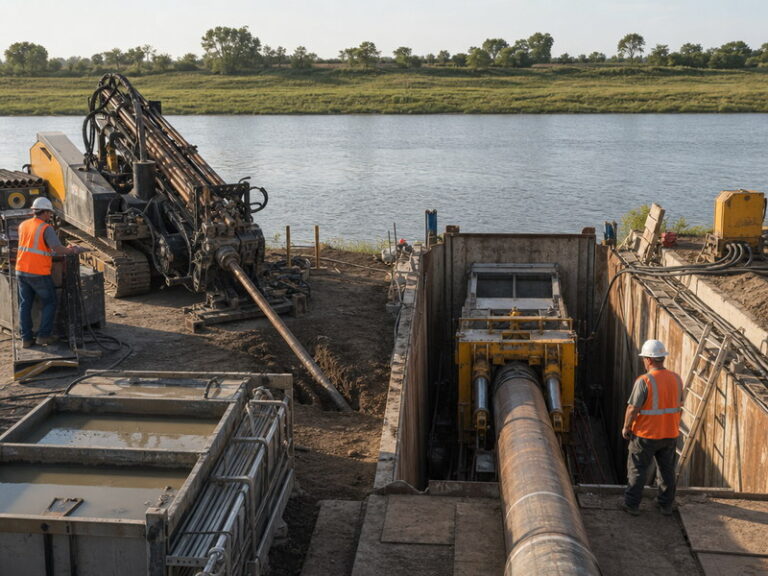
Choose Direct Pipe (a single-pass, thrust-based trenchless method) where a drilling-fluid return to the surface cannot be tolerated — levees, watercourses, shallow cover and congested urban corridors — and horizontal directional drilling (HDD) for long bores, small-diameter products and competent ground, where its lower unit rate holds.
This guide is written for owners, EPC engineers and bidders who have to pick one of HDD vs. Direct Pipe for a specific crossing, and then defend that choice at tender and in front of a permitting authority. It covers how each method installs the pipe, where each envelope ends, how cost and schedule behave, when a combination of the two is the rational answer, and how to document a selection that survives tender review.
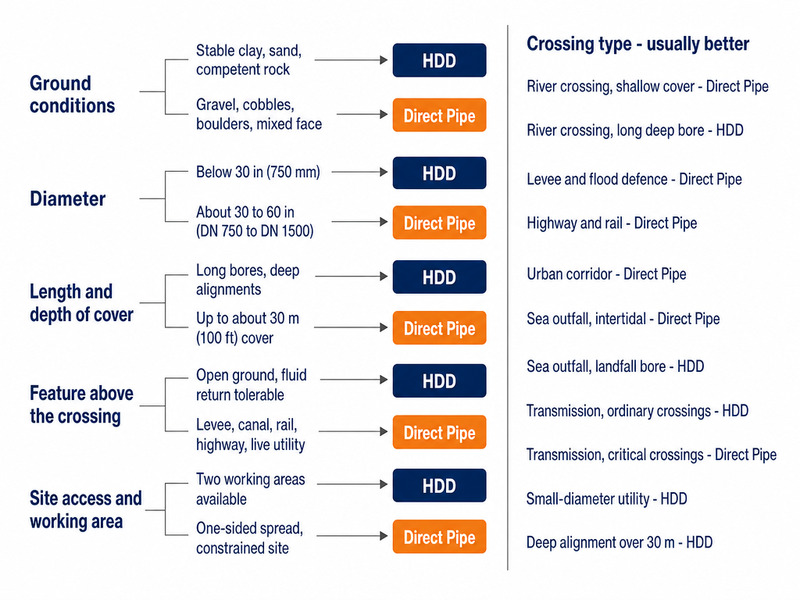
The decision turns on five variables: ground conditions, pipe diameter, crossing length and depth of cover, what sits above the alignment, and available site footprint. Screen on those five first, then confirm against the crossing-type table under “Which Crossing Type Are You Building?” later in this guide.
Key Takeaways
- HDD is a staged, open-bore process: pilot hole, enlargement passes, then pullback, with the bore held open by pressurised drilling fluid. Direct Pipe is single-pass: a microtunnel boring machine (MTBM) excavates while a hydraulic Pipe Thruster (the thrusting unit that drives the pipe string from the launch shaft) pushes a welded steel pipe string in behind it.
- Within those five variables, three thresholds most often decide the method on their own: 30 in (750 mm) of diameter, 30 m (100 ft) of cover, and whether a fluid return to the surface would be tolerable.
- A Direct Pipe drive depends on face conditions and available thrust, so a face obstruction slows the drive directly; an HDD programme spreads its risk across the pilot, enlargement and pullback stages, where the pullback load is the moment of greatest consequence.
- The selection is defensible only when it is documented: geotechnical baseline, fluid-escape consequence, total installed cost on the same contingency basis, physical fit, and contractor and equipment availability.
HDD vs. Direct Pipe at a Glance
| Decision factor | HDD | Direct Pipe |
|---|---|---|
| Installation principle | Pilot hole, one or more enlargement passes, then pullback of the product pipe | Single pass: the MTBM excavates while the pipe string is thrust behind it |
| Bore condition | Open bore, held open by drilling fluid while drilling and reaming | Face continuously supported by the machine; no open bore at any stage |
| Fluid pressure regime | Pressurised circulation; pressure can fracture weak ground and reach the surface | Closed-loop slurry circuit at pressures only slightly above hydrostatic |
| Typical product pipe | HDPE, PVC and steel; flexible and rigid products | Steel pipe string, prewelded on site |
| Diameter envelope | Very small to very large; strongest below 30 in (750 mm) | Typically 30 to 60 in (DN 750 to DN 1500, nominal diameter) outside diameter |
| Practical depth of cover | No standard limit; fluid-pressure risk grows with depth | Standard configuration to about 30 m (100 ft), where face pressure stays near 3 bar; deeper drives need higher-pressure machines |
| Achieved crossing lengths | Long bores are routine in competent ground; two 5,100 ft (about 1,550 m) bedrock bores were completed beneath New York’s East River in 2025 | Drive record 1,930 m, with a single 1,496.48 m pipe string, at Whangaparaoa, New Zealand, 2018 |
| Navigation | Walkover or wireline systems; survey uncertainty grows with length | Gyrocompass inside the machine; tight steering in congested alignments |
| Boulders and cobbles | Tool wear, steering loss and stuck-pipe risk | Machine can ingest boulders up to roughly one-third of the face diameter, per the manufacturer’s published specification |
| Working area required | Entry and exit sides, plus pipe string layout and fluid handling | Entire spread, including the prefabricated pipe string, can sit on one side of the crossing |
| Unit rate in cooperative ground | Lower; usually the most economical method | Higher; more equipment and continuous thrusting per metre |
| Principal residual risks | Fluid escape, bore collapse, stuck pipe, fluid disposal volumes | Face obstruction, thrust capacity, coating protection, restricted depth envelope |
HDD vs. Direct Pipe: How Each Method Installs Your Pipe
HDD and Direct Pipe both finish with a pipe in the ground and no open trench. What differs is what happens between the entry point and that finished pipe, and that difference drives every selection criterion in the sections below. Figure 1 compares the two installation sequences.
HDD installs the pipe in three stages
Horizontal directional drilling starts with a pilot hole drilled along a designed arc, steered by a downhole assembly and tracked by walkover or wireline survey. The bore is then enlarged to final diameter in one or more reaming passes, and only after the last pass is the product pipe pulled back in a single continuous operation.
In HDD, the pilot and reaming stages hold an open bore, which is kept open by drilling fluid pumped under pressure. That fluid must carry cuttings to the surface and overcome annular friction, so its pressure rises with length, depth and viscosity. In coarse or shallow ground, that pressure can exceed the strength of the formation and escape, the mechanism known as frac-out or an inadvertent return.
Direct Pipe installs the pipe in one pass
Direct Pipe reverses the sequence. A prewelded steel pipe string is positioned in the launch shaft behind an MTBM, and a hydraulic Pipe Thruster pushes the string forward while the machine excavates the ground in front of it. The pipe string itself transmits the thrust to the cutterhead, the spoil is removed through a closed slurry circuit, and steering is handled by a gyrocompass inside the machine.
The method was introduced commercially in 2007, when a 48-inch steel casing was thrust 464 m beneath the Rhine near Worms, Germany, at a maximum depth of 10 m through silt, sand and gravel, with the slurry circuit running at a maximum of 1.5 bar, a Pipe Thruster rated at 500 t of thrust, and breakthrough 13 days after works began.

Why the sequence changes risk, schedule and site layout
Collapse of an open bore and loss of drilling fluid to the surface are the two most common causes of HDD trouble in weak ground, and Direct Pipe removes both, because it never leaves an unsupported bore. Because the thrusting spread and the prefabricated pipe string sit on one side of the crossing, Direct Pipe also needs a smaller working area than an HDD spread with a pipe side and a rig side, which is why it is often selected in densely populated corridors.
The trade-offs in Direct Pipe are thrust capacity and machine availability. Every metre of a Direct Pipe drive depends on face conditions and available thrust, so a face obstruction slows the drive directly. HDD spreads its schedule risk differently: the pilot and enlargement stages can move quickly, and the pullback load is the moment of greatest consequence. The Czeszów–Wierzchowice gas pipeline crossings in Poland illustrate the throughput a clean Direct Pipe drive can reach: a 700 m drive at 1.047 m outside diameter was completed in 13 drilling days with a best day of 147 m, followed by a second 464 m drive in 16 drilling days using the same 500 t thrust capacity.
Five Variables That Decide Your Crossing
Method selection is not a preference exercise. In our reviews of crossing proposals, the same five inputs come up in almost every case, and any one of them can override the other four.
| Variable | Favours HDD | Favours Direct Pipe |
|---|---|---|
| Ground conditions | Stable clay, silt, sand and competent rock without boulders | Heterogeneous, coarse or unstable ground, including gravel, cobbles and boulders |
| Diameter and wall thickness | Below 30 in (750 mm), and very large diameters in favourable ground | Welded steel pipe from about 30 to 60 in (DN 750 to DN 1500) |
| Length and depth of cover | Long bores; deep alignments with no standard limit | Short to medium drives at shallow to moderate cover, generally up to about 30 m (100 ft) |
| What sits above | Open ground, farmland, ground where a fluid return would be tolerable | Levees, rivers, canals, rail and highway embankments, live utility corridors |
| Site access and working area | Two working areas available, with space for pipe string and fluid handling | One-sided spread in a constrained or built-up area |
1. Ground conditions, and how well you actually know them
Ground is the single largest driver. HDD performs best in consistent fine-grained soils and competent rock; its difficulties begin where the bore passes through mixed or coarse material, where cutting tools lose steering and fluid escapes along gravel paths. Direct Pipe was developed for precisely those conditions and can ingest boulders of up to roughly one-third of its face diameter, per the manufacturer’s published specification.
The caveat is knowledge, not method. On the Champlain Hudson Power Express terrestrial works, the project team sampled cores at the entry and exit of every bore and then every 400 to 500 ft along the bore path, extending about 20 ft below planned maximum depth, and reported that the early spend produced very few surprises. A geotechnical investigation that only covers the entry and exit pits is the most common reason a method that looked right on paper fails in the field.
2. Diameter and pipe material
Diameter narrows the field quickly. Below about 30 in, HDD or microtunnelling (US: microtunneling) is normally the practical answer, because the thrust-based method is built around welded steel pipe strings in the 30 to 60 in range. Within that large-diameter band both methods are viable and the ground decides.
Material matters as much as size. Direct Pipe requires a rigid, prewelded steel string, because the thrust force passes through the pipe wall during the drive. Flexible HDPE and PVC products are installed by HDD, which pulls the pipe rather than pushing it. Wall thickness and coating also enter the calculation, because they govern how much thrust the string can transmit.
3. Crossing length and depth of cover
Length and cover pull in opposite directions. HDD has no standard depth limit and is the method of long, deep crossings; two 5,100 ft bores beneath New York’s East River, completed in 2025 for the Champlain Hudson Power Express with 20 in steel casing, show the scale it can reach. The single-pass method’s advantage is concentrated at shallower cover, where its near-hydrostatic closed loop removes the fluid-escape mechanism that shallow HDD crossings fight against.
Direct Pipe’s documented limit is depth rather than length. Applicability: the standard configuration suits cover depths to about 30 m (100 ft), where face pressure stays near 3 bar. Drives deeper than that require a higher-pressure machine configuration, which must be priced explicitly rather than assumed. Beyond that envelope, HDD’s economics improve relative to Direct Pipe.
4. What sits above the crossing
Direct Pipe is the lower-consequence option wherever what sits above the alignment cannot tolerate a fluid return. The reason is that a return of fluid to the surface under an embankment, a river, a canal, a rail line or an operating utility corridor is not merely an environmental nuisance: it can trigger stop-work and remediation obligations that dominate the project schedule.
Where the ground above is open and tolerant, and where a surveyor can work safely along the alignment, the trade shifts back toward HDD’s lower unit rate. A 4,038 ft record Direct Pipe drive at Freeport, Texas, in 2015 illustrates the other case: a 48 in steel line thrust by a 750 t Pipe Thruster crossed beneath a flood-control levee, a barge canal, a rail line and several roads in a single pass, completed in two months.
5. Working area, access and schedule window
Direct Pipe suits a one-sided spread, and that difference is often what decides a crossing in a city. The entire spread, including the prewelded pipe string and the thrusting equipment, stays on the launch side, which is why it is often preferred where a second working area is simply not available. HDD needs both sides, a stringing area for the product pipe and room for fluid handling and containment, and its schedule risk sits in the pilot and enlargement stages. Whichever method is proposed, the schedule question is whether the critical path runs through the drive or through the civil works around it.
Which Crossing Type Are You Building?
Most HDD vs. Direct Pipe decisions in practice are made from the crossing type, because the type already implies the constraints. Use the table as a first screen, then verify it against the five variables above.
| Crossing type | Usually better | Why |
|---|---|---|
| River and waterway — shallow cover over an erodible bed | Direct Pipe | A fluid return would reach the watercourse directly; the closed slurry loop removes that pathway |
| River and waterway — long, deep bore in competent ground | HDD | Long deep bores in stable ground carry HDD’s lower unit rate |
| Levee and flood defence | Direct Pipe | Continuously supported face and near-hydrostatic pressure protect the embankment from fluid-related disturbance |
| Highway and rail embankment with settlement limits | Direct Pipe | Cover is usually shallow, and the structure above tolerates very little ground movement |
| Urban and congested corridor | Direct Pipe | One-sided spread, gyrocompass steering and closer approach to live utilities |
| Sea outfall and shore approach — intertidal section | Direct Pipe | Shallow cover and sensitive intertidal ground at the most expensive working area |
| Sea outfall and shore approach — long landfall bore in stable ground | HDD | Beyond the intertidal zone, long deep bores in stable ground favour HDD economics |
| Long onshore transmission programme — ordinary crossings | HDD | Hundreds of crossings reward a repeatable, low unit rate |
| Long onshore transmission programme — critical crossings | Direct Pipe | A few technically difficult crossings justify the premium |
| Small-diameter utility, fibre and water | HDD | Below the diameter envelope of Direct Pipe; flexible products cannot be thrust |
| Deep alignment, more than about 30 m | HDD | No standard depth limit versus Direct Pipe’s pressure-limited envelope |
Waterway crossings
Direct Pipe is normally the choice for a waterway crossing with shallow cover over an erodible bed, and HDD for a long, deep bore in consistent ground. The two governing questions are how much cover sits between the bore and the bed, and how long the crossing is. Shallow cover over an erodible bed is where drilling fluid returns into water, and the consequence is contamination of a watercourse together with the stop-work and remediation obligations that follow; long, deep crossings in consistent ground are where horizontal directional drilling is at its most efficient.
Levee and flood-defence crossings
Direct Pipe is normally the choice for a levee or flood-defence crossing. Embankments are assessed for seepage and stability, not just for surface damage, so fluid escaping beneath one is treated as a potential internal erosion pathway. HDD applies to a levee crossing only where a competent, cohesionless stratum exists below the embankment and can carry the bore at adequate depth for its full length. Where no such stratum exists, Direct Pipe is often the reason the crossing can be permitted at all.
Highway and rail crossings
Direct Pipe is normally the choice beneath a highway or rail embankment where a settlement limit applies. Cover there is usually shallow and the structure above tolerates very little ground movement, so settlement rather than cost governs the choice, and the continuously supported face of Direct Pipe never leaves an open bore.
Urban and congested corridors
Direct Pipe is normally the choice in a congested urban corridor. The governing constraints there are one-sided working space and proximity to live services: the whole spread, including the prewelded pipe string, stays on one side of the crossing, and gyrocompass steering holds the alignment close to existing utilities where a walkover survey is difficult or impossible. Urban crossings are therefore where the footprint argument most often decides the method.
Sea outfalls and shore approaches
Direct Pipe is normally the choice for the intertidal section of a sea outfall or shore approach, and HDD for the longer landfall bore behind it. Shore approaches combine shallow cover, tidal ground and a seaward working area that is expensive to occupy. A 2018 award-winning sea outfall shore approach in the Gulf of Mexico used 4,900 ft (about 1,495 m) of Direct Pipe onshore and then pushed a further 1,350 ft offshore, 6,250 ft of thrusted 42 in pipe in total, precisely because the transition zone could not tolerate open-cut works.
Long onshore transmission lines
Standardise on HDD for the ordinary crossings in an onshore transmission programme, and reserve Direct Pipe for the few technically critical ones. A transmission project is not one crossing, it is dozens or hundreds, and the selection logic changes with volume. On the Champlain Hudson Power Express terrestrial contract, more than 300 trenchless crossings and roughly 420,000 ft of conduit were installed by one programme of works, with a reported trenchless value of USD 284 million, which is the scale at which a repeatable unit rate matters more than any single crossing.
How Costs and Schedules Compare: HDD vs. Direct Pipe
Grand View Research puts the global HDD market at about USD 9.3 billion in 2025, about USD 10.5 billion in 2026 and about USD 20.9 billion by 2033, roughly 10.3 percent compound annual growth; Fortune Business Insights publishes a higher trajectory, about USD 25.11 billion by 2034 at about 11.75 percent.
Comparing HDD vs. Direct Pipe on cost has to start with a defined crossing, because machine time and ground conditions dominate both, and because a return of fluid to the surface, a frac-out, can turn a low unit rate into an expensive crossing. What can be compared honestly is the shape of the cost, and where each method’s money goes.
| Scenario | HDD | Direct Pipe |
|---|---|---|
| Cooperative ground, adequate cover | Lower unit rate and lower total cost; the reference case for budget estimates | Premium from the machine, the Pipe Thruster and continuous thrusting |
| Gravel, cobble or boulder-prone ground | Low unit rate on paper, but elevated risk of tool wear and stuck pipe | Higher unit rate with a drive that matches its plan more often |
| Shallow cover under water or an embankment | Requires fluid containment, monitoring and contingency; failures cost schedule, not just money | Predictable cost; the fluid-escape risk that drives HDD contingency is largely absent |
| Constrained urban site | Needs two working areas and pipe stringing space, which may not exist | Reduces land take and community disruption |
| Long, deep crossing in competent ground | Usually cheaper and the proven option | Both the depth envelope and the cost premium work against Direct Pipe in deep, competent ground |
In our own bid reviews of crossings in ground that would support HDD, the HDD unit rate has repeatedly come in materially below the Direct Pipe rate, and the comparison inverts once the ground is coarse, the cover is shallow, or a watercourse sits directly above the alignment. The unit rate is not the cost of the crossing; the cost of the crossing includes what happens when the first method does not work.
When comparing tenders, ask each bidder to itemise:
- Drilling-fluid volumes, containment, recycling and disposal
- Machine or rig time, including enlargement passes or shaft and thrusting time
- Contingency and restoration, priced separately rather than folded into a lump sum
- Geotechnical risk allocation, and what triggers a change order
When a Combination Beats Either Method Alone
Framing the decision as HDD vs. Direct Pipe forces a choice that the site may not require. Several combinations are common in transmission and outfall projects.
- Shore approach plus long bore. Direct Pipe through the shallow, environmentally sensitive intertidal section, then HDD for the deeper, longer run behind it.
- Critical crossing within an HDD programme. Standardise on HDD for the line, and let Direct Pipe take the two or three crossings where cover is shallow or the ground is coarse.
- Steel casing for a difficult bore. Where fractured rock or adverse ground threatens a cable or conduit crossing, either method can install a steel casing that protects the product and allows a simpler pull.
- Direct Pipe where the pipeline already runs alongside existing services. On the Czeszów–Wierzchowice crossings in Poland, the alignments followed existing gas lines, and the gyrocompass steering of the machine was chosen to keep deviations within tight tolerances.
A Six-Step Method Selection Process
We use this sequence when an owner asks whether horizontal directional drilling or Direct Pipe should go to tender. Each step produces a written output, so the decision can be reviewed rather than argued. Figure 2 summarises the screen that steps 1 to 3 apply.
1. Characterise the ground along the full alignment
Boreholes or soundings along the path, not only at the entry and exit pits, and deep enough to cover the planned profile with margin. Record the coarse fraction, boulder potential and any weak or permeable layer separately, because they drive different failure modes.
2. Define the crossing envelope
Fix outside diameter, wall thickness and product type, then plot the length and cover profile. Diameter alone will often eliminate one method before ground considerations are reached.
3. Screen the fluid-escape consequence
Map what lies above the alignment and rate the consequence of a surface return: tolerable in open farmland, intolerable beneath an operating watercourse, flood defence or live utility. Screening the fluid-escape consequence is the step that most often selects Direct Pipe.
4. Compare total installed cost, not unit rate
Price both methods with the same contingency basis and the same restoration scope, including fluid handling and any monitoring obligations. The method with the lower unit rate is not automatically the cheaper crossing.
5. Check the physical fit
Confirm that the selected method’s equipment can actually occupy the available land: launch shaft or rig pad, pipe stringing area, access routes and laydown. A method that cannot be mobilised is not a method.
6. Verify contractor and equipment availability
Ask for comparable crossings, the guidance system that will be used, the thrust or pull capacity against the calculated requirement, and a written fluid or face-management plan. Direct Pipe capacity and machine availability are less widely distributed than HDD capacity, and lead time can decide the schedule.
Selection Mistakes We See in Bid Documents
Common Ground Alliance reported the annual economic cost of utility damage in the United States at about USD 83.2 billion, or roughly USD 227 million a day — a measure of what it costs to be wrong about what lies underground. The selection mistakes below belong to the same family: each one is a decision taken on an incomplete picture of the ground, the corridor or the contingent cost.
- A method named before the ground is known. Fixing HDD vs. Direct Pipe before the ground has been characterised means the rest of the review only justifies a decision already taken.
- Entry-and-exit-only investigation. Two boreholes do not describe a 1,000 m profile, and the middle of the crossing is where problems occur.
- Unit rate used as the decision. Comparing cost per metre hides the difference in contingent cost between the methods.
- Depth envelope ignored. A Direct Pipe proposal below its standard pressure envelope needs the higher-pressure configuration priced explicitly, not assumed.
- Footprint taken for granted. Both methods need land that is often the scarcest item on the project.
- Fluid and spoil management priced optimistically. Containment, recycling and disposal of drilling fluid are major HDD cost and risk items, and are routinely underestimated.
HDD vs. Direct Pipe FAQ
Which method is better for a levee crossing?
Direct Pipe is normally the safer selection for a levee or flood-defence crossing. The face is continuously supported and the slurry circuit runs as a closed loop at near-hydrostatic pressure, so the failure mode that regulators worry about most, drilling-fluid escape beneath or through the embankment, is largely removed. HDD remains viable where a competent, cohesionless stratum can be targeted below it for the full length of the crossing.
Is Direct Pipe always more expensive than HDD?
No. Direct Pipe carries a higher unit rate because it needs an MTBM, a Pipe Thruster and a continuous thrusting operation, so in cooperative ground HDD is usually cheaper. In gravel, low-cover or waterway conditions the comparison often reverses, because the cost of a stalled or heavily mitigated HDD programme, including drilling-fluid containment, recovery and restoration, can exceed the Direct Pipe premium.
Can HDD install 36-inch pipe, and can Direct Pipe install 12-inch pipe?
Direct Pipe is specified for welded steel pipe strings, typically 30 to 60 inches outside diameter, and HDD is the method for smaller products. So 36-inch steel is within HDD’s range where the rig, the ground and the pullback loads allow, while a 12-inch utility, fibre or water line stays with HDD because it falls below Direct Pipe’s diameter envelope.
Which method handles rock?
Both can, with different equipment, and the deciding factor is the rock mass rather than the rock strength alone. HDD uses rock reamers and, in hard formations, downhole motors; Direct Pipe uses a machine fitted with a suitable cutterhead. Highly fractured, abrasive or cavity-prone rock raises cutter and steering risk in both methods, which is why the ground model matters more than the method label.
How long does a method selection review take?
With a usable geotechnical report, a crossing length, a diameter and a plan and profile, a documented method selection can normally be produced in about five working days. Without ground information the review can only be indicative, because ground conditions drive the answer more than any other single input.
What is Direct Pipe, and how does it install a pipeline?
Direct Pipe is a single-pass trenchless method: a microtunnel boring machine excavates the ground while a hydraulic Pipe Thruster pushes a prewelded steel pipe string in behind it, so the pipe string itself carries the thrust to the cutterhead and no open bore is left unsupported at any stage. Spoil leaves through a closed-loop slurry circuit at near-hydrostatic pressure, and the machine steers with an internal gyrocompass.
Direct Pipe vs. microtunnelling: which is better?
Direct Pipe and microtunnelling share the same closed-face machine and slurry circuit, and differ mainly in what carries the thrust and what the product pipe is. Microtunnelling jacks pipe, usually concrete or clay, from a thrust shaft over comparatively short drives that must hold a tight grade. Direct Pipe thrusts a continuous, prewelded steel string, and is chosen where the product must be steel, where the drive is long, or where the working area is limited to one side of the crossing.
How JSW Supports Your Crossing Decision
JSW is a pipeline engineering and construction partner that supports owners and contractors across the full lifecycle of trenchless crossings, from the method decision through to commissioning. We provide pipeline construction services, trenchless pipeline repair technology, pipeline maintenance services and horizontal directional drilling.
Alongside those services, crossing projects depend on pipeline automatic welding technology, pipeline cold bending, pipeline hot tapping and plugging services and microtunnelling support. Our fabrication and tooling layer includes pipeline hot tapping equipment, pipeline plugging pigs and pipeline cutting machines used to prepare and join pipe strings on the entry spread.
What that integration changes in practice:
- Method selection from data — we recommend from the geotechnical baseline and the consequence of fluid escape, not from a preferred technique.
- Pipe string readiness — welding, cold bending and joint preparation planned against the drive programme, so the string is not the constraint on the critical path.
- One delivery chain — bore or thrust design, pipe fabrication, crossing works, tie-ins and restoration under a single scope.
- Records that stand up — daily drive or drilling records, fluid or face management logs and as-builts for handover and audit.
- Explicit risk pricing — fluid handling, restoration and recovery contingencies itemised rather than absorbed into a headline rate.
If you are weighing HDD vs. Direct Pipe for an upcoming crossing, send our engineering team the pipe diameter and wall thickness, crossing length, depth of cover, geotechnical report and the type of feature being crossed. We will return a documented method recommendation with the governing criteria and a scoped cost comparison on the same contingency basis, typically within five working days.
Not sure which method fits your crossing?
Send us the pipe diameter and wall thickness, the crossing length and depth of cover, and the geotechnical report. We will come back with a documented recommendation and a scoped cost comparison, typically within five working days. Request a method review.
Related reading on this site: our companion assessment of which of the two methods carries the lower risk in specific ground and cover conditions.
About the Author: Written by the JSW Engineering Team, pipeline construction and infrastructure specialists with field experience on utility, oil and gas, and infrastructure crossings across multiple continents. Reviewed against current manufacturer project data and the published records of the crossings cited in this article (Worms 2007, Czeszów–Wierzchowice 2016, Whangaparaoa 2018, Freeport 2015, Champlain Hudson Power Express 2025).





































 English
  Arabic
  Russian
  Spanish
  French
  Vietnamese
  Polish
  Thai
Thai  Indonesian
  Turkish
  Portuguese