
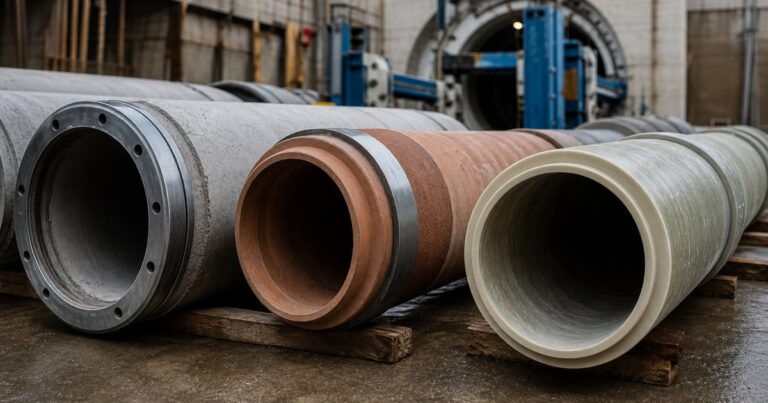
Microtunneling pipe materials are selected on one governing criterion: whether the pipe and its joint can carry the jacking load at the governing point of the drive while staying watertight and on line. Direct jacking is dominated by reinforced concrete pipe (RCP), vitrified clay pipe (VCP), polymer concrete and glass-reinforced plastic (GRP); steel is usually a casing or sleeve in a two-pass system, and a standard ductile iron pipe can be jacked only where the manufacturer confirms jacking capacity. This comparison sets out the governing standards, the typical diameter ranges, the joint systems and, most importantly, where the jacking load actually comes from for each family. It is written for engineers and bidders choosing a pipe for a specific drive, and every range here is an input to project-specific design.
What Makes a Pipe Suitable for Microtunneling Duty?
A jacking pipe is a structural element, not only a conduit: it has to transfer the machine thrust from pipe to pipe and hold its seal while the line is steered. In our design reviews the first question is always whether the pipe and its joint can carry the jacking load at the governing point of the drive, ahead of internal flow capacity; we ask for the supplier’s jacking-load table before we compare materials.
For these microtunneling pipe materials to work in jacking duty, each pipe has to meet five conditions at the same time:
- Carry axial load through the joint. The thrust passes from pipe to pipe across the joint faces and the collar, so the joint, not just the barrel, is the load path.
- Provide a shear connection. The joint has to keep the pipes aligned under load rather than allowing one pipe to step off line.
- Resist external earth and traffic loads once installed, in service as well as during the drive.
- Stay watertight when articulated. As the line is corrected, the joint opens slightly on one side, and the seal still has to hold.
- Follow the bored line. The machine cuts an overcut beyond the pipe outside diameter, so the pipe rests somewhere inside the bored hole rather than being gripped by the ground.
The values on this page are inputs to project-specific design and must be confirmed by a competent engineer for the actual drive. A range in a comparison table is never a substitute for a pipe-by-pipe jacking check against the supplier’s data.
The reason is that jacking capacity depends on the specific product: the minimum wall thickness, the concrete or laminate strength, the collar and the packers, and the joint deflections expected on this drive. A standard fixes dimensions and material grades, not the axial capacity of a particular pipe, so the bid has to carry the supplier’s current jacking-load table, the packer and collar detail and the joint deflection.
Reinforced Concrete Pipe: The Default for Direct Jacking
Reinforced concrete pipe (RCP) is the dominant material for direct jacking, and for good reason: it is stiff, widely available in large diameters and made in a joint form that is proven under repeated axial loading. The RCP is normally made to BS EN 1916, with the 2017 edition adding BS 5911-1, and it is also covered by AS/NZS 4058 and by the ASTM C76 and ASCE 27-00 family. Standard concrete jacking pipes run from 450 mm to 2400 mm, with sizes up to 3000 mm or more made to order.
Length is part of the standard, not a free choice: concrete jacking pipes are normally 1.2 m to 2.5 m long. That length sets the number of joints over a drive, and every joint is a place where load has to pass and where articulation has to be tolerated. A minimum Class 4 pipe to AS/NZS 4058 is usually recommended, with Class 3 suitable for some short drives, and jacking installation leads to a recommended bedding factor between 2 and 3.
Two material points matter in practice when microtunneling pipe materials are compared. Concrete compressive strength is typically up to 60 MPa and above, with water absorption below 4 percent against a 6 percent maximum in AS/NZS 4058. And the packer matters as much as the pipe: medium density fibreboard has been found the most suitable of the timber-based materials under repeated loading, with good recovery, and packers must not extend over the full joint width because a small gap left to the inside surface prevents localized spalling of the joint edge.
The jacking load for a concrete pipe comes from the manufacturer’s table for that diameter, wall thickness, collar and packer, and one manufacturer’s fixed-collar envelope shows the form that data takes.
Vitrified Clay and Polymer Concrete: Chemical and Abrasion Duty
Vitrified clay pipe (VCP) brings high axial strength, chemical resistance and very long service life, which is why it holds a firm place in sewerage and aggressive effluent duty. A clay pipe for jacking is made to BS EN 295-7, with BS EN 12889 covering the construction of the pipeline, and it is supplied in diameters from about 150 mm to 700 mm. Typical lengths are 1.0 m to 2.0 m, shorter than concrete, which means more joints across the same drive.
The joint is the reason clay performs in jacking. Clay jacking pipes use machined ends with a stainless steel collar and an EPDM seal, so the axial load is carried on machined faces rather than on rough concrete edges. That machined joint is also what makes the small diameter range work: the tighter the joint faces, the better the load transfer at small diameters.
Polymer concrete is the specialist that sits beside clay on chemical and wear duty. It is made to DIN 54815-1 and DIN EN 14636-1, and it is known for very tight dimensional control and good abrasion resistance. Where a drive has to meet a tight fabricated tolerance, or where abrasive or aggressive flow shortens the life of other materials, polymer concrete is one of the direct-jack options worth pricing.
GRP, FRP, Steel and Ductile Iron: Specialist, Casing and Carrier Duties
Glass-reinforced plastic (GRP) sits in the direct-jack family, while steel and ductile iron are usually casing, carrier or lining products rather than gravity grade jacking pipes. The terminology is worth stating honestly, because GRP and FRP are used loosely. A filament-wound GRP pipe is made to ISO 25780 or BS 5480, while a centrifugally cast glass-reinforced plastic pipe is a different product family made to ASTM D3262. A GRP pipe is light, corrosion resistant and easy to handle, but it has lower relative stiffness than concrete, and the jacking faces need careful design so the thrust is spread evenly around the laminate rather than concentrated at a point.
GRP and FRP pipes are often selected for corrosive or pressure duty, and they are also widely used as a relining product rather than as a first-pass pipe. Where a GRP pipe is chosen for direct jacking, the joint and the end face detail become the governing items, and the manufacturer’s jacking data is the only acceptable basis for the allowable load.
Steel is generally used as a casing or sleeve in a two-pass system, where the steel is installed first and the product pipe is pulled or pushed through afterwards. Steel casing is commonly made to AWWA C200 or API 5L, the welded lengths are set by welding time and pit size, and line and level tolerances are relaxed because the inner product pipe sets the finished alignment. Coating, corrosion allowance and annulus grouting then become the design items that decide the casing’s service life.
Ductile iron is a carrier, lining and pressure product, made in the EN 545, EN 598, ISO 2531 and AWWA C151 family, with restrained joints whose shear performance is tested to at least 50 DN in EN 545. Those joints are designed to resist pull-out and ground movement, not to transfer a jacking thrust. A standard ductile iron pipe is not a jacked pipe unless the manufacturer confirms jacking load capacity for the specific product, and that confirmation has to be in writing before it is specified for a jacking drive.
Microtunneling Pipe Materials Compared Side by Side
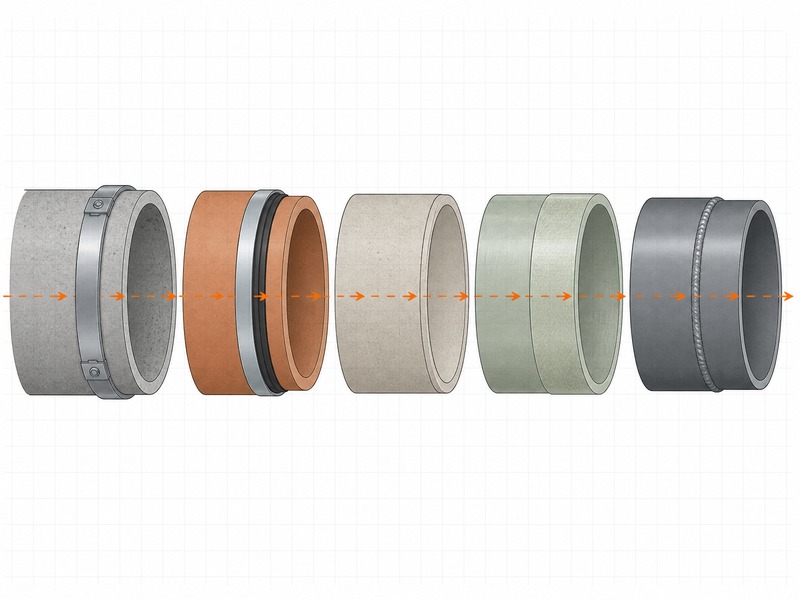
This comparison is a screening step: each row gives the governing standard, the typical diameter range, the joint form and the source of the jacking load for one material family, so the field can be narrowed before a project-specific jacking check is run. The final choice depends on ground conditions, drive length, diameter, internal and external pressure, corrosion and abrasion exposure, the tolerance required and what can be delivered to site on programme.
| Material | Governing standard | Typical diameter range | Jacking load source | Joint | Best fit | Limits |
|---|---|---|---|---|---|---|
| RCP (reinforced concrete pipe) | BS EN 1916 with BS 5911-1, AS/NZS 4058, ASTM C76, ASCE 27-00 | 450-2400 mm standard, larger to order | Manufacturer’s jacking-load table by diameter | Fixed steel collar or flush joint with packer | Gravity sewers, storm and large-diameter drives | Heavy units; needs jacking data per size |
| VCP (vitrified clay pipe) | BS EN 295-7, BS EN 12889 | About 150-700 mm | Manufacturer’s data for machined ends and collar | Machined end, stainless collar, EPDM seal | Aggressive effluent and long-life sewerage duty | Smaller diameter range; more joints |
| Polymer concrete pipe | DIN 54815-1, DIN EN 14636-1 | Small to medium, to order | Manufacturer’s jacking data | Close-tolerance machined joint | Tight tolerance and abrasion resistance | Higher unit cost; fewer suppliers |
| GRP pipe (filament-wound) and FRP pipe (centrifugally cast glass-reinforced plastics, CCFRPP) | ISO 25780 and BS 5480 (GRP), ASTM D3262 (centrifugally cast FRP) | Small to medium, to order | Manufacturer’s jacking data; faces need care | Bonded or mechanical joint | Corrosive and pressure duty; relining | Lower relative stiffness; end-face detail |
| Steel | AWWA C200 or API 5L | Wide, to order | Welded casing; not a jointed jacked pipe | Welded, with annulus grouting | Casing or sleeve in a two-pass system | Not a gravity grade product; corrosion allowance |
| Ductile iron | EN 545, EN 598, ISO 2531, AWWA C151 | Carrier and lining sizes | None unless the manufacturer confirms jacking capacity | Restrained joint tested to at least 50 DN in EN 545 | Carrier or lining product | Not a jacked pipe as standard |
Where the Jacking Load and the Fabrication Tolerance Actually Come From
Two project documents decide whether a pipe can be jacked: the manufacturer’s jacking-load table for the pipe being supplied, and the fabrication tolerance it is made to. A standard title alone fixes neither for a specific product, so the working document on site is the manufacturer’s table.
Fabrication tolerance is the second reason. At 48 in. inside diameter the published allowable variance is different for each material, and successive pipes that deviate the same way can double the effective allowance. Each material’s allowable variance comes from its own standard and can change a jacking check. These published ID variances come from a specifying article on microtunneling installation tolerances (Tunnel Business Magazine / North American Microtunneling Association).
| Material | Standard cited for the tolerance | Published allowable ID variance at 48 in. ID (about 1,219 mm) |
|---|---|---|
| Reinforced concrete pipe | ASCE 27-00 | 0.79 in. (about 20 mm) |
| Vitrified clay pipe | ASTM C1208 | 1.44 in. (about 37 mm) |
| Centrifugally cast FRP pipe | ASTM D3262 | 0.48 in. (about 12 mm) |
| Polymer concrete pipe | ASTM D6783 | 0.48 in. (about 12 mm) |
The variance can double if successive pipes deviate the same way.
Table 3 shows one manufacturer’s declared fixed-collar jacking envelope for its own concrete jacking pipes; it is quoted as a manufacturer statement and illustrates the shape of the diameter-to-load relationship, not an industry norm or a design value for another product.
| Nominal diameter | Published maximum jacking load per pipe – one manufacturer’s fixed-collar jacking envelope (tonnes) |
|---|---|
| DN300 | About 100 t |
| DN600 | About 240 t |
| DN1000 | About 515 t |
| DN1200 | About 650 t |
| DN1500 | About 840 t |
| DN1600 | About 1,020 t |
Every value in Table 2 and Table 3 is an input to project-specific design and must be confirmed by a competent engineer for the actual drive, using the manufacturer’s current data for the pipe actually supplied. A published envelope from one manufacturer is not a substitute for a pipe-by-pipe jacking check on the project’s own product.
How Material Choice Is Made and Recorded
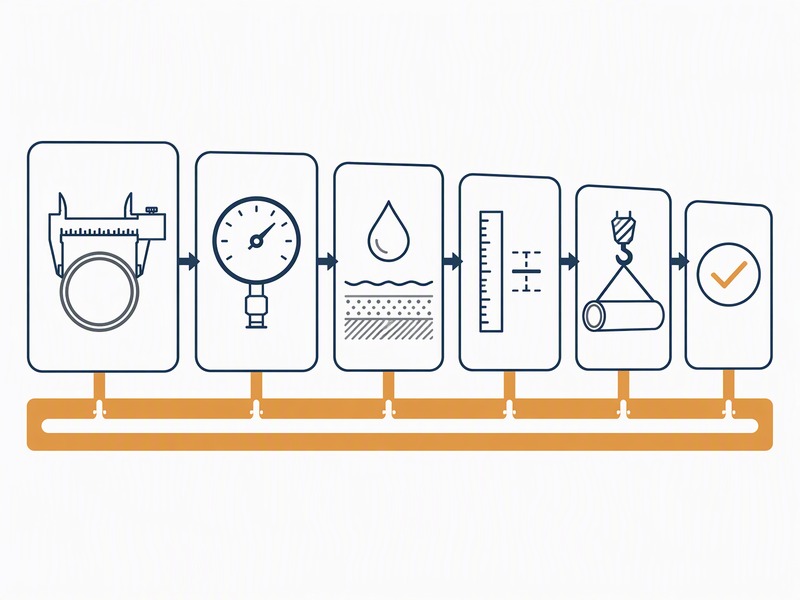
The choice between microtunneling pipe materials is a filter run in a fixed order: diameter and jacking load first, then the internal and external environment, then tolerance, then delivery and cost. A municipal owner specifying a gravity sewer, an EPC bidder pricing the drive, a third-party design consultant signing the selection and a contractor’s design team each run the same filter but weight the inputs differently. A pipe that cannot carry the governing jacking load is not a candidate, and a pipe that cannot be delivered on programme is not a candidate however well it performs in service. If the question is which material to use for a specific drive, for example a 900 mm gravity sewer crossing mixed ground, or a choice between RCP and GRP on a corrosive duty, this page answers it as a filter run in a fixed order.
- Diameter and jacking load come first. If the drive is large diameter and long, the concrete family is usually in front because of its stiffness and its published jacking envelope.
- The environment then filters the field. Aggressive effluent favors vitrified clay or polymer concrete; a corrosive or pressure duty points to GRP or FRP; a tight finished grade may point to a two-pass steel casing.
- Tolerance is checked against the fabrication allowance, and where the design slope is shallow the vertical tolerance is the tightest of the three.
- Delivery and pipe records close the loop. Delivered pipe dimensions and damage are commonly checked weekly, and pipes are identified individually against the jacking sequence.
Our field teams record the delivered pipe dimensions and any joint damage against the jacking sequence, because a chipped joint edge or an out-of-tolerance pipe will fail under thrust long before the barrel does.
How the jacking force budget is built around that pipe is set out in our jacking forces guide, and the tolerance the finished line must meet is covered in our design line, grade and tolerance guide.
Frequently Asked Questions
What is a jacking pipe and how is it different from an ordinary pipe?
A jacking pipe is a pipe designed to carry axial jacking load through its joint as well as to convey flow. An ordinary pipe is checked mainly for internal pressure, external earth and traffic load and watertightness, but it must also transfer the machine thrust from one pipe to the next, provide a shear connection and keep its seal when the line is articulated.
Which pipe materials are used for microtunneling?
Direct jacking is dominated by reinforced concrete pipe, vitrified clay pipe, polymer concrete pipe, and glass-reinforced plastic (GRP) together with centrifugally cast FRP pipe. Steel is usually a casing or sleeve in a two-pass system rather than a gravity grade product, and standard ductile iron pipe is a carrier or lining material unless the manufacturer confirms it as a jacking pipe.
Why does jacking strength come from the manufacturer and not the standard?
A general pipe standard fixes dimensions, crushing strength, watertightness and materials, but it rarely fixes the axial jacking capacity of a specific pipe. That capacity depends on the wall thickness, concrete or laminate strength, collar, joint and the packers used, so the bid has to carry the supplier’s current jacking-load table, the packer and collar detail and the joint deflection assumed for this drive.
Is ductile iron pipe suitable for microtunneling?
A standard ductile iron pipe carries jacking load only where the manufacturer confirms jacking load capacity for that product. Ductile iron is used more often as a carrier or lining product, and where it is considered for jacking the joint, shear and axial capacity have to be verified against the manufacturer’s data before it is specified.
When is steel used in a microtunnel?
Steel is generally used as a casing or sleeve in a two-pass system, where the steel is installed first and the product pipe is pulled or pushed through afterwards. Welded steel tolerates relaxed line and level because the inner product pipe sets the finished alignment, but coating, corrosion allowance and annulus grouting then have to be designed.
How do fabrication tolerances affect material choice?
Fabrication tolerance sets how much of the allowed deviation is spent before the drive starts, and the allowance differs by material because each pipe is made to its own standard. At 48 in. inside diameter the published allowable variance is about 0.79 in. for reinforced concrete pipe, 1.44 in. for vitrified clay pipe and 0.48 in. for both centrifugally cast FRP and polymer concrete, and the variance can double if successive pipes deviate the same way.
Key Takeaways
- Microtunneling pipe materials are set by the joint as much as the barrel: the joint carries the jacking load, provides the shear connection and has to stay watertight when articulated.
- Direct jacking is dominated by RCP, VCP, polymer concrete and GRP; steel is usually a casing in a two-pass system and ductile iron is a carrier or lining product.
- Jacking strength comes from the manufacturer’s jacking-load table for the specific pipe, collar and packer, not from a general pipe standard.
- A standard ductile iron pipe carries jacking load only where the manufacturer confirms jacking load capacity for that product.
- Fabrication tolerance differs by material and can double if successive pipes deviate the same way, so it is a selection variable, not a footnote.
- Every selection ends in three records: the standard, the manufacturer’s jacking-load table and the fabrication tolerance.
How JSW Supports Microtunneling Pipe Selection
JSW is a pipeline engineering and construction company that executes trenchless drives with its own crews and equipment. Our scope covers microtunneling construction, the wider trenchless technologies portfolio and dịch vụ lắp đặt đường ống, and, where an installed pipe has to be reinstated or restored in service, we provide pipeline repair services and pipe restoration solutions in the same contract. Because pipe selection sits with the team that will jack it, the jacking-load check and the choice between microtunneling pipe materials are made together.
We write the material selection against the manufacturer’s jacking-load table and the actual ground conditions rather than against a generic data sheet, and we record the assumed inputs so the choice can be audited.
- Integrated delivery: selection, jacking-load check, drive and records under one scope, which removes the handover between designer and constructor.
- Auditable engineering: the material basis, the jacking-load source and the tolerance allowance are recorded so a reviewer can trace each choice.
- Risk-explicit pricing: tolerance, abrasion and two-pass systems are identified and priced against defined triggers rather than bundled.
- Material-neutral advice: the pipe is chosen on jacking duty, environment, tolerance and delivery, not on a preferred supplier.
Choosing a pipe for a microtunneling drive? Send the drive diameter, ground conditions, required line and grade and the pipe data sheets you are considering. Our engineers return a scoped selection review, naming the governing jacking check, the three checkable items we would ask for, and an indicative budget range.





































 English
  Arabic
  Russian
  Spanish
  French
  Vietnamese
  Polish
  Thai
Thai  Indonesian
  Turkish
  Portuguese