

Microtunneling under roads answers to the owner of the surface, not to the ground alone. The same machine and the same jacking pipe can cross a city street, a live railway and an operating runway, yet each surface sets its own line-and-grade tolerance, minimum cover, settlement limit, permit authority and construction window. This guide ranks those three surfaces as three levels of constraint, then converts them into a permit map, a settlement-trigger table and a risk register that a bid team can act on.
What makes microtunneling under roads, railways and runways harder than an open cut?
The difficulty of a crossing is set by the surface owner, not by the soil. A drive under a residential street may be governed by a municipal excavation permit and a repaving obligation, while a drive of identical length under a main-line railway is governed by the railroad’s engineering standard, its liability insurance requirement and a flagging crew. The geology is a shared variable, but the constraint set is not.
Treat every crossing as one of three levels of constraint. Each level adds an authority, a minimum cover rule and a settlement expectation that the others do not carry.
- Road: the governing constraints are the road authority permit, the local minimum cover rule and a traffic-management window.
- Railway: the governing constraints are the casing requirement, a track-load deflection limit and a possession window agreed with the railroad.
- Runway: the governing constraint is runway availability, because closing a runway costs far more per hour than closing a road.
Tolerances: how tight must the line and grade be?
Microtunneling under roads usually accepts a looser line than a railway or a runway. In stable, self-supporting and uniform ground, pipe-jacking practice commonly works to a line and grade of about ±50 mm at any point. Where the alignment crosses loose ground or an obstruction, the tolerance may fall outside what any machine can hold, and the design has to accept the coarser figure.
Diameter helps. A larger pipe gives the steering more room to correct without crowding the joint, so large-diameter drives often hold a tighter line than small ones. Where a crossing must meet a strict grade, a laser-guided machine is normally specified; the laser guidance systems used on site can hold roughly ±25 mm, which is a working accuracy rather than a guarantee for every soil.
Tolerance and settlement are linked through the overcut. The annular gap left around the pipe is typically 13–38 mm. An overcut of about 35 mm is enough to let ground move into the gap and appear at the surface, so under a road, a railway or a runway the overcut is deliberately reduced to keep settlement below roughly 10 mm.
How much cover does a road, a railway or an airfield crossing require?
For microtunneling under roads, cover is the first number an authority checks, and it is defined differently by each owner. Under a road, minimum cover is set by the local ordinance and is measured from the top of the pavement, from natural ground, or from the deepest trench bottom, depending on the rule. Published ordinance examples sit in a wide band, roughly 24 in. to 42 in., with about 3 ft a common planning value. The definition matters as much as the number.
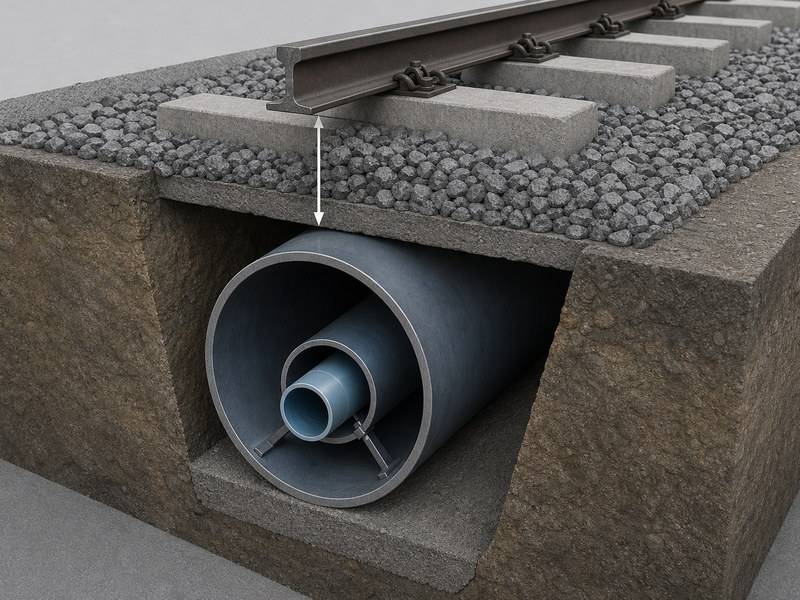
Under a railway, the governing reference is the AREMA Manual for Railway Engineering, Chapter 1 (Roadway and Ballast), Part 5 (Utilities), which covers pipeline crossings inside railroad property. That utilities chapter deals with auger boring, horizontal directional drilling, microtunneling, railplow and open-cut methods, so the choice of method stays with the railroad. Pipelines under track are usually required to run inside a casing pipe, and several railroad and agency guidelines give a minimum clearance from the top of the casing to the base of rail of about 5 ft to 5 ft 6 in. The figure differs between railroads and must be confirmed with the owner.
How much cover does a runway crossing need under aircraft loading?
Under a runway, cover follows airport design standards and the aircraft load case rather than a single ordinance. Airport design criteria and the construction-safety advisory material set the working envelope, and the cover has to keep the pavement structure and the underlying utilities stable under aircraft loading.
In our shaft siting reviews, the minimum working footprint for a road or rail crossing is about 11,000 sq ft, and that area, not the drive length, decides whether a tight site fits.
Which permits and restoration rules apply to a road crossing?
A road crossing is controlled by an encroachment permit issued by the local road authority, which may be a city, a county or a state transportation department. The permit fixes the working hours, the lane-closure plan, the cover and separation rules, and the standard to which the pavement must be restored. It is issued before the shaft is dug, not alongside it.
The permit survives the change of method: two shafts still break the pavement, and the permit still requires a surface restored to the authority’s standard. Compared with an open trench, that surface work is far smaller. Published comparisons of a 760 mm pipe jack against a 1,400 mm open cut show about 0.5 m³ of excavation per metre against 6.1 m³, about 8 truckloads of spoil per 100 m against 136, and carbon dioxide output of about 27.1 t against 66.7 t.
Planning is dominated by the permit clock. An encroachment permit for a busy road can take longer to obtain than the drive takes to build, so the application is normally the first deliverable on the programme, ahead of the geotechnical report.
Why does a railway crossing need AREMA, a casing pipe and a possession?
A railroad crossing is controlled by the railroad company through its own pipeline-crossing permit, and the process follows the Association of American Railroads (AAR) reference process for utility crossings. The railroad normally requires the crossing to be designed to its standard, to carry railroad liability insurance, and to be built with a flagman and a planned possession, which is the agreed window in which track is handed over for work.
The casing pipe is the visible part of that control. Under live track, the product line usually runs inside a larger casing installed by the crossing method, so that track load never reaches the carrier and the line can be replaced without re-boring. Auger boring, directional drilling and microtunneling are all accepted methods under the utilities chapter of the railroad standard; the method is chosen for the ground, the cover and the possession length, not for preference.
What does a possession window cost a railway crossing programme?
In our bid reviews, the schedule risk on a railroad crossing sits in the possession, not in the drive. If the railroad can offer only short night possessions, the same metre of tunnel takes several times the calendar time it takes under a road.
Cover and method interact. Where cover is thinner than one pipe diameter, an open-face method with a controlled face is often the only safe route, because there is not enough ground to hold a pressurised slurry face. Records for the Denver 33rd Street Outfall show a 252 lf drive under a rail yard carrying five Union Pacific main tracks and two RTD commuter tracks; one length of that same drive went to hand-mined shield excavation because the cover was less than one pipe diameter.
How do you work inside an operating airfield?
An airfield crossing is governed by the airport operator and by federal airport standards. The Federal Aviation Administration advisory circular on operational safety during construction, AC 150/5370-2, sets how work is carried out so that aircraft operations stay safe; AC 150/5300-13 covers airport design; and AC 150/5340-30 deals with visual aids. Together they define the working envelope, the marking and lighting duties and the safety procedures a contractor must follow inside the airfield.
The dominant constraint is runway availability. A runway cannot be handed over casually: foreign-object debris control, restricted-area access and low-traffic windows all reduce the hours available, and the cost of a closure is measured in delays and lost capacity rather than in a permit fee. For a runway crossing, the schedule is usually planned around the shortest possible closure, which favours a method that needs the least open excavation.
How do road, railway and airfield crossings differ on cover, tolerance and permit?
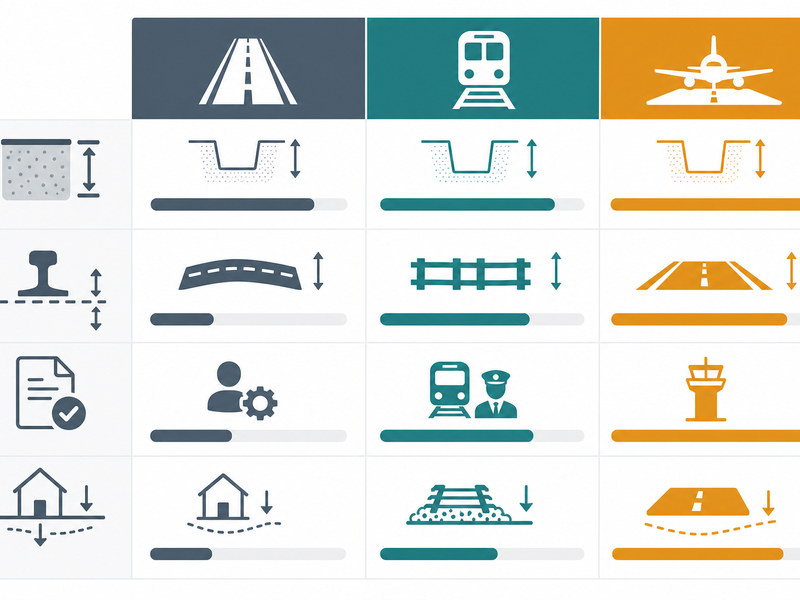
The table below summarises the four variables that decide a crossing: cover, tolerance, permit and settlement. Read it as a planning screen only; every row still has to be confirmed with the specific owner.
| Crossing class | Minimum cover | Line and grade tolerance | Permit authority | Settlement limit |
|---|---|---|---|---|
| Road | Local ordinance; examples 24–42 in., about 3 ft typical | About ±50 mm in stable ground; about ±25 mm with laser guidance | Local road authority excavation permit | Set by the road owner; keep near or below about 10 mm |
| Railway | Casing top to rail base about 5 ft to 5 ft 6 in. | Governed by the railroad’s own standard; normally tighter than a road | Railroad crossing permit, with flagging and a possession | Set by the railroad; track geometry governs, confirmed with the owner |
| Runway | Airport design standards and aircraft load case | Set by airport design standards to protect pavement and utilities | Airport operator under federal airport construction rules | Set by the airport operator; pavement integrity governs |
Which authority issues the permit for each crossing class?
Permits are held by whichever body owns the surface, and the authority changes with the crossing. The table below pairs each crossing with its authority and the document that governs it.
| Crossing | Authority | Governing document | Main condition |
|---|---|---|---|
| Municipal or county road | Local road authority | Encroachment permit ordinance | Working hours, cover, restoration |
| State highway | State transportation department | Highway occupancy permit | Lane closure and cover rules |
| Railroad | Railroad company | Pipeline crossing permit under the AREMA utilities chapter | Casing, insurance, flagging, possession |
| Airport runway | Airport operator | Federal airport construction and design standards | Debris control, restricted access, closure window |
Settlement monitoring: what should be installed, and when should it trigger action?
Settlement monitoring for microtunneling under roads is a measurement of a known mechanism, not a search for an unknown one. Ground settlement is seldom simply a mistake by the crew. Its physical cause is soil loss and stress relief: overcut, steering correction, incomplete annulus grouting and an out-of-balance face pressure all move ground toward the tunnel.
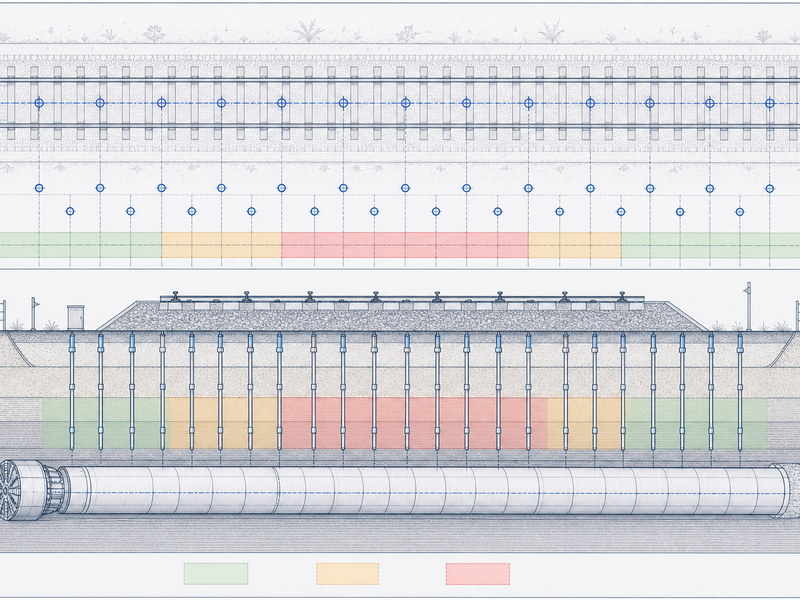
A practical monitoring scheme under a railway or a runway has three layers.
- Surface points: pavement or track points give the visible movement.
- Subsurface points: extensometers or settlement points give the depth of movement.
- Track or pavement survey: the survey gives the geometry the owner cares about.
On an airfield, the instrument layout has to be agreed with the airport operator before the closure window opens.
When should a settlement trigger stop the drive?
Triggers should be set as three bands, not one number.
- Green: readings inside the green band need no intervention; keep the drive running.
- Amber: review face pressure, overcut and grouting before the next ring.
- Red: stop the drive and inspect the machine and the annulus.
Where we have run monitoring on rail and airfield crossings, the plan only earns its keep when the trigger values are written before the drive, not negotiated after a reading appears.
What belongs in a crossing risk register?
Every register entry names a failure mode, the surface it affects, the mitigation and the party who owns it. The set below is a usable minimum for a road, railway or runway drive.
| Failure mode | Crossing affected | Mitigation | Responsible |
|---|---|---|---|
| Excess settlement at the surface | Road, railway, runway | Reduce overcut, grout continuously, use trigger bands | Contractor, monitored by the owner |
| Cover less than one pipe diameter | Railway, runway | Change to a controlled open-face method or realign | Designer with the authority |
| Possession or closure withdrawn | Railway, runway | Keep mobile plant ready and hold a programme buffer | Contractor with the railroad or airport |
| Permit condition changed late | Road, railway, runway | Freeze the permit before the design review | Owner and authority |
| Utility clash in the shaft | Road | Complete a utility survey before the shaft is sited | Designer |
Signing the register and the possession assumptions at the same time as the drawings is what we have seen protect a programme, not afterwards.
FAQ: common questions on crossing permits and risk
What tolerance can microtunneling hold under a road or railway?
In stable, uniform ground, about ±50 mm; about ±25 mm with laser guidance. Ask the owner which value governs, because a tolerance written for a road is routinely rejected under live track, and a larger diameter is the cheapest way to hold a tighter line.
How deep must the pipe be under each crossing class?
Each owner sets its own minimum, so the rule has to be read for the specific crossing. Road ordinances commonly sit between roughly 24 in. and 42 in., a railway typically wants the casing top about 5 ft to 5 ft 6 in. below the base of rail, and a runway follows airport design and aircraft load criteria.
Why do railroad crossings usually need a casing pipe?
A casing pipe carries the track load off the product line and keeps the line replaceable without a new bore. Railroads generally require a casing under live track, and the casing also gives a defined annular space for inspection and venting.
Who issues the encroachment permit, and when should it be applied for?
The local road authority issues the encroachment permit, and it should be applied for before the design is frozen. The permit fixes working hours, cover and restoration, so any late change to those conditions can force a redesign.
Why does a runway crossing cost so much in schedule?
Because the runway can be released for only short windows, and a closure costs far more than a road closure. Debris control, restricted-area access and the need to protect aircraft operations all limit the hours available for a runway crossing.
What is settlement monitoring actually measuring on a railway crossing?
It measures soil loss and stress relief around the drive, expressed as movement at the surface and at depth. Settlement monitoring is only useful when the readings are compared against the trigger bands set before the drive.
Những điểm chính cần lưu ý
- The surface owner, not the ground, sets the difficulty of microtunneling under roads; each surface adds its own cover, tolerance, permit and settlement rules.
- Tolerance is set by the ground first and the surface owner second.
- An overcut of 13–38 mm is normal, yet about 35 mm can show at the surface, so road and railway crossings reduce it to keep settlement near 10 mm.
- A railroad crossing is governed by the AREMA utilities chapter, a casing and a possession; an airfield drive is governed by airport operations and the cost of a closure.
- The road authority permit, not the drive, is usually the longest item on a road crossing programme.
- Movement monitoring works only when trigger bands are written before the drive and the mechanism is read as soil loss, not operator error.
How JSW supports road, rail and runway crossings
JSW is a pipeline engineering and construction company that executes trenchless crossings with its own crews and equipment. Our scope covers microtunneling construction, trenchless technologies, dịch vụ lắp đặt đường ống, pipeline inspection service and automatic pipeline welding, so a casing or crossover under a highway, a railroad or a runway is delivered by one team.
Because the same team reviews the constraints and then builds the crossing, the design basis reflects what the equipment and crews can hold. Our machines install pipe from DN300 to DN1500 (12–60 in.), over drive lengths up to about 600 m, with laser guidance holding roughly ±25 mm and installation depths of about 2–25 m. We work in soft clay, sand, gravel, mixed face and hard rock up to about 80 MPa UCS, set interjack stations on long drives every 100–150 m, and hold ISO 9001:2015, ISO 14001:2015 and ISO 45001:2018 certification.
- Integrated delivery: crossing review, shaft design, pipe jacking and inspection sit inside one scope.
- Auditable process data: line, grade, jacking force and settlement readings are recorded for the owner’s file.
- Risk-explicit pricing: casing, bracing, monitoring and possession risk are priced openly rather than absorbed into a lump sum.
- Safety and compliance: the work is planned around the railroad, road and airport permits and their windows.
Planning a microtunneling under roads, a railroad or a live runway? Send your crossing drawings, the surface owner’s requirements, the cover and the settlement limit for a free technical review. Our engineers respond with a scoped recommendation and a budget range.





































 English
  Arabic
  Russian
  Spanish
  French
  Vietnamese
  Polish
  Thai
Thai  Indonesian
  Turkish
  Portuguese