
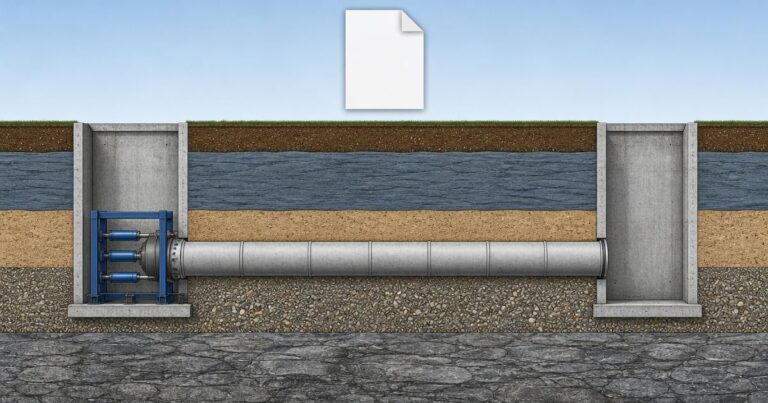
Short answer: a balanced microtunneling contract puts unforeseeable geology on the owner and foreseeable execution on the contractor. A measurable baseline, a clear differing site conditions clause and disciplined delay rules are what make that split hold up when the ground does not match the drawings.
Every microtunneling contract is, at heart, an agreement about what lies between the launch shaft and the reception shaft. This article follows that uncertainty through four decisions: what a differing site conditions clause covers, how a baseline turns geology into a measurable yardstick, who owns which day of delay, and where the dispute route runs.
Who Should Carry Ground Risk in a Microtunneling Contract?
A microtunneling contract should place unforeseeable geology with the owner and foreseeable execution with the contractor. The party most able to manage each risk should carry it. The owner holds the site, the investigation and the documents; the contractor controls the machine, the crew and the methods, so the risk allocation in a contract follows that split.
- Owner carries: unforeseeable ground, contaminated material, unknown utilities and third-party actions that only the owner can influence.
- Contractor carries: means and methods, productivity, workmanship and the condition of its own equipment.
- Shared: foreseeable but uncertain conditions, settlement limits and downtime from causes outside both parties.
Why Ground Risk in Microtunneling Needs Its Own Clauses
Microtunneling – a remotely controlled, guided, face-supported pipe jacking drive, to ASCE 36-15 – concentrates ground risk. Once the machine is in the ground the face is closed to inspection, so a wrong reading of the ground is discovered only by its consequences.
A machine caught in mixed face can require a rescue shaft, and cutter wear in rock drives both advance rate and cost. A published review of 29 rock microtunneling cases between 1995 and 2008 examined how rock type and strength govern penetration, while industry guidance treats obstructions up to roughly 30 percent of the face as a cutterhead design limit.
The contract must therefore state who carries the residual uncertainty: that is a risk allocation question the contract has to answer. For hard rock and mixed ground behaviour, see our guide to microtunneling in rock and mixed ground.
The Geotechnical Baseline Report: What It Does and Does Not Do
If the question is whether the ground you actually meet matches the ground you priced, the geotechnical baseline report is the document that answers it. It conveys a realistic interpretation of anticipated subsurface conditions and forms the measurable baseline a changed-condition claim is tested against.
A geotechnical baseline report interprets the factual data and sits on top of it; the investigation itself remains the source of the facts. When a baseline is vague it fails at its one job, and NASTT’s guidance is direct that baselines which cannot be measured effectively tend to produce confusion rather than clarity.
A baseline only allocates the conditions it describes; anything it never mentions falls back to the general differing site conditions clause. How the baseline is folded into the technical documents is covered in our guide to writing a microtunneling specification under Section 02441.
Differing Site Conditions: Type I and Type II Explained
What does a differing site conditions clause cover? Two classic types, and the distinction matters because the evidence, the notice and the burden of proof differ for each.
| Aspect | Type I | Type II |
|---|---|---|
| What it covers | Physical conditions differing materially from those indicated in the contract documents | Unknown and unusual physical conditions differing from those ordinarily encountered |
| Trigger | The contract documents pointed to different conditions | Nothing in the documents anticipated the condition |
| Microtunneling example | Borings show clay, but the drive meets running sand | An unmapped boulder field in ground normally logged as clean sand |
| Evidence needed | The contract documents, borings and laboratory results | A baseline of what is ordinarily encountered in this geology |
| Typical dispute | Was the condition materially different from what was indicated? | Was the condition truly unusual for this ground? |
For a microtunneling drive, a Type I claim often turns on the baseline: the documents said fine sand, the machine met cobbles, and the question is whether the difference was material. A Type II differing site conditions claim turns on what is ordinarily encountered in that geology, so a baseline of obstacles, strengths and pressures helps both sides argue from the same facts.
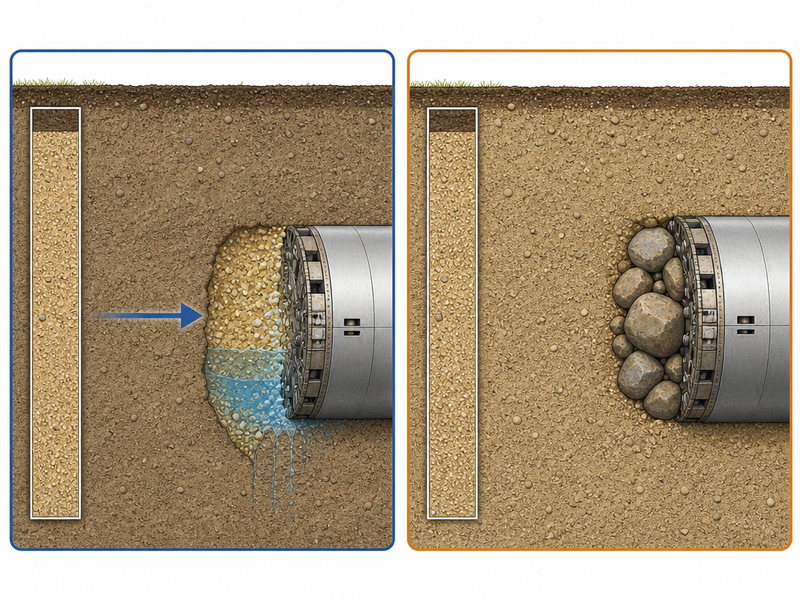
Bottom line: Type I is a comparison with the contract documents; Type II is a comparison with local convention, so a Type II claim is only as strong as the baseline that records what is normal for the site.
Contract Clauses That Actually Allocate Ground Risk
- Differing site conditions clause: defines Type I and Type II, the notice requirement and the remedy.
- Baseline incorporation: states that the baseline report governs expectations.
- Data disclaimer: confirms the factual data is available for information while the baseline governs.
- Ground risk matrix: names, event by event, who carries each ground and delay risk.
- Force majeure clause: separates true force majeure from ground risk that stays with the owner.
- Notice and records clause: sets the period for a claim and the records the contractor must keep.
FIDIC’s Emerald Book integrates excavation, support and lining into a single baseline, and owners can borrow the idea by making the baseline the single reference point for every ground clause.
Writing Measurable Baselines for Ground, Cutters and Obstructions
What makes a baseline usable? It has to be expressible in quantities a contractor can price and a reviewer can measure, because an unmeasurable baseline looks like an allocation while settling nothing.
- Rock strength: a uniaxial compressive strength range in MPa, never “rock may be encountered”.
- Obstructions: boulder size and the percentage of the face they may occupy.
- Groundwater: pore pressure or head range by stratum.
- Cutter wear: estimated cutter consumption per cubic metre by ground type.
- Mixed face: the percentage of drive length expected in mixed face.
Measure a change against the baseline: only the difference between the baselined condition and the condition encountered is measured, so the baseline must use the units the claim will use.
A geotechnical baseline report built on this pattern feeds directly into pricing, productivity and delay analysis; where unforeseen ground conditions fall outside the baseline, the changed-condition clause decides the outcome. On projects we have executed, a baseline expressed in numbers has settled arguments that vague wording started.
How those quantities interact with geometry and diameter is covered in what drives microtunneling cost and schedule.
Delay Risk: Who Owns Which Day
Who pays for a delay on a microtunneling drive? The dividing line is foresight. Foreseeable delay belongs to the contractor. Delay caused by unforeseen ground conditions belongs to the owner, provided the contractor gave timely notice, kept records and the contract grants an extension of time for that cause.
- Unforeseen cutter wear in unanticipated rock: owner, subject to the baseline and notice.
- Settlement exceeding the specified limit, caused by the works: contractor.
- Slurry downtime for routine maintenance: contractor.
- Slurry downtime from a foreign obstruction: owner, as a changed condition.
- Delay after a utility strike with wrong records: decided by the utility clause.
A critical-path delay and a concurrent delay are treated differently, which is why the schedule should be updated as the drive progresses. Our breakdown of microtunneling productivity and advance rates shows what a realistic shift produces.
Delay Damages, Extensions of Time and Cost Recovery
How do the two delay mechanisms fit together? Delay damages and time entitlement are two halves of one mechanism. Granting an extension of time takes the owner’s delay damages off that period, and a delay the contractor caused leaves the entitlement route closed and the damages in place.
Owners increasingly fix the daily exposure with liquidated delay damages, and contractors answer with a clear entitlement route: notice, cause, critical-path effect and contemporaneous records, with an extension of time as the first question to settle on a changed-condition claim, and where the owner’s own actions cause delay the contract should address cost recovery too.
Utility Conflicts and Third-Party Risk
Why do utility conflicts become claims? Because the records that locate a buried main are often wrong by a margin that matters, and the contract must say who carries a locating error.
The workable split is simple: the owner supplies the utility information it holds, the contractor verifies by potholing where the contract requires it, and the party that failed to disclose a known conflict carries the cost.
Unforeseen ground conditions are one source of changed-condition claims, and a mislocated utility is a second: a contract risk of its own, tracked separately from the geological baseline.
Where a third party’s permit or access obligation has to be written down, environmental impact assessment for trenchless construction sets out where it sits.
Avoiding Disputes: Notice, Records and Process
Most microtunneling disputes turn on process rather than geology. A valid differing site conditions entitlement with late notice or thin records becomes a weak claim.
Notice period discipline matters most. Give notice inside the stated period, commonly 7 to 14 days, and describe the condition before it is buried or covered by the next pipe.
Records should be contemporaneous and routine: daily shift reports, jacking force logs, cutter inspection records, slurry volumes, survey and settlement readings, and quantity and labour-hour ledgers. The same record-keeping is tested earlier, in contractor prequalification. Our contract reviews often find notice and records clauses that a busy site team cannot realistically satisfy.
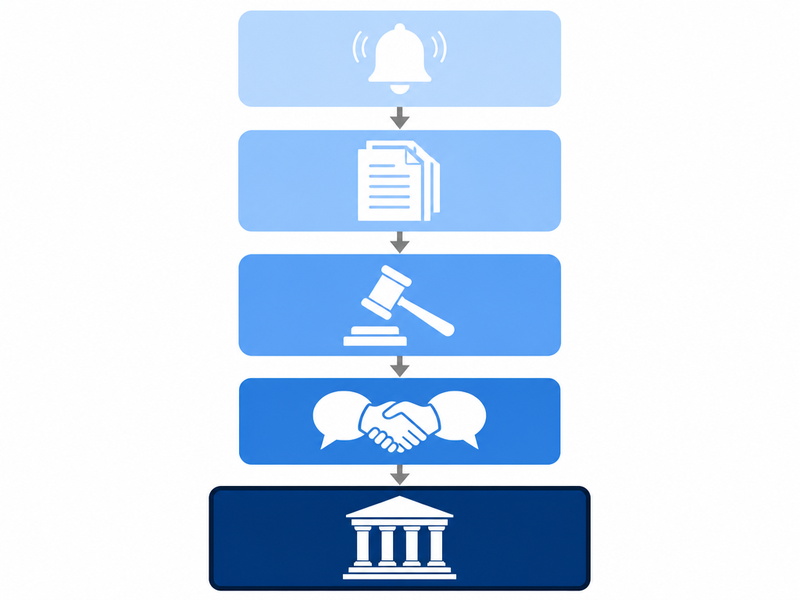
A tiered dispute resolution process keeps disagreements proportionate: a site decision, then the engineer’s determination, then mediation or a dispute review board, and only then arbitration. Read the notice period again at that stage, because it is the first clause an adjudicator checks, and define the dispute resolution route before the first claim rather than after it.
Bottom line: the strongest ground risk clause works through a notice period that is observed and records written the same day.
A Balanced Risk Allocation Model
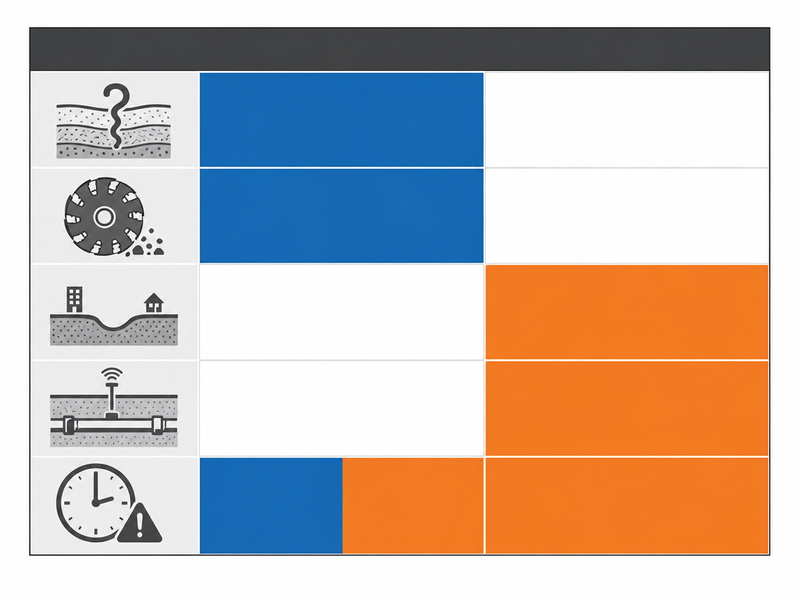
A balanced risk allocation model is simple to state: the owner carries unforeseen ground conditions, the contractor carries foreseeable means and methods, and each carries the consequences it can control, whether you let one drive or many.
| Risk event | Who should carry it | Contract mechanism |
|---|---|---|
| Unforeseeable geology (voids, unmapped rock) | Owner | Changed-condition clause plus baseline |
| Ground variability within the baseline | Contractor | Priced into the bid |
| Cutter wear within the baselined rock | Contractor | Productivity assumption |
| Cutter wear beyond the baselined rock | Owner | Changed-condition claim |
| Settlement above the limit caused by the works | Contractor | Performance requirement |
| Utility locating error from owner records | Owner | Utility clause |
| Utility verification placed on the contractor | Contractor | Potholing requirement |
| Third-party interference | Negotiated | Force majeure or third-party clause |
| Delay from an owner-ordered suspension | Owner | Extension of time plus cost |
| Delay from the contractor’s equipment failure | Contractor | No extension |
The same logic applies to method risk: where a drive is a close call, read the risk profile alongside the price, as our comparison of microtunneling and HDD key differences shows.
Bottom line: a matrix that names the owner for unforeseeable ground and the contractor for foreseeable execution is the most useful single page in a microtunneling contract.
Planning a microtunneling package? JSW reviews conditions of contract, baseline measurability and notice procedures before bids are invited. A short review at tender stage is the least expensive ground risk work on the project.
Câu hỏi thường gặp
What is a differing site condition in a microtunneling contract?
A physical condition that differs from what the contract documents indicate, or an unknown and unusual condition differing from what is ordinarily encountered. Microtunneling contracts tie it to a baseline that states what the parties expect the ground to be.
What is the difference between a Type I and a Type II differing site condition?
Type I covers conditions differing materially from those indicated in the contract documents, such as borings that show clay while the drive meets running sand. Type II covers unknown and unusual conditions, such as an unmapped boulder field in ground normally logged as clean sand.
Does a geotechnical baseline report replace a geotechnical investigation?
No. It conveys a realistic interpretation of anticipated subsurface conditions and forms a measurable baseline, but it cannot replace the investigation behind it. A vague baseline tends to produce confusion rather than clarity.
Who pays for unforeseen ground conditions in microtunneling?
In a balanced contract the owner carries the unforeseeable ground that could not reasonably have been anticipated, and the contractor carries the foreseeable means and methods. The contractor must still give notice and keep contemporaneous records.
Can an owner recover delay damages for a delayed microtunneling drive?
Yes, where the delay is the contractor’s responsibility and the contract sets liquidated damages. If the contractor is granted an extension of time for a changed condition, the owner cannot recover those damages for that period.
How long does a contractor have to give notice of a changed condition?
Notice periods vary by contract, but a common notice period for a changed condition runs from about 7 to 14 days after it is discovered. Late notice is a common reason a valid claim is reduced.
How are microtunneling contract disputes resolved?
Most contracts use a tiered dispute resolution process: a site-level decision, then the engineer’s determination, then mediation or a dispute review board, and only then arbitration or litigation.
Reviewing Your Contract Conditions
Reviewing your contract conditions before you bid or award is the least expensive risk management on a microtunneling project: a measurable baseline, a clear differing site conditions clause and a disciplined notice procedure decide who pays when the ground does not match the model. Read the conditions next to the baseline, and read the notice and records clauses before mobilisation, because they set the evidence needed months later. For how the asset behaves after handover, see pipeline maintenance services.
Want your contract conditions reviewed before you award? The JSW Engineering Team can align the baseline, the changed-condition clause and the delay regime so every bidder prices the same risk.
Sources
- FIDIC, Conditions of Contract for Underground Works (Emerald Book)
- NASTT, Good Practices Guidelines and knowledge resources
- ASCE 36-15, Standard Construction Guidelines for Microtunneling
- ASTM F1962 and ASTM D653, standard definitions for soil and rock





































 English
  Arabic
  Russian
  Spanish
  French
  Vietnamese
  Polish
  Thai
Thai  Indonesian
  Turkish
  Portuguese