
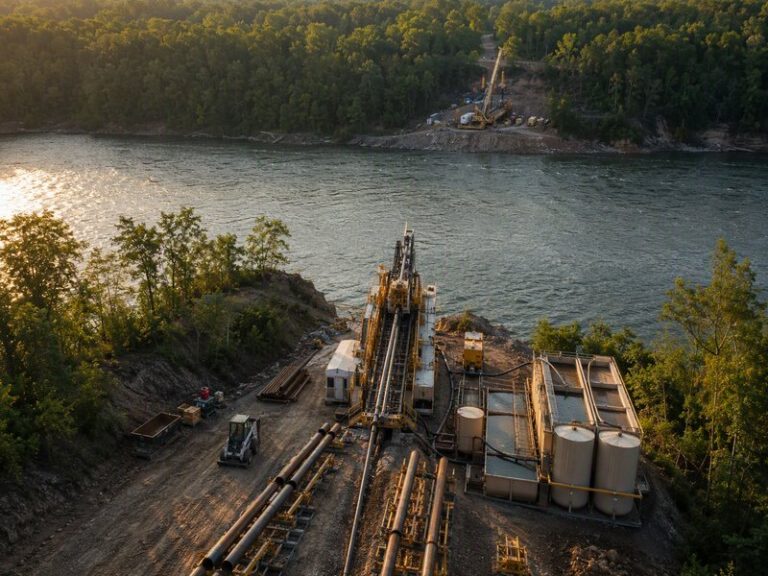
In 2024, two maxi rigs used horizontal directional drilling to install a 42-inch natural gas pipeline across a 3,407 ft crossing beneath the Coosa River in Alabama, and completed the pullback on July 6, 2024. The rigs drilled toward each other from opposite banks, met mid-river via the intersect method, and opened the bore in three reaming passes to 54 in. without excavating the riverbed. This HDD river crossing case study explains why the owner screened out microtunneling and open cut, how the crossing was drilled and pulled back, and what to copy when planning a similar large-diameter crossing.
The crossing is part of the Southeast Energy Connector project on the Transco Pipeline System, and it received the Pipeliners Association of Houston Project of the Year award. All figures in this horizontal directional drilling case study come from the documented project record; where the owner has not published a parameter, such as crossing depth or pullback force, we say so instead of estimating it.
Key takeaways:
- A 42-inch steel pipeline was pulled through very hard gneiss bedrock because the reaming program was matched to the rock.
- Two maxi rigs and the intersect method beat a single long drive where length, steering error and steep banks would have accumulated risk.
- Five fabricated pullback sections and 24/7 operations solved a narrow right-of-way and the risk of stopping a string inside the bore.
- Method selection turned on access: HDD won because two pads fit the steep banks where shafts and trenches could not.
- Where the public record is silent (crossing depth, entry and exit angles, pullback force), we flag them as unpublished instead of estimating.
Project Facts at a Glance
The table below summarizes the parameters that define this crossing. Every number in it is taken from the public record of the completed horizontal directional drilling project.
| المعلمة | القيمة |
|---|---|
| الموقع | Coosa River, about 50 miles south of Birmingham, Alabama, USA |
| Pipeline system | Transco Pipeline System (Williams), Southeast Energy Connector project |
| HDD scope | 3,407 ft (about 1,039 m) of 42-inch steel carrier pipe beneath the river |
| الطريقة | Pilot hole intersect with two maxi rigs, opposite banks |
| Reaming program | Three passes: 30 in., 42 in., final 54 in. |
| Ground condition | Very hard, abrasive gneiss bedrock; steep slopes and restricted access |
| الانسحاب | Five fabricated sections, 24/7 operations |
| Completion | Pipe in entry pit on July 6, 2024; mobilization began March 2024 |
| Recognition | Pipeliners Association of Houston Project of the Year award |
Why the Coosa River Crossing Was Needed
The Transco system is the largest interstate natural gas pipeline network in the United States, roughly 10,000 miles long, and it moves gas from south Texas to New York City. At a location about 50 miles south of Birmingham, Alabama, the system had a bottleneck: it could not install a fifth 42-inch pipeline crossing beneath the Coosa River, and that single constrained point limited flow for the whole region.
Earlier pipeline river crossings at this location had been difficult regardless of installation method, because the subsurface geology and the drastic topography made every conventional option risky. The owner, Williams, needed one more line under the same river, and the crossing had to be executed without shutting down or excavating an active waterway used for navigation and recreation.
The solution became part of the Southeast Energy Connector project, an approximately 1.9-mile, 42-inch pipeline loop that relieves the bottleneck. U.S. Pipeline Inc. built the mainline and tie-ins, and the HDD portion of the scope, the river crossing itself, went to Michels Trenchless Inc.
Why the Owner Chose HDD Over Microtunneling and Open Cut
Williams first engaged the HDD contractor in 2021, and the two teams screened four installation methods at the site before committing: horizontal directional drilling, direct steerable pipe thrusting, microtunneling, and open trench construction. The screening combined site visits, a survey, and a geotechnical investigation on land and from a barge on the river, with trenchless consulting support on the feasibility work.
The geology decided the comparison. The crossing would pass through very hard, abrasive gneiss bedrock, and the banks were too steep and too constricted for the long, flat work areas that open cut and shaft-based methods demand. Horizontal directional drilling fit the ground and the footprint: the bore could follow a curved path under the river, the entry and exit pads could be sized to the steep terrain, and no excavation would touch the riverbed.
| الطريقة | Footprint and Access | Behavior in Hard Gneiss | Outcome at Coosa |
|---|---|---|---|
| Open trench construction | Needs long, flat, continuous work areas along the whole route | Rock excavation across a riverbed is slow and disruptive | Rejected; terrain and waterway ruled it out |
| النفق الدقيق | Requires launch and reception shafts large enough for the machine | Capable in rock, but shafts on steep banks were impractical | Evaluated and screened out for this site |
| Direct steerable pipe thrusting | Smaller footprint, but thrust loads and steering limits bind at 42 in. | Limited track record in this rock at this diameter | Evaluated and screened out for this site |
| Horizontal directional drilling (HDD) | Two pads only, sized to the steep terrain | Proven with mud motors and rock reamers; curved path fits the crossing | Selected and completed successfully |
The selection was specific to this site, not a verdict on the other methods. Shaft-based tunneling remains the right answer for many river crossings, and the same Williams team would screen again from scratch on a different geology, depth or diameter. What the Coosa record shows is that HDD can win the comparison even in very hard rock when access is the binding constraint.
How the HDD River Crossing Was Executed
The construction program ran in five documented phases, from terrain preparation to the final pullback. The sequence below is the same order every large-diameter HDD river crossing follows, and the Coosa schedule shows where the real time went.
- Mobilization and terrain preparation (March 2024). Crews moved rigs, drill pipe and support equipment up steep slopes to entry and exit pads on both banks. Access work took about two weeks and relied on cable winches to haul equipment up the steep slopes.
- Pilot hole intersect. Two custom-built maxi rigs (the largest class of horizontal directional drilling rigs) drilled pilot holes toward each other from opposite banks, and a guidance system joined the two holes beneath the river. Intersect drilling was chosen because of the length and complexity of the installation.
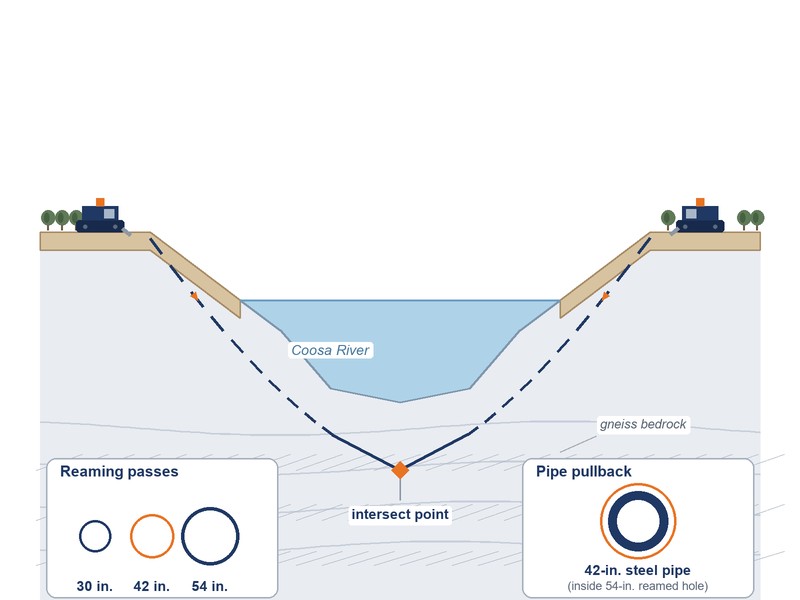
- Three reaming passes. After the intersect, the bore was opened in three passes: 30 in., then 42 in., then a final 54-in. pass sized to clear the product pipe and its coating (see Figure 1).
- Spoils and cuttings removal. Each reaming pass returned large volumes of rock cuttings to the surface, and crews transported them up the steep hills around the river, again with winching support.
- Pullback and tie-in. The 42-inch steel pipe was welded into five sections within the narrow right-of-way, pulled through on 24/7 operations, and reached the entry pit on July 6, 2024. The mainline contractor then completed the adjacent open-cut and tie-in construction.
Why the intersect method was used
Intersect drilling is a two-ended technique: rigs on both sides of the obstacle drill toward a meeting point, magnetic guidance brings the two pilot holes together, and one side then pulls the product pipe through the full length. The method exists because a single rig pushing drill pipe for thousands of feet accumulates steering error, torque loss and friction that two shorter drives avoid.
At Coosa, the record states that the length and complexity of the installation drove the intersect decision. The payoff was practical: each rig worked within a reach matched to its side of the river, and neither bank needed a straight, kilometer-long assembly corridor for the drill string.
Drilling in very hard gneiss bedrock
Gneiss is a metamorphic rock that is both hard and abrasive, and it punishes tooling that is not matched to it. Directional drilling in bedrock of this class requires mud motors to rotate the bit without rotating the whole drill string, rock reamers built for high compressive strength, and a drilling fluid program that cools the tools and carries cuttings out of a hole that wants to absorb energy instead of returning it.
The Coosa program absorbed that reality in its reaming design. Three passes meant each tool size cut a smaller volume per pass, which protected the tools and kept penetration moving; a single oversized pass through gneiss would have risked stalling the string and losing the hole. This is the standard trade-off on rock crossings: more passes cost time, fewer passes cost tooling and risk.
Reaming to 54 inches and the pullback
The final 54-in. hole was roughly 12 in. larger than the 42-in. pipe, an overcut that clears the steel, its coating, and the return flow of drilling fluid during pullback. The five pullback sections were a direct response to the terrain: the right-of-way was too narrow to string the full 3,407 ft of welded pipe on rollers, so the crew fabricated shorter sections, welded them together progressively, and pulled the growing string into the bore.
Pullback is the highest-risk hour of any large-diameter crossing, because the pipe, once committed, cannot be inspected from outside. The 24/7 schedule and the decision to work through the July 4 holiday were deliberate: once the string began moving, stopping it in the bore invited the pipe to stick, and the crew chose continuity over calendar.
Key Numbers From the Coosa River Crossing
The project data below is the reference set for anyone benchmarking a large-diameter HDD river crossing. Note the parameters the record does not contain: the owner and contractor have not published crossing depth, entry and exit angles, radius of curvature, or peak pullback force, and we do not invent them here.
| البند | Recorded Value |
|---|---|
| Product pipe | 42-inch steel carrier pipe, natural gas service |
| Full loop scope | About 1.9 miles (about 3.1 km) of 42-inch pipe (Southeast Energy Connector) |
| Pipe string assembly | Five sections fabricated in a narrow right-of-way |
| Operations pattern | 24/7 during reaming and pullback |
| Terrain preparation | About two weeks of access and setup before pilot hole work |
| الجدول الزمني للمشروع | 2021 feasibility engagement; March 2024 mobilization; about two weeks of terrain setup; July 6, 2024 pullback complete. |
Benchmarking a large-diameter river crossing? Send JSW the crossing length, pipe diameter and ground report, and our engineers will return a free technical feasibility review and an itemized proposal within five working days.
Lessons From the Coosa River HDD Crossing
Engineers review case studies for the decisions that transferred from one project to the next. Five lessons from Coosa apply directly to future river crossings, and each one maps to an action an owner can take before mobilization.
- Screen methods against access, not just geology. The site was won for HDD because two pads fit the steep banks while shafts and trenches did not. Run your method comparison with the real topography, not a generic soil profile.
- Geotechnical work belongs on the water as well as on land. The team completed supplemental borings from a barge on the river. Riverbed conditions can differ from bank conditions, and the reaming program depends on knowing both.
- Plan spoils removal before the first ream. Each reaming pass returned large cuttings volumes to the surface, and at Coosa those volumes moved uphill with winching support. If the site has no haul road, the cuttings plan is part of the schedule, not an afterthought.
- Match pipe assembly to the right-of-way. Five pullback sections were fabricated because longer strings would not fit the corridor. Owners should confirm stringing length against the available laydown area early, because it changes welding, coating and pullback logistics.
- Commit to continuity for the pullback. The 24/7 schedule and holiday work were risk decisions, not overtime theater. A stopped string in a rock bore is a hazard; plan the pullback as a continuous operation with the crews and inspection staged for it.
One honesty note applies to every lesson: this crossing succeeded in conditions that are documented as difficult, but HDD crossings fail when the ground, the design and the crew are mismatched. The Coosa outcome does not make every river HDD-able, and the same rigor that selected HDD here should be applied when a site suggests a different method.
How to Plan a Large-Diameter HDD River Crossing
The Coosa record compresses into a planning sequence that owners can reuse. This checklist is the order we apply when we review pipeline river crossing designs for owners and contractors.
- Define the corridor and the constraint. Confirm the pipeline route, the river crossing location, the design diameter and the depth of cover required. The bottleneck at Coosa was a fifth line under one river; define yours the same way.
- Run a method screening with real access data. Compare HDD, shaft-based tunneling, direct pipe and open cut against the surveyed banks, not a map. At Coosa, access eliminated the shaft-based and trenching options before cost was even discussed.
- Complete land and riverbed geotechnical investigation. Bore on both banks and from the water, and characterize rock hardness, abrasiveness and fractures. The reaming program and tooling selection depend on this data.
- Decide single-rig versus intersect early. Length, steering tolerance and terrain decide whether one rig or two will drill the pilot hole. Intersect changes the whole execution plan, including rig mobilization to both banks.
- Design the reaming program for the ground. Select pass sizes and tooling for the ground, because directional drilling in bedrock rewards smaller passes and heavier tooling. The sequence of 30-in., 42-in. and 54-in. passes at Coosa was a deliberate load split for gneiss, and a soil crossing of the same pipe would not need the same program.
- Plan the pipe string and the pullback. Confirm the welding and coating approach, the stringing length the right-of-way allows, and the 24/7 crews and inspection needed for a continuous pullback. Steel string fabrication on site depends on pipeline automatic welding technology, pipeline cold bending for route fit, and pipe cutting machines at the entry spread.
- Budget access, spoils and weather. Haul routes, cuttings removal, drilling fluid handling and rain contingency carried real schedule weight at Coosa. Itemize them before you compare bids.
A crossing plan is only as good as its assumptions, and the assumptions only hold if they are written down. The Coosa project moved from first feasibility engagement in 2021 to pipe in the ground in July 2024, and most of that interval was design, investigation and planning rather than drilling.
HDD River Crossing vs Microtunneling vs Open Cut
Owners comparing methods for a pipeline river crossing should weigh the same factors the Coosa team weighed, but with their own site data. The table below is a neutral comparison, because each method wins a different combination of conditions.
| عامل القرار | محرك الأقراص الصلبة | النفق الدقيق | Open Cut |
|---|---|---|---|
| Typical diameter range | Up to about 48 in. of product pipe in verified records | Often 36 in. and larger; strong at big diameters | Any diameter, limited by excavation and dewatering |
| Crossing geometry | Curved bore along a controlled arc | Straight or near-straight line between shafts | Straight trench at shallow depth |
| Ground conditions | Soil to very hard rock with the right tooling | Soil to rock; precise grade control in mixed ground | Easiest in soft, dry, accessible ground |
| Access footprint | Two pads; fits steep or restricted banks | Launch and reception shafts, often with large laydown areas | Continuous corridor along the full route |
| Riverbed impact | None; bore passes beneath the bed | None below the shafts; bed untouched between shafts | Full excavation across the waterway; dewatering and flow control |
| Main cost drivers | Rock tooling, reaming passes, pullback logistics | Shaft construction, machine size, jacking forces | Cofferdams, dewatering, restoration, environmental controls |
| When it typically wins | Long crossings, steep banks, large diameter in rock | Very large or precise-grade crossings where HDD limits bind | Shallow crossings in open, dry, low-impact ground |
The Coosa crossing fell squarely into the HDD column: long, curved, 42-in. pipe, steep banks, and very hard rock. Change any one of those factors and the ranking can flip, which is why microtunneling belongs in the same screening document rather than in a different conversation.
HDD River Crossing FAQ
What is an HDD river crossing?
A horizontal directional drilling river crossing installs a pipeline beneath a river without excavating the bed or the banks. Crews drill a steerable pilot hole under the waterway, open it with reaming passes, and pull the product pipe back through the bore.
Why did the Coosa River crossing need two rigs and the intersect method?
The crossing was 3,407 ft long through very hard gneiss bedrock beside steep terrain, and the owner and contractor chose the intersect method because a single entry could not carry the full length and complexity reliably. Two custom-built maxi rigs drilled toward each other from opposite banks, a guidance system joined the pilot holes under the river, and one side then pulled the 42-inch pipe through.
How long did the 42-inch Coosa River HDD crossing take?
Mobilization began in March 2024, terrain setup took about two weeks, and the 42-inch pipeline reached the entry pit on July 6, 2024. The final reaming and pullback ran on 24/7 operations, and the crew worked through the July 4 holiday to finish the crossing.
Can HDD cross a river in very hard bedrock?
Yes. The Coosa crossing was drilled through very hard, abrasive gneiss bedrock, which is among the most difficult ground for directional drilling. Directional drilling in bedrock of this hardness needs mud motors, rock reamers and slower penetration than soil, but the project proves a 42-inch steel pipe can be installed through gneiss with a properly sized reaming program.
What size bore does a 42-inch pipeline need?
The Coosa crossing used three reaming passes after the pilot hole intersect: a 30-in. pass, a 42-in. pass, and a final 54-in. pass. The final hole must clear the pipe and its coating, and the annulus also carries drilling fluid back to the entry pit during pullback.
Is an HDD river crossing safer for the river than open cut?
HDD avoids excavating the riverbed and banks, which removes the largest in-water disturbance of an open cut. The remaining risks are drilling fluid and cuttings management, which is why the Coosa team built spoils removal and fluid handling into the plan. No trenchless method has zero environmental impact; each crossing needs a documented containment and monitoring plan.
When should an owner choose microtunneling instead of HDD?
Microtunneling usually wins when the design needs a very large diameter, a precise grade line, or support inside the tunnel, and it is often competitive on shorter crossings where shaft construction is easy. HDD won on the Coosa River because the site favored a long, curved, large-diameter bore from two restricted banks. Owners should screen both methods against geology, depth, diameter and access before selecting, and for a side-by-side comparison of the two trenchless methods, see our guide to microtunneling construction.
How much does an HDD river crossing cost?
There is no fixed per-foot price: total cost scales with crossing length, pipe diameter, geology and site access, and the rock reaming program is usually the largest single driver. At Coosa, three reaming passes through gneiss and winch-assisted spoil hauling were the schedule- and cost-critical items. Send JSW the crossing length, pipe diameter and ground report for an itemized technical review.
How JSW Supports HDD and Pipeline Projects
JSW is a pipeline engineering and construction partner that supports owners and contractors on horizontal directional drilling river crossings and the pipeline work around them. We provide pipeline construction services, trenchless pipeline repair technology and pipeline maintenance services across utility, oil and gas, and infrastructure systems. For a crossing like Coosa, our support also covers pipeline automatic welding technology, pipeline cold bending for route fit, and pipeline hot tapping and plugging services for tie-ins on live lines.
Our teams supply the fabrication and tooling layer of the work as well, from pipeline hot tapping equipment and pipeline plugging pigs to pipeline cutting machines used to prepare pipe strings on the entry spread. On the engineering side, we review crossing designs with the same sequence this case study describes: method screening against real access, reaming program checks against the geotechnical data, and pullback plans that fit the right-of-way.
What distinguishes our support is that we price the bore and the pipe string as one system, we document spoils, drilling fluid and as-built records that survive audit, and we tell owners when a crossing should not be drilled. If your project is at the screening stage or already has a bore plan, send us the geotechnical report, the crossing length, the pipe diameter and the bank access survey, and our engineers will return a technical feasibility review.
Planning an HDD river crossing or a large-diameter pipeline bore? Contact our engineering team via our contact form with your crossing length, pipe diameter and geotechnical data. We will respond with a free technical feasibility review and a scoped proposal within five working days, including a straight answer when the data says the crossing should not be drilled.





































 English
  Arabic
  Russian
  Spanish
  French
  Vietnamese
  Polish
  Thai
Thai  Indonesian
  Turkish
  Portuguese