
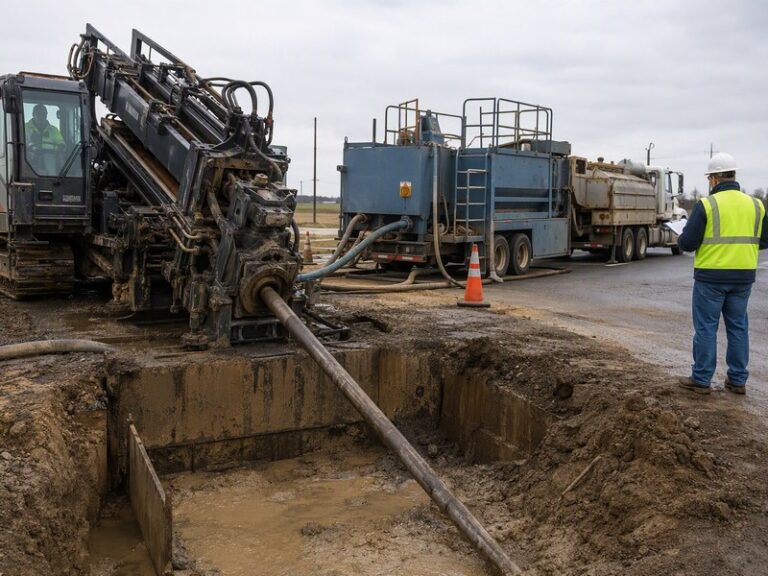
A typical horizontal directional drilling cost for a North American utility crossing falls between $20 and $50 per linear foot, and a complete 100-foot bore usually lands between $1,000 and $3,000 once mobilization, crew, drilling fluid, product pipe and restoration are included. Two pricing views matter: the unit rate per foot and the total installed cost.
This guide is written for project owners, engineers and procurement teams comparing directional bore quotes. It breaks the quote into eight cost components, explains why directional bore cost varies so widely between contractors, compares directional drilling with open-cut trenching on total project cost, and ends with a seven-step checklist for an accurate directional drilling cost estimate. New to the method? Our overview of horizontal directional drilling shows the rig spread, crews and site process behind every quote.
Figures are cross-checked against published contractor rate pages and project cost guides from September 2025 to July 2026, alongside our bid reviews on utility, oil and gas and infrastructure crossings; ranges were last reviewed on September 6, 2026. Treat every range as a planning reference, because the scope behind the number decides what it means.
النقاط الرئيسية
- Unit prices range from $4.50-$6 per foot on high-volume fiber programs to $20-$50 per foot on typical utility crossings; the scope behind the number matters more than the number.
- Short bores are dominated by mobilization and setup, while long bores are driven by drilling time, tooling, drilling fluid and pipe welding, which is why a horizontal directional drilling cost only makes sense with the scope attached.
- Judge methods and contractors on total installed cost with identical scope; surface restoration and risk handling often decide whether HDD or open-cut wins the comparison.
In this guide: typical 2025-2026 price ranges, the eight cost components behind a quote, why contractor bids vary, HDD vs open-cut on total cost, a seven-step estimate checklist with a sample 100-foot estimate, and the directional bore cost FAQ.
What Does a Typical Horizontal Directional Drilling Cost Look Like in 2026?
Published contractor pricing and 2026 project cost guides cluster around the ranges below, but quotes differ in basis: some cover the bore only, others include the product pipe, restoration or both. Confirm what the number includes before comparing ranges.
| Pricing basis | Typical 2025-2026 range | What the range usually includes |
|---|---|---|
| High-volume fiber or conduit programs | About $4.50-$6 per linear foot | Mobilization amortized over thousands of feet; bare bore or conduit with minimal restoration |
| Utility service bores (water, gas, power, telecom) | About $20-$50 per linear foot | Mobilization, crew, drilling fluid and often the product pipe; restoration varies by quote |
| Typical 100-foot road or driveway crossing, total project | About $1,000-$3,000 | Complete installed cost as published in 2026 project cost guides, including setup and basic restoration |
| Engineered river, rail or highway HDD crossings | Quoted per project | Geotechnical work, welded steel pipe string, fluid plan and restoration; per-foot comparison is not meaningful |
A low per-foot number is not automatically a bargain: a $25 quote versus a $45 quote for the same service crossing usually differs in what is excluded – product line, restoration, fluid disposal or contingency – items that reappear as change orders later.
The most reliable horizontal directional drilling cost comparisons use an identical scope and an itemized breakdown. For a closer look at how unit rates behave on longer programs, see our guide to HDD cost per foot, then use the seven-step checklist below to build your own comparison.
Where Your Money Goes: Eight Cost Components of a Directional Bore
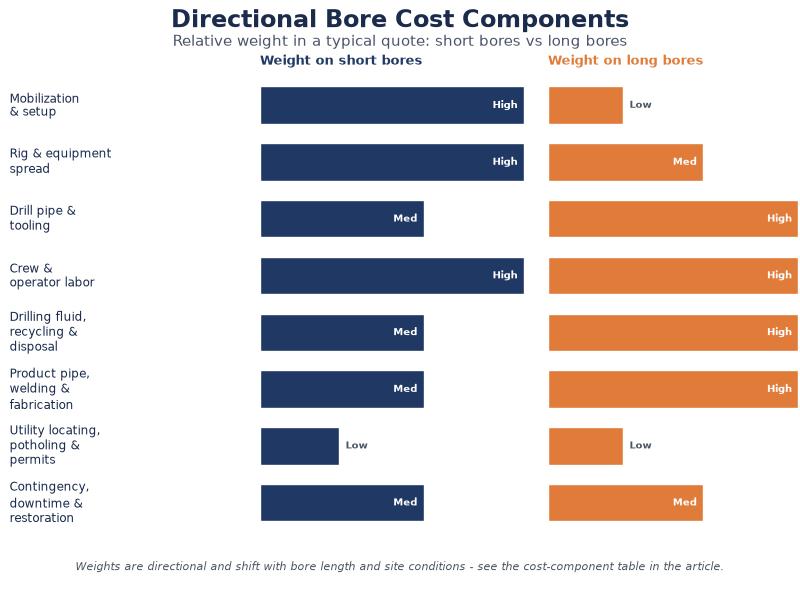
Strip any directional bore quote to its parts and the same eight components appear in every horizontal directional drilling cost estimate, only in different proportions. They show what you pay for, where a low bid cuts corners, and where negotiation is realistic.
| Cost component | Weight on short bores | Weight on long bores | Why it matters |
|---|---|---|---|
| Mobilization and setup | عالية | منخفضة | Fixed cost paid once per site regardless of bore length |
| Rig and equipment spread | عالية | متوسط | Rig class and support fleet set the daily cost base |
| Drill pipe and downhole tooling | متوسط | عالية | Bits, reamers and drill pipe wear with every foot drilled |
| Crew and operator labor | عالية | عالية | Skilled crews are the recurring line item on every shift |
| Drilling fluid, recycling and disposal | متوسط | عالية | Fluid volume, additives and disposal grow with bore size |
| Product pipe, welding and fabrication | متوسط | عالية | Material and joining dominate on steel and large-diameter work |
| Utility locating, potholing and permits | منخفضة | منخفضة | Small absolute cost that prevents disproportionate damage claims |
| Contingency, downtime and restoration | متوسط | متوسط | Hidden costs that decide the final invoice on built-up sites |
Treat the weights as directional, not fixed; the sections below explain each component and how to question it in a quote.
1. Mobilization and Site Setup
Mobilization covers moving the rig, drill pipe trailers, fluid system and support trucks to the site, then rigging up and down at entry and exit points. It is a fixed cost that weighs heavily on short bores and barely moves the unit price on long programs.
Industry cost discussions consistently list mobilization, equipment, setup, crew and restoration as the true cost drivers of a short-bore job. If your project is under a few hundred feet, expect mobilization and setup to dominate the invoice.
Ask for mobilization as a separate line item. Contractors who bury it in the unit rate make it hard to compare bids and hard to negotiate when multiple crossings share one site visit.
2. Drill Rig and Equipment Spread
The drill rig and its support spread are the directional boring equipment that sets the project’s cost base. Rig class defines the job: mini rigs typically handle service bores up to about 12 inches in clay and sand, midi rigs cover distribution mains and short river crossings, and maxi rigs are reserved for large-diameter and long-distance work. Bigger machines cost more per day and need more support equipment.
Rental and operating cost rise steeply with rig size, so contractors match the machine to the bore rather than sending the largest available rig. The equipment spread also includes the mud mixing and recycling plant, a vacuum truck, trailers and, on maxi jobs, cranes and welding spreads.
Confirm the proposed rig class in writing and ask how many support units the rate includes; a quote that hides the supporting fleet is usually incomplete.
3. Drill Pipe and Downhole Tooling
Every bore consumes tooling. The pilot bore uses a steerable bottom-hole assembly, each reaming pass uses progressively larger reamers, and all of it is driven by drill pipe that wears, bends and eventually fatigues. Tooling cost scales with bore length, diameter and the abrasiveness of the ground.
Rock and gravel shorten tool life sharply compared with clay and sand, so hard-ground quotes legitimately carry higher tooling allowances. Reaming is priced per pass, and a conservative contractor may add an extra pass where conditions are uncertain.
Ask how many reaming passes are budgeted and what tooling wear allowance is included. Two similar bids can differ mainly because one plans three passes and the other plans two.
4. Crew, Operator and Locating Labor
Directional drilling is labor-intensive. A typical spread runs operators, a drill locate person at the entry, a walkover or wireline locator tracking the bore head, and ground crews handling pipe, fluid and reaming, often in two shifts on longer programs.
Crew labor is the recurring cost that keeps growing hour by hour, which is why productivity and downtime discipline matter as much as the day rate. Skilled HDD crews are scarce in many markets, and their rates reflect it.
Ask whether the quote assumes one shift or two, how many crew are included, and the overtime rate; on long bores shift assumptions change the total by a meaningful margin.
5. Drilling Fluid, Recycling and Disposal
Drilling fluid, commonly called mud, cools the tool, carries cuttings and holds the bore open. Its cost has three parts: water and additives, mixing and pumping, and disposal or recycling of returns at the exit pit.
Fluid volumes grow with bore diameter, and disposal is a real cost wherever environmental rules restrict discharge. Recycling systems, which separate cuttings and reuse the water, have become standard practice on mid-size and larger spreads precisely because they cut both fluid purchase and disposal volume.
Ask how the contractor handles fluid returns and whether recycling is included. An itemized horizontal directional drilling cost quote should state fluid supply, handling and disposal separately rather than folding them into one vague line.
6. Product Pipe, Welding and Fabrication
The product pipe is frequently the single largest material cost on the project. HDPE is fused into a continuous string on the entry side, while steel pipe is welded into a string, often with field bends, before pullback. Pipe cost, welding labor, joint coating and testing all belong in this component.
On steel crossings, welding and inspection add a layer of cost that HDPE projects avoid, but steel remains the choice where pressure, temperature or regulation demands it. Pipe string fabrication and pipeline cold bending are scheduled in parallel with drilling to protect the program.
Ask whether the quoted price includes the pipe material, welding and joint testing or assumes you supply the pipe. This single scope question causes more bid confusion than any other.
7. Utility Locating, Potholing and Permits
Before the rig moves, the site needs utility locate tickets, and every crossing on the bore path should be potholed to confirm depth and position; permits for road, rail, waterway and municipal crossings are another fixed item.
Locating and potholing cost a few hundred to a few thousand dollars per crossing, a small line compared with the damage claim a single unverified utility strike can generate. In our project reviews, the projects that skip this step to save money are the ones that burn contingency later.
Confirm that locate and pothole work is included in the bid and that the contractor carries the equipment and insurance profile your crossing requires. This is a risk line, not a decoration.
8. Contingency, Downtime and Restoration
The last component is the one owners most often forget. Contingency covers ground that differs from the soil report, a reamer that fails mid-bore, or a frac-out that needs cleanup. Downtime from equipment failure, weather or late utility locates also carries a real hourly cost.
Restoration closes the job: backfilling the entry and exit pits, repairing disturbed surfaces, reseeding or repaving, and restoring drainage. On paved and landscaped sites, restoration can rival the drilling cost itself.
Ask each bidder to state their contingency in writing and to itemize restoration by surface type. A bid without a stated contingency is not cheaper; it is simply less honest about risk.
Why Do Directional Bore Quotes Vary So Much Between Contractors?
Two contractors can quote the same crossing at prices that differ by 50 percent or more, and usually both are bidding in good faith. The reason is that the horizontal directional drilling cost is driven by site-specific variables, not by a standard price list, so each bidder prices the risks they expect to meet.
| متغير | How it moves the price |
|---|---|
| Soil and rock conditions | Clay and sand drill fast with modest tool wear; gravel, cobble and rock slow progress and consume tooling |
| Product pipe diameter and material | Larger diameters need bigger reamers, more fluid and heavier rigs; steel adds welding cost |
| Bore length and depth | Length scales drilling time and tooling; depth affects fluid pressure and locating method |
| Obstacles and congestion | Crossings under live utilities, rail or waterways require extra planning, potholing and safety measures |
| Site access and footprint | Restricted entries, long hose runs or environmentally sensitive areas raise setup and restoration cost |
| Regional labor and fuel rates | Crew rates and fuel differ by market and shift the day-rate base |
| Season and schedule windows | Weather windows, night work and expedited schedules carry premiums |
| Scope and specification | Welding standards, inspection levels and restoration specifications vary between owners |
Treat an unusually low quote as a question, not a gift: ask what the bidder excluded, how many reaming passes they plan, and how fluid disposal and restoration are priced. The bid that documents its assumptions is worth more than one that only states a number.
Is Directional Drilling Cheaper Than Open-Cut Trenching?
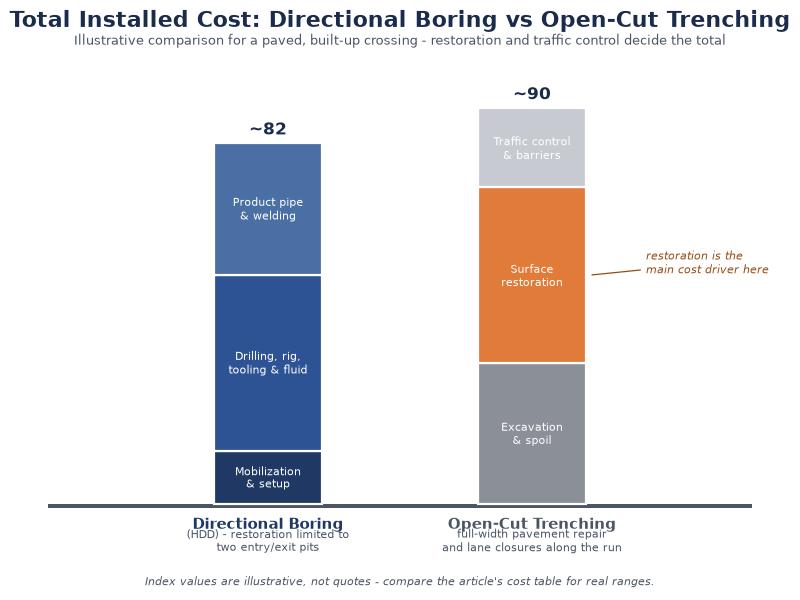
On a per-foot basis, open-cut trenching is usually cheaper in soft, open ground, and for a short rural run with no surface constraints it is often the sensible choice. The comparison flips once restoration, traffic control and surface disruption enter the picture, which is why the trenchless industry positions directional boring as a total-project-cost play rather than a low-unit-cost one.
| Cost factor | Directional boring | Open-cut trenching |
|---|---|---|
| Upfront cost per foot | Higher mobilization and equipment cost | Lower unit cost in soft, accessible ground |
| Surface restoration | Minimal, limited to entry and exit pits | Full-width pavement, landscaping and drainage repair along the entire run |
| Traffic control | Short-duration work points | Lane closures, detours and barriers for the full excavation period |
| Permits and utility conflicts | Fewer surface permits; crossings verified by potholing | More excavation permits; live utilities exposed and rerouted in some cases |
| Environmental impact | Small footprint; fluid handling managed at two pits | Large spoil volumes, dewatering and erosion control along the trench |
| Best when | Roads, driveways, rail, waterways, mature landscaping or hard paving must stay intact | Open fields and soft ground with no surface value and short distances |
Contractor cost guides that compare both methods reach the same conclusion: directional boring can carry a higher upfront price, but it often lowers overall project cost wherever the crossing involves roads, driveways, landscaping or finished surfaces, because restoration is where open-cut budgets bleed. A related trenchless option, microtunneling, competes on large-diameter and deep crossings where its predictable cost beats a difficult HDD program. We weigh both methods line by line, including the cases where open-cut genuinely wins, in our comparison of directional drilling vs trenching cost.
Run the comparison on your own numbers before accepting either method: trench length times open-cut unit cost, plus restoration and traffic control, against an itemized directional boring cost quote for the same crossing. On most built-up sites the bore wins on total cost even when its unit rate is higher.
How to Get an Accurate Directional Drilling Cost Estimate: Seven-Step Checklist
Accurate pricing starts before bids are requested. These seven steps, drawn from how we scope crossings with owners, remove the ambiguity behind wildly different quotes and surprise change orders.
- Fix the scope in writing. State pipe material and diameter, bore length and depth, entry and exit locations, welding standards, and exactly what restoration the contractor must return.
- Complete the surface investigation first. Order utility locate tickets, pothole every crossing on the bore path, and confirm depths before asking for pricing. Contractors price visible risk far lower than hidden risk.
- Share what you know about the ground. Pass on any geotechnical reports or past bore records for the site; without them, budget for a soil investigation or accept larger contingencies in bids.
- Ask for an itemized breakdown of the horizontal directional drilling cost. Require separate lines for mobilization, rig and crew time, tooling, drilling fluid supply and disposal, pipe and welding, locating, permits, restoration and contingency.
- Define inclusions and exclusions. Get each bidder to confirm in writing what the price covers: pipe material, restoration, fluid disposal, night work, mobilization distance and demobilization.
- Question the low bid and the assumptions behind every bid: reaming pass count, rig class, shift assumptions, recycling and the stated contingency. The bidder who documents assumptions will not surprise you.
- Compare total installed cost, not the HDD cost per foot alone. Convert every quote to the same scope and compare the bottom line, including a realistic allowance for risks each bidder has left outside the number.
Owners who follow this checklist usually see bid spreads narrow sharply, because contractors stop hiding risk in the unit rate when the scope is explicit.
Sample Estimate: 100-Foot Driveway Crossing
To show how the checklist becomes a number, the model below applies the published 2025-2026 ranges to a typical residential driveway crossing: 6-inch HDPE product pipe, 100 feet of bore in clay and sand, one reaming pass, no rock, and a paved driveway that stays intact apart from the entry and exit pits.
| Line item | Assumption | Illustrative amount |
|---|---|---|
| التعبئة وإعداد الموقع | Rig, fluid system and support truck move to site; rig up and down | About $600 |
| Rig and crew | One day on site with two or three operators | About $700 |
| Tooling and reaming pass | One reaming pass in clay and sand | About $250 |
| Drilling fluid supply and disposal | Water, additives and handling of returns | About $200 |
| Product pipe and fusion | 100 feet of 6-inch HDPE fused into one string | About $300 |
| Utility locating and potholing | Locate tickets and two potholes on the bore path | About $250 |
| Restoration | Backfill and paving repair confined to the entry and exit pits | About $350 |
| Contingency | Allowance for ground or tooling variance | About $100 |
| Total, complete 100-foot crossing | Falls within the published $1,000-$3,000 project range | About $2,750 |
Illustrative model built from published 2025-2026 ranges – not a quote. Actual prices depend on the contractor, ground conditions and scope. Use the seven-step checklist above to build your own itemized estimate, and treat any line a bidder omits as a question, not a saving. Line items merge or split the eight cost components to mirror how contractors actually bill – for example, rig and crew are usually quoted together, while restoration and contingency are separate lines.
If you are comparing itemized directional bore quotes right now, our engineering team reviews estimates against comparable crossings – see how we support HDD projects below.
Directional Bore Cost FAQ
How much does horizontal directional drilling cost per foot?
Most utility-grade directional bores in North America are quoted between $20 and $50 per linear foot, and high-volume fiber or conduit programs can drop toward $4.50 to $6 per foot because mobilization spreads over thousands of feet. Published 2026 project guides put a complete 100-foot crossing between $1,000 and $3,000. Confirm what the unit rate includes before comparing bids, because product pipe and restoration are sometimes priced separately.
Why is directional boring so expensive for a short run?
Mobilization and setup dominate short bores. A rig, crew, fluid system and support truck must reach the site, rig up and demobilize whether the bore is 40 feet or 400 feet, so a small crossing carries the same fixed cost as a larger one. This is why a 100-foot bore can cost $1,000 to $3,000 even when the drilling itself takes only hours.
What is the largest cost component of a directional bore?
For short bores, mobilization, equipment and crew together form the largest share. For long bores, drilling time, downhole tooling, drilling fluid and product pipe welding grow fastest and usually dominate the total. Restoration and contingency often decide the final number on built-up sites.
HDD vs Open Trench Cost: Which Is Really Cheaper?
So is HDD cheaper than open trenching? Rarely on unit cost alone, often on total project cost. Open-cut trenching has a lower upfront cost per foot in soft, open ground, but directional drilling avoids most surface restoration, traffic control and pavement repair. For crossings under roads, driveways, rail and finished landscaping, boring is frequently the lower total cost once restoration is included.
How can owners lower their HDD cost per foot?
Bundle adjacent crossings into one mobilization, provide accurate locate and pothole data, share geotechnical information, ask for drilling fluid recycling, and compare itemized bids with identical scope. Each step trims the risk allowance contractors build into the horizontal directional drilling cost, and the savings show up in the bid.
What should an itemized HDD bid include?
An itemized bid should separate mobilization and setup, rig and crew time, drill pipe and tooling, drilling fluid supply and disposal, product pipe and welding, locate and pothole work, permits, restoration, and a stated contingency. If any of these is missing, ask whether it is included or excluded before comparing quotes.
How much does it cost to bore under a driveway?
A complete 100-foot driveway crossing typically lands between $1,000 and $3,000, per published 2026 project cost guides, and shorter crossings do not shrink in proportion: mobilization, setup and crew dominate the price, so a 40-foot bore under a driveway can cost nearly as much as a 100-foot one. Before comparing quotes, confirm whether the price includes the product pipe, entry and exit pit restoration and locate work, because these are the lines most often priced separately. See the sample estimate above for a line-by-line model of a 100-foot driveway crossing.
How JSW Supports HDD and Pipeline Projects
JSW is a pipeline engineering and construction partner that supports owners and contractors across the full lifecycle of trenchless crossings.
Engineering services: pipeline construction services, pipeline repair services, pipeline maintenance services and trenchless pipeline repair technology keep the asset productive from installation through repair and maintenance.
Crossing technologies: directional drilling technology, pipeline automatic welding technology, cold bending capabilities, pipeline hot tapping and plugging services and microtunneling capabilities prepare, join and install the pipe string on trenchless crossings.
Equipment and tooling: pipeline hot tapping equipment, pipeline plugging pigs and pipeline cutting machines used on the entry spread to fabricate and join pipe.
What distinguishes our support is cost transparency built on engineering data:
- Bid validation – our engineering team reviews itemized horizontal directional drilling cost estimates against comparable crossings and flags omitted line items or unrealistic assumptions.
- Integrated delivery – bore planning, pipe string fabrication and welding, cold bending, pullback and restoration under one contract, which removes interface risk and its cost.
- Itemized pricing – mobilization, rig time, fluid handling, restoration and contingency quoted as separate lines, so you see exactly where your money goes.
- Risk documentation – daily drilling records, fluid logs, pullback force curves and as-builts that stand up to audit when a change order is disputed.
- International field experience – utility, oil and gas and infrastructure crossings across multiple continents, including engineered river crossings that demand maxi-rig capability.
A defensible horizontal directional drilling cost is not a single number; it is a scoped, itemized cost model built on verified ground conditions and comparable project records. That standard applies to every estimate we produce or review and is the basis for the scoped reference range below.
Not sure whether your directional bore quote is realistic?
Send our engineering team your bore parameters – pipe diameter and material, length, ground conditions and crossing type – and we will usually provide a technical cost review and a scoped reference range within five working days. Reach us via our contact form.





































 English
  Arabic
  Russian
  Spanish
  French
  Vietnamese
  Polish
  Thai
Thai  Indonesian
  Turkish
  Portuguese