
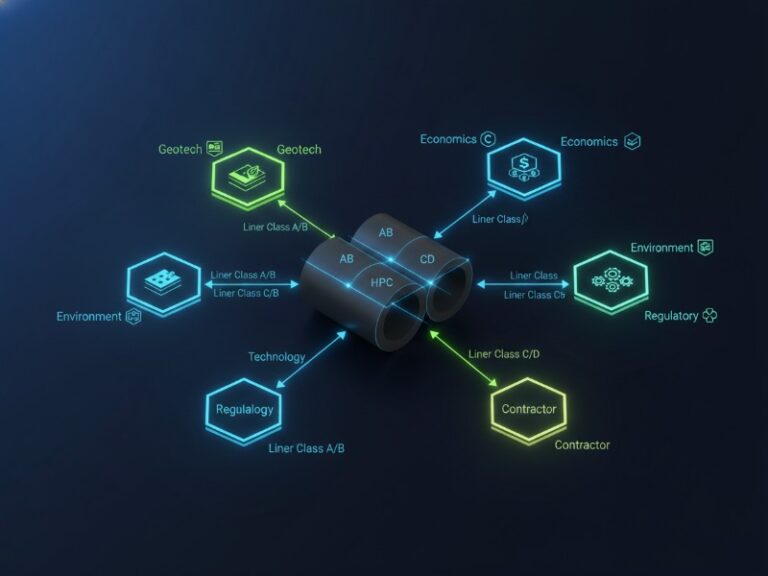
يعتمد اختيار المشاريع التي لا تتطلب حفر خنادق على ستة عوامل حاسمة: الظروف الجيوتقنية تحت السطحية (استقرار التربة والتحكم في المياه الجوفية)، والجدوى الاقتصادية مع وفورات في دورة الحياة تتراوح بين 30 و50%، ملاءمة التكنولوجيا بما في ذلك فئات البطانات وفقًا لمعيار ISO 11295، والمتطلبات التنظيمية، والتكاليف البيئية والاجتماعية المحددة كمياً، والقدرة المثبتة للمقاول في مجال خبرة تحليل إجهاد الأنابيب. يوفر هذا الدليل مصفوفات الاختيار، وبيانات مقارنة التكاليف، والمواصفات الفنية التي يستخدمها مهندسو المرافق ومالكو البنية التحتية لتقييم الطرق غير الحفرية مقابل الطرق المفتوحة لتركيب خطوط الأنابيب وإصلاحها.
الانتقال إلى جدول فئات بطانات PE | الانتقال إلى مصفوفة القرار
1. ما هي العوامل الجيوتقنية التي تحدد جدوى تنفيذ الأعمال بدون حفر خنادق؟
تُعد ظروف الطبقات الجوفية العامل الأكثر تأثيرًا على الإطلاق في اختيار المشاريع التي تُنفَّذ بدون حفر. فبدون بيانات جيوتقنية دقيقة، تواجه المشاريع التي تُنفَّذ بدون حفر معدلات فشل أعلى بنسبة تتراوح بين 5 و20% في التربة الحصوية والحبيبية مقارنةً بالطين المتماسك (بيانات APWA 2025).
لماذا تُعد البيانات الجيوتقنية عاملاً حاسماً في اختيار الطريقة
تحدد ظروف التربة على طول مسار الحفر المقترح بشكل مباشر قابلية الحفر ودقة التوجيه واستقرار الفراغ الحلقي. ويؤثر كل من تكوين التربة ومستويات المياه الجوفية ووجود الصخور وتضارب المرافق القائمة بشكل مختلف على جدوى هذه الطريقة.
تحديد خصائص الموقع المطلوبة للتصميم بدون حفر
يجب أن يتضمن الفحص الجيوتقني الشامل ما يلي:
- حفر آبار استكشافية في التربة على مسافات تتراوح بين 30 و60 متراً على طول المسار المقترح، بحيث يمتد إلى عمق لا يقل عن 3 أمتار تحت عمق الأنابيب المخطط له
- رصد المياه الجوفية لتقييم الضغط الهيدروستاتيكي ومخاطر التصدع المائي
- الفحوصات المخبرية لتوزيع حجم الحبيبات، وحدود أتربيرغ، ومحتوى الرطوبة، وقوة الضغط غير المحصورة
- الطرق الجيوفيزيائية بما في ذلك استخدام الرادار المخترق للأرض لتحديد مواقع المرافق القائمة
المتطلبات الجيوتقنية الخاصة بكل طريقة
| الطريقة غير الحفرية | العوامل الجيوتقنية الحاسمة | الحالات عالية الخطورة |
|---|---|---|
| الحفر الأفقي الموجه (HDD) | تماسك التربة، وحجم الحبيبات، وضغط المياه الجوفية | الحصى التي يزيد قطرها عن 50 مم، والرمال المتحركة، والطين عالي اللدونة |
| حفر الأنابيب بالضغط/حفر الأنفاق الصغيرة | وقت الوقوف، معامل الاحتكاك، وجود الصخور | تدفق المياه الجوفية >50 لترًا في الدقيقة، صخور غير متآكلة |
| الأنابيب المُعالجة في الموقع (CIPP) | الحالة الهيكلية للأنابيب الحالية، الانحراف عن الشكل الدائري | تآكل شديد > فقدان سماكة جدار 50%، وانهيار أجزاء |
| تكسير الأنابيب | قدرة الأنابيب الحالية على تحمل الضغط، وضغط التربة المحيطة | أنبوب من الخرسانة المسلحة، الصخر الأساسي على عمق لا يتجاوز 1 متر |
نظرة نقدية: يصبح تحليل التكسير الهيدروليكي — الذي يهدف إلى تحديد قدرة الضغط الحلقي للتربة المحيطة على احتواء سائل الحفر — شرطًا تنظيميًّا قبل إصدار التراخيص في المناطق الحساسة بيئيًّا.
2. كيف تؤثر العوامل الاقتصادية على اختيار طريقة العمل بدون حفر؟
تُعتبر العوامل الاقتصادية دائمًا المحرك الرئيسي لاتخاذ القرار. وعند مقارنة الطرق التي لا تتطلب حفر خنادق بالطرق التي تعتمد على حفر الخنادق المفتوحة، فإن تحليل تكلفة دورة الحياة (LCCA) — الذي يأخذ في الاعتبار القيمة الحالية الصافية عبر مراحل التركيب والصيانة ودورات الإصلاح على مدى 50 عامًا — هو الذي يحدد الجدوى الاقتصادية الحقيقية للمشروع.
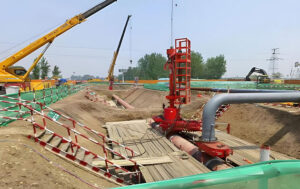
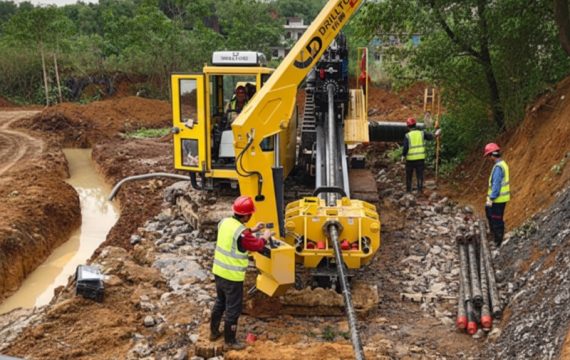
[صورة: جهاز الحفر باستخدام الأقراص الصلبة مقابل الحفر في خندق مفتوح في شارع حضري]
توضح هذه المقارنة المرئية السبب وراء تفوق تقنية «بدون حفر» في 87% من المشاريع الحضرية من حيث مساحة الاضطراب السطحي.
مقارنة مكونات التكلفة المباشرة
| عنصر التكلفة | الحفر في خندق مفتوح | الطريقة غير الحفرية |
|---|---|---|
| الحفر والدعم | $50-120 لكل متر طولي | $0 (حفر الوصول المحدودة فقط) |
| مواد الأنابيب وتركيبها | $30-80 لكل متر طولي | $60-150 لكل متر طولي (مادة عالية الجودة) |
| إزالة الرصف واستبداله | $80-200 لكل متر طولي | $10-30 لكل متر طولي |
| تنظيم حركة المرور والطرق البديلة | $20-50 per linear meter | $5-15 per linear meter |
| Landscape and irrigation restoration | $30-100 per linear meter | $5-20 per linear meter |
| Business interruption (commercial areas) | $10,000+ per day | $1,000-3,000 per day |
Total project cost difference: Trenchless methods typically save 30-50% compared to open-trench when full restoration costs are included. For gas service line replacement, documented savings average $5,000-7,000 per job, with equipment cost recovery after approximately 14 jobs.
Life Cycle Cost Analysis Framework
A comprehensive LCCA for trenchless versus open-trench must include:
- Construction costs: Equipment, labor, materials, and installation time
- Maintenance costs: Projected over 25, 50, and 75-year horizons
- Environmental costs: Emissions from equipment operation and material transport (trenchless reduces carbon footprint by 40-60%)
- Social costs: Traffic delays valued at $25-50 per vehicle-hour, business interruption, noise pollution
Hidden costs often overlooked in bid comparisons: Surface restoration for concrete slabs, driveways, asphalt parking areas, pavers, landscaping, and irrigation systems adds $2,000-5,000 to open-trench residential projects and $10,000-50,000 to commercial projects.
3. What Technology Factors Determine Trenchless Applicability? {#liner-classes}
Technology factors rank second only to economics in method selection. The availability of proven trenchless rehabilitation technologies for specific pipe materials, diameters, pressure ratings, and host pipe conditions directly determines feasibility.
PE Liner Classes (ISO 11295 / AWWA M28 Standard)
For pressurized pipeline rehabilitation, liner classification is the critical decision point. The standard establishes four classes based on structural interaction with the host pipe:
| المعيار | Class A (Independent) | Class B (Interactive) | Class C (Semi-Structural) | Class D (Non-Structural) |
|---|---|---|---|---|
| Pressure resistance | Full MOP carried by liner alone | Host pipe bears pressure load | Limited pressure rating <50 psi | Zero pressure rating |
| SDR range | 9-17 | 17-26 | 26-40+ | لا ينطبق |
| Host pipe condition required | Any degradation acceptable | Must be structurally sound | Minor corrosion only | Purely for corrosion barrier |
| تطبيق نموذجي | Water mains, gas lines | Force mains, gravity sewers | Large diameter storm drains | Chemical-resistant lining |
| Design life | 50+ years | 50+ years | 30-50 years | 20-30 years |
Critical formula for Class A liner design: The liner wall thickness must satisfy hoop stress requirements: t = (P × D)/(2 × S), where P = operating pressure, D = pipe diameter, S = liner material allowable stress at 50°C.
Technology Selection by Application
| سيناريو التطبيق | Recommended Technology | SDR Range | Key Limitation |
|---|---|---|---|
| Water main, 4-24″, Class A requirement | Fold-and-formed HDPE lining | 11-17 | Requires access pits at both ends |
| Gas distribution, 2-12″, 100 psi MOP | Swaged HDPE liner | 9-13 | Maximum operating temperature 40°C |
| Gravity sewer, 6-36″, Class C | تبطين CIPP | 26-40 | Not suitable for pressure >50 psi |
| Large-diameter storm drain, 36-120″ | Sliplining with fiberglass | 32-48 | Significant flow capacity reduction |
| Chemical plant, hostile environment | Fiber-reinforced polymer (FRP) | 26-32 | Higher material cost (+30-50%) |
Hydraulic capacity calculation: For any liner installation, verify flow remains adequate. Manning’s equation n-value increases from 0.013 (new concrete) to 0.015-0.018 (CIPP liner), reducing flow by 5-10% at same gradient.
4. How Do Environmental and Social Costs Influence Selection?
Environmental and social factors have moved from secondary considerations to primary decision drivers in trenchless project selection, often determining regulatory approval in urban and sensitive areas.
Quantified Environmental Impact Comparison
Open-Trench Environmental Costs (per 100 linear meters):
- Excavated soil requiring disposal: 50-150 tons
- Heavy equipment CO2 emissions: 200-400 kg per day
- Groundwater dewatering: 10,000-50,000 liters pumped and treated
- Pavement removed and landfilled: 20-50 tons
Trenchless Environmental Benefits (per 100 linear meters):
- Excavated soil: 5-15 tons (access pits only) – 70-90% reduction
- CO2 emissions: 80-160 kg per day – 50-60% reduction
- Groundwater impact: Minimal to none (no trench dewatering)
- Pavement disturbance: 80-95% reduction
Social Cost Quantification Framework
Social costs are pivotal in urban trenchless project selection, often representing 20-40% of total project cost in dense commercial areas:
| Social Cost Factor | Open-Trench Impact | Trenchless Impact | Dollar Value Difference (per day) |
|---|---|---|---|
| Traffic delay (major urban road) | 5,000-10,000 vehicle-hours | 500-2,000 vehicle-hours | $25,000-50,000 saved |
| Business interruption | 10-20 businesses fully blocked | 0-2 businesses minimally affected | $10,000-100,000 saved |
| Noise pollution (85-95 dB vs 65-75 dB) | High community complaints | Low to moderate | Intangible but significant |
| Property access disruption | 20-50 properties | 2-10 properties | $5,000-20,000 saved |
Regulatory trigger: In historic preservation districts, wetlands, railroad crossings, and airport property, open-trench excavation may be completely prohibited, making trenchless the only viable option regardless of cost.
5. What Regulatory and Permitting Factors Affect Project Viability?
Regulatory requirements vary significantly by jurisdiction and can add 3-12 months to project timelines if not addressed in method selection.
Regulatory Triggers That Require or Favor Trenchless Methods
- Clean Water Act Section 404 (USA): Stream and wetland crossings require trenchless methods for permit approval
- Historic preservation districts: Open-trench excavation vibration and visual impact may be prohibited
- Railroad and interstate highway crossings: Regulatory bodies mandate trenchless to prevent settlement
- Airport approach zones: Vibration restrictions eliminate open-trench blasting
- Endangered species habitat: Seasonal restrictions may make open-trench timelines impossible
Permitting Timeline Comparison
| Permit Type | Open-Trench Processing | Trenchless Processing | الميزة |
|---|---|---|---|
| Road opening permit (urban) | 2-4 weeks | 1-2 weeks | بدون حفر |
| Environmental impact review | 3-6 months | 1-3 months | بدون حفر |
| Water crossing permit (federal) | 6-12 months | 3-6 months | بدون حفر |
| Historic district review | 2-4 months | 1-2 months | بدون حفر |
| Individual state NPDES permit | 3-6 months | 1-3 months | بدون حفر |
Bottom line: Trenchless methods typically face 30-50% shorter permitting timelines due to reduced environmental and community impact assessment requirements.
6. How Does Contractor Capability Impact Selection Success? {#decision-matrix}
Even the most appropriate trenchless technology will fail without competent execution. Contractor experience and equipment availability are frequently underestimated decision factors that differentiate successful projects from costly failures.
Critical Contractor Qualifications to Verify Before Selection
Technical Experience Requirements:
- Minimum 5 similar projects completed within the last 3 years
- Proven track record with your specific geotechnical conditions (cobbles, high groundwater, contaminated soil)
- Documented pipe stress analysis capability for pulling or jacking installations
- ISO 9001:2015 quality management certification
Equipment and Personnel Verification:
- Fleet age and maintenance records for HDD rigs, pipe cutters, and fusion equipment
- Availability of backup equipment to prevent project delays (critical for emergency work)
- Downhole component inventory for addressing unexpected conditions
- Certified pipe fusion technicians for HDPE liner installations
Risk Mitigation Through Contractor Assessment
Professional trenchless contractors provide feasibility assessments that include:
- Evaluating geotechnical data and site conditions against method requirements
- Performing hydrofracture analysis for HDD projects in sensitive areas
- Calculating pipe pulling loads and confirming liner SDR selection
- Identifying specific risks and mitigation measures for each candidate method
- Providing ranked alternatives with cost and schedule confidence ranges
Red flag: Contractors who cannot demonstrate pipe stress analysis capability for pulling loads exceeding operational loads (common in directional drilling and pipe bursting) present unacceptable risk of pipe buckling or joint failure.
Decision Matrix: Trenchless Method Selection Framework
Use this matrix to evaluate candidate trenchless methods against your project-specific factors:
| Selection Factor | محرك الأقراص الصلبة | Pipe Jacking | CIPP | تكسير الأنابيب |
|---|---|---|---|---|
| Suitable pipe diameter | 2-48″ | 12-120″ | 4-36″ | 2-24″ |
| Maximum length per drive | 1,500 m | 300 m | Unlimited (segmented) | 150 m |
| Requires access pits | Yes (both ends) | Yes (both ends) | Yes (one end) | Yes (both ends) |
| Surface access needed | الحد الأدنى | معتدل | Minimal (manholes) | الحد الأدنى |
| Suitable for pressure pipe (Class A) | Yes (SDR 9-17) | نعم | No (<50 psi, Class D only) | Yes (SDR 11-17) |
| Relative cost (1-5, 5=highest) | 3 | 5 | 2 | 3 |
| Geotechnical risk level | متوسط | عالية | منخفضة | متوسط |
| Typical production rate | 100-300 m/day | 20-50 m/day | 200-500 m/day | 50-150 m/day |
| Permitting advantage | عالية | معتدل | Very high | عالية |
FAQ: Common Questions About Trenchless Project Selection
Q: When is trenchless cheaper than open-cut?
Urban projects exceeding 100 linear meters where social costs represent more than 40% of total budget favor trenchless methods. The break-even point varies by location but typically occurs between 50-150 meters depending on pavement type, traffic volume, and business density.
Q: What is the difference between Class A and Class B liners?
Class A (Independent) liners carry full operating pressure independently with SDR ranges of 9-17, suitable for any host pipe condition including severely degraded pipes. Class B (Interactive) liners share pressure load with a structurally sound host pipe using SDR ranges of 17-26+. Select Class A when host pipe integrity is questionable.
Q: How much cost savings can I expect from trenchless methods?
Trenchless methods typically save 30-50% compared to open-trench when accounting for full restoration and social costs. For residential gas service line replacement in paved areas, documented savings average $5,000-7,000 per job. For urban water mains under commercial streets, savings of $200,000-500,000 per kilometer are common.
Q: What is the typical lifespan of trenchless rehabilitation?
Properly installed Class A independent liners (ISO 11295) are designed for 50-75 years of service at full operating pressure. Class C CIPP liners in gravity sewers offer 50+ years. This matches or exceeds new pipe installation lifespans while eliminating excavation and surface restoration costs.
Q: Does trenchless reduce pipe flow capacity?
CIPP liners increase Manning’s n-value from 0.013 (new concrete) to 0.015-0.018, reducing flow capacity by 5-10% at the same gradient. For gravity sewers, verify that reduced capacity remains above peak design flow. Sliplining with continuous HDPE reduces inner diameter by approximately 10-15%, with proportional capacity reduction.
Q: How do I verify contractor pipe stress analysis is correct?
Request the raw output including: pull force calculations accounting for soil friction coefficient (typically 0.2-0.6), minimum bend radius verification (typically 100-200 × pipe OD for HDPE), and tensile stress compared to material yield strength (should not exceed 50% of yield for HDPE). Reject analyses that use “rule of thumb” multipliers instead of project-specific geotechnical data.







 English
  Arabic
  Russian
  Spanish
  French
  Vietnamese
  Polish
  Thai
Thai  Indonesian
  Turkish
  Portuguese